SwarmWorld: Stigmergic technological evolution in societies of language-model agents
Abstract: Collective intelligence can emerge when individuals coordinate through a shared environment, allowing local actions to accumulate into durable social organization. Language-model agents offer a new substrate for this process, yet most multi-agent systems rely on direct conversation, predefined roles, or centralized workflows. It remains unclear whether decentralized agents can build functional technologies and outperform independent search. Here, initially homogeneous LLM agents in SwarmWorld self-organize without assigned roles or recipes into evolving technological societies. Agents explore a spatial environment, process resources, test materials, construct persistent artifacts, and write executable controllers evaluated by a deterministic simulator under unseen disturbances after the agents are removed. SwarmWorld splits cognition from consequence: agents propose architectures and controllers within fixed action and material schemas, while the simulated world determines function. Shared societies develop broader, more resilient technological portfolios than a strong best-of-N isolated-search baseline, although isolated search remains competitive for the strongest artifact. Agents differentiate into exploration, construction, maintenance, and coordination behaviors, transitioning as the world matures. Technologies accumulate through collaborative construction, executable inheritance, and persistent agent-artifact networks, with most reuse beginning through physical observation rather than communication. Explicit cultural mechanisms amplify collaboration and organization, but functional benefits depend on outcome and timescale. Physical stigmergy alone supports capable societies, while interaction drives persistent technological ecologies rather than universally superior individual inventions.
Paper Prompts
Sign up for free to create and run prompts on this paper.
Top Community Prompts
Explain it Like I'm 14
1. What is the paper about?
The paper introduces SwarmWorld, a computer simulation where many language-model agents—AI programs that can read, reason, plan, and write instructions—live and work together.
The researchers wanted to know whether these AI agents could create a useful society without being given fixed jobs such as “builder,” “scientist,” or “leader.” They also asked whether working together would help the agents create better technology than simply letting each agent search for solutions alone.
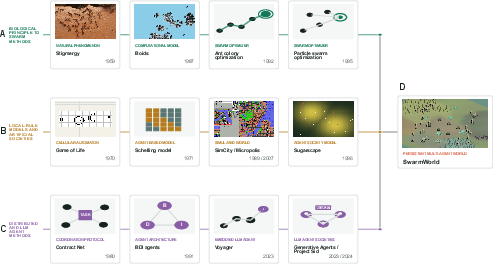
The idea is inspired by groups of animals such as ants and bees. These animals can organize without one leader. For example, an ant may leave a chemical trail that helps other ants find food. This kind of coordination through changes to the environment is called stigmergy.
2. What questions did the researchers ask?
The main research questions were:
- Can identical AI agents naturally divide into different kinds of workers?
- Can they build lasting tools and technologies?
- Can later agents discover, copy, and improve the work of earlier agents?
- Is communication necessary, or can agents coordinate simply by changing the shared environment?
- Does cooperation produce better results than many agents searching separately?
- Do shared societies create one extremely powerful invention, or many useful and dependable technologies?
The researchers were especially interested in the difference between creating the best single invention and creating a strong collection of inventions that work together.
3. How was the research carried out?
The simulated world
SwarmWorld was a digital landscape containing:
- Resources such as minerals, plants, chitin, water, and other materials
- Different areas where resources could be found
- Processing stations for changing raw materials
- Environmental problems such as contamination, drought, and storms
- AI agents that could move, gather materials, test ideas, and build artifacts
An artifact was a lasting object created by an agent. It could have a shape, use particular materials, and contain a computer program called a controller. The controller told the artifact how to respond to its surroundings.
For example, an agent might build an object that captures water, removes contamination, or helps repair another structure.
Agents made plans, but the world judged the results
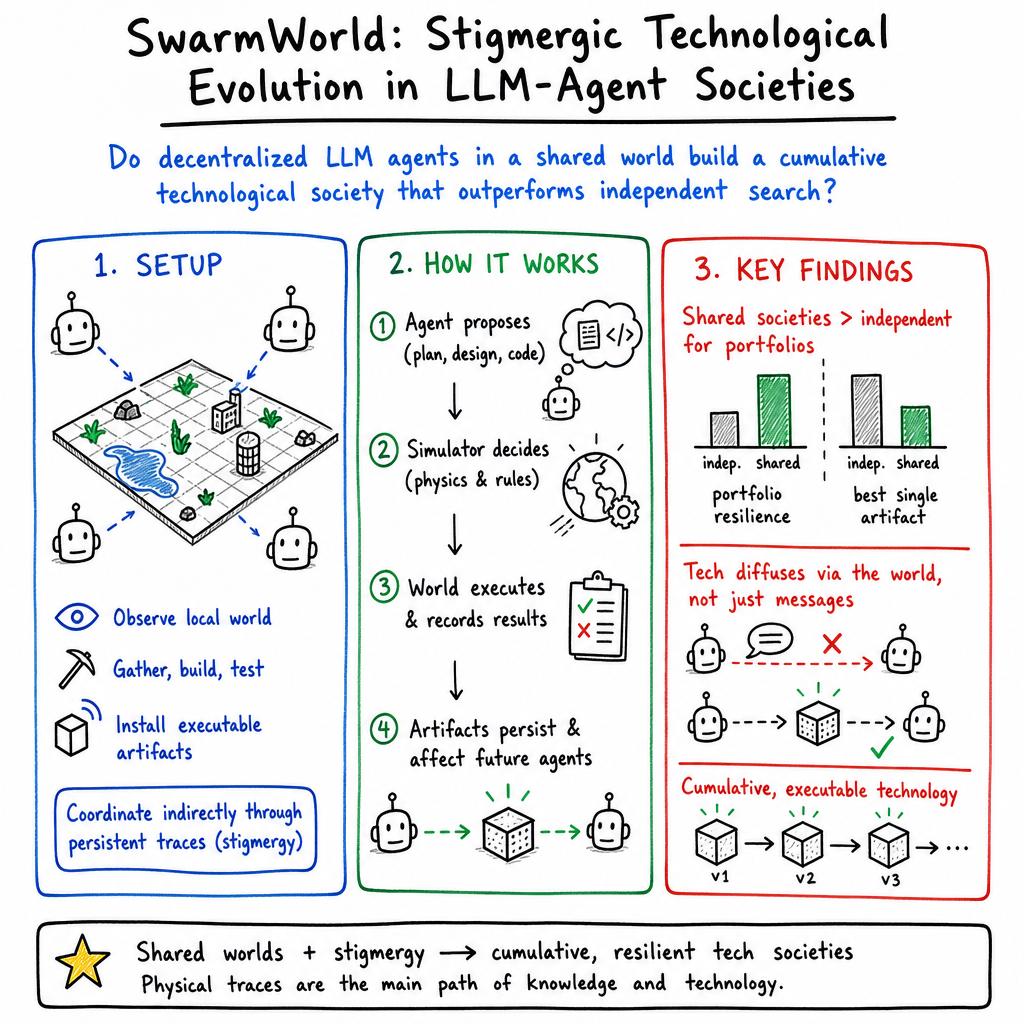
The AI agents suggested actions and designs using language. However, the simulator decided whether those actions were actually possible.
This was important because an agent could claim, “I built a highly effective water purifier,” but that claim did not count unless the simulator showed that the object really purified water.
In simple terms, the agents could make plans, but the computer world acted like a strict referee.
Different kinds of societies
The researchers compared four situations:
| Situation | What the agents could do |
|---|---|
| Full culture | Share a world, communicate, inherit computer programs, and interact with lasting artifacts |
| No communication | Share a world and use artifacts, but could not send direct messages |
| No explicit culture | Could coordinate only through physical changes and artifacts; they could not directly inherit programs or skills |
| Independent search | Each agent worked alone in its own world |
The independent-search group was a strong comparison. It used the best result from many separate agents, similar to asking 100 students to solve a problem alone and choosing the best answer.
Testing whether inventions really worked
At certain points, the researchers removed the agents from the simulation. They then placed copies of the world under new conditions, including unfamiliar storms, droughts, and contamination.
This tested whether the artifacts still worked without their creators. It was similar to checking whether a machine could keep protecting a town after the engineers had left.
The researchers studied societies of 50, 100, and 200 agents for 800 time steps. They also ran longer experiments with 100 agents for 3,200 time steps.
4. What did the researchers find?
Agents developed different behaviors
Although all agents started out the same, they gradually behaved differently.
Some agents became more focused on:
- Exploring the world
- Finding resources
- Testing materials
Others spent more time:
- Staying near useful artifacts
- Building and repairing technologies
- Installing and improving controllers
- Coordinating activity around shared work sites
This happened without the researchers assigning jobs. It is similar to how people in a community may naturally become explorers, builders, repair workers, or organizers.
Shared worlds built broader collections of technology
Societies working in a shared world usually created more varied and dependable portfolios of technology than isolated agents.
A portfolio is a collection of different tools or inventions. A society might have one artifact that captures water, another that removes contamination, and another that helps repair structures.
Shared societies were often better at:
- Creating several useful inventions
- Making technologies that continued working under new conditions
- Building redundant systems, so the society did not depend on only one object
- Producing more validated inventions
At 3,200 time steps, the study found approximately:
- Full culture: 5.75 validated inventions on average
- No explicit culture: 7.00 validated inventions
- Independent search: 2.75 validated inventions
This suggests that cooperation helped agents build a useful technological ecosystem.
The best single invention was sometimes found by isolated search
Cooperation did not win every contest.
Independent search produced the strongest single final artifact, with a score of about 0.3488. This was higher than the average score for the best artifact in the full-culture societies, about 0.2380.
This means that if the goal is to find one record-breaking invention as quickly as possible, many agents searching separately may work just as well—or better—than a society.
However, isolated agents were not as good at building a broad group of technologies that worked together.
Physical objects could spread useful ideas
Agents often learned from objects left in the world, even when they could not communicate directly.
A later agent could:
- Find an artifact
- Observe what it did
- Copy or modify its design
- Build a new version
Some agents could also inherit and edit executable programs created by others. This created a kind of technological family tree, with older programs acting as ancestors of newer ones.
This is similar to cultural learning in humans: one person creates a tool, another person copies it, and a third person improves it.
Communication helped organization, but not always performance
Direct communication and explicit cultural systems increased:
- Collaboration
- Program sharing
- The number of agents working around shared artifacts
- The density of connections between agents and technologies
However, more communication did not always produce better results.
In some tests, societies without explicit cultural mechanisms performed better than societies with full communication. The benefits of communication also changed depending on:
- How long the society had been running
- Whether the researchers measured the best single invention, total inventions, or resilience
- The type of environmental challenge
So, communication was useful for organizing a society, but it was not automatically useful for every goal.
5. Why are these findings important?
The study suggests that a group of AI agents can do more than simply work in parallel. In the right kind of world, they can leave behind lasting objects, learn from those objects, and gradually build a technological society.
The most important result is a limited or “bounded” swarm advantage:
Cooperation was especially helpful for creating a diverse, lasting, and resilient collection of technologies, but it did not always create the single best invention.
This distinction matters. A team may not produce the most impressive individual tool, but it may create a complete system that is more useful in real life because it has backup tools and can handle changing conditions.
6. Possible impact of the research
SwarmWorld could help researchers design future groups of AI agents that work together in areas such as:
- Scientific discovery
- Engineering and materials design
- Space exploration
- Disaster response
- Environmental protection
- Automated laboratories
- Robot teams
For example, one AI agent might explore for new materials, another might test them, and another might repair or improve existing equipment. These roles would not necessarily need to be programmed in advance; they might emerge naturally from the agents’ interactions.
The research also gives an important warning. Simply adding more agents or more communication will not guarantee better results. Designers must decide whether they want:
- The best single solution
- The largest number of solutions
- A reliable system with backup technologies
- A society that can continue learning over a long period
Finally, SwarmWorld is only a computer simulation. Its inventions are not real-world machines, and the number of experiments was limited. Therefore, the results show what might be possible, rather than proving that real AI societies will automatically organize successfully. Still, the paper provides evidence that shared environments and lasting artifacts may allow AI agents to develop more cumulative and useful forms of cooperation.
Knowledge Gaps
Knowledge gaps, limitations, and open questions
- Limited statistical power: Most comparisons rely on only four world seeds per condition, making effect estimates and claims about consistency sensitive to stochastic variation and insufficient for reliable population-level inference.
- Restricted model and agent diversity: The paper does not establish whether the findings generalize across different LLM families, model sizes, temperatures, prompting strategies, context-window limits, or agent memory architectures.
- Dependence on simulator design: The observed swarm advantage may depend strongly on SwarmWorld’s specific resource economy, spatial layout, disturbance rules, material schemas, action constraints, and artifact-program interface; transfer to other environments is not tested.
- Bounded technological open-endedness: Although agents are not given recipes or technology catalogs, they can only act within predefined material types, fabrication operations, sensors, actuators, controller formats, and validation criteria. It remains unclear whether similar cumulative organization would emerge with substantially richer or differently designed action spaces.
- Uncertain real-world validity of technologies: Artifact performance is measured only by a deterministic simulator. The paper does not test whether the proposed materials, fabrication processes, or control strategies correspond to physically realizable technologies or transfer to laboratory, robotic, or high-fidelity engineering settings.
- Incomplete causal attribution of collective benefits: The ablations remove several mechanisms simultaneously in some conditions, particularly the “no explicit culture” condition. Their results therefore do not fully isolate the effects of messages, public records, teaching, task claims, program inheritance, and artifact-mediated coordination individually.
- Potential confounding in the isolated-search baseline: The endpoint-wise best-of- envelope selects different isolated runs for different outcomes and checkpoints. This makes it a strong optimization baseline but not a directly comparable society, and may obscure differences in computational cost, resource access, trajectory length, or selection dynamics.
- No systematic compute- or cost-matched evaluation: The analysis does not fully quantify whether shared-world gains persist when controlling for total LLM calls, token usage, simulator steps, memory retrieval, communication volume, and the computational cost of maintaining a shared world.
- Unresolved effects of communication bandwidth and topology: Communication is treated largely as present or absent. The paper does not determine how message quality, latency, cost, visibility radius, network topology, misinformation, or selective communication affect technological accumulation.
- Unclear mechanism of physical stigmergy: The results show that artifacts and environmental changes support coordination, but do not identify which artifact properties—location, visibility, function, persistence, accessibility, or observability—are most responsible for the observed benefits.
- Weak evidence for functional cultural transmission: Program forks and recorded provenance demonstrate syntactic or executable descent, but the study does not establish which inherited components are causally responsible for improved performance or whether agents understand and intentionally improve inherited programs.
- Provenance does not establish causal influence: Knowledge-lineage graphs are based on recorded authorship, construction, installation, and parent references. They do not test whether a specific observation, message, artifact, or program was necessary for a later invention.
- Emergent specialization may be analysis-dependent: Behavioral roles are inferred using a two-cluster k-means model and researcher-selected features. The robustness of the exploration-versus-artifact-centered distinction to alternative clustering methods, feature sets, numbers of clusters, and temporal analyses is unresolved.
- Role stability is not established: The paper reports differentiated behavioral phenotypes but does not determine whether agents maintain stable specializations, switch roles in response to resource conditions, or are merely classified retrospectively according to short-term behavior.
- Identity and capability effects are not separated: Initially homogeneous agents may still develop different effective capabilities through unequal experience, memory accumulation, spatial starting conditions, or access to artifacts. The relative contributions of these factors to specialization are not measured.
- Long-horizon conclusions remain underpowered: The 3,200-tick analysis still uses only four seeds and one population size, so the reported crossover times and endpoint-specific tradeoffs may not generalize to longer runs, larger populations, or alternative disturbance schedules.
- No scaling law is established: Population sizes of 50–200 agents are insufficient to determine whether collective benefits continue to grow, saturate, or collapse at larger scales because of congestion, coordination overhead, resource depletion, or communication bottlenecks.
- Robustness is evaluated under a narrow disturbance distribution: Held-out tests use contamination, drought, and storm schedules. Generalization to qualitatively different, adversarial, sequential, correlated, or distribution-shifted disturbances remains unknown.
- Portfolio resilience may reflect quantity rather than complementarity: The study reports broader and more redundant technological portfolios, but does not fully disentangle whether resilience improves because of genuine functional complementarity, simple artifact-count effects, duplicated controllers, or greater material and spatial coverage.
- Selection and evaluation metrics may favor particular strategies: Discovery-frontier AUC, validated invention counts, portfolio resilience, and service coverage encode specific assumptions about early discovery, redundancy, thresholds, and useful function. Alternative multi-objective metrics could produce different rankings of culture and independent search.
- The source of no-explicit-culture superiority is unexplained: No explicit culture sometimes outperforms full culture, especially for validated inventions and held-out resilience. The paper does not identify whether this results from reduced distraction, lower coordination overhead, less premature convergence, different exploration patterns, or other mechanisms.
- Negative social effects are not systematically analyzed: The study does not quantify failure cascades, resource competition, exclusion of agents, monopolization of productive sites, deceptive communication, maladaptive conventions, or collective lock-in.
- Evolution of norms and institutions remains unexplored: Explicit cultural actions generate collaboration and code inheritance, but the paper does not examine whether agents develop stable norms, governance structures, trust mechanisms, sanctions, ownership conventions, or conflict-resolution procedures.
- Learning and adaptation after deployment are limited: Agents are removed during evaluation, so the experiments test artifact persistence but not whether societies can continue repairing, redesigning, or adapting technologies after environmental changes occur.
- Artifact degradation and maintenance are not fully characterized: The paper discusses maintenance behaviors and executable controllers, but does not separate construction quality from maintenance quality or quantify how technological performance changes under varying maintenance failure rates.
- Human-designed prompts and schemas may induce the observed organization: The extent to which prompt wording, memory retrieval, event logging, validation rules, and available action primitives bias agents toward construction, maintenance, communication, or specialization is not systematically tested.
- Reproducibility details are incomplete in the presented results: The paper does not provide enough information here about model checkpoints, prompts, decoding settings, token budgets, failed calls, simulator implementation, seed generation, and artifact-validation thresholds to independently reproduce all findings.
- Comparison with non-LLM collective algorithms is absent: The study does not compare SwarmWorld agents against classical swarm optimization, multi-agent reinforcement learning, evolutionary algorithms, scripted heuristics, or hybrid LLM–algorithmic systems under equivalent budgets.
- Human-agent or mixed-population settings are untested: It remains unknown whether humans can interpret, improve, compete with, or be misled by the emergent technologies and cultural records produced by the agent societies.
- The relationship between linguistic communication and physical coordination remains unresolved: Because physical observation can initiate reuse even without direct communication, the paper does not determine when language adds information unavailable from artifacts and when it merely accelerates or duplicates stigmergic discovery.
- Generalization beyond ecological-material tasks is unknown: The results may not extend to domains with different objectives, such as abstract mathematics, software engineering, social planning, scientific theory formation, or adversarial environments where artifacts are informational rather than spatial and material.
Practical Applications
Immediate Applications
The paper’s findings are demonstrated in a simulated, materially constrained world rather than in physical deployment. The following applications are therefore feasible now as software prototypes, research workflows, or decision-support systems, but should not yet be interpreted as validated real-world technologies.
- Multi-agent simulation platforms for technology discovery — Software, R&D, engineering Organizations can adapt the SwarmWorld architecture to let initially similar language-model agents explore shared virtual environments, propose designs, write executable controllers, and test outcomes under deterministic physics. This could support early-stage exploration in materials, manufacturing, logistics, architecture, and infrastructure. Dependency: The target domain must have a sufficiently accurate simulator, a constrained action/material schema, and objective evaluation metrics.
- Resilient portfolio design rather than single-solution optimization — Energy, infrastructure, robotics, operations research The results suggest using interacting agents to construct a diverse collection of complementary solutions instead of selecting only the best individual design. Examples include portfolios of energy-storage configurations, distributed sensors, emergency-response strategies, or maintenance policies. Dependency: Portfolio-level metrics must capture redundancy, coverage, and performance under disturbances; otherwise the system may over-optimize for one record-setting artifact.
- Automated design-space exploration with held-out stress testing — Materials science, chemical engineering, climate adaptation A practical workflow could allow agents to generate candidate structures or processes, freeze the resulting designs, remove the agents, and evaluate the designs under unseen disturbances. This directly operationalizes the paper’s separation between agent claims and simulator-measured consequences. Dependency: Disturbance scenarios must be genuinely unseen and representative of real operating conditions. Simulator validity is critical.
- Executable knowledge and program lineage for scientific research — Academia, software engineering, computational science Research groups can store not only papers or textual suggestions but also versioned executable procedures, simulation controllers, experimental protocols, and provenance graphs. Later agents or researchers could fork, test, and improve earlier workflows. Potential products include an “executable lab notebook,” content-addressed research protocols, and dashboards tracing evidence to code and downstream results. Dependency: Reproducible environments, version control, permissions, licensing, and reliable metadata are required.
- Stigmergic coordination for multi-robot systems — Robotics, warehouse automation, search and rescue Robots could coordinate indirectly through persistent environmental markers, shared maps, task states, placed tools, or modified infrastructure rather than relying exclusively on continuous communication. For example, one robot might identify a damaged area or construct a temporary relay that guides later robots. Dependency: Robots need compatible sensing and action interfaces, reliable localization, collision avoidance, and safeguards against corrupted or misleading environmental signals.
- Adaptive allocation of exploration and maintenance roles — Industrial operations, fleet management, software agents The spontaneous differentiation between exploratory and artifact-centered agents can inform systems that dynamically allocate some agents to search, others to construction or maintenance, and others to coordination—without hard-coding permanent roles. Dependency: Role emergence must be monitored because specialization may become inefficient, redundant, or biased toward locally visible tasks.
- Digital twins for industrial process development — Manufacturing, energy, environmental engineering Companies could deploy a SwarmWorld-like layer over a digital twin in which agents test fabrication sequences, maintenance strategies, and resource flows before physical implementation. The paper’s distinction between construction inputs, fabrication processes, and operational flows is particularly useful for auditability. Dependency: The digital twin must represent material balances, process constraints, degradation, and disturbances with sufficient fidelity.
- Collaborative educational environments for systems thinking — Education and training Students could interact with a persistent simulated world in which they design technologies, observe how others’ artifacts alter the environment, and evaluate resilience after removing the designers. This could teach engineering design, ecology, programming, scientific method, and collective behavior. Dependency: Educational versions require transparent scoring, age-appropriate interfaces, teacher controls, and mechanisms for distinguishing valid discoveries from simulator exploits.
- Benchmarking framework for multi-agent systems — Academia and AI evaluation The paper provides a practical benchmark pattern: compare shared-world agents with a matched best-of- independent-search baseline, use mechanism ablations, and evaluate artifacts after agents are removed. This can be used to test whether communication or memory produces genuine collective advantage rather than merely more samples. Dependency: Benchmarks need standardized seeds, compute budgets, held-out disturbances, statistical replication, and protection against reward hacking.
- Provenance and accountability tools for AI-generated designs — Regulated engineering, finance, healthcare software, public administration Knowledge-lineage graphs can record who or what proposed, modified, installed, and validated each component of an AI-generated solution. Such records could support audits of model-generated code, engineering plans, research results, or policy simulations. Dependency: Provenance records must be tamper-resistant and distinguish recorded ancestry from actual causal influence.
- Daily-life planning assistants that preserve reusable workflows — Consumer software A personal assistant could maintain a persistent task environment in which successful routines—such as meal planning, household maintenance, budgeting, or travel preparation—are stored as executable, revisable workflows rather than isolated chat responses. Dependency: Personal data protection, user consent, explainability, and strict limits on autonomous actions are necessary. The paper does not establish that such systems would be reliable in unstructured real-world settings.
- Policy sandboxing for decentralized cooperation — Public policy and governance Policymakers can use persistent multi-agent simulations to study how local infrastructure, communication channels, or shared resources influence cooperation, technological accumulation, and resilience during droughts, storms, contamination events, or supply disruptions. Dependency: Agent behavior must be calibrated against empirical human and institutional data; simulated LLM societies cannot by themselves predict real populations.
Long-Term Applications
These applications require further research, real-world validation, larger-scale infrastructure, or integration with physical systems.
- Autonomous materials and bio-inspired manufacturing laboratories — Materials science, biotechnology, chemical engineering SwarmWorld could evolve into a closed-loop system in which agents propose material compositions and fabrication recipes, robotic laboratories manufacture samples, sensors measure performance, and successful designs become reusable executable technologies. The paper’s material-process-operation separation could help connect feedstocks, fabrication, and function. Dependencies: Physical validation, laboratory robotics, safety controls, supply-chain constraints, intellectual-property management, and accurate cross-scale simulation are required. Simulator performance alone is insufficient evidence of real material behavior.
- Self-organizing robotic construction and repair systems — Robotics, construction, space exploration, disaster response Robot collectives could explore damaged or unfamiliar environments, build temporary infrastructure, inherit successful controllers, and maintain a distributed technological habitat. Potential uses include lunar construction, underwater repair, wildfire response, and post-disaster utilities restoration. Dependencies: Robust hardware, energy autonomy, real-time safety verification, communication under failure, human override, and extensive physical testing are necessary.
- Distributed infrastructure that adapts to environmental disturbances — Energy, water, agriculture, climate resilience Persistent agent-built networks could manage water capture, contamination removal, nutrient exchange, local energy collection, or repair across a distributed landscape. A portfolio of technologies may be more resilient than one globally optimized device. Dependencies: Real-world sensing, regulatory approval, ecological impact assessment, maintenance logistics, and evidence that environmental modifications remain beneficial outside the simulator.
- Autonomous scientific communities with cumulative research culture — Academia and pharmaceutical R&D Large populations of agents could form persistent research ecologies that observe data, generate hypotheses, run simulations or experiments, publish executable findings, and build on earlier technological lineages. This may accelerate drug discovery, protein engineering, climate modeling, and computational physics. Dependencies: Reliable experiment execution, scientific validity checks, prevention of circular citation or self-reinforcing errors, human peer review, and mechanisms for preserving minority hypotheses and exploration.
- AI-designed healthcare and biomedical intervention portfolios — Healthcare and biotechnology Rather than searching for a single treatment or diagnostic model, interacting agents could develop portfolios of complementary interventions: screening methods, treatment combinations, monitoring policies, and contingency plans robust to changing patient or pathogen conditions. Dependencies: Clinical evidence, patient-specific data governance, regulatory approval, interpretability, bias testing, and strict separation between simulation results and clinical recommendations.
- Adaptive disaster-response ecosystems — Emergency management and public policy Agents could construct and revise communication relays, evacuation routes, resource depots, sensor networks, and repair strategies while disturbances change over time. The held-out evaluation idea could test whether the resulting infrastructure remains useful after the original planning agents are unavailable. Dependencies: High-fidelity geographic and social models, interoperability with emergency systems, cybersecurity, reliable communications, and validation with historical and live disaster data.
- Self-improving software ecosystems — Software engineering and cybersecurity Persistent executable lineages could allow agents to fork, test, and deploy reusable modules for monitoring, optimization, debugging, and recovery. Software teams might use this to maintain large systems in which successful patches and operational strategies propagate across services. Dependencies: Formal verification, sandboxing, rollback, supply-chain security, access control, and defenses against malicious or low-quality inherited code. Unconstrained code inheritance could amplify vulnerabilities as well as useful behavior.
- Financial risk and market-infrastructure stress testing — Finance and regulatory technology A persistent multi-agent market simulator could explore how decentralized institutions respond to liquidity shocks, fraud, outages, or policy changes. A portfolio-resilience metric could evaluate whether multiple risk controls outperform a single optimized strategy. Dependencies: Realistic behavioral and institutional calibration, avoidance of actionable market manipulation, regulatory oversight, and recognition that LLM-agent behavior is not an adequate substitute for empirical market models.
- Urban and regional planning with cumulative infrastructure evolution — Smart cities and public administration Agents could design transportation, water, energy, and public-service technologies whose effects persist and influence later decisions. Planners could compare centralized plans, independent search, and stigmergic development under long-horizon disturbances. Dependencies: Integration of demographic, economic, environmental, and political data; participatory governance; fairness constraints; and safeguards against optimizing measurable resilience while degrading equity or quality of life.
- Machine cultures with explicit governance and institutional memory — AI safety and governance The paper’s findings could support research into how artificial societies develop norms, ownership rules, maintenance responsibilities, and inheritance mechanisms. Future systems might require agents to justify modifications, preserve provenance, and negotiate access to shared artifacts. Dependencies: Formal definitions of agency, responsibility, consent, and cultural persistence; robust alignment methods; and human governance over emergent institutions.
- Hybrid human–AI innovation networks — Industry, academia, and public-sector innovation Human researchers could enter a persistent technological ecology alongside AI agents, contributing observations, approving experiments, or selecting among competing lineages. The system could prioritize knowledge hubs with broad downstream utility rather than rewarding only prolific authors. Dependencies: Effective human oversight, comprehensible lineage visualizations, fair attribution, protection of confidential research, and evaluation of whether emergent organization improves human outcomes rather than merely simulator scores.
- General-purpose resilience engineering for complex systems — Cross-sector application The most general long-term implication is a workflow for designing systems that accumulate useful capabilities over time: agents explore locally, persistent artifacts preserve successful work, later agents modify those artifacts, and independent stress tests measure the resulting ecology. This could apply to infrastructure, organizations, software, robotics, and scientific discovery. Dependency: The central assumption is that the target system can be represented as a persistent environment with meaningful local observations, legal actions, state changes, and objective functional assays. Where those assumptions fail—especially in social, political, or ethical domains—the approach may produce misleading conclusions.
Glossary
- Ablation: An experiment that removes a specific mechanism to measure its effect; “We isolate communication, cross-agent program inheritance, and physical stigmergy through controlled ablations”
- Agent-artifact network: A network representing relationships between agents and the technological objects they create or use; “persistent agent-artifact networks”
- Asymptotic population-level inference: Statistical generalization about a population as its sample size approaches infinity; “the analysis emphasizes effect sizes, paired consistency, and mechanisms rather than asymptotic population-level inference.”
- Artifact-mediated stigmergy: Coordination through persistent objects or environmental modifications produced by agents; “Full culture provides a shared world, explicit messages and records, cross-agent executable-program inheritance, and artifact-mediated stigmergy.”
- Best-of- envelope: A comparison curve formed by selecting the best result among independent trials at each endpoint or checkpoint; “an endpoint-wise best-of- envelope of matched isolated agents”
- Betweenness centrality: A network measure indicating how often a node lies on shortest paths between other nodes; “node area increases with betweenness centrality.”
- Biofoundry: A facility or simulated environment for designing, fabricating, and testing biological or bio-inspired materials; “Within-run evolution of a representative no-explicit-culture society with and seed 3202.”
- Bootstrap interval: An uncertainty interval estimated by repeatedly resampling observed data; “error bars are paired seed-bootstrap 95\% intervals.”
- Cellular automata: Discrete computational systems in which local rules produce global patterns across a grid of cells; “cellular automata showed how repeated local rules generate persistent global structure”
- Content-addressed: Identified by a cryptographic or otherwise content-derived identifier rather than by location or name; “These are content-addressed forks and installations”
- Cross-agent program inheritance: The reuse or modification of one agent’s executable program by another agent; “Full culture provides a shared world, explicit messages and records, cross-agent executable-program inheritance”
- Deterministic simulator: A simulator that produces the same outcome from the same state and inputs; “a deterministic simulator under unseen disturbances”
- Discovery-frontier AUC: The area under the curve of the best performance discovered over time, rewarding early and sustained breakthroughs; “Discovery-frontier AUC integrates the running best measured artifact performance”
- Embodied reserve: Material stored within an artifact and consumed during its operation; “embodied reserve consumption.”
- Executable inheritance: The transmission and reuse of programs that can be run by later agents or artifacts; “Explicit culture generated collaboration and executable inheritance”
- Held-out assay: An evaluation performed on conditions not exposed during development or discovery; “The held-out assay further separates discovery from evaluation”
- Knowledge-lineage graph: A directed graph recording how evidence, programs, and artifacts derive from earlier records; “the underlying knowledge-lineage graph”
- K-means classification: An unsupervised clustering method that partitions observations into a selected number of groups; “the two-group k-means classification is learned from 15 robust-scaled behavioral features”
- Macroturn: A larger cycle of agent decision-making and world-state updating within a simulation; “One staggered macroturn begins with a local observation and retrieved private memory”
- Material schema: A constrained representation specifying allowable materials and their properties or uses; “within fixed action and material schemas”
- Mechanism-resolved condition: An experimental condition designed to isolate the contribution of particular causal mechanisms; “The population-scaling study ran four mechanism-resolved conditions”
- Operational flux: The rate at which matter or another quantity is actually transferred or consumed during operation; “operational fluxes specify what the resulting artifact actually moved or consumed”
- Phenotype: An observable pattern of behavior or traits produced by an agent; “The first phenotype combined artifact proximity, artifact-bound motion, construction, control, and cultural coordination”
- Portfolio resilience: The breadth and redundancy of useful functionality across a collection of artifacts; “Portfolio resilience quantifies the breadth and redundancy of functional service across the final artifact collection.”
- Provenance graph: A graph recording the origins, transformations, and relationships of data or artifacts; “The recorded provenance graph identifies how evidence, programs, and precursor artifacts were reused”
- Quorum-guided decision: A collective decision influenced by the number or proportion of agents supporting an option; “from ant foraging and honeybee nest-site selection to quorum-guided decisions in fish schools”
- Robust-scaled feature: A feature normalized using statistics resistant to outliers, typically the median and interquartile range; “15 robust-scaled features”
- Seed-bootstrap interval: A bootstrap uncertainty interval generated by resampling experimental world seeds; “shaded regions are 95\% seed-bootstrap intervals.”
- Sensor-to-actuator control signature: The characteristic mapping from an artifact’s sensed conditions to its operational actions; “sensor-to-actuator control signature”
- Source–sink accounting: Tracking the origins and destinations of resources as they are consumed, transformed, or transferred; “process source--sink-accounted resources”
- Stigmergy: Indirect coordination in which agents respond to persistent changes left in a shared environment; “persistent environmental modifications can coordinate later activity through stigmergy”
- Technological ecology: A networked, evolving collection of technologies and relationships that support one another within an environment; “a diverse, persistent technological ecology”
- Transactional validation: Atomic checking and resolution of actions so that invalid operations do not partially alter the system; “ends with transactional validation of actions, targets, permissions, and material preconditions.”
- Validation gate: A set of required criteria that an artifact must satisfy before being classified as successful; “We reserve the term ``invention'' for artifacts that clear the full validation gate”
- Vector loading: The contribution or weight of an original feature along a projection direction in dimensionality reduction; “The numbered arrows are the six largest loading vectors”
- World seed: An initial random-state specification used to reproduce or replicate a simulated world; “The world seed is the unit of replication throughout”

