Praxist: From Experimental Artifacts to Solution Lineages
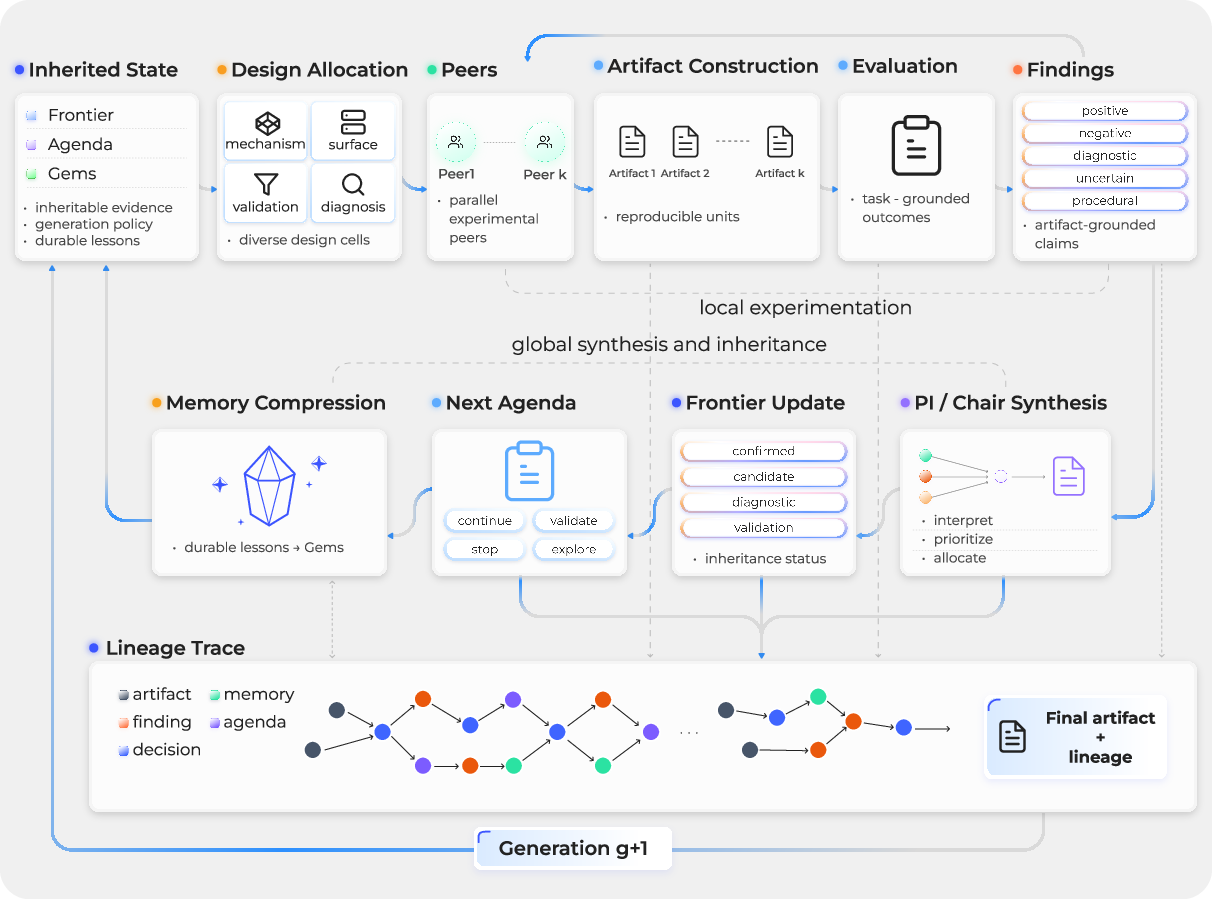
Abstract: Autonomous R&D agents now write, run, and improve executable artifacts under automated evaluation---but largely as laboratory instruments: shown on curated benchmarks, with gains that are hard to trace to a cause and costs well above what sustained engineering practice absorbs. The limitation is structural. Most systems treat each attempt as nearly self-contained, so logs, memories, and search trees record what happened without establishing which design element produced an improvement, whether its evidence survived validation, or how it recombines with others. Long campaigns therefore keep re-learning the same lessons. We introduce Praxist, a lineage-centered generational system that converts reproducible artifacts and evaluator outcomes into a typed evidence graph of findings, lane-structured frontiers, and agendas. Separating local artifact construction from cohort-level evidence synthesis lets later attempts inherit validated mechanisms, unresolved claims, and useful constraints, and leaves results attached to an inspectable lineage. On the standardized 75-task MLE-bench suite, the finalized official-grader results give Praxist 60 medals (80.0\%), 49 of them gold, against 55 medals (73.3\%) and 34 gold for a Claude Code baseline on Claude Opus 4.8---at a recorded model spend of US$3,054 versus US$38,370, roughly a twelfth of the cost. Four case studies---quantitative trading, LiDAR-inertial-visual SLAM, tokamak magnetic control, and rocket landing---carry the same process into open-ended engineering problems, improving on each task-native baseline in headline accuracy, survival, or resource cost, with the discovery path on record. Stronger artifacts at an order of magnitude less spend, each backed by an auditable lineage, are, to our knowledge, first brought together here: the operating profile production research requires, not the one a benchmark demonstration establishes.
First 10 authors:
Paper Prompts
Sign up for free to create and run prompts on this paper.
Top Community Prompts
Explain it Like I'm 14
1. What is the paper about?
The paper introduces Praxist, a system designed to help AI agents carry out long research and engineering projects.
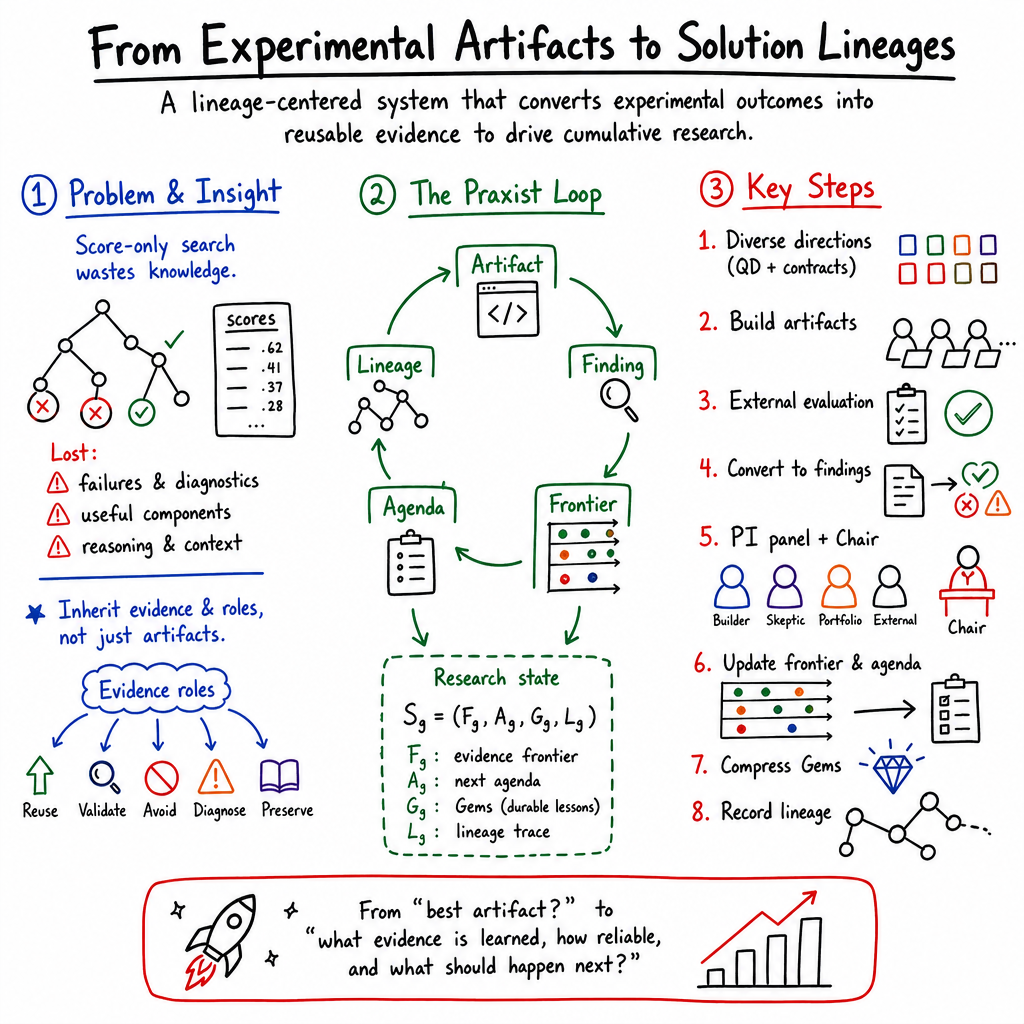
The main idea is simple: instead of treating every experiment as a separate attempt, Praxist helps AI agents learn from earlier experiments and reuse useful parts in later ones. It also keeps a clear record of how the final solution was created.
The paper’s title, From Experimental Artifacts to Solution Lineages, refers to this process:
1 |
Experiment → Finding → Useful evidence → Next plan → Research history |
An artifact is the result of an experiment, such as computer code, a machine-learning model, or a controller. A lineage is the history showing where that result came from and which earlier ideas influenced it.
2. What questions are the researchers asking?
The researchers are mainly asking:
- Can AI systems improve when they reuse evidence from earlier experiments, instead of only keeping the best previous solution?
- Can AI agents learn from failed experiments as well as successful ones?
- Can a system encourage agents to try different approaches, rather than having everyone copy the same promising idea?
- Can the system produce not only a strong final answer, but also a clear explanation of how that answer was developed?
- Does Praxist work across many different kinds of problems, such as machine learning, rocket landing, trading, robot navigation, and fusion control?
3. How does Praxist work?
Praxist organizes research into repeated rounds called generations. Each generation works like a team of students trying different ways to solve a difficult problem.
Planning different experiments
Before writing code, each AI worker receives a design contract. This is a plan that says:
- What idea the worker will test
- Which part of the system it will change
- Which earlier experiment it is building on
- What result would support or weaken the idea
- How the experiment should be checked
- Which changes are not allowed because they would make the test unclear
Praxist also uses Quantified Diversity, or QD. This means it deliberately sends different workers in different directions. For example, one worker may improve an existing method, another may test a new mechanism, and another may investigate why an earlier method failed.
This is similar to a science class where different groups test different explanations instead of all repeating the same experiment.
Building and testing artifacts
Each AI worker creates a reproducible artifact. In a machine-learning task, this might include:
- The model’s output
- The computer code
- The settings and files needed to run the experiment again
An outside evaluator then scores the artifact. This is important because the AI does not simply decide that its own work is good. It must be tested using the task’s actual scoring system.
The evaluator may check the work at different levels:
- A quick basic check
- A partial test
- A complete scored test
- Repeated tests for extra confidence
A high score from only a quick test is not treated as fully trustworthy.
Turning results into useful findings
Praxist changes each experiment into a written finding. A finding explains:
- What was tried
- What happened
- How strong the evidence is
- What should happen next
Findings can have different roles:
- Positive: the idea appears to improve the result
- Negative: the idea made things worse
- Diagnostic: the experiment revealed a problem or limitation
- Uncertain: the idea looks interesting but needs more testing
- Procedural: the experiment teaches the team how future tests should be run
This means failures are not thrown away. For example, if a method fails because a certain kind of data is unreliable, future agents can avoid making the same mistake.
Choosing what to keep
At the end of each generation, several AI roles review the evidence:
- A Builder looks for the strongest ideas to develop further.
- A Skeptic looks for weak evidence, mistakes, or claims that need more testing.
- A Portfolio role makes sure the team is not spending all its effort on one type of approach.
- An External-validity role may check whether the results are likely to work outside the exact test setup.
A senior role called the Chair combines these reviews and creates the next agenda. Each idea is assigned an action:
- Continue it
- Stop it
- Test it again
- Explore a different direction
Praxist stores evidence in different categories, called frontier lanes:
| Lane | Meaning |
|---|---|
| Confirmed | Evidence that has been tested enough to build on |
| Candidate | A promising idea that still needs checking |
| Diagnostic | A failure, limitation, or warning |
| Validation | An idea waiting for reproduction or closer testing |
The system also creates Gems when memory compression is enabled. A Gem is a short lesson that summarizes something important, such as “this method works only when the data is cleaned in a certain way.” Gems help long projects remember key lessons without storing every detail.
Finally, Praxist creates a lineage trace. This is a connected record showing which experiments led to which findings, decisions, and later experiments.
4. What did the researchers find?
The researchers tested Praxist in two main ways.
Large machine-learning benchmark
They used MLE-bench, a collection of 75 machine-learning competitions. Systems had to create submissions that were scored by the official grading system.
Praxist was compared with a locally run Claude Code system using Claude Opus 4.8.
| System | Tasks with any medal | Gold medals |
|---|---|---|
| Claude Code | 55 out of 75, or 73.3% | 34 |
| Praxist | 60 out of 75, or 80.0% | 49 |
Praxist performed better in the low-, medium-, and high-difficulty groups. It also used a reported cost of about $3,054**, compared with about **$38,370 for the Claude Code sweep. However, the paper explains that these were single large runs, not many repeated trials, so the results should not be treated as perfect proof that Praxist will always be better or cheaper.
Four open-ended case studies
The researchers also tested Praxist on more unusual problems.
Rocket landing
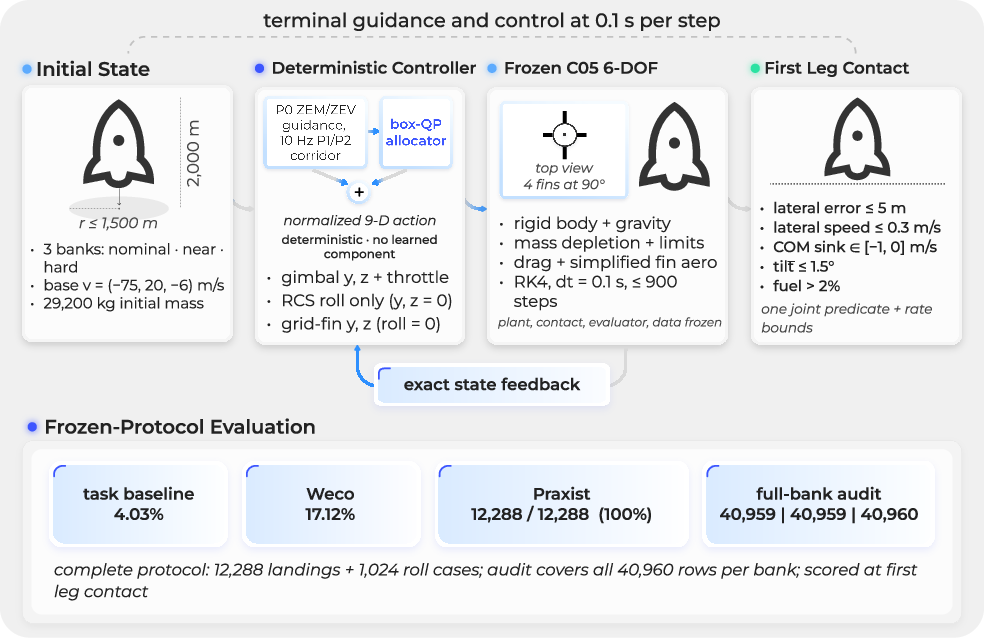
Praxist created a rocket controller that landed successfully on all 12,288 of 12,288 test cases under the study’s main protocol. The paper also reports additional tests with nearly complete success.
Quantitative trading
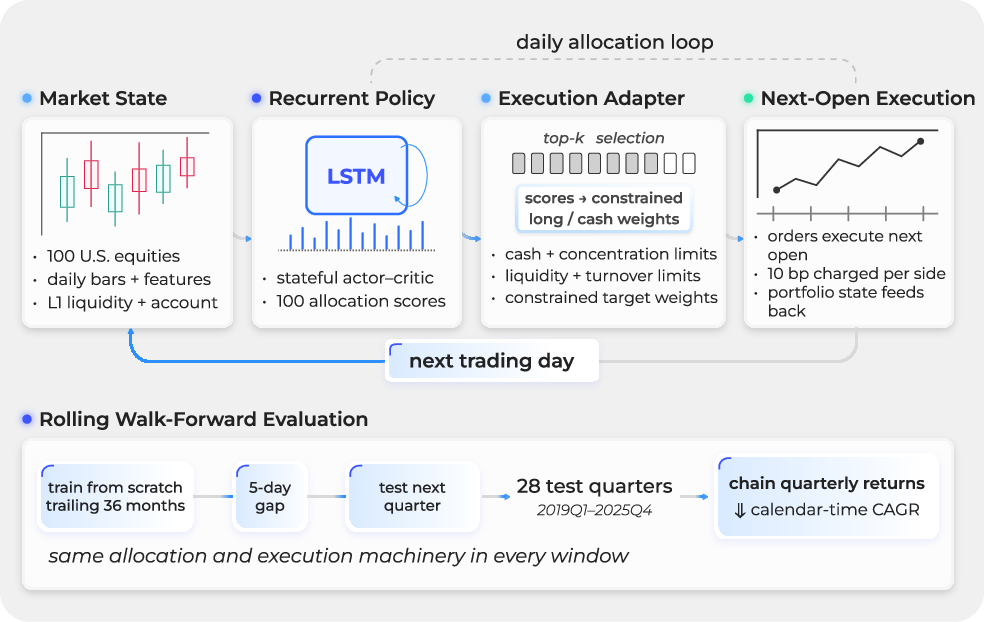
Praxist discovered a trading strategy with a reported 53% walk-forward CAGR, compared with 23% for its paired baseline. CAGR means the average yearly growth rate of an investment. “Walk-forward” means the strategy was tested on later data after being developed on earlier data, which is meant to imitate real-world use more closely.
Robot navigation, or SLAM
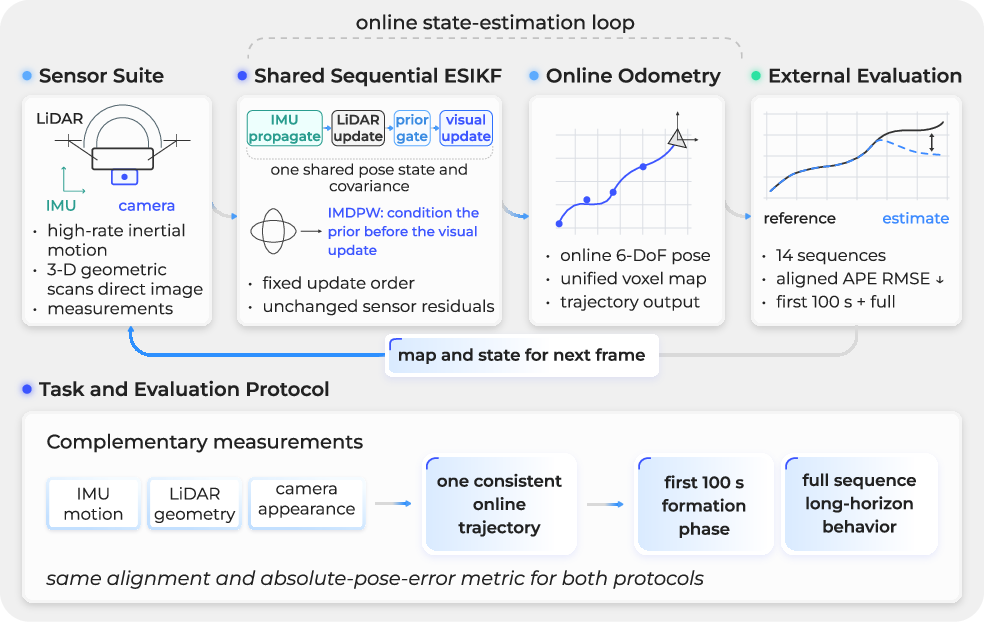
SLAM systems help robots understand where they are while building a map of their surroundings. Praxist found that these systems were spending too much computer power examining repeated or unhelpful camera images.
It introduced:
- A scheduler that chooses visual updates when they are most useful
- A gate that decides which map information should be saved
These changes reduced visual-processing time by about 72% across 14 test sequences, while keeping similar movement accuracy.
Tokamak fusion control
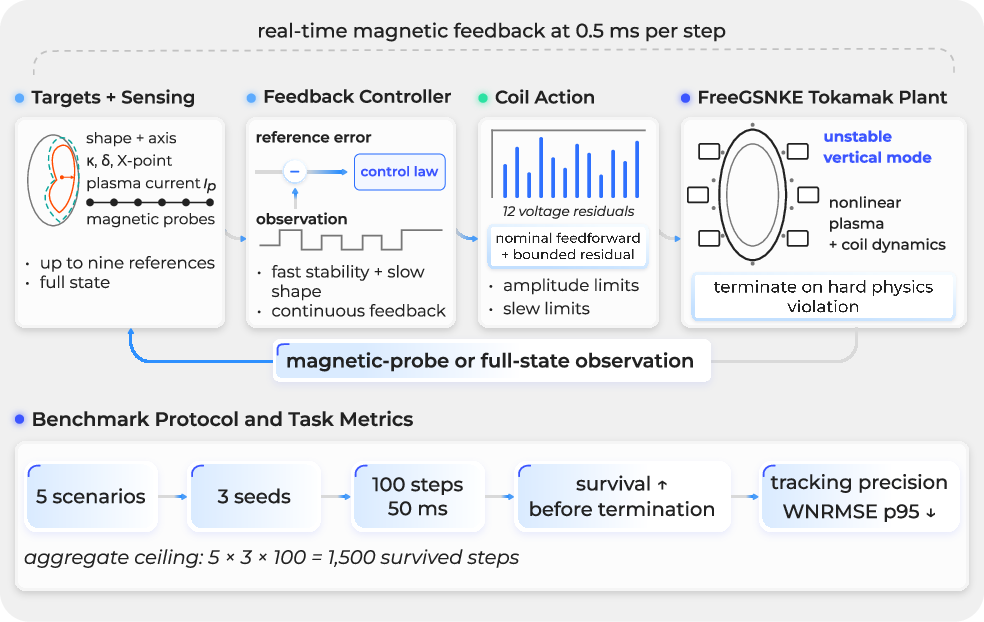
A tokamak is a machine that uses magnetic fields to control extremely hot plasma, with the long-term goal of producing fusion energy.
Praxist’s controller had better overall survival and lower tracking error on some measures. However, the original task-specific controller was still better on the benchmark’s main full-horizon score and completion rate. This is an important example of a mixed result: Praxist was not best in every category.
5. Why are these findings important?
The results suggest that an AI research system may be more useful when it remembers structured lessons, not just a list of previous scores.
A normal system might say:
“This was the best earlier program, so copy it.”
Praxist tries to say something more helpful:
“This part of the earlier program helped in these conditions, this other part failed, and this idea still needs testing.”
That difference matters because difficult discoveries often come from combining several smaller ideas. A failed experiment can also be useful if it shows what not to do.
The lineage record is valuable too. In science and engineering, it is important to know not only that something works, but also:
- Which tests support the claim
- Which assumptions were made
- Which failures occurred
- What still needs to be checked
- How the final solution developed
6. Possible impact and limitations
If systems like Praxist work reliably, they could help AI agents perform longer and more complicated research projects. They might be useful for:
- Designing machine-learning systems
- Improving robots
- Developing engineering controllers
- Testing scientific theories
- Discovering efficient algorithms
- Avoiding repeated mistakes in large projects
The approach could also make AI research more auditable. Researchers would have a detailed history of how a result was produced instead of only seeing the final answer.
However, the paper has some limitations:
- The MLE-bench comparison used one large run for each system, not many repeated runs.
- The case studies used different problem-specific evaluators, so they are not all direct, fair head-to-head comparisons.
- Some results depend on particular AI models, hardware, settings, and evaluation rules.
- A detailed lineage does not automatically guarantee that every conclusion is correct.
- The system can require considerable computing resources and careful organization.
Overall, the paper argues that future AI research agents should act less like people making isolated guesses and more like a research team that tests ideas, records lessons, learns from failure, tries diverse approaches, and builds new solutions from reliable pieces of earlier work.
Knowledge Gaps
Knowledge gaps, limitations, and open questions
The paper leaves the following issues unresolved:
- No controlled ablation isolates the source of improvement. The evaluation does not separately quantify the contributions of evidence inheritance, lineage tracking, QD allocation, DIG contracts, PI/Chair synthesis, frontier lanes, or Gems.
- The baseline comparison is confounded by different base models. Praxist uses
deepseek-v4-pro, whereas the main baseline uses Claude Opus 4.8, so the reported MLE-bench gains cannot be attributed specifically to the Praxist system. - The MLE-bench comparison is based on a single sweep per system. Because each arm is run once, the paper cannot estimate run-to-run variance, statistical uncertainty, or the robustness of the medal-rate differences.
- The baseline is not fully matched in accepted-task coverage. Claude Code has five unscored tasks after post-run screening, while Praxist is reported across all 75 tasks, complicating direct comparisons of medal composition and rates.
- The cost comparison lacks sufficiently standardized accounting. The paper reports substantially lower Praxist cost but does not establish whether model pricing, hardware utilization, failed attempts, evaluator calls, orchestration overhead, and development effort were measured identically across systems.
- The effects of contamination adjudication are difficult to interpret independently. Praxist excludes 90,423 attempts and substitutes clean actors on nine tasks, but the paper does not quantify how these exclusions changed the overall results relative to an independently defined, preregistered evaluation protocol.
- The selection process may introduce post-run cherry-picking. The reported Rocket and Quant artifacts were selected from outside the confirmed frontier after the campaign, despite the formal output rule selecting the best confirmed-lane artifact; the implications of this mismatch are not systematically evaluated.
- The method’s promotion and synthesis decisions are not shown to be reliable. Findings, frontier lanes, and agendas are largely produced through agent or LLM-mediated interpretation, but the paper does not measure inter-rater agreement, decision consistency, false promotions, or missed useful findings.
- The causal validity of typed findings remains uncertain. The system records claims such as “positive,” “negative,” and “diagnostic,” but it is not demonstrated that these labels correspond to causal effects rather than correlations caused by confounding implementation changes.
- The reproducibility of artifacts is not empirically stress-tested. Although artifacts are defined as reproducible, the paper does not report independent reruns, cross-machine replication, environment perturbation tests, or reproducibility failure rates for the artifacts and evaluator outcomes.
- The QD design space is manually specified and may encode researcher bias. Mechanism family, intervention surface, and intent are task-defined dimensions, but the paper does not establish how to choose them, how sensitive results are to their definitions, or whether poor dimensions can systematically misdirect exploration.
- Soft diversity targets in later generations are not formally analyzed. The opening allocation enforces diversity caps, whereas later generations treat them as soft targets; the effect of this relaxation on coverage, exploitation, and search collapse is unknown.
- The optimal cohort size and number of generations are not studied. No experiments vary or , so it remains unclear whether the reported gains arise from the lineage method or simply from a particular parallelism and compute allocation.
- The memory-compression mechanism is under-evaluated. Gems are enabled in only one case study, with a six-generation period and four active memories; their benefits, compression errors, forgetting behavior, and sensitivity to are not established.
- The paper does not measure harmful inheritance or error propagation. Incorrect findings, overgeneralized failures, and misleading Gems may influence many later generations, but the system lacks reported safeguards or measurements for lineage-wide propagation of early mistakes.
- The cost of lineage construction and synthesis is not fully compared with its benefits. PI roles, Chair arbitration, evidence extraction, validation, and ledger maintenance may introduce substantial computational and latency overhead, which is not reported as a separate component.
- The external evaluator assumption limits applicability. Praxist is designed around task-grounded automated evaluators, but the paper does not show how it performs when evaluation is noisy, delayed, expensive, subjective, adversarial, or only partially observable.
- Evaluator gaming is not systematically investigated. Because agents optimize against external scores, the experiments do not establish whether Praxist encourages overfitting to evaluator quirks, benchmark leakage, reward hacking, or brittle solutions that fail under distribution shift.
- Generalization beyond the four case studies is unresolved. The open-ended experiments cover rocket landing, trading, SLAM, and tokamak control, but they do not demonstrate transfer to other scientific domains, real-world laboratory settings, non-code interventions, or tasks without deterministic simulation.
- The case studies lack matched competing systems. Except for the limited Rocket comparison with Weco, the case studies compare against task-native baselines rather than systems with equivalent model, compute, and search budgets, leaving the relative advantage of Praxist uncertain.
- Several headline metrics are not directly comparable across systems or evaluation protocols. For example, the SLAM arms use different pose stamping procedures, and the fusion study favors different metrics for different systems; these protocol differences weaken causal interpretation of the reported improvements.
- Real-world deployment validity is not demonstrated. The Rocket, SLAM, trading, and fusion results are evaluated in specified environments, but the paper does not establish performance under hardware noise, changing dynamics, sensor failures, market regime shifts, or operational constraints.
- Safety and failure-boundary behavior remain insufficiently characterized. The system explicitly records diagnostic and negative findings, but the experiments do not quantify catastrophic failure rates, safe fallback behavior, or whether inherited evidence improves performance in rare high-consequence conditions.
- The lineage’s usefulness to human researchers is asserted but not measured. No user study evaluates whether lineages improve understanding, auditability, reproduction time, debugging, collaboration, or the ability of independent researchers to continue a campaign.
- The method’s sensitivity to prompt, role, and model configuration is unknown. The paper does not test alternative LLMs, PI-role prompts, Chair policies, context-window sizes, or different implementations of the same operational vocabularies.
- The formalization does not provide guarantees for allocation or promotion quality. Operators such as
Allocate,Interpret,Promote,Compress, andChairare described procedurally, but no theoretical or empirical guarantees bound regret, coverage, evidence quality, or convergence. - The relationship to existing search, memory, provenance, and multi-agent methods is not tested through matched baselines. The paper motivates Praxist using several related traditions but does not compare against isolated implementations of reflection memory, MAP-Elites/QD search, artifact databases, graph memory, or provenance tracking under the same budget.
- The paper does not establish whether lineage evidence transfers across tasks. Gems and reusable findings are described as durable state, but it remains unclear whether knowledge learned in one task can safely or beneficially initialize another task, or whether all evidence is campaign-specific.
- Long-horizon scaling is unverified. The paper argues that lineage-centered inheritance addresses growing campaign state, yet it does not report experiments over substantially longer campaigns, larger artifact populations, or lineage graphs large enough to expose retrieval, compression, and bookkeeping bottlenecks.
- The endpoint criterion may undervalue robust or diverse solutions. Selecting the highest-scoring confirmed artifact does not account for compute cost, uncertainty, maintainability, transfer performance, or diversity, so the final-output rule may favor brittle solutions even when the lineage contains safer alternatives.
Practical Applications
Immediate Applications
The paper’s core contribution—turning evaluated artifacts into typed, selectively inherited evidence with an auditable lineage—can be applied now in settings that already have executable workflows, automated evaluators, and experiment-tracking infrastructure.
- Machine-learning engineering and model development — experiment-management workflow
- Integrate Praxist-style records into existing tools such as
MLflow,Weights & Biases,DVC, or internal experiment platforms. - For every training run, store not only code, parameters, and metrics, but also:
- the hypothesis or intervention tested;
- the parent experiment;
- evidence maturity;
- positive, negative, diagnostic, or uncertain findings;
- the recommended next action: reuse, validate, avoid, diagnose, or archive.
- This would help teams avoid repeatedly testing known-failed preprocessing choices, architectures, or hyperparameter regimes.
- Dependencies: reproducible data and code pipelines, stable evaluation metrics, artifact versioning, and sufficient human or automated review to prevent incorrect findings from being promoted.
- Integrate Praxist-style records into existing tools such as
- Automated Kaggle, benchmark, and data-science competition systems — autonomous search
- Deploy the generational loop for competitions or internal modeling challenges: parallel agents explore distinct mechanism families, validate promising candidates, and retain failure modes as reusable constraints.
- The reported MLE-bench result—60 medals out of 75 tasks, including 49 golds—suggests potential value for automated model selection and competition-style optimization, although it is based on a single campaign and should not be treated as a general performance guarantee.
- Dependencies: access to a task-grounded evaluator, controls against data leakage or benchmark contamination, and compute budgets compatible with parallel experimentation.
- Software engineering — repository-level autonomous development
- Use design contracts before code changes to specify the intended mechanism, affected intervention surface, validation hook, and forbidden changes.
- Record each pull request or agent-generated patch as an artifact linked to tests, benchmarks, review decisions, regressions, and failed approaches.
- A software team could maintain frontier lanes such as:
- confirmed fixes;
- candidate refactorings;
- regression diagnostics;
- changes requiring additional validation.
- Potential products include a lineage-aware coding agent or a GitHub/GitLab extension that explains why a change was adopted and which prior failures it avoids.
- Dependencies: reliable test suites, reproducible build environments, meaningful integration tests, and human approval for security- or safety-critical changes.
- Scientific and engineering research — reproducibility and lab notebooks
- Extend electronic lab notebooks and experiment trackers so that every result is linked to its protocol, raw data, software environment, evaluator output, and interpretation.
- Researchers could use the system to distinguish mature results from preliminary observations and to preserve negative results rather than discarding them.
- This is immediately relevant to computational biology, materials science, robotics, control, and scientific machine learning.
- Dependencies: standardized metadata, persistent storage, clear provenance policies, and domain experts capable of judging whether an observed effect is genuinely reusable.
- Research-group project management — evidence-based agenda setting
- Apply the PI/Chair structure as a lightweight governance workflow:
- a Builder proposes the strongest implementation path;
- a Skeptic audits unsupported or fragile claims;
- a Portfolio role balances exploration across approaches;
- a Chair assigns the next cycle’s continue, stop, validate, and explore decisions.
- This can improve weekly research planning by replacing informal status updates with evidence-linked decisions.
- Dependencies: independent review, transparent evidence-freeze procedures, and safeguards against excessive bureaucracy or role-based bias.
- AI-assisted hyperparameter and system optimization — quality-diversity exploration
- Use Quantified Diversity to allocate parallel runs across explicit cells defined by mechanism family, intervention surface, and research intent.
- Instead of launching many near-identical experiments around the current best score, teams can reserve capacity for diagnostics, ablations, and fundamentally different approaches.
- Potential applications include neural architecture search, compiler optimization, database tuning, and distributed-system configuration.
- Dependencies: a meaningful design space, enough parallel compute, and carefully chosen diversity dimensions; poorly defined cells could encourage superficial rather than substantive diversity.
- Robotics and autonomous systems — experiment provenance and failure libraries
- For SLAM, navigation, manipulation, or autonomous driving, represent each controller, planner, sensor policy, and map-admission strategy as a reproducible artifact.
- The SLAM case study suggests an immediate engineering workflow for testing observability-aware visual-update scheduling and geometry-aware map admission to reduce redundant visual computation.
- A robotics team could retain diagnostic findings such as “this sensor policy fails under low texture” or “this map update causes drift under repeated observations.”
- Dependencies: high-fidelity simulation or safe physical testing, representative environments, deterministic evaluation where possible, and strict separation between simulation evidence and real-world validation.
- Energy and control-system development — offline controller research
- Apply the framework to tokamak control, battery management, grid dispatch, wind-turbine control, or industrial process optimization in simulation and hardware-in-the-loop environments.
- Candidate controllers could be promoted only after passing progressively stronger evidence stages: smoke tests, partial probes, full simulations, robustness checks, and hardware-in-the-loop validation.
- The method’s explicit treatment of diagnostic and validation evidence is particularly useful where a high score on one metric may conceal instability or poor completion rates.
- Dependencies: validated simulators, safety interlocks, domain-specific constraints, and independent verification before deployment.
- Financial research — reproducible strategy discovery
- Use the quantitative-trading workflow to organize candidate signals, execution policies, transaction-cost assumptions, and walk-forward results.
- Typed findings could distinguish:
- a potentially reusable alpha mechanism;
- a failed signal;
- a diagnostic showing sensitivity to slippage;
- a procedural requirement for out-of-sample evaluation.
- The paper’s reported 53% walk-forward CAGR versus a 23% paired baseline illustrates the type of evidence the system can organize, but does not establish live-trading profitability.
- Dependencies: leakage-free data, realistic transaction costs, regime-diverse validation, risk constraints, compliance review, and a substantial gap between backtest evidence and production deployment.
- Rocket and aerospace design — automated simulation campaigns
- Use design contracts and lineage records to manage trajectory, landing-controller, aerodynamic, or structural-design experiments.
- A campaign can preserve not just the best simulation result but also the conditions under which it worked, the failed assumptions, and the rows or scenarios requiring further validation.
- The reported perfect score on a frozen rocket protocol is useful as an example of evaluator-grounded search, but should not be interpreted as flight readiness.
- Dependencies: representative simulation physics, independent test scenarios, hardware-in-the-loop testing, uncertainty quantification, and certification processes.
- Policy and public-sector research — auditable analytical decision support
- Government agencies could use typed evidence and lineage for policy simulations, resource-allocation studies, and regulatory impact analyses.
- A policy recommendation would be accompanied by the models, assumptions, failed alternatives, sensitivity analyses, and validation status that produced it.
- This could improve auditability and make it easier for policymakers to identify which conclusions are established versus exploratory.
- Dependencies: legally compliant data access, explainable evaluation criteria, democratic and expert oversight, and explicit handling of distributional effects and uncertainty.
- Education and daily life — structured learning and personal experimentation
- In education, the approach could support project-based learning: students propose hypotheses, run reproducible experiments, receive evaluator feedback, and maintain a lineage of revisions and failed approaches.
- In daily life, a lightweight personal version could track experiments such as exercise routines, study methods, budgeting strategies, or home-energy interventions while distinguishing anecdotal observations from validated effects.
- Dependencies: privacy-preserving data storage, simple interfaces, adequate sample sizes, and warnings against treating personal correlations as causal conclusions.
Long-Term Applications
These applications require additional research because they involve safety-critical deployment, large-scale coordination, uncertain evaluators, or broader social and institutional effects.
- General-purpose autonomous research organizations — persistent AI laboratories
- A future system could operate long-running campaigns across literature review, experiment design, implementation, evaluation, replication, and publication.
- Frontier lanes and Gems could function as an institutional memory spanning projects, teams, and years rather than a single agent context.
- The lineage could become a machine-readable “solution history” that allows new agents or researchers to continue from validated mechanisms without rereading every raw experiment.
- Dependencies: reliable scientific reasoning, robust evaluator design, protection against self-reinforcing errors, human research leadership, and standards for authorship and accountability.
- Safety-critical engineering — certified evidence inheritance
- Aviation, medical devices, nuclear systems, autonomous vehicles, and industrial control could use lineage-grounded exploration to manage design alternatives and verification evidence.
- Promotion rules could require independent replication, formal safety checks, adversarial testing, and sign-off before an artifact moves from candidate to confirmed.
- Dependencies: formal certification frameworks, traceability standards, conservative promotion policies, independent evaluators, and guarantees that agents cannot modify the evaluation criteria to improve apparent performance.
- Clinical research and personalized healthcare — adaptive treatment and workflow optimization
- The framework could organize clinical-trial arms, diagnostic models, treatment protocols, and patient-specific decision policies.
- Negative and diagnostic findings could prevent repeated exposure to ineffective interventions, while validation lanes could require external cohorts or prospective trials.
- Potential tools include lineage-aware clinical decision-support systems and reproducible pipelines for medical-imaging model development.
- Dependencies: regulatory approval, patient consent, privacy, robust causal evidence, clinically meaningful endpoints, demographic fairness, and mandatory human clinician oversight. Simulation or retrospective benchmark gains would be insufficient for treatment decisions.
- Autonomous robotics fleets — collective learning from validated failures
- Warehouse robots, delivery vehicles, agricultural machines, and space systems could share typed findings across deployed units.
- A failure observed by one robot—such as localization degradation in a particular lighting or terrain condition—could become a diagnostic constraint for future planning and fleet-wide experimentation.
- Dependencies: secure fleet communication, domain-shift detection, fault isolation, safe online learning, and mechanisms preventing one erroneous finding from propagating throughout the fleet.
- Energy-grid and climate-control optimization — multi-objective frontier management
- A large-scale system could jointly optimize reliability, emissions, cost, resilience, and equity rather than selecting the highest value on a single metric.
- Frontier lanes could represent solutions confirmed for reliability, candidates for efficiency improvement, diagnostics for rare failures, and validation experiments for extreme-weather conditions.
- Dependencies: high-quality digital twins, real-time observability, regulatory authority, robust optimization under uncertainty, and explicit safeguards against optimizing cost or emissions at the expense of reliability.
- Financial institutions — governed autonomous strategy research
- Banks, asset managers, and insurers could use lineage graphs to track the origins of trading strategies, credit models, underwriting rules, and stress-test assumptions.
- A strategy would not be promoted solely because of a high backtest score; it would also need evidence of robustness, stability across regimes, and compliance with risk policies.
- Dependencies: market nonstationarity, adversarial behavior, regulatory model-risk management, secure data infrastructure, and independent validation. The framework cannot by itself solve overfitting or financial-market feedback effects.
- Open scientific infrastructure — interoperable evidence and lineage standards
- The paper’s artifact, finding, frontier, agenda, Gem, and lineage objects could evolve into interoperable schemas integrated with repositories, laboratory systems, benchmark platforms, and publication infrastructure.
- Journals or funders could require machine-readable provenance linking published claims to code, data, evaluations, replications, and known limitations.
- Dependencies: community agreement on ontologies and APIs, long-term repository maintenance, identity and access controls, and incentives for publishing negative or diagnostic results.
- Public policy experimentation — continuously updated evidence portfolios
- Governments could maintain live evidence frontiers for interventions such as education programs, public-health campaigns, transport policies, or energy subsidies.
- New pilots would be allocated across exploitation, validation, diagnosis, and exploration cells, while prior failures and boundary conditions remain visible to decision-makers.
- Dependencies: ethical experimentation, representative populations, political legitimacy, causal identification, protection from policy-induced harms, and processes for resolving conflicts between quantitative metrics and public values.
- AI alignment and governance — provenance-aware agent oversight
- Lineage could provide an audit trail for how an autonomous agent formed plans, inherited lessons, changed objectives, and selected final outputs.
- Governance systems might inspect whether an agent preserved diagnostic failures, ignored forbidden actions, or promoted immature evidence.
- Dependencies: trustworthy logging, tamper resistance, interpretable agent decisions, adversarial testing, and agreement on which evidence and actions are acceptable in a given domain.
- Commercial research platforms — lineage-aware optimization products
- A mature product could offer “research campaigns as a service,” combining parallel coding agents, experiment schedulers, external evaluators, evidence databases, and visual lineage explorers.
- Likely markets include model development, chip design, drug discovery, industrial engineering, and software performance optimization.
- Dependencies: scalable compute orchestration, predictable cost controls, domain-specific evaluator integrations, strong security and intellectual-property protections, and empirical evidence that the additional synthesis machinery improves outcomes beyond simpler experiment tracking.
- Human knowledge management — durable organizational memory
- Enterprises could convert project histories, incident reports, experiments, and design reviews into reusable Gems and diagnostic constraints.
- This would support onboarding, reduce repeated mistakes, and preserve tacit knowledge when employees or research teams leave.
- Dependencies: accurate extraction from heterogeneous records, protection against outdated lessons, versioning of organizational knowledge, and mechanisms for retiring Gems whose assumptions no longer hold.
Glossary
- Ablation: An experiment that removes or alters one component to measure its individual contribution. “the validation or ablation hook that makes the result interpretable”
- Artifact lineage: The documented history connecting an artifact to its predecessors, evidence, and production steps. “each artifact points to the parents, contract, and findings it descended from”
- Assembly theory: A framework that explains complex objects through the histories by which reusable parts are assembled. “Assembly theory suggests a different primitive”
- Canary evaluation: An early, limited evaluation used to detect whether a system or artifact is functioning adequately. “the rocket evaluator reports canary, development, and complete”
- Cohort-level allocation: The assignment of experimental workers to a coordinated set of diverse research directions. “The cohort-level component of Allocate is Quantified Diversity (QD).”
- Common-horizon tracking error: An error measure calculated over the same time interval for competing control systems. “lower common-horizon tracking error than a task-native controller”
- Contaminated lineage: A chain of artifacts or experiments affected by invalid, compromised, or disallowed data or procedures. “attempts drawn from a contaminated lineage are excluded outright rather than down-weighted”
- Cross-generation inheritance: The selective transfer of evidence or lessons from one research iteration to later iterations. “This treatment of feedback as persistent, reusable state generalizes verbal-reflection and self-refinement mechanisms”
- Design cell: A discrete location in a research-design space defined by selected experimental attributes. “where a cell is the tuple”
- Design contract: A pre-experiment specification that defines what an agent will test, how it will be evaluated, and which changes are disallowed. “The allocation operator returns one design contract for each peer .”
- Diagnostic finding: A result that identifies a constraint, failure mode, or invalidity condition rather than merely reporting performance. “diagnostic (a constraint, failure mode, or invalidity condition)”
- Evidence maturity: A label indicating how thoroughly a result has been evaluated and how much confidence it warrants. “the evidence maturity ”
- Evidence signature: The expected pattern of observations that would support or weaken an experimental hypothesis. “the evidence signature that would support or weaken it”
- Evaluator-grounded research and development: Research in which an external task-specific evaluator supplies feedback for guiding subsequent experiments. “We introduce Praxist, a lineage-centered system that implements this interface for evaluator-grounded autonomous R{paper_content}D.”
- External validity: The extent to which findings generalize beyond the specific experimental setting. “the panel adds an External-validity role that checks reproducibility and evidence boundaries”
- Failure mode: A characteristic way in which a system, assumption, or intervention can fail. “A failed artifact can reveal an invalid assumption, an evaluator constraint, a data-processing error, or a fragile score”
- Finding extraction: The process of converting an evaluated artifact and its outcome into reusable, structured claims. “The extraction operator converts each artifact, its outcome, and its intended design into one or more artifact-grounded claims.”
- Frontier: The current set of evidence considered eligible for inheritance or further research action. “the frontier is partitioned into four lanes by operational role”
- Generational state-transition process: A model in which each research generation consumes one state and produces the next. “We formalize Praxist as a generational state-transition process.”
- High-horizon precision: The accuracy of a control system measured over an extended time horizon. “leads on survival but not on full-horizon precision in tokamak control”
- Inheritance lane: A category that specifies the operational status and permitted use of inherited evidence. “the frontier update then sorts the surviving evidence into inheritance lanes”
- Intervention surface: The specific part or behavior of a system that an experiment modifies. “the mechanism family being tested, the intervention surface it changes”
- Lineage graph: A graph representing the relationships and ancestry among research artifacts, findings, decisions, and outcomes. “Together they form a lineage graph that stays active throughout the campaign”
- LiDAR-inertial-visual SLAM: A simultaneous-localization-and-mapping approach that combines laser ranging, inertial sensing, and visual information. “LiDAR-inertial-visual SLAM”
- Memory compression: The distillation of accumulated research evidence into a smaller set of durable lessons. “Where a campaign enables it, every generations Praxist performs a memory compression”
- Observability-aware scheduler: A scheduling mechanism that allocates computation according to how informative observations are expected to be. “Replacing the uniform visual-update policy with an observability-aware scheduler”
- Provenance: Information describing the origin, processing history, and derivation of a data product or result. “provenance models that connect entities, activities, and derived results”
- Quantified Diversity (QD): A quality-diversity strategy that maintains coverage across distinct regions of a behavior or design space. “The cohort-level component of Allocate is Quantified Diversity (QD).”
- Reproducibility: The ability to independently recreate an artifact, experiment, or result using the recorded materials and procedures. “The reproducible artifact is the minimal file set required to reproduce, inspect, or evaluate one attempt.”
- Score-ranked artifact collection: A set of candidate artifacts organized primarily by their numerical evaluation scores rather than by their evidential roles. “Systems that carry state as score-ranked artifact collections---evolving program databases, solution trees---inherit an untyped object”
- Selective evidence inheritance: The controlled retention and reuse of only the evidence relevant to future research directions. “Because a long run produces far more evidence than any single prompt context can hold, inheritance is selective”
- Solution lineage: The traceable sequence of artifacts, findings, decisions, and evidence through which a final solution was constructed. “The output is thus not only an evaluated artifact but the solution lineage that explains how it was obtained”
- Task-grounded evaluator: An evaluation mechanism whose judgments are based on the objective and metrics of the specific task. “The same pattern underpins machine-learning engineering benchmarks”
- Tokamak magnetic control: The regulation of magnetic fields in a tokamak to control and sustain plasma behavior. “tokamak magnetic control for fusion”
- Typed finding: A structured research claim assigned a defined category, maturity level, and recommended action. “Praxist inherits typed findings whose frontier lanes make validation status explicit”
- Validity state: A status indicating whether an evaluated artifact or result satisfies the conditions required to be considered valid. “which returns a task-grounded outcome together with a validity state and an evidence stage”
- Walk-forward CAGR: The compound annual growth rate measured through sequential historical training and testing intervals. “its 53\% walk-forward CAGR is 2.3 times the 23\% of its paired all-eligible equal-weight baseline”

