Effective Learning Rate Governs Loss Dynamics in Language Model Pretraining
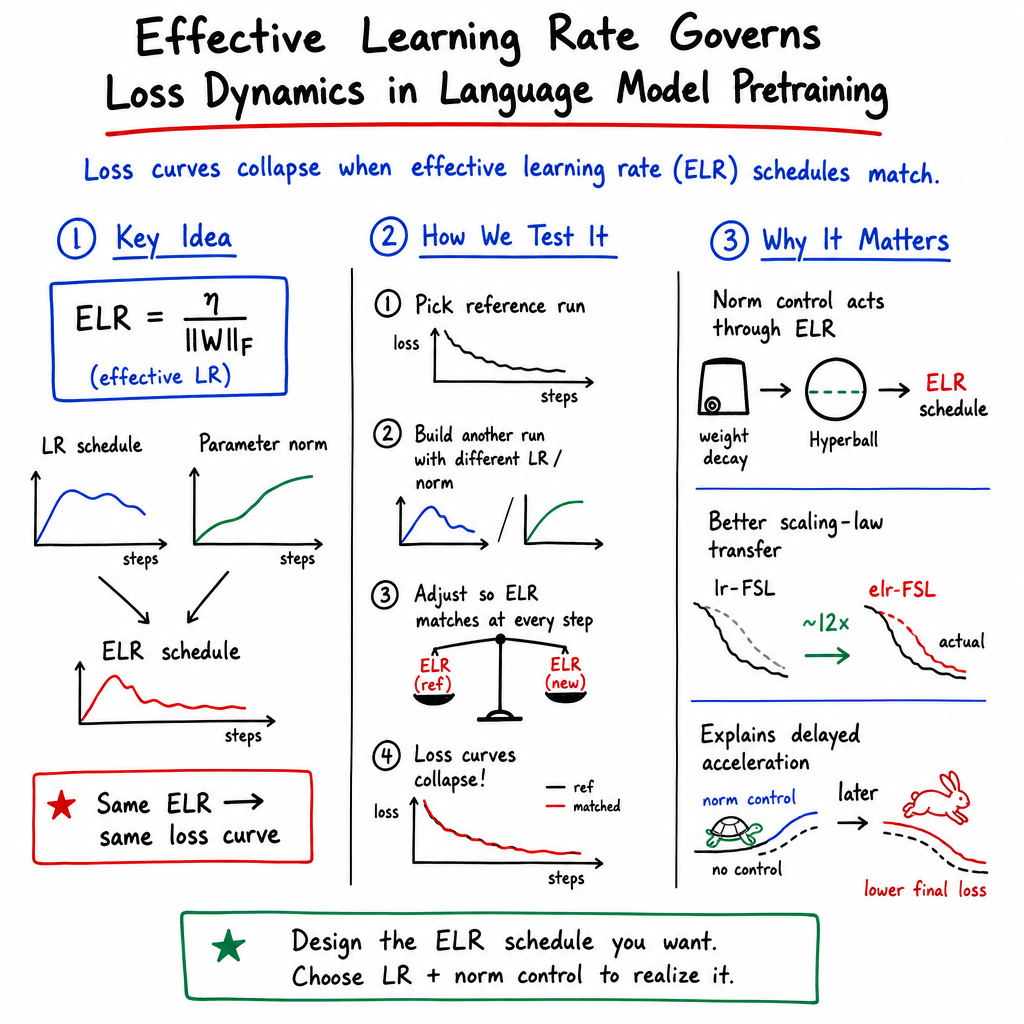
Abstract: We uncover ELR collapse in LLM pretraining: learning rate (LR) and parameter norm govern loss dynamics primarily through their ratio, the effective learning rate (ELR). When ELR is matched across runs, their loss trajectories collapse throughout training despite substantially different LRs and parameter norms. Across optimizers, architectures, datasets, and model scales, mean collapse errors are typically a few x 10-3, below the seed-to-seed variation measured in a representative configuration. Systematic ablations identify normalization design and the timescale of LR-norm variation as key determinants of collapse precision. Controlled interventions further show that weight decay and Hyperball shape loss dynamics primarily through the ELR schedules they induce. Replacing LR with ELR enables a fitted functional scaling law (FSL) to transfer across norm-control methods. The resulting ELR-based FSL also explains delayed acceleration, a recurring effect of norm control. Together, these results establish ELR as a common coordinate linking LR scheduling, norm control, and loss dynamics.
Paper Prompts
Sign up for free to create and run prompts on this paper.
Top Community Prompts
Explain it Like I'm 14
1. What is this paper about?
This paper studies how LLMs learn during training. In particular, it looks at two things that can affect learning:
- Learning rate (LR): how large a step the model takes when changing its settings.
- Parameter norm: roughly, the overall size of the model’s internal numbers, called parameters.
The researchers introduce a combined measurement called the effective learning rate, or ELR:
Their main claim is that the model’s training loss is controlled mostly by this ratio, rather than by the learning rate or parameter norm separately.
An analogy is walking on a map. The learning rate is like the size of each step, while the parameter norm affects how much that step really changes the model’s direction. The ELR describes the model’s effective step size.
2. What questions did the researchers ask?
The paper focuses on several main questions:
- Can different learning rates and parameter sizes lead to the same training behavior if they have the same ELR?
- Do practical techniques such as weight decay and Hyperball affect training mainly by changing the ELR?
- Can ELR help predict training loss for models trained with methods that were not used to build the prediction rule?
- Why do some norm-control methods seem unhelpful at first but produce better results later?
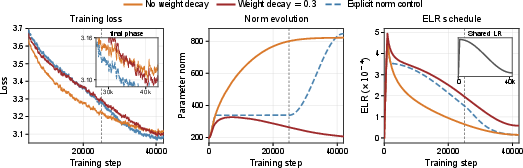
This last behavior is called delayed acceleration. For example, a model using weight decay may have a higher loss early in training but eventually achieve a lower loss than a model without weight decay.
3. How did they study the problem?
Comparing training runs
The researchers trained LLMs many times. They changed the learning-rate schedule and the way the model’s parameter size changed.
A schedule is simply a plan for how something changes during training. For example, the learning rate might:
- Start small and increase,
- Stay steady,
- Decrease,
- Rise and fall in a wave-like pattern.
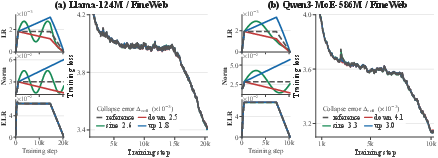
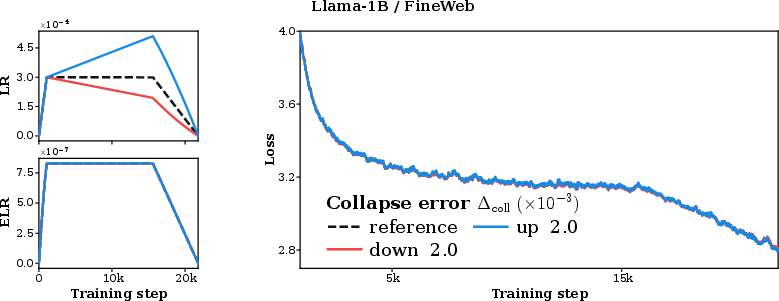
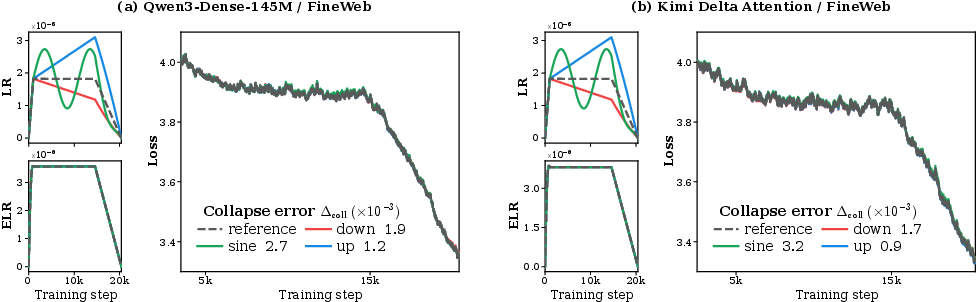
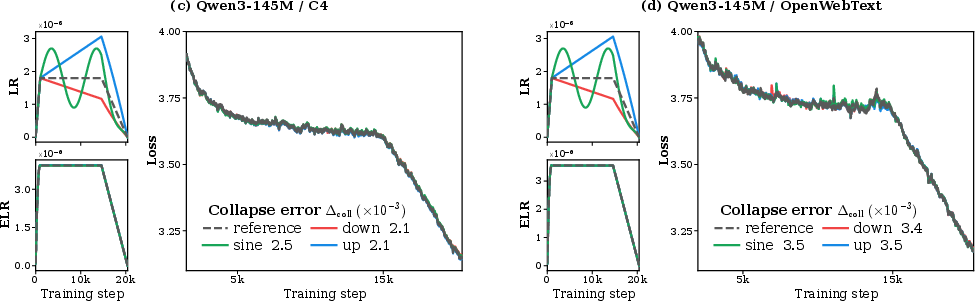
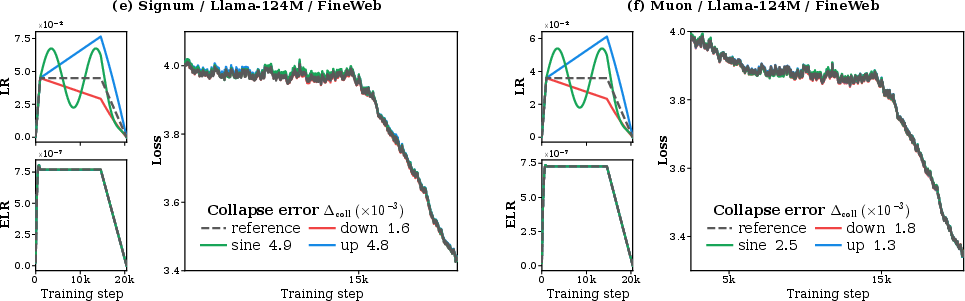
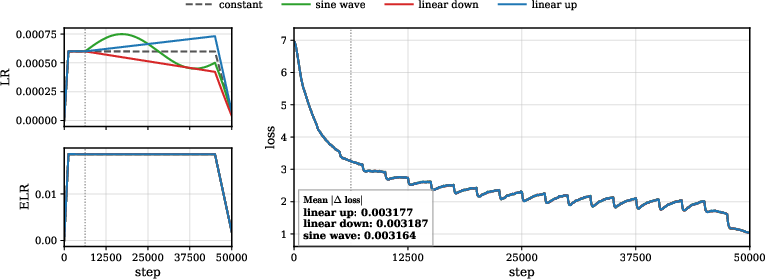
The researchers designed different runs so that their learning rates and parameter norms were different, but their ELR values matched at each training step.
They then compared the models’ loss curves. Loss is a number showing how badly the model is performing on its training task. Lower loss usually means the model is predicting the text more accurately.
If the ELR idea is correct, the loss curves from these different runs should look nearly the same. The paper calls this result ELR collapse: different training curves collapse onto almost one common curve.
Testing many kinds of models
The experiments included:
- Dense Transformer models,
- Mixture-of-Experts models,
- A model using linear attention,
- Models from about 100 million to 1 billion parameters,
- Several text datasets,
- Several optimizers, including AdamW, Muon, and Signum.
An optimizer is the rule that decides how the model changes its parameters after seeing an error.
The researchers also tested models for image recognition, not just LLMs.
Testing norm-control methods
The paper examined two methods for controlling parameter size:
- Weight decay: gently shrinks the model’s parameters during training.
- Hyperball: keeps parameters close to a chosen size, like forcing a point to stay on the surface of a ball.
The researchers compared these methods with runs that used different learning rates. They adjusted the learning rate so that the runs had matching ELR schedules.
Testing a scaling law
The authors also used a functional scaling law, or FSL. This is a mathematical formula designed to predict how loss changes during training.
They created two versions:
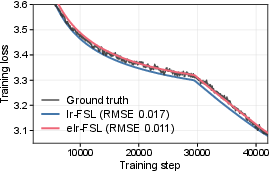
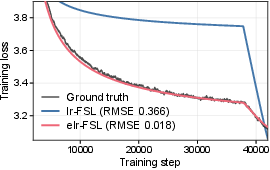
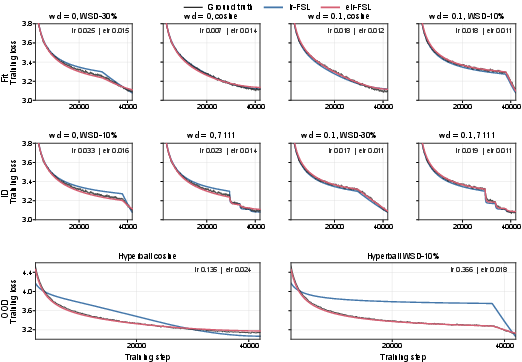
lr-FSL, which uses the ordinary learning rate,elr-FSL, which uses the effective learning rate.
They trained the formula using some runs and then tested whether it could predict other runs, including Hyperball runs that were not used when building the formula.
4. What did they find?
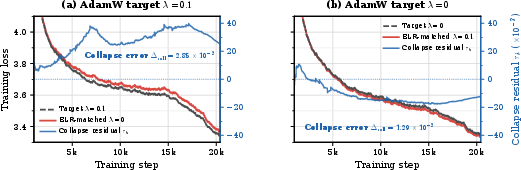
Matching ELR produced nearly matching loss curves
This was the paper’s most important result.
Across 26 comparisons, the typical difference between ELR-matched loss curves was about:
All comparisons had errors below:
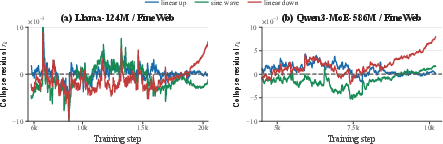
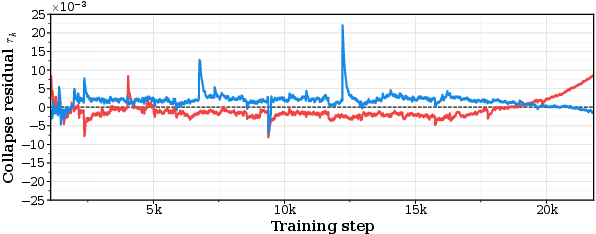
These differences were smaller than the natural differences caused simply by changing the random starting point or the order of training examples. In other words, two runs with the same ELR behaved more similarly than two ordinary runs that differed only because of randomness.
This happened across different:
- Model types,
- Model sizes,
- Datasets,
- Optimizers.
Weight decay and Hyperball mainly worked through ELR
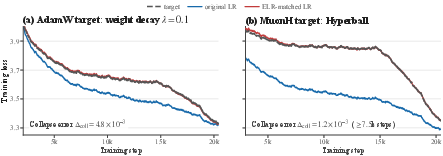
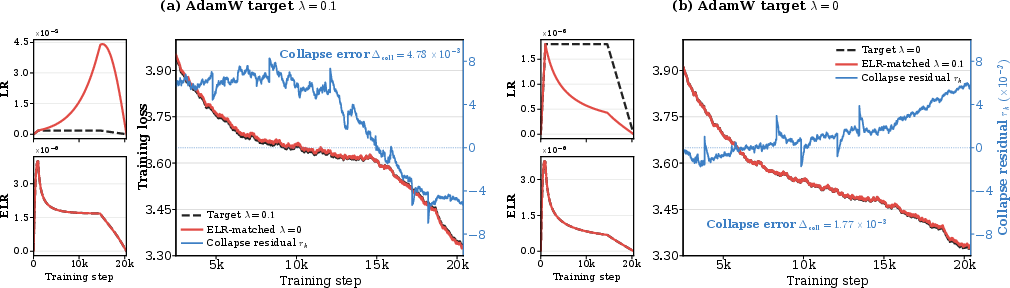
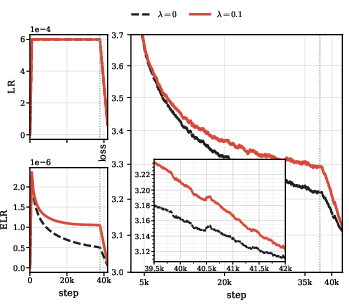
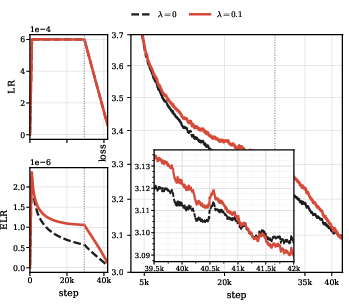
When the researchers removed weight decay, the model’s parameter norm changed, and its loss curve changed too.
However, when they adjusted the learning rate to restore the original ELR, the loss curve became very similar to the weight-decay run again.
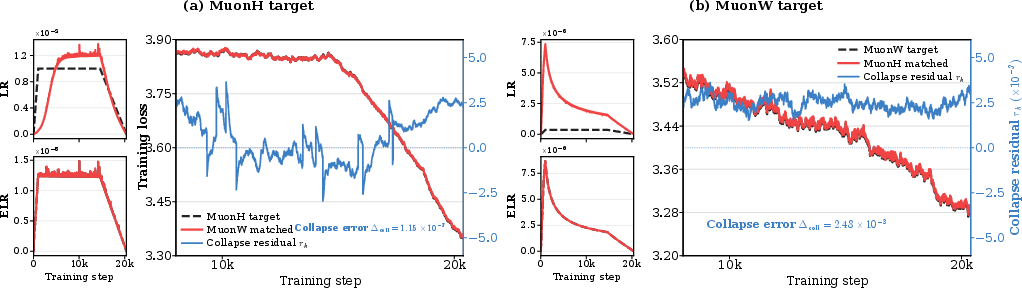
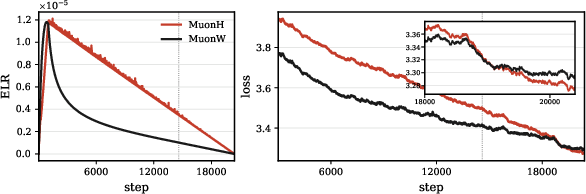
A similar result occurred when comparing Hyperball with another norm-control method. Matching ELR brought their loss curves close together.
This suggests that these methods may not affect loss through completely separate mechanisms. Instead, they often influence loss by changing the model’s effective learning rate.
ELR improved prediction across methods
The ELR-based scaling law was much better at predicting Hyperball training runs than the ordinary learning-rate version.
For unseen Hyperball runs:
lr-FSLhad an average prediction error of about0.2508.elr-FSLhad an average prediction error of about0.0212.
The ordinary version made an error almost 12 times larger. This is important because it means ELR can help a prediction rule transfer from one training method to another.
ELR helped explain delayed acceleration
Without weight decay, the parameter norm often grew steadily. Since ELR is the learning rate divided by the parameter norm, this caused ELR to become smaller more quickly.
Weight decay slowed the growth of the parameter norm. As a result, the model kept a larger ELR for longer and learned more effectively during part of training.
At first, the larger ELR also added more training noise. This could make the weight-decay model look worse early on. Later, the noise became less important, and the earlier learning advantage became visible. The weight-decay model then passed the model without weight decay.
So delayed acceleration can be understood as:
- A larger ELR helps the model learn useful information earlier.
- Extra noise hides this advantage at first.
- Later, the noise decreases, revealing the earlier advantage.
The effect was not perfect
ELR matching did not make the curves exactly identical. The researchers found that the quality of the match depended on several factors:
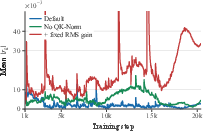
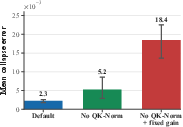
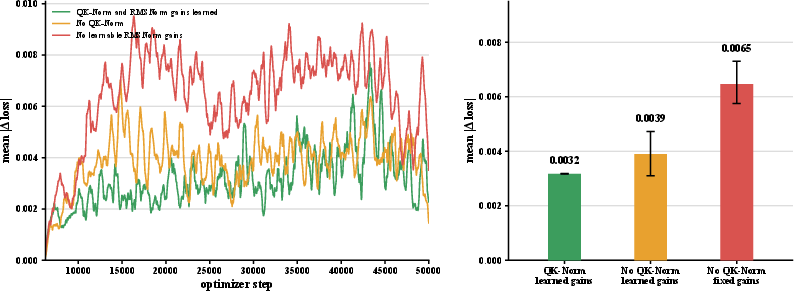
- QK-Norm, a type of normalization used in the attention mechanism, improved the match.
- Learnable RMSNorm gains also improved the match.
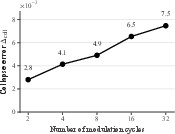
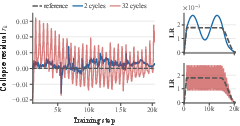
- Changing the learning rate and norm too quickly made the match worse.
For example, rapidly making the learning rate and norm rise and fall caused small waves in the difference between the loss curves.
This means ELR is a powerful approximation, but it is not a complete explanation of everything happening inside a Transformer.
5. Why is this research important?
The paper suggests a simpler way to think about several training choices. Instead of treating learning rate, weight decay, and norm constraints as totally separate controls, researchers could first design a desirable ELR schedule and then choose different methods for creating it.
This could make it easier to:
- Transfer training settings to larger or smaller models,
- Compare different optimizers and norm-control methods,
- Predict how loss will change during training,
- Design better training schedules,
- Understand why weight decay sometimes helps only near the end.
The paper also suggests a practical strategy:
Design the effective learning-rate schedule first, then choose the learning rate and norm-control method that can safely produce it.
However, the authors warn that matching loss curves does not guarantee that the models have the same internal representations or will perform identically on every task. ELR mainly explains the training loss, not every part of a model’s behavior.
Overall, the research presents ELR as a useful “common language” for understanding how different training methods control the learning of LLMs.
Knowledge Gaps
Knowledge gaps, limitations, and open questions
- The microscopic mechanism behind ELR collapse is unresolved. The paper does not derive why the high-dimensional Transformer dynamics can be reduced to the scalar quantity , particularly in architectures that are not exactly scale invariant.
- The role of normalization remains unexplained. QK-Norm and learnable RMSNorm gains substantially improve collapse precision, but the paper does not identify whether this arises from gain dynamics, gradient geometry, activation statistics, attention behavior, or another mechanism.
- The appropriate ELR definition may be optimizer- and parameterization-dependent. The study uses as its central coordinate, while prior scale-invariant analyses use different powers of the norm or optimizer-specific forms. It does not establish when the Frobenius-norm ratio is theoretically valid or whether layerwise, blockwise, spectral, or angular ELRs would be more accurate.
- Layerwise heterogeneity is not fully investigated. The analysis appears to emphasize aggregate parameter norms, leaving open whether loss dynamics are governed by a global ELR or by a vector of layer-specific ELRs whose relative values matter.
- The equivalence between matched ELR schedules and matched optimization dynamics is only approximate. Collapse errors increase under rapid LR–norm modulation, but the paper does not characterize the response kernel, cutoff frequency, phase lag, or other dynamical quantities that determine the approximation error.
- The finite response timescale is not quantified. The experiments vary the number of sinusoidal cycles over one training horizon, but do not establish a general timescale in optimization steps, tokens, intrinsic time, or model-dependent units.
- The source of the initial Hyperball mismatch is unresolved. The brief transient during ELR matching is attributed to the large adapted LR at initialization, but the relative contributions of projection, optimizer-state initialization, gradient normalization, and parameter geometry are not isolated.
- The influence of optimizer state is insufficiently separated from ELR. AdamW, Muon, and Signum are tested, but the paper does not determine whether momentum, adaptive preconditioning, update normalization, or their internal state introduces additional dynamical coordinates beyond ELR.
- The effects of batch size and gradient-noise scale are not systematically tested. Because the FSL noise term depends on the learning-rate schedule, it remains unclear whether ELR collapse persists under changes in batch size, gradient accumulation, data-parallelism, or stochastic-gradient noise.
- The study does not establish how ELR interacts with token-level training budgets. The proposed coordinate is evaluated over fixed experimental horizons, but its behavior under substantially different numbers of training tokens, data repetitions, or compute-optimal training regimes remains unknown.
- Cross-scale validity is limited. Although models range from approximately 100M to 1B parameters, the experiments do not show whether the same ELR formulation and collapse precision extend to modern multi-billion- or trillion-parameter models.
- The generality across architectures remains incomplete. Dense Transformers, MoE models, KDA-based models, and ViTs are included, but convolutional networks, encoder–decoder models, recurrent architectures, multimodal models, and architectures with other normalization schemes are not examined.
- The scope across datasets is uncertain. FineWeb, C4, and OpenWebText are tested, but the results may differ for multilingual, code, mathematical, multimodal, synthetic, heavily deduplicated, or domain-shifted datasets.
- Only a narrow set of norm-control mechanisms is evaluated. Weight decay and Hyperball are central, while spectral-norm constraints, weight normalization, adaptive norm targets, gradient clipping, RMS-based parameter rescaling, and other explicit norm-control methods are not tested systematically.
- The distinction between parameter groups is underexplored. Embeddings, attention projections, FFN matrices, normalization gains, and output heads may respond differently to LR and norm changes, but the paper does not determine whether they should share one ELR schedule.
- The impact of biases and normalization parameters is unclear. The definition of ELR is naturally stated for matrix-valued parameters, yet the treatment and dynamical contribution of biases, scalar gains, embeddings, and other non-matrix parameters are not fully specified.
- The experiments rely heavily on prescribed norm trajectories that may be difficult to realize in practice. It remains unclear whether arbitrary target ELR schedules can be implemented stably using practical LR and norm-control mechanisms without violating optimizer, hardware, or numerical constraints.
- The feasible set of realizable ELR schedules is not characterized. The paper proposes designing ELR first but does not determine which schedules can be realized by weight decay, Hyperball, or other mechanisms, nor how realization constraints depend on model scale and optimizer.
- ELR matching may conceal differences in parameter and representation dynamics. The paper explicitly limits its claims to loss trajectories, but does not measure whether matched runs produce similar activations, attention patterns, feature geometry, learned representations, or parameter directions.
- The effect on validation loss and downstream performance is unresolved. Training-loss collapse does not establish equivalence in validation loss, calibration, memorization, sample efficiency, robustness, or task-specific downstream accuracy.
- The relationship between ELR collapse and generalization is not established. Norm control may affect implicit regularization and generalization independently of its effect on training loss, so matched ELR does not necessarily imply matched statistical behavior.
- The scaling-law transfer evaluation is small and narrowly controlled. The FSL transfer experiment uses a 124M model, one principal dataset, four fitting runs, four held-out in-distribution runs, and two Hyperball runs; the reported OOD advantage therefore requires validation across more models, schedules, datasets, and norm-control settings.
- The elr-FSL substitution lacks a theoretical derivation. The paper replaces LR by ELR in both the intrinsic-time and noise terms but does not derive why the same functional form, exponents, or kernel structure should remain valid after this substitution.
- The FSL model’s parameter identifiability and robustness are not assessed. It is unclear whether the improvement from ELR reflects better coordinate choice, differences in fitting flexibility, sensitivity to initialization, or overfitting to the selected trajectories.
- The FSL noise decomposition may omit optimizer- and data-dependent variables. The proposed explanation of delayed acceleration does not test whether gradient covariance, curvature, momentum state, or changing data distributions contribute independently to the observed loss reversal.
- Delayed acceleration is demonstrated in limited settings. Its prevalence, necessary conditions, and dependence on optimizer, batch size, model scale, dataset, decay coefficient, and LR schedule are not quantified.
- The causal claim that norm-control methods act “primarily through ELR” is not fully established. LR-only interventions provide evidence for mediation at the level of loss, but do not rule out compensating effects or interactions that happen to cancel in the tested configurations.
- The paper does not compare ELR against alternative effective-step coordinates. Candidate quantities involving update norms, gradient norms, preconditioned update norms, angular displacement, sharpness, or layerwise normalized steps are not benchmarked to determine whether ELR is uniquely explanatory.
- The choice of Frobenius norm is not justified empirically against alternatives. No systematic comparison is provided with spectral norms, RMS norms, per-parameter norms, or norms of optimizer updates.
- Stochastic variability is not comprehensively quantified. Collapse errors are compared with seed variation in one representative configuration, but confidence intervals, multiple paired seeds, and statistical significance across all configurations are not reported in the provided text.
- The evaluation metric may understate important deviations. Mean absolute residual averaged over selected training steps can obscure localized instability, phase-shifted trajectories, tail behavior, or discrepancies in final loss; alternative metrics are needed.
- The evaluation windows are not uniform across experiments. In particular, the Hyperball comparison excludes the initial 7.5k steps, making its reported collapse error difficult to compare directly with experiments evaluated over the full trajectory.
- Numerical and implementation effects are not isolated. The sensitivity of collapse to mixed precision, distributed reduction, projection accuracy, optimizer implementation, and hardware-specific numerical error remains unknown.
- The stability limits of ELR-first design are unspecified. The paper notes that stability and numerical precision impose additional constraints but does not provide criteria for selecting an ELR schedule that avoids divergence, oscillations, or poor optimization.
- No optimization procedure is given for discovering an optimal ELR schedule. The late-stage norm-growth intervention is heuristic, and the paper does not formulate or solve a principled schedule-design problem that balances signal learning, noise accumulation, stability, and compute.
- The interaction between ELR and weight-decay hyperparameters is incompletely characterized. The experiments use selected decay values, but do not map how , LR, equilibrium norm, and transient norm dynamics jointly determine the induced ELR schedule.
- The paper does not establish whether matched ELR remains predictive under nonstandard LR schedules. More extreme discontinuities, cyclical schedules, cosine restarts, adaptive schedules, and event-driven LR changes could expose limitations not captured by gradual or sinusoidal schedules.
- The relationship between ELR and curvature is left open. The paper does not determine whether ELR collapse holds because normalized updates induce similar angular motion, because curvature rescales with parameter norm, or because loss is insensitive to the remaining trajectory differences.
- Theoretical guarantees are absent. There is no bound connecting ELR mismatch, norm-variation frequency, normalization properties, optimizer state, and resulting loss discrepancy.
- The long-term behavior beyond the reported training horizon is unknown. It is unclear whether matched trajectories continue to collapse during very long pretraining, near convergence, after LR decay, or when entering regimes dominated by memorization or optimization noise.
Practical Applications
Immediate Applications
- ELR-aware learning-rate scheduling for LLM pretraining — Industry / Software
- Training systems can compute and monitor the effective learning rate, , rather than treating the nominal learning rate as the sole schedule variable.
- Optimizer frameworks could expose an
ELR schedulerthat adjusts the nominal learning rate as parameter norms change, maintaining a desired effective schedule. - This is deployable with existing AdamW, Muon, and Signum-style training pipelines, provided parameter norms are logged or estimated during training.
- Dependencies: The paper evaluates ELR primarily for loss dynamics, not downstream accuracy, representation quality, or alignment. Norms may need to be tracked per matrix, layer, or parameter group rather than globally.
- Hyperparameter tuning through ELR matching — Industry / Cloud AI
- Training teams can compare different learning-rate schedules, weight-decay settings, and explicit norm-control strategies by matching their induced ELR schedules.
- A practical workflow is:
- 1. Run a pilot configuration and record its ELR trajectory.
- 2. Reproduce that trajectory using an alternative optimizer, learning-rate schedule, or norm-control mechanism.
- 3. Select the realization that is most stable, efficient, or compatible with hardware constraints.
- This can reduce expensive searches over independently chosen learning rates and weight-decay coefficients.
- Dependencies: Matching must be sufficiently gradual; rapid LR–norm modulation produces oscillatory deviations and weaker collapse. The relationship also depends on normalization design.
- Cross-method trajectory prediction with ELR-based FSL — Industry / Software
- Existing functional scaling-law tools can be modified to use ELR in both accumulated training time and optimization-noise terms.
- An
elr-FSLforecasting tool could predict loss curves for a new norm-control regime—such as Hyperball—using data collected from ordinary or weight-decayed runs. - This supports early stopping, compute budgeting, and selection of training horizons without fully training every candidate configuration.
- The reported benefit is especially large for out-of-distribution transfer to Hyperball, where ELR-based prediction substantially outperformed nominal-LR-based FSL.
- Dependencies: The experiments use relatively small model scales and a limited set of configurations. Production use requires validation across larger models, more datasets, optimizers, and training objectives.
- Diagnostics for training instabilities and unexplained loss changes — Industry / MLOps
- Training dashboards can plot nominal LR, parameter norms, and ELR simultaneously.
- A sudden loss slowdown despite an unchanged nominal LR may be diagnosed as excessive norm growth and consequent ELR decay.
- Conversely, unexpectedly aggressive optimization may indicate norm shrinkage or an ELR increase.
- This provides a concrete monitoring signal for detecting schedule drift, optimizer bugs, unstable normalization behavior, or implementation errors.
- Dependencies: ELR is an empirical macroscopic indicator, not a complete stability criterion. Gradient statistics, activation scales, numerical precision, and hardware effects must also be monitored.
- Improved late-stage training schedules — Industry / LLM deployment pipelines
- Training schedules can be designed to preserve a relatively large ELR early, while enforcing a stronger ELR decline late in training.
- This may retain early optimization progress while reducing late-stage noise, potentially lowering final pretraining loss.
- The paper demonstrates a heuristic implementation by allowing parameter norms to grow more rapidly in the late phase rather than maintaining uniformly small norms.
- Such schedules could be integrated into pretraining recipes for foundation models, retrieval models, and domain-adapted LLMs.
- Dependencies: The proposed late-stage norm schedule is heuristic and was not shown to be universally optimal. Final-loss improvements may not translate directly to downstream task improvements.
- Norm-control selection based on desired dynamics — Industry / ML infrastructure
- Weight decay and explicit norm constraints can be viewed as alternative mechanisms for realizing a target ELR schedule, rather than as intrinsically different sources of loss improvement.
- Teams can choose:
- weight decay when simplicity and compatibility are priorities;
- explicit norm control when precise norm trajectories are required;
- LR adaptation when modifying the optimizer or parameterization is impractical.
- This reframing may simplify engineering decisions across training stacks.
- Dependencies: Different methods may still differ in memory use, computational overhead, parameter geometry, generalization, and behavior outside the training-loss metric.
- Small-scale proxy experiments for large-model training — Academia / Industry
- Researchers can use ELR-matched small models to test schedule and norm-control hypotheses before committing to expensive large-scale runs.
- For example, a proposed weight-decay or Hyperball schedule can first be evaluated on a 100M–1B parameter proxy by checking trajectory collapse and ELR behavior.
- This can reduce the cost of optimizer and pretraining-recipe development.
- Dependencies: Cross-scale transfer of the appropriate target ELR schedule is not established by the paper. Small-model results should be treated as screening evidence, not conclusive validation.
- Reproducible optimizer comparisons — Academia
- Benchmark studies can report ELR trajectories in addition to nominal learning rates, weight decay, batch size, and loss.
- Optimizers can then be compared under matched ELR conditions, helping distinguish improvements caused by the optimizer itself from improvements caused by different norm evolution.
- This would make comparisons among AdamW, Muon, Signum, and future optimizers more interpretable.
- Dependencies: Matching ELR does not imply matching parameter trajectories, representations, gradients, or downstream performance; these should remain separate evaluation targets.
- Normalization ablation and architecture design guidance — Academia / Software
- When developing Transformer variants, researchers can test whether QK-Norm and learnable RMSNorm gains improve the precision of ELR-based trajectory prediction.
- The findings suggest that making a model more statically scale invariant is not necessarily sufficient; adaptive normalization components may contribute to better dynamical compensation.
- This can inform normalization choices in language, vision, and multimodal architectures.
- Dependencies: The mechanism remains unresolved, and the observed effect may depend on the specific Transformer implementations and optimizers tested.
- Training and curriculum policy for compute allocation — Policy / Institutional research
- Organizations managing shared AI-compute resources could use ELR-based forecasts to estimate when additional training steps are likely to produce meaningful loss reduction.
- Compute allocation policies could prioritize runs whose ELR schedules indicate sustained effective progress rather than relying only on nominal LR or elapsed steps.
- Dependencies: This application concerns operational planning rather than public policy in the regulatory sense. Forecast reliability must be established for each model family and data regime.
Long-Term Applications
- A unified cross-scale hyperparameter-transfer system — Industry / Foundation-model training
- A future training platform could first infer an ELR schedule appropriate for a target model size, batch size, data budget, and horizon, then automatically synthesize a compatible LR and norm-control realization.
- The resulting system might provide an interface such as:
1
2
3
4
target model scale + data budget + training horizon → target ELR schedule → feasible LR/norm-control schedule → stability and hardware-constrained implementation- This could replace separate transfer rules for learning rate, weight decay, and norm targets.
- Dependencies: A theory or sufficiently broad empirical model is needed to determine how optimal ELR changes with scale, batch size, data distribution, and compute budget.
- Automated ELR control and feedback optimization — Industry / Robotics / Autonomous ML
- Future optimizers could treat ELR as a controlled state variable and adapt learning rates or norm targets online in response to loss curvature, gradient noise, training progress, and stability signals.
- A controller could preserve high ELR during productive phases, suppress it when noise dominates, and avoid rapid LR–norm oscillations.
- This is potentially relevant to large-scale distributed training, continual learning, and adaptive robotics systems.
- Dependencies: The paper does not provide a closed-loop controller or prove that ELR alone is sufficient for stable control. Feedback delay, noisy norm estimates, optimizer-specific update geometry, and distributed synchronization are unresolved issues.
- Compute-optimal pretraining through ELR-based scaling laws — Industry / Energy
- An ELR-based FSL could be combined with energy, token, and hardware-cost models to select training horizons and schedules that minimize loss for a fixed compute or energy budget.
- It could help determine when to increase batch size, modify the LR, strengthen norm control, or terminate training.
- This could reduce energy consumption in data-center pretraining and improve utilization of expensive accelerators.
- Dependencies: The current FSL results focus on loss prediction and do not establish compute-optimality, energy savings, or transfer to very large models and heterogeneous hardware.
- Generalized ELR coordinates for other architectures and objectives — Academia / Multimodal AI
- The same methodology could be investigated for vision transformers, diffusion models, multimodal models, reinforcement-learning agents, and linear-attention architectures.
- Possible extensions include layerwise, blockwise, or optimizer-specific effective rates that account for parameter matrices, gradient normalization, or update norms.
- A successful generalization could provide a common dynamical coordinate across different model families.
- Dependencies: The paper reports evidence beyond standard LLMs, including ViTs, but does not establish universality. Different objectives may require alternative definitions of effective step size.
- Downstream-performance-aware ELR design — Industry / Healthcare / Finance / Education
- Domain-specific model builders could eventually optimize ELR schedules not only for pretraining loss but also for downstream accuracy, calibration, robustness, fairness, or domain shift.
- For example, healthcare and finance models might use conservative late-stage ELR schedules to prioritize stability and calibration, while education models might optimize transfer to smaller downstream tasks.
- Dependencies: The paper explicitly limits its conclusions to loss dynamics. The relationship between ELR collapse and downstream behavior, safety, privacy, and generalization remains unknown.
- Formal dynamical theory of ELR collapse — Academia
- A long-term theoretical program could explain why a high-dimensional, non-scale-invariant Transformer exhibits an approximately one-dimensional loss response.
- The theory would need to account for:
- QK-Norm and learnable RMSNorm gains;
- finite response times to LR–norm changes;
- structured residual oscillations under rapid modulation;
- differences among AdamW, Muon, and Signum;
- the distinction between loss collapse and parameter or representation similarity.
- Dependencies: The paper identifies these mechanisms as open questions. Formal guarantees should not be inferred from the reported empirical results.
- ELR-aware optimizer and hardware co-design — Software / Hardware
- Optimizers, accelerator kernels, and distributed-training systems could be co-designed around effective rather than nominal update magnitudes.
- Hardware-aware schedulers might realize the same ELR using different LR–norm combinations depending on memory pressure, communication overhead, quantization constraints, or numerical precision.
- Dependencies: Hardware effects and finite-precision behavior were not studied. Norm computation and control may introduce nontrivial communication or kernel overhead at scale.
- Adaptive model compression and deployment workflows — Software / Edge AI
- If ELR-based dynamics can be reliably transferred across model sizes, compressed or distilled models might inherit training schedules from larger reference models through ELR normalization.
- This could support more systematic pretraining of edge models for mobile, embedded, or on-device applications.
- Dependencies: The paper does not study pruning, quantization, distillation, or inference performance. ELR transfer across architectures and compression regimes requires independent validation.
- Policy standards for transparent reporting of training dynamics — Policy / Academia
- Research and governance bodies could eventually encourage reporting of parameter norms, ELR schedules, normalization design, and norm-control methods in foundation-model documentation.
- Such reporting would improve reproducibility and make nominal learning-rate comparisons less misleading.
- Dependencies: Standardized definitions are needed for parameter groups, optimizer-specific ELR, exclusions such as embeddings and output layers, and the handling of adaptive update normalization.
Glossary
- AdamW: An optimizer that decouples weight decay from the gradient-based parameter update. “both trained with AdamW.”
- angular update: A change in a parameter’s direction rather than its magnitude. “controls effective angular updates for scale-invariant models”
- attention: A neural-network mechanism that weights interactions among input representations. “before the attention and FFN blocks.”
- batch size: The number of training examples processed before an optimization update. “Training dynamics are primarily governed by hyperparameters such as the learning rate (LR) and batch size.”
- collapse error: The mean absolute difference between the loss trajectories of two matched training runs. “the median collapse error is ”
- data-order seed: A random seed determining the order in which training data are presented. “changing only the initialization seed or data-order seed”
- decoupled weight decay: Weight decay applied independently of the optimizer’s gradient update. “weight norm control, which generalizes decoupled weight decay”
- delayed acceleration: A training pattern in which a norm-controlled model initially performs worse but later surpasses an uncontrolled baseline. “We call this late-emerging gain delayed acceleration”
- dense model: A neural network in which all relevant parameters are potentially used for each input. “a dense Llama model with 124M parameters”
- effective learning rate (ELR): A learning-rate-to-parameter-norm ratio that characterizes the effective scale of optimization updates. “We define its effective learning rate (ELR) as”
- embedding layer: A model component that converts discrete tokens into continuous vector representations. “the embedding and output layers introduce further scale dependence.”
- extrapolation: Prediction beyond the range of conditions or scales used for fitting. “improves extrapolation across model sizes and data budgets.”
- Frobenius norm: The square root of the sum of the squared entries of a matrix. “constrains each matrix parameter to a sphere of prescribed radius ”
- functional scaling law (FSL): A fitted mathematical model that predicts loss dynamics as a function of training variables. “The functional scaling law (FSL) of \citet{li2025fsl} models loss dynamics”
- gradient descent: An optimization method that updates parameters opposite to the loss gradient. “For gradient descent, the ELR governing the dynamics”
- Hyperball: A norm-control method that constrains matrix parameters to Frobenius-norm spheres. “Hyperball constrains parameters to prescribed Frobenius-norm spheres”
- in-distribution (ID): Evaluation on examples drawn from the same type of distribution represented during fitting. “we refer to these as in-distribution (ID) runs.”
- initialization seed: A random seed controlling the initial parameter values of a model. “changing only the initialization seed or data-order seed”
- intrinsic training time: A cumulative training-time variable obtained by summing learning-rate values. “define the intrinsic training time”
- irreducible loss: The component of prediction loss that cannot be eliminated by further optimization. “where is the irreducible loss.”
- learnable gain: A trainable scalar that rescales normalized activations. “QK-Norm and learnable RMSNorm gains unexpectedly improve collapse precision.”
- linear attention: An attention mechanism designed to reduce the computational cost of standard attention. “linear attention based on Kimi Delta Attention (KDA)”
- loss residual: The signed difference between a matched run’s loss and a reference run’s loss. “We define the loss residual and mean collapse error”
- memory kernel: A function describing how prior optimization-noise contributions influence later loss. “the signal term and memory kernel satisfy”
- MoE (mixture-of-experts): An architecture that routes each input through a selected subset of expert subnetworks. “MoE (Qwen3-MoE)”
- Muon: An optimizer used for training neural networks, appearing in variants with different norm-control mechanisms. “We take MuonH (Muon with Hyperball) as the target”
- nonhomogeneous activation: An activation function whose scaling behavior does not preserve proportionality under input rescaling. “nonhomogeneous activations”
- norm control: A mechanism that regulates the evolution or magnitude of model parameter norms. “norm control provides another axis”
- OOD (out-of-distribution): Evaluation on a type of data or method not represented in the fitting set. “The two Hyperball trajectories test out-of-distribution (OOD) transfer”
- parameterization: The specific representation and arrangement of trainable quantities in a model. “Fixing the RMSNorm gains makes the parameterization more scale invariant.”
- pre-norm residual block: A Transformer block that normalizes activations before applying a residual sublayer. “In a pre-norm residual block”
- QK-Norm: Normalization applied to query and key representations in an attention mechanism. “our default models therefore apply QK-Norm”
- RMSNorm: A normalization method that rescales activations using their root-mean-square magnitude. “RMSNorm~\citep{zhang2019rmsnorm}, with learnable gains”
- scale invariance: The property that rescaling parameters does not change the model’s objective or behavior. “Normalization has motivated extensive study of scale-invariant objectives”
- scale-insensitive optimizer: An optimizer whose update behavior is relatively unaffected by parameter rescaling. “For scale-insensitive optimizers such as signSGD and Adam”
- shrinkage factor: A multiplicative factor that reduces parameter magnitudes during weight decay. “through the shrinkage factor ”
- Signum: An optimizer that uses the signs of update directions rather than their full magnitudes. “Optimizers: AdamW, Muon, and Signum.”
- signal–noise decomposition: A representation of loss as separate signal-learning and optimization-noise components. “The signal--noise decomposition of FSL explains”
- spectral norm: A matrix norm equal to the largest singular value. “SSO imposes spectral-norm constraints”
- Transformer: A neural-network architecture based primarily on attention and feed-forward sublayers. “Transformers are not exactly scale invariant.”
- trajectory-level agreement: Agreement between models across an entire sequence of training steps rather than at one point. “ELR collapse is therefore a trajectory-level quantitative agreement”
- weight decay: A regularization or norm-control technique that multiplicatively shrinks model parameters during optimization. “weight decay regulates its evolution through the shrinkage factor”
- warmup–stable–decay (WSD): A learning-rate schedule consisting of an initial increase, a stable phase, and a final decrease. “we prescribe a common warmup--stable--decay (WSD) ELR schedule”

