Modular TTT: Rethinking Test-Time Training as Composable Modules
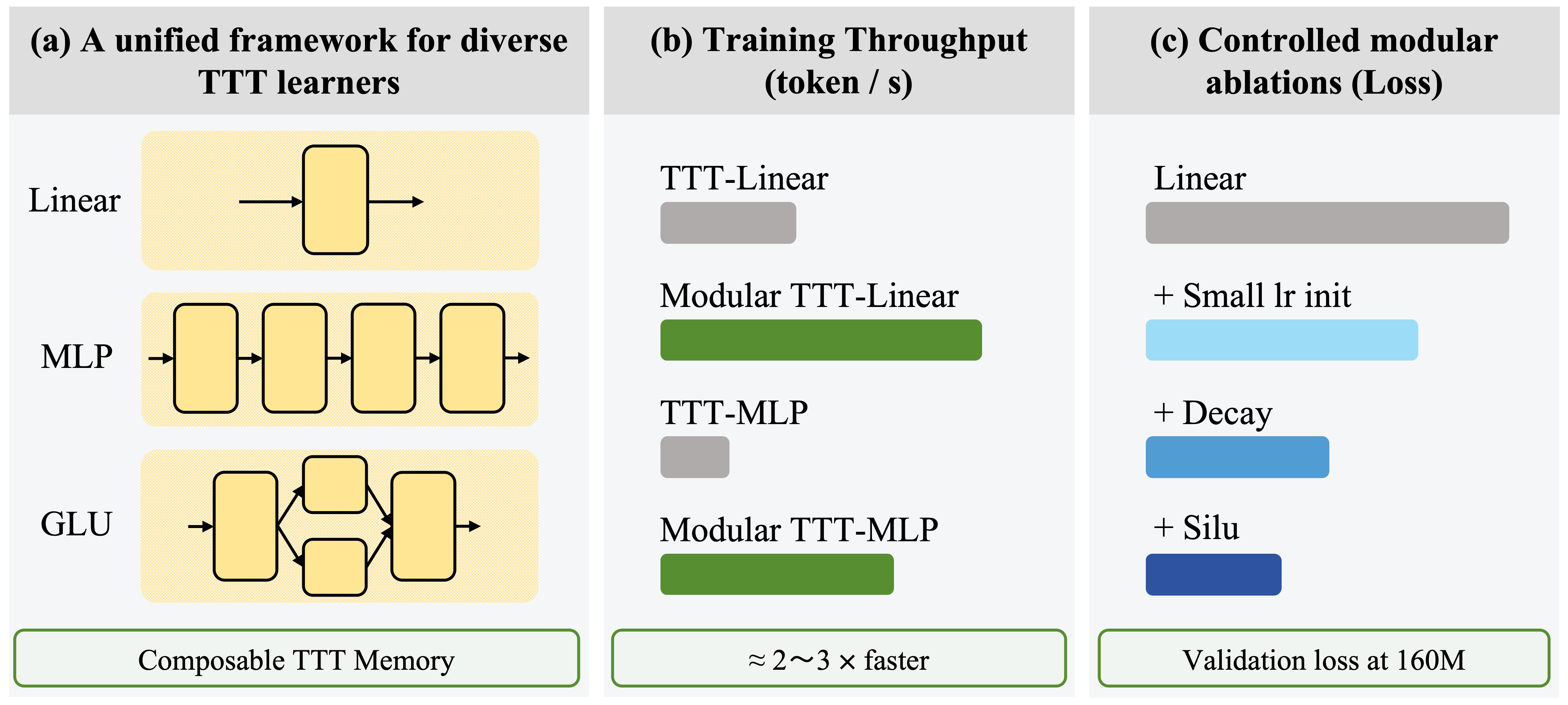
Abstract: Test-time training (TTT) views sequence modeling as an online learning problem in which fast weights are updated by an internal learning rule. Despite the growing number of TTT variants, existing approaches typically hard-code each variant separately, which makes it difficult to design new TTT methods and to isolate the role of each component. To address this, we propose Modular TTT, a framework that represents the inner learner as a directed acyclic graph and exposes the fast-weight network, loss function, learning rate, weight decay, and normalization as explicit design dimensions. Modular TTT automatically composes primitive-level train-view forward, train-view backward, and causal query-view rules into the full graph-level TTT computation, including the fast-weight state transition. Using Modular TTT, we systematically ablate the components of TTT and find that small learning-rate initialization, weight decay, and a single-layer nonlinearity improve performance, while MSE and inner-product losses perform similarly. Deeper fast-weight networks and normalization tend to hurt performance because they induce excessively large activations, while residual connections and gating provide little measurable benefit. Guided by these findings, we train the best resulting variant as 410M- and 1.45B-parameter models on 100B tokens, and observe training loss and benchmark performance comparable to Gated DeltaNet.

Paper Prompts
Sign up for free to create and run prompts on this paper.
Top Community Prompts
Explain it Like I'm 14
1. What is the paper about?
This paper introduces Modular TTT, a new way to build and study language-model memory systems.
The name comes from test-time training (TTT). In ordinary neural networks, the model’s main weights usually stay fixed while it reads text. In TTT, the model makes small, temporary updates to some internal weights while processing a sequence. These temporary weights are called fast weights.
An analogy is a student solving a long set of problems:
- The student’s long-term knowledge is like the model’s regular weights.
- The notes the student writes while solving the worksheet are like fast weights.
- The student changes those notes as new questions arrive.
The main problem is that existing TTT systems are often designed as separate, specially written programs. This makes them difficult to modify and compare. Modular TTT tries to solve this by treating each part of a TTT system as a replaceable module, similar to building with Lego bricks.
2. What questions does the research ask?
The researchers wanted to answer two main questions:
- Can different TTT systems be built using one flexible framework? Instead of writing a completely new program for every design, can small building blocks be connected in different ways?
- Which design choices actually help TTT models? The paper tests choices such as:
- How large the learning rate should be at the beginning
- Whether the model should use weight decay, which helps it forget old information
- Which training loss should be used
- Whether to use nonlinear functions such as GELU or SiLU
- Whether the fast-weight network should be deeper
- Whether normalization, residual connections, or gates are useful
The goal was not only to create a new model, but also to understand why some TTT designs work better than others.
3. How did the researchers do it?
Building TTT as a graph
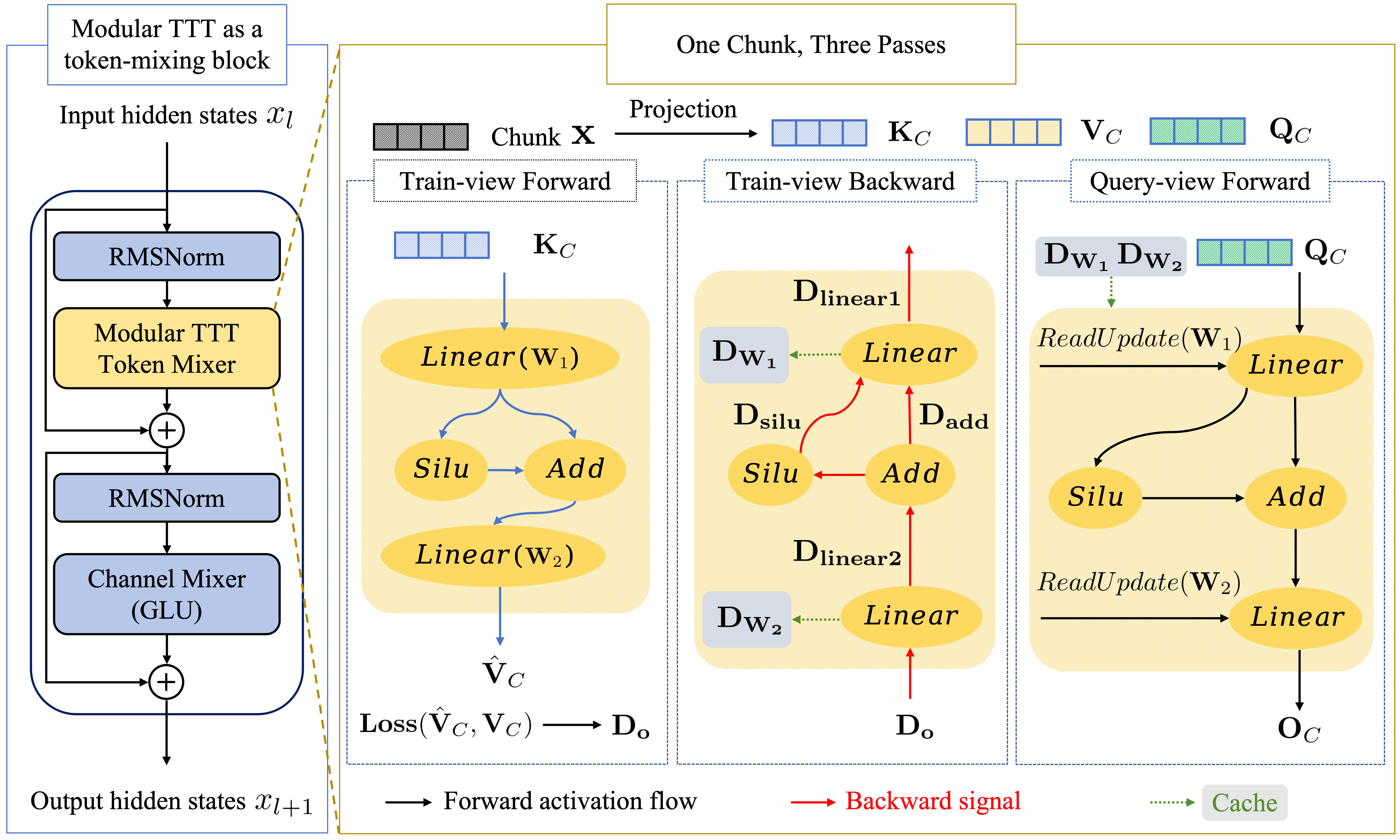
Modular TTT represents the internal learner as a directed acyclic graph, or DAG. This sounds complicated, but it is similar to a flowchart:
- Each circle in the flowchart is an operation, such as a linear layer or activation function.
- Arrows show which operation sends information to the next one.
- The arrows never form a loop.
Because each operation has clearly defined rules, the researchers can rearrange or replace parts without rewriting the entire system.
The three computation stages
For each group of tokens, Modular TTT performs three main stages:
- Training-view forward pass The model uses the input keys to make a prediction.
- Training-view backward pass The model compares its prediction with the target and calculates how its fast weights should change. This is similar to checking homework and identifying mistakes.
- Query-view forward pass The model processes the query tokens using the updated fast weights. This produces the final output.
The word causal means that the model is only allowed to use information from the past and present, not from future tokens. This is important for language modeling because, when predicting the next word, the model should not secretly look ahead.
The researchers also used automatic differentiation, a standard machine-learning tool that calculates how much each part of a model contributed to an error. They added special rules for how each module should update its temporary weights.
Experiments
The experiments had two stages.
First, the researchers performed ablation studies. An ablation study means changing one part of a system at a time to see what effect it has—like removing one ingredient from a recipe to find out which ingredient matters.
They trained models with about 160 million and 410 million parameters on 10 billion tokens.
Next, they trained selected designs at larger sizes:
- 410 million parameters
- 1.45 billion parameters
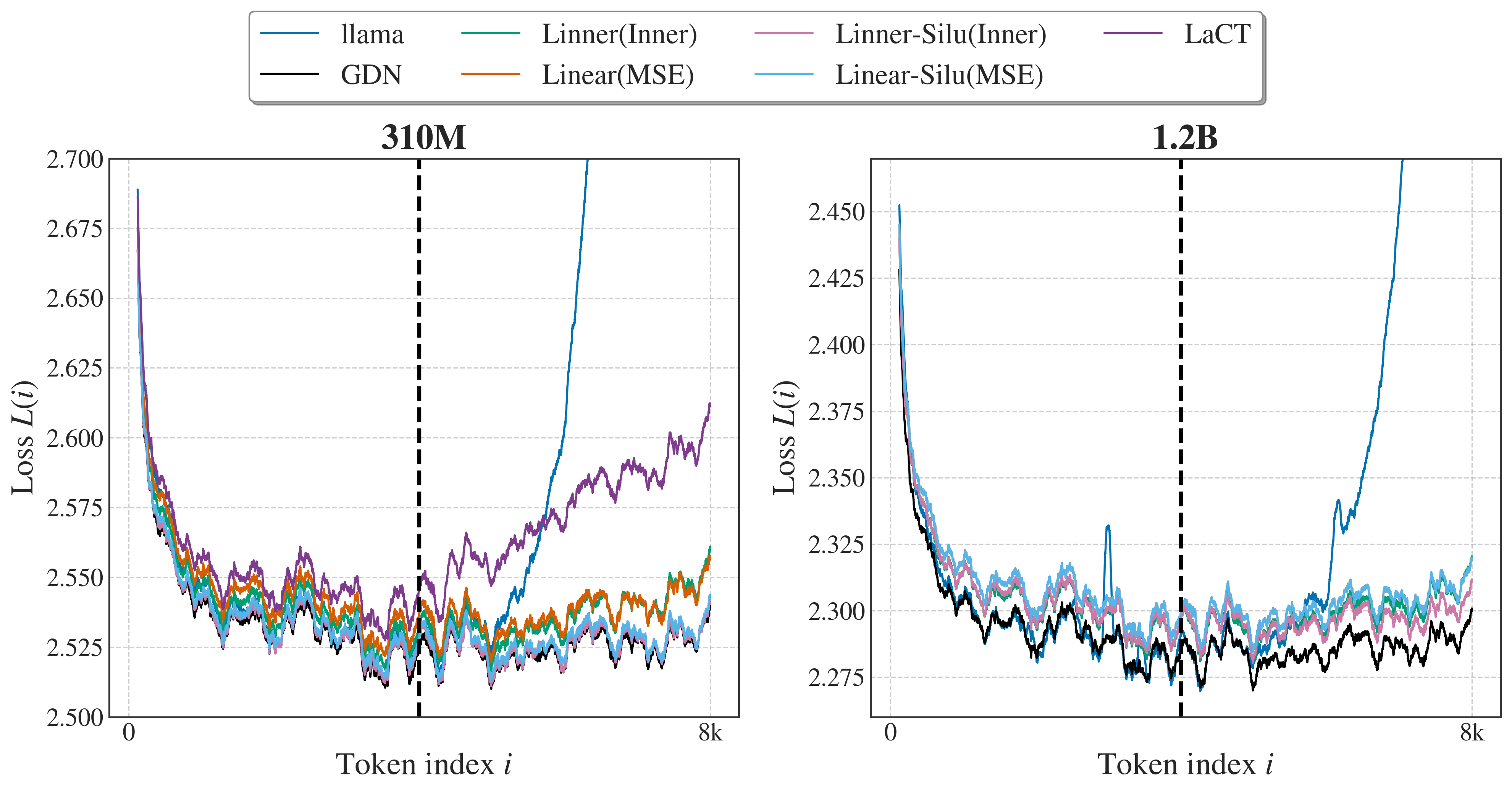
These larger models were trained on 100 billion tokens and compared with other sequence models, including Gated DeltaNet (GDN), LLaMA, and LaCT.
They measured:
- Training loss, which shows how well the model learns the training data
- Perplexity, a measure of how surprised the model is by text
- Accuracy on several question-answering and reasoning benchmarks
- Training speed and memory use
4. What were the main findings?
Some simple choices helped consistently
The experiments showed that three choices were especially useful:
- A small starting learning rate Starting with a very small update—about —made training more stable and improved results. A large learning rate can cause the temporary weights to change too suddenly, like a student erasing and rewriting all their notes after every question.
- Weight decay Weight decay helps the model gradually reduce the importance of old information. This is useful because a model may need to forget outdated or irrelevant context.
- One nonlinear activation function Adding a single activation such as GELU or SiLU improved performance. These functions allow the model to respond in more flexible, non-straight-line ways.
Some choices did not help much
The paper found that:
- MSE loss and inner-product loss worked about equally well. These are two different ways of measuring prediction errors, but neither was clearly better in the tested settings.
- L1 and RMSE losses performed worse.
- Deeper fast-weight networks usually hurt performance. Adding more layers made the temporary memory harder to train. The researchers suggest that deeper networks can create very large activations and unstable updates.
- Normalization often hurt or behaved inconsistently. Normalization is meant to keep values under control, but in these TTT systems it could sometimes make activations or gradients too large.
- Residual connections and gating offered little measurable improvement in the tested experiments.
The framework made TTT faster
The researchers reported that their carefully designed computation rules made Modular TTT much faster than the official implementations of similar TTT models:
- About 1.65 times faster for one type of basic operation
- About 2.62 times faster for normalization operations
- About 2.2 to 3.3 times faster for complete training comparisons
This matters because LLMs require enormous amounts of computation. Faster training can reduce both time and cost.
Large models performed competitively
The best Modular TTT models were trained at 410 million and 1.45 billion parameters.
Their training loss and benchmark scores were generally competitive with other efficient sequence models. At the larger scale, some Modular TTT variants came close to Gated DeltaNet, especially on multiple-choice tasks.
However, the results were not better at every task. The models had more difficulty on some containment-style tasks, which test whether the model can locate or reproduce specific information.
5. Why is this research important?
The biggest contribution is not simply one new model design. It is the modular framework.
Before this work, researchers often had to manually create and mathematically derive a new implementation whenever they wanted to test a different TTT idea. Modular TTT makes this more like experimenting with building blocks. Researchers can change the loss, activation, decay method, or network structure separately and observe the result.
This has several possible effects:
- It may make it easier to invent new long-context LLMs.
- It helps researchers understand which parts of a model are truly useful.
- It can reduce programming effort and testing time.
- Faster implementations may make TTT systems more practical for large-scale training.
The results also give useful design advice: begin with small updates, include a sensible forgetting mechanism, and prefer a shallow fast-weight network with one simple activation. Still, the study tested particular model sizes, data, and settings, so its conclusions may not apply perfectly to every future TTT system.
Simple conclusion
Modular TTT is a toolkit for building temporary-learning memory systems in LLMs. It breaks these systems into understandable, interchangeable parts and automatically connects them.
The experiments suggest that simple designs can work surprisingly well. Small learning rates, forgetting through weight decay, and one nonlinearity improve results, while extra depth and normalization may make training more difficult. Overall, the paper could help researchers design faster and more understandable models that remember useful information while reading long sequences.
Knowledge Gaps
The paper leaves the following knowledge gaps, limitations, and open questions unresolved:
- Limited data and domain diversity: The experiments use a large-scale English pretraining corpus and a GPT-2 BPE tokenizer, leaving the effectiveness of Modular TTT on multilingual, code, domain-specific, multimodal, and non-language sequence data unclear.
- Narrow context-length evaluation: Ablations use sequence lengths of 2K and 4K tokens, so the claimed long-context advantages and stability of the proposed updates at substantially longer contexts remain untested.
- Restricted scale-up evidence: Large-scale experiments are reported only at 410M and 1.45B parameters with 100B training tokens; behavior at substantially larger model sizes, longer training budgets, and different data-to-parameter ratios is unresolved.
- Incomplete comparison with competing architectures: Comparisons focus mainly on LLaMA, Gated DeltaNet, LaCT, and official TTT implementations. The framework is not systematically compared with a broader set of modern linear-attention, recurrent, state-space, and attention-based models under strictly matched parameter, compute, and training-data budgets.
- Unclear fairness of external-baseline comparisons: The paper does not fully establish whether all external baselines use identical data mixtures, tokenization, optimization schedules, augmentation, initialization, parameter counts, and evaluation protocols.
- Insufficient characterization of statistical uncertainty: Although some five-seed results are reported, most ablations and large-scale comparisons do not provide confidence intervals, significance tests, or variance estimates, making it difficult to determine whether small performance differences are robust.
- Incomplete hyperparameter exploration: The conclusions about learning-rate initialization, decay, normalization, and nonlinearities are based on selected settings rather than comprehensive sweeps over learning-rate schedules, decay rates, activation placements, chunk sizes, and optimizer configurations.
- Unresolved interaction effects: The ablations largely vary individual components, but interactions among loss functions, learning-rate parameterizations, decay types, nonlinearities, normalization, chunk size, and backbone placement are not fully disentangled.
- Limited loss-function design space: Only inner-product, MSE, L1, and RMSE losses are evaluated. The consequences of robust losses, contrastive objectives, adaptive targets, token-dependent objectives, or multi-step optimization losses remain unexplored.
- Unclear explanation for the similarity of MSE and inner-product losses: The paper offers gradient-based intuition but does not establish when the two losses are theoretically equivalent, when they diverge, or how their relative behavior changes with normalization, target statistics, or sequence length.
- Unresolved learning-rate dynamics: Small learning-rate initialization improves results, but the optimal schedule, dependence on token position, layer depth, model scale, data distribution, and training phase is not determined.
- Limited decay mechanisms: The study compares no decay, scalar decay, and vector decay, but does not investigate richer forms of content-dependent, token-dependent, learned, or time-varying forgetting, nor their stability and efficiency trade-offs.
- Incomplete analysis of normalization: The negative or mixed results for normalization are based on a small set of normalization choices. Alternative placements, RMSNorm variants, LayerNorm variants, centering strategies, clipping, rescaling, or normalization applied only to updates are not evaluated.
- Unresolved causes of deep-memory failure: The factorization analysis identifies scale-dependent update dynamics, but it does not demonstrate whether reparameterization, balanced factorization, orthogonal constraints, adaptive preconditioning, normalization, or multiple inner steps can make deeper fast-weight networks competitive.
- No systematic study of multi-step inner optimization: The framework appears primarily evaluated with a single causal update per token or chunk. The benefits, costs, and stability of multiple gradient steps, momentum, Adam-like inner optimizers, or second-order approximations remain unknown.
- Limited DAG coverage: The framework is illustrated with linear maps, activations, additions, multiplication, gating, and normalization, but its correctness and usefulness for broader DAG structures—such as convolutions, attention-like primitives, recurrent branches, cross-layer sharing, and conditional computation—are not established.
- Unclear compositionality guarantees: The paper assumes that local train-view, backward, and query-view rules can be composed into valid global TTT computations, but does not provide formal conditions under which this composition preserves causal semantics or corresponds to a well-defined optimization procedure.
- Potential inconsistency between automatic differentiation and custom query rules: Automatic differentiation supplies train-view gradients, while causal query computation requires separately registered primitive rules. The paper does not fully characterize when these custom rules are mathematically equivalent to online learning on the stated objective.
- Insufficient verification of primitive correctness: The analytic operators are benchmarked for latency against autodifferentiation, but there is limited numerical validation of forward outputs, gradients, state transitions, and long-horizon error accumulation across diverse graph configurations.
- Unexplored numerical stability over long sequences: The effects of finite precision, activation growth, gradient accumulation, decay underflow, chunk-boundary errors, and state drift over very long streams are not systematically measured.
- Chunk-size trade-offs remain underexplored: A chunk size of 256 is used for TTT variants, but the effects of chunk size on accuracy, causality, throughput, memory, and optimization stability are not comprehensively evaluated.
- Limited inference-time efficiency analysis: Throughput benchmarks focus primarily on training and compare against official TTT implementations. End-to-end decoding latency, memory usage, batching behavior, prompt processing, and serving efficiency relative to attention and recurrent baselines remain unclear.
- No study of online adaptation at deployment: Despite the test-time-training framing, the paper does not evaluate adaptation to distribution shift, nonstationary streams, continual learning, or tasks where the model receives unlabeled test-time data.
- Unclear separation between memory and backbone contributions: The experiments place the TTT module within a standard pre-norm backbone, but do not fully isolate how much performance comes from the fast-weight memory versus the surrounding backbone architecture.
- Limited task-level evaluation of long-range memory: The reported benchmarks include perplexity, multiple-choice, and containment-style tasks, but do not directly measure retrieval over long delays, interference, selective forgetting, compositional recall, or algorithmic sequence-learning capabilities.
- Weak evidence for the claimed modular-design benefit: The paper demonstrates implementation speedups and component ablations, but does not quantify researcher productivity, implementation error reduction, time-to-new-variant, or the number and quality of novel architectures enabled by the framework.
- No automated architecture search or principled module selection: Although Modular TTT exposes a compositional design space, the paper does not investigate search procedures, differentiable module selection, Bayesian optimization, or theoretical criteria for selecting fast-weight graphs.
- Residual and gating conclusions may be setting-specific: The reported limited benefits of residual connections and gating are obtained under the evaluated scales, data, and stabilization choices; their behavior under larger models, longer contexts, alternative losses, or adaptive decay remains unresolved.
- Unclear robustness and generalization properties: The paper does not evaluate sensitivity to adversarial or corrupted inputs, distribution shifts, rare-token regimes, noisy targets, or changes in sequence statistics.
- Open question about expressivity: It remains unclear which sequence functions Modular TTT can represent more efficiently than fixed-state recurrent models, linear attention, or SSMs, and whether deeper or nonlinear fast-weight graphs provide a theoretically meaningful expressivity advantage despite their current optimization difficulties.
Practical Applications
Immediate Applications
- Efficient experimentation platform for sequence-model research — Academia / AI R&D
- Researchers can use the Modular TTT framework and its released implementation to construct and compare TTT variants by changing explicit components: fast-weight topology, loss, learning-rate schedule, decay, activation, and normalization.
- A practical workflow is to define a learner as a directed acyclic graph, register train-forward, train-backward, and query-forward rules for each primitive, and run controlled ablations without re-deriving an entire global update rule.
- Type: Immediate Application.
- Dependencies and assumptions: The application assumes compatibility with the paper’s PyTorch/Flame implementation and that new primitives have correct causal query-view and state-transition semantics. Results may depend on sequence length, chunk size, hardware, tokenizer, and training regime.
- Faster prototyping and benchmarking of long-context LLMs — Software / Cloud AI
- Model developers can use the analytic backward operators and compiled implementation to accelerate training and comparison of TTT-based LLMs. The reported results show approximately – higher throughput than the official TTT implementations in the tested settings.
- Potential tools include a configurable TTT layer library, automated architecture sweeps, and experiment dashboards comparing perplexity, memory usage, throughput, and downstream accuracy.
- Type: Immediate Application.
- Dependencies and assumptions: The reported speedups were measured on particular GPU configurations and implementations; they should not be assumed to transfer unchanged to all accelerators, model sizes, or software stacks. Custom primitives may require additional kernel optimization.
- Replacing quadratic attention in selected long-sequence workloads — NLP / Document processing
- The framework can be evaluated as an efficient recurrent or linear-complexity memory module for workloads involving long documents, log streams, code repositories, or continuous text.
- A practical initial deployment would be to place a Modular TTT layer inside an existing pre-normalized Transformer-like backbone and compare it with attention, Gated DeltaNet, SSMs, or linear-attention layers on fixed-length production traces.
- Type: Immediate Application.
- Dependencies and assumptions: The evidence establishes competitiveness primarily in language modeling at 410M and 1.45B parameters, not universal superiority. Long-context quality, retrieval accuracy, and behavior under distribution shift require workload-specific validation.
- Stable default configuration for TTT implementations — Machine-learning engineering
- Teams implementing TTT models can adopt the empirically supported starting configuration:
- small learning-rate initialization, approximately ;
- scalar decay for inexpensive forgetting;
- a shallow linear fast-weight learner;
- a single SiLU or GELU activation where the quality–efficiency trade-off permits;
- MSE or inner-product loss rather than L1 or RMSE.
- This can reduce instability and shorten hyperparameter-search cycles.
- Type: Immediate Application.
- Dependencies and assumptions: These are empirical recommendations under the evaluated training setup, not universal guarantees. Learning-rate stability depends on feature scales, chunk size, parameterization, and the spectrum of the input covariance.
- Streaming and continual context summarization — Software / Operations
- Scalar decay can be used as a lightweight forgetting mechanism for continuously arriving data, such as application logs, customer-support conversations, telemetry, or event streams.
- A TTT state could be maintained per session, device, tenant, or data stream, allowing recent context to influence predictions without storing the complete history.
- Type: Immediate Application.
- Dependencies and assumptions: The model must be able to reset, checkpoint, isolate, and audit fast-weight states. Decay does not guarantee privacy deletion, and state contamination across users or sessions would be a major operational risk.
- Memory- and throughput-aware model selection — Cloud infrastructure
- The ablation results provide an engineering decision rule: scalar decay offers most of the quality improvement of vector decay with substantially better throughput and lower memory cost, while vector decay may be reserved for quality-critical experiments.
- This supports deployment profiling for GPU inference and training clusters, especially where memory bandwidth and batch throughput are limiting factors.
- Type: Immediate Application.
- Dependencies and assumptions: The reported vector-decay penalty—roughly 25% lower throughput and about 3 GB additional memory—may vary with hardware, dimensions, and implementation.
- Teaching and reproducible evaluation of online learning systems — Academia / Education
- The framework can serve as an instructional testbed for demonstrating computation graphs, online optimization, automatic differentiation, causal state updates, and the distinction between training-view and query-view computation.
- Course or laboratory workflows could ask students to add an activation, decay operator, or alternative loss and evaluate its effect under matched conditions.
- Type: Immediate Application.
- Dependencies and assumptions: Educational use requires documentation, corrected implementation details, and carefully designed exercises because the paper’s notation and source text contain formatting artifacts.
Long-Term Applications
- Adaptive long-context assistants and document agents — Enterprise software / Knowledge management
- A future product could use fast weights as a task- or session-specific memory that adapts online while processing a document collection, meeting transcript, codebase, or workflow history.
- Possible workflows include:
- adapting a memory module to a customer’s terminology during a support session;
- maintaining a compact state for an ongoing project;
- adapting to a user’s preferred output format without fine-tuning the full model.
- Type: Long-Term Application.
- Dependencies and assumptions: Reliable deployment requires safeguards against prompt injection, state poisoning, catastrophic forgetting, cross-session leakage, and uncontrolled adaptation. The model would also need interpretable state management and rollback mechanisms.
- Online adaptation under distribution shift — Healthcare, finance, cybersecurity, and industrial monitoring
- Modular TTT could support models that adapt to changing data distributions, such as evolving clinical terminology, market regimes, fraud patterns, network attacks, or machine operating conditions.
- The modular graph makes it possible to test different forgetting factors, robust losses, and state-update rules for each domain.
- Type: Long-Term Application.
- Dependencies and assumptions: The paper evaluates English language modeling rather than these domains. High-stakes deployment requires domain-specific validation, uncertainty estimation, safety constraints, audit logs, and guarantees that adaptation does not amplify noise or adversarial inputs.
- Personalized on-device AI — Mobile, edge computing, and IoT
- Compact TTT states could enable devices to adapt to a user, sensor, or environment without repeatedly transmitting all raw data to a central server.
- Potential products include adaptive keyboards, voice interfaces, wearable assistants, predictive-maintenance sensors, and local anomaly detectors.
- Type: Long-Term Application.
- Dependencies and assumptions: On-device use depends on reducing memory and energy costs, supporting reliable state persistence, and preventing private information from being encoded in unprotected fast weights. The paper reports training throughput, not end-to-end energy consumption or low-power inference performance.
- Adaptive vision and multimodal systems — Robotics / Computer vision
- Because the framework is defined over composable learner graphs rather than text-specific operations, it could be extended to video, image streams, multimodal tokens, and embodied-agent observations.
- Applications could include online object tracking, changing lighting or sensor calibration, robot navigation in unfamiliar environments, and adaptation to a new user or workspace.
- Type: Long-Term Application.
- Dependencies and assumptions: Vision and robotics require new causal query rules, temporal stability tests, and careful control of adaptation. The paper cites related vision-oriented TTT work but does not itself demonstrate performance in vision, multimodal learning, or physical robots.
- Adaptive control and robotics memory — Robotics / Autonomous systems
- A fast-weight learner could act as a compact, continuously updated model of local dynamics, enabling robots or autonomous vehicles to adjust to payload changes, terrain variation, component wear, or environmental conditions.
- The modular framework could allow separate experiments with linear memories, gated updates, decay, and bounded activations before integrating an adaptive module into a controller.
- Type: Long-Term Application.
- Dependencies and assumptions: Safety-critical control requires bounded updates, stability proofs, simulation-to-real validation, latency guarantees, and mechanisms to freeze adaptation during unsafe conditions. The paper’s finding that large learning rates and deep fast-weight networks can be unstable is particularly relevant.
- Resource-efficient foundation models for inference at scale — Cloud AI / Energy
- If further validated, TTT layers could reduce the cost of processing long sequences by avoiding quadratic attention and by using compiled analytic backward rules during training.
- This could lead to lower-cost document analysis, code completion, real-time transcription, and large-scale event-stream processing.
- Type: Long-Term Application.
- Dependencies and assumptions: End-to-end benefits depend on actual inference latency, memory traffic, batching behavior, sequence-length scaling, and quality parity with attention-based systems. Comparable benchmark accuracy in the reported tasks does not establish equivalent performance for retrieval, reasoning, or generation quality.
- Automated architecture search for online learners — AI tooling / Academia
- The explicit DAG representation could support automated search over learner topology, activation placement, losses, decay mechanisms, and learning-rate parameterizations.
- A future tool could optimize a multi-objective score involving validation loss, throughput, memory, energy, and stability, while automatically generating the required local forward, backward, and query-view rules.
- Type: Long-Term Application.
- Dependencies and assumptions: This requires a larger primitive library, formal validation of causal semantics, efficient compilation, and search methods that avoid selecting architectures that perform well only under narrow training conditions. Deep learners would need improved parameterizations or normalization alternatives because the paper finds that naive depth often harms optimization.
- Policy and governance tools for adaptive AI — Public policy / AI safety
- The framework’s explicit state transition and modular update rules could support auditable specifications of how an AI system changes during use.
- Regulators and organizations could require logging of fast-weight updates, limits on adaptation rates, state reset policies, and tests for harmful behavior after online adaptation.
- Type: Long-Term Application.
- Dependencies and assumptions: This requires standardized state formats, reproducible monitoring, privacy-preserving logs, and methods for attributing behavior to updates. The paper does not provide governance mechanisms or safety evaluations, so these applications are prospective rather than directly demonstrated.
Glossary
- Ablation: A controlled experiment that removes or changes one component to measure its effect. “we conduct systematic ablations over the key components of TTT”
- Automatic differentiation: A method for automatically computing derivatives of functions represented by computational operations. “Automatic differentiation provides the local backward signals of the train-view loss”
- Backpropagation: The reverse-mode procedure for computing gradients through a neural network. “we execute the train-view backward in reverse topological order to obtain intermediate gradients”
- Causal query-view: A query computation that uses only the current and preceding sequence information. “This query-view form follows the causal dual update used in TTT”
- Chunkwise computation: Processing a sequence in fixed-size chunks rather than one token at a time. “reformulating token-wise recurrences into chunkwise recurrent computation”
- Computational graph: A directed graph representing operations and their dependencies in a computation. “a general TTT module can be viewed as a computation graph”
- Continuous-time state equation: A differential-equation formulation describing how a system’s state changes continuously over time. “State space models start from continuous- or discrete-time state equations”
- Cumulative sum (
cumsum): An operation that replaces each element with the sum of all preceding elements. “For the Gate operator, and are taken along the sequence dimension.” - Directed acyclic graph (DAG): A directed graph containing no cycles, so its nodes can be ordered by dependencies. “we represent a TTT module as a directed acyclic graph ”
- Eigenvalue: A scalar describing how a matrix scales a corresponding eigenvector. “the matrix may have eigenvalues with magnitude larger than $1$”
- Elementwise nonlinearity: A nonlinear function applied independently to each tensor element. “an elementwise nonlinearity, a residual addition, or a normalization layer”
- Fast weights: Model parameters that are updated rapidly, often during processing of an input sequence. “the hidden state is no longer a fixed-form vector state, but the fast weights”
- Feature map: A transformation that maps inputs into a representation used by another operation, such as attention. “Linear attention rewrites attention as inner products of feature maps”
- Forgetting factor: A multiplicative value that reduces the influence of older information. “Scalar decay applies a global forgetting factor to past contributions at each step”
- Gated learner: A learner whose information flow is controlled by learned multiplicative gates. “(a) Linear, MLP, and gated learners viewed as composable TTT memory forms”
- GPU utilization: The effective use of a graphics processor’s computational resources. “enables more efficient GPU utilization while preserving linear complexity with respect to sequence length”
- Inner learner: The model or optimization procedure updated internally by test-time training. “the TTT inner learner as a directed acyclic graph”
- Inner-product loss: A loss based on the negative or otherwise transformed dot product between predictions and targets. “MSE and inner-product losses perform similarly”
- Learning-rate initialization: The choice of the initial value or parameterization of a model’s learning rate. “TTT is highly sensitive to learning-rate initialization”
- Linear attention: An attention mechanism whose computational and memory complexity grows linearly rather than quadratically with sequence length. “Linear attention rewrites attention as inner products of feature maps”
- Linear recurrent neural network (Linear RNN): A recurrent network whose state transition is linear, typically without nonlinear activation functions. “Recent work shows that removing nonlinearities from RNNs can improve efficiency”
- Long-context modeling: Modeling sequences with a large number of tokens while retaining relevant dependencies. “All of these approaches aim to preserve long-context modeling ability”
- Matrix factorization: Representing a matrix as a product of two or more matrices. “the represented memory function remains unchanged”
- Mean squared error (MSE): A loss equal to the average squared difference between predictions and targets. “MSE preserves the residual magnitude in ”
- Memory write: An update that stores information in a model’s internal state or parameters. “both maintain an informative update scale”
- Normalization: A transformation that rescales activations to control their magnitude or distribution. “the fast-weight network, loss function, learning rate, weight decay, and normalization are treated as modular components”
- Online learning: Learning in which a model updates continuously as it receives sequential data. “casting sequence modeling as an online learning process”
- Parameterization: The mathematical specification of how model parameters represent a function or operation. “We compare two parameterizations.”
- Perplexity: A language-modeling metric related to the exponentiated average negative log-likelihood. “Table~\ref{tab:large_scale_eval} reports downstream benchmarks at 410M and 1.45B, covering perplexity”
- Pointwise activation: An activation function applied independently to each element of its input. “GELU and SiLU provide the best trade-off between quality and efficiency.”
- Pre-norm backbone: A neural-network architecture that applies normalization before a main transformation or sublayer. “the Modular TTT layer within a standard pre-norm backbone”
- Primitive operator: A basic computational operation used as a building block in a larger graph. “Primitive operators and loss functions used in Modular TTT.”
- Query-view forward: The forward computation that produces outputs using a query and the state updates derived from training-view computation. “Finally, we perform another forward pass using a query , which we refer to as the query-view forward”
- Recurrent neural network (RNN): A neural network that processes sequences using a state updated at each step. “RNN Recurrent models compress historical context into a fixed-size hidden state”
- Residual connection: A network connection that adds an earlier representation to a later one. “residual connections and gating yield little measurable benefit”
- Root mean square error (RMSE): The square root of the mean squared prediction error. “L1 and RMSE consistently underperform”
- Structured state space model (SSM): A sequence model based on structured state-space dynamics for representing long-range dependencies. “structured state space models (SSMs)”
- Test-time training (TTT): A sequence-modeling approach that updates internal parameters while processing data. “Test-time training (TTT) offers a different perspective by casting sequence modeling as an online learning process”
- Topological order: An ordering of graph nodes in which every node appears after its dependencies. “we execute the forward pass of each node in topological order”
- Throughput: The amount of data or computation processed per unit of time. “Modular TTT achieves a -- throughput improvement”
- Token-wise recurrence: Sequentially updating a state once for each token in a sequence. “naive TTT implementations typically rely on token-wise recurrent updates”
- Weight decay: A regularization mechanism that shrinks model parameters during optimization. “small learning-rate initialization, weight decay, and a single-layer nonlinearity provide consistent gains”
Collections
Sign up for free to add this paper to one or more collections.

