Belief Coevolution in a Social Network of Generalist and Specialist Large Language Models
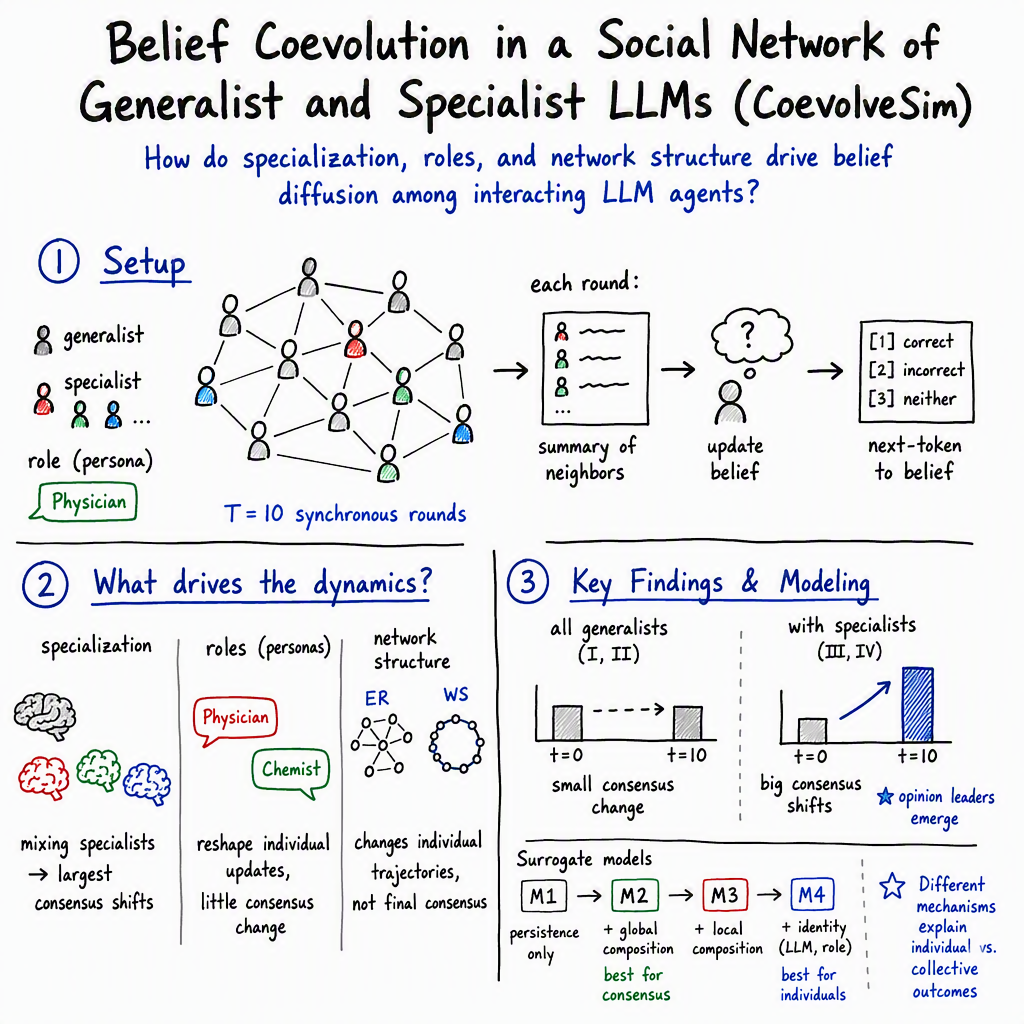
Abstract: LLMs are increasingly deployed in multi-agent environments. However, the processes by which beliefs form and propagate among interacting LLMs remain poorly understood. We introduce CoevolveSim, a framework for studying belief diffusion within networked LLM populations. CoevolveSim allows us to isolate and study three factors: domain specialization, social-role assignment, and social network structure. Within this framework, generalist and specialist LLM agents exchange and revise beliefs. In each round, an LLM agent observes a summary of its neighbors' beliefs before updating its own. We run 1,280 controlled simulations spanning four scenarios, two network structures, and 20 medical-indication statements. We find that persona-style role assignment and network structure reshape individual belief revision but have minimal effect on population-level consensus. In contrast, introducing (finetuned) specialist LLMs more than doubles the shift in consensus and gives rise to consistent asymmetries in exerted influence. We further show that simple persistence-based opinion-dynamics models reproduce collective outcomes in all-generalist LLM populations, whereas heterogeneous LLM populations require population-level belief composition to reproduce consensus and agent identity to predict individual belief transitions. Our results indicate that realistic simulation of belief diffusion in multi-agent LLM systems requires a diverse set of underlying LLMs, not persona prompting alone.
Paper Prompts
Sign up for free to create and run prompts on this paper using GPT-5.
Top Community Prompts
Explain it Like I'm 14
What is this paper about?
This paper builds and tests a simulation called CoevolveSim to see how “beliefs” spread and change when lots of AI chatbots (LLMs, or LLMs) talk to each other. The researchers compare different kinds of AI agents, different “roles” the agents pretend to have, and different ways the agents are connected, to learn what really drives group agreement or disagreement.
Think of it like watching how a rumor or fact moves through a big group chat where some people are generalists (know a little about many things) and some are specialists (experts in a subject), and some wear name tags like “Doctor” or “Engineer.”
The main questions
The study asks two simple questions:
- What makes beliefs spread or change in a crowd of talking AIs: the type of AI (generalist vs. specialist), the “role” label they’re given, or the way they’re connected?
- Can simple, classic models of social influence explain what happens in these AI crowds?
How did they study it?
The setup in everyday terms
- Agents: 48 AI agents “talk” for 10 rounds. Some are generalists (one base model) and others are specialists (14 different models fine-tuned for areas like medicine, math, or cybersecurity). All models are similar in size to keep things fair.
- Topics: They discuss 20 short medical statements (like “X is used to treat Y”), some true and some false.
- Information shared: Each round, an agent sees a short summary of what its neighbors (directly connected agents) believed in the previous round and then updates its own belief (correct, incorrect, or unsure).
- Roles vs. expertise: An agent can be powered by (say) a medical specialist model but be labeled with a different social role, like “Mathematician.” The label is like a name tag (a “persona” prompt). This lets the researchers test whether what an agent knows (its specialization) matters more than what it’s called (its role).
The four scenarios they compare
- I. All generalists, same role for everyone (basic starting point).
- II. All generalists, but each gets a random social role label (like “Doctor,” “Analyst,” etc.).
- III. A mix of generalists and specialists, with random role labels.
- IV. A mix of generalists and specialists, and each agent’s role label matches its expertise (e.g., medical model labeled “Physician”).
Two ways agents are connected
- Random network (Erdős–Rényi): like a friend group formed by chance.
- Small-world network (Watts–Strogatz): like tight friend circles with a few long-distance links—real-world social networks often look like this.
How they measured change (in simple words)
- Plasticity: How much an agent’s belief wiggles around from round to round. High = moves a lot; low = stays put.
- Directedness: Whether an agent’s belief moves mostly in one direction (toward a final answer) or flips back and forth.
- Outgoing influence: How much an agent’s belief change is followed by changes in its neighbors (think “opinion leaders”).
- Consensus: How much the whole group agrees at the end vs. the start.
A second step: testing simple “social rules” to explain the results
The team also built simple “surrogate” models to see what rules could predict the agents’ next beliefs:
- M1: People mostly stick to what they already think (persistence).
- M2: People are swayed by the overall crowd’s mix of opinions (global composition).
- M3: People are swayed by their direct neighbors (local composition).
- M4: Like M3, but also includes who the agent is (its underlying model and role label).
They checked which rule set best predicts individual updates and whether it recreates the final group agreement.
What did they find, and why does it matter?
- Social roles change behavior, but not the group’s final agreement much.
- Giving generalist agents role labels (“Doctor,” “Engineer,” etc.) makes them move their beliefs around more and in less steady ways.
- But this barely changes how much the whole group agrees at the end. In other words, personas affect how agents move, not where they end up as a crowd.
- Real diversity (mixing specialist models) drives big group shifts.
- When specialists join the population, agents change more and the group’s overall agreement shifts a lot more. The crowd’s final consensus moves farther from where it started.
- This also creates “opinion leaders”—a few agents whose moves trigger bigger changes in their neighbors. That didn’t happen with just role labels on generalists.
- Matching the role label to the expertise adds little—and can slightly reduce consensus shifts.
- Calling the medical specialist a “Physician” (instead of a random role) doesn’t dramatically change agent behavior and slightly reduces how much the overall consensus shifts.
- Network shape changes how individuals move but not where the group lands.
- Random vs. small-world networks changed how much agents wiggled and how steadily they moved.
- But the final group agreement (consensus) didn’t depend much on the network type.
- Simple rules explain simple crowds; mixed crowds need richer info.
- In all-generalist settings, a very simple rule—“people mostly stick with their current belief” (M1)—already predicts individual updates well and recreates the group’s final agreement.
- In mixed populations (with specialists), you need to consider the neighborhood’s beliefs (M3) and who the agent is (M4) to predict individual changes. To match the group consensus, knowing the overall belief mix in the population also helps (M2/M3).
- Translation: Diverse groups don’t behave like simple “follow your last belief” systems; identity and local context matter.
Why this matters
- Multi-agent AI is here: More apps rely on many AI agents talking to each other (for debate, planning, or answering questions). Understanding how their beliefs spread is crucial for safety, reliability, and fairness.
- Personas aren’t a shortcut: Simply giving agents role labels changes their behavior but doesn’t substitute for having genuinely different, expert models. To simulate realistic information spread (including opinion leaders), you need real diversity in the underlying AIs.
- Design guidance: If you want strong, stable group outcomes, pay attention to:
- Model diversity: Specialists can push the crowd more and create leaders.
- Network design: Shapes individual dynamics, even if final consensus is stable.
- Role labels: Useful for shaping how agents act, but less for changing group conclusions.
- Better simulations and safeguards: The results suggest building multi-agent systems with thoughtfully mixed expertise and carefully monitored influence patterns to avoid echo chambers, bias amplification, or overconfident consensus.
In short: The study shows that who the agents really are (their underlying models) drives where the group ends up, while what they’re called (their roles) mostly changes how they move along the way. Simple rules can explain uniform groups, but diverse AI crowds need richer, identity- and context-aware models to predict and manage belief spread.
Knowledge Gaps
Knowledge gaps, limitations, and open questions
The following items identify concrete limitations and unanswered questions left by the study, organized to guide actionable follow-up work.
Scope and external validity
- Narrow task domain and item count: Results are based on 20 medical-indication statements; it is unclear whether findings generalize to other domains, question types (causal, ethical, numerical), or larger and more diverse item sets.
- Single-truth regime: The study emphasizes consensus formation but provides limited analysis of truth-tracking (i.e., whether final consensus aligns with ground truth across conditions); quantify accuracy shifts, not just agreement.
- One LLM family and size: All agents are 8B Llama-3–family models; cross-architecture, cross-size, and proprietary/open model generalization remain untested.
- English-only setup: It is unknown whether results transfer to multilingual interactions and cross-lingual communities.
Agents and model heterogeneity
- Specialist mix and proportion: The impact of varying the ratio and composition of specialists to generalists (e.g., 10%, 50%, 90% specialists) on consensus and influence asymmetries is not explored.
- Domain alignment granularity: Only two extremes are tested (random roles vs. perfectly matched roles); partial or noisy alignment and degrees of mislabeling are not analyzed.
- In-domain vs. out-of-domain tasks: Specialists are evaluated on medical statements regardless of their finetuning domain; it is unclear how influence and consensus behave when statements are matched to each specialist’s domain.
- Identity predictors of influence: The attributes that predict opinion-leader emergence (e.g., base accuracy, calibration, confidence, entropy of beliefs) are not modeled; a predictive analysis of which agents become influential is missing.
Network structure and coevolution
- Limited network topologies: Only ER and WS graphs with fixed parameters are examined; scale-free, community/assortative, core–periphery, and directed/weighted networks are untested.
- Network size and density: Effects of varying n, average degree, clustering, and path length on plasticity, directedness, and consensus are not systematically studied.
- Static networks: Ties are fixed; no coevolution of network structure with beliefs (e.g., rewiring by homophily, trust, or performance).
- Absent edge weights and direction: Trust asymmetries and directional influence (who listens to whom) are not modeled beyond role labels appearing in summaries.
Interaction protocol and update dynamics
- Memoryless, synchronous updates: Belief updates are Markovian and synchronous; asynchronous schedules, memory of longer histories, and recency/primacy effects are not investigated.
- Information channel minimalism: Agents see only neighbor counts and roles; the impact of richer messages (rationales, citations, proofs, examples), source credibility scores, or uncertainty displays is unexplored.
- No agent learning: Agents do not adapt prompts, strategies, or weights across rounds; effects of meta-learning, reinforcement, or self-reflection on belief dynamics are open.
- No external evidence or retrieval: The role of tools (search, RAG) and evidence-sharing on consensus and accuracy is not evaluated.
Belief elicitation and measurement
- Uncalibrated probabilities: Next-token probabilities are used without calibration; how logit calibration or temperature affects belief scores, “neither” mass, and transitions is unknown.
- Token mapping sensitivity: Belief labels are inferred from a small set of tokens; robustness to alternative phrasings, label vocabularies, or prompt templates is not tested.
- “Neither” handling: Assigning residual probability mass to “neither” may conflate uncertainty with modeling artifacts; alternative uncertainty elicitation (e.g., Likert scales, explicit probability reports) is not compared.
- Ordering and presentation biases: Although role order is shuffled, the impact of different summary formats (e.g., randomized vs. ranked by confidence, anonymized vs. attributed) on updates is not quantified.
Outcomes and metrics
- Consensus-only population metric: Agreement is measured via pairwise consensus; polarization, bimodality, and echo-chambers are not captured. Add entropy, variance, silhouette/modularity by belief clusters, and within-/between-community agreement.
- Causality of influence: Outgoing influence is correlation-based; causal identification (e.g., interventions, do-operations, randomized exposure, Granger causality, transfer entropy) is needed to separate genuine influence from co-movement.
- Topic-conditional dynamics: Whether influence and consensus effects vary systemically by statement difficulty, truth value, or prior model disagreement is not examined in depth.
Surrogate modeling and theory linkage
- Limited theoretical baselines: Only persistence and (local/global) composition with identity are tested; bounded-confidence models (Hegselmann–Krause), heterogeneous DeGroot weights, Bayesian updating, stubborn/zealot agents, and trust-evolution models are not compared.
- Parameter inference: Influence weights are not inferred from data; learning network weights or confidence thresholds that best explain observed transitions is an open direction.
- Generalization of surrogates: Surrogate models are evaluated largely in-sample; out-of-network, out-of-statement, and out-of-composition generalization is not assessed.
Robustness and sensitivity
- Hyperparameter sensitivity: Effects of decoding temperature, sampling vs. greedy decoding, seed variability, and prompt format changes on dynamics are not reported.
- Statement selection bias: Maximin selection of 20 items may not reflect natural distributions of difficulty or ambiguity; sensitivity to alternative sampling strategies is untested.
- Single-run stability: Multiple independent replicates with different stochastic seeds per condition are not detailed; the variance of outcomes under identical settings remains unclear.
Safety, adversarial, and normative considerations
- Adversarial agents: The system’s robustness to a small number of manipulative, misaligned, or highly central adversarial agents is untested.
- Misinformation dynamics: Scenarios with systematically false statements, persuasive confabulations, or strategic framing are not examined.
- Stereotype and role-bias effects: Persona labels may carry social stereotypes that affect trust and update behavior; the ethical and bias implications of role assignment are not analyzed.
Implementation transparency and reproducibility
- Finetuning details: Specialist training data, objectives, and alignment procedures are not fully documented; reproducibility and potential data leakage are uncertain.
- Mapping from model identity to graph nodes: The allocation strategy of 15 unique LLMs across 48 agents and its impact on results is not fully specified; alternative allocation schemes remain to be tested.
Concrete next steps (actionable)
- Vary specialist proportion, network topology (including community and scale-free structures), and size to map phase diagrams of consensus, polarization, and influence asymmetry.
- Add richer communication (rationales, citations) and tool use (retrieval) to test effects on truth-tracking vs. mere agreement.
- Introduce causal tests (randomized exposure, agent-level perturbations) and infer trust/influence weights to identify opinion leaders mechanistically.
- Evaluate multiple belief elicitation methods (calibrated probabilities, Likert, free-text with scoring) and test sensitivity to prompting and decoding settings.
- Run cross-domain, multilingual studies and include matched in-domain statements for each specialist to assess conditional influence.
- Extend surrogate baselines to bounded-confidence, stubborn-agent, and trust-evolution models; fit parameters from data and assess out-of-distribution generalization.
- Incorporate dynamic networks (rewiring by homophily or performance) to study full coevolution of ties and beliefs.
- Stress-test with adversarial agents and misinformation to characterize robustness and mitigation strategies.
Practical Applications
Immediate Applications
The paper’s framework (CoevolveSim) and findings can be applied now to design, audit, and monitor multi-agent LLM systems, especially where multiple models interact or advise humans.
- Multi-agent system design playbooks (Software, Enterprise AI)
- Use a principled mix of generalist and specialist LLMs to shape collective outcomes: heterogeneity drives meaningful consensus shifts; personas mainly change individual trajectories without moving consensus.
- Practical workflow: simulate candidate agent graphs (ER vs WS), role assignments, and model mixes in CoevolveSim; select the smallest specialist proportion that achieves desired consensus and stability; deploy with ongoing telemetry of plasticity, directedness, and influence.
- Assumptions/dependencies: effects observed on 8B Llama-3 variants; generalization likely but should be revalidated for other model families/sizes and domains.
- Influence monitoring and throttling for agent swarms (Software Safety, Platform Ops)
- Track “opinion leader” emergence with the outgoing influence ICC; cap or rebalance agents whose influence persistently dominates (e.g., rotate models, reduce connectivity, or dampen weight on neighborhood summaries).
- Tools/products: dashboard module showing agent-level influence, run-level consensus delta, oscillation risk.
- Assumptions/dependencies: requires access to per-round beliefs or logits; Markovian update assumption mirrors study design.
- Pre-deployment simulation for ensemble-LLM safety (Governance, Compliance)
- Run “what-if” trials to estimate consensus drift, oscillation risk, and susceptibility to majority lock-in; certify ensembles against thresholds for plasticity/directedness/consensus change.
- Tools/products: Simulation-as-a-Service (SaaS) based on CoevolveSim; export audit artifacts for AI assurance reports.
- Assumptions/dependencies: belief extraction templates must be domain-appropriate; medical-indication statements in the paper suggest replicating with sector-specific statements.
- Content moderation and intervention design (Policy, Social Platforms)
- Simulate how injecting verified specialist agents (vs persona-only generalists) shifts discourse consensus; design minimal interventions to counter echo chambers or misinformation.
- Workflows: test interventions (add specialists, alter local clustering) and deploy “expert seeding” in high-risk threads.
- Assumptions/dependencies: network structure had limited effect on final consensus in study; still shapes agent-level trajectories, which may matter for user experience.
- Enterprise decision support ensembles (Finance, Healthcare, Operations)
- Build advisory panels mixing domain specialists (e.g., risk, compliance, clinical) with a small number of generalists; avoid persona-only solutions if consensus or decisive convergence is desired.
- Product idea: “Consensus Controller” tuning specialist share to meet governance criteria (e.g., risk appetite, diagnostic confidence).
- Assumptions/dependencies: ensure specialists are well-calibrated on the domain; apply human oversight for high-stakes decisions.
- Clinical AI “tumor-board” style advisors (Healthcare)
- Orchestrate multiple medical specialists (e.g., guidelines, pharmacology, imaging) with generalists; use influence metrics to ensure no single model dominates unjustifiably; measure consensus deltas across rounds.
- Assumptions/dependencies: strict clinical validation; bias and hallucination management; regulatory compliance (e.g., FDA/EMA).
- Education: multi-expert tutoring orchestration (EdTech)
- Use specialists (math, writing, science) to produce constructive consensus on solutions; personas alone will mainly affect intermediate reasoning style, not final agreement.
- Workflows: simulate curricula tasks and calibrate the specialist mix to reach stable, correct consensus within a small number of rounds.
- Assumptions/dependencies: age-appropriate safety controls; alignment to curriculum standards.
- Cybersecurity blue-team ensembles (Security)
- Balance specialist detectors (malware, vuln analysis, threat intel) to avoid premature consensus or oscillation; monitor influence asymmetry to prevent brittle single-point failure.
- Assumptions/dependencies: access to domain-tuned security models; careful eval on real signals.
- Trading/advisory agent collectives (Finance)
- Mix macro, quant, and news-specialist LLMs to mitigate herding; run pre-market simulations to measure consensus amplification and dampen through topology or weighting.
- Assumptions/dependencies: backtesting data; risk controls; compliance with financial advice regulations.
- Productized “Echo-check” and “Consensus meter” (Consumer AI Assistants)
- Surface a user-facing summary of agent diversity, consensus level, and uncertainty; allow users to toggle “diversity mode” (more specialists) vs “coherence mode” (faster consensus).
- Assumptions/dependencies: lightweight on-device or edge orchestration; UX for uncertainty communication.
- Red-teaming for persuasion/misinformation (Trust & Safety)
- Stress-test how harmful claims propagate among agents; evaluate whether adding experts reduces adoption; identify vulnerable topologies or role settings.
- Assumptions/dependencies: controlled prompts; content risk governance.
- Model evaluation and selection with belief-dynamics metrics (ML Ops)
- Use plasticity, directedness, and outgoing influence to benchmark candidate models for ensemble roles (leader, mediator, contrarian).
- Assumptions/dependencies: standardized probing templates across models.
- Debate and committee prompt engineering (Software)
- Given persona prompts alone don’t move consensus much, prioritize true model diversity (different finetunes) when building debate systems that must converge or robustly explore.
- Assumptions/dependencies: budget for hosting multiple base models.
- Organizational change simulations (HR/Comms)
- Run internal simulations of message diffusion using LLM agents mapped to roles/specialties to plan communication cadence and content; tune specialist “champions” to catalyze adoption.
- Assumptions/dependencies: synthetic agents approximate real org roles; privacy-preserving data use.
Long-Term Applications
These opportunities require further research, scaling, integration with human–AI systems, or policy development.
- Human–AI co-evolution labs (Academia, Policy)
- Couple human participants with heterogeneous LLM agents to study mixed belief diffusion; refine interventions to avoid manipulation while preserving helpful convergence.
- Dependencies: IRB/ethics approvals; robust safeguards; cross-cultural validation.
- Standards for multi-agent AI safety (Policy, Standards Bodies)
- Define thresholds and tests for plasticity, directedness, consensus change, and influence ICC in multi-agent deployments; require pre-deployment simulation and ongoing monitoring.
- Dependencies: industry consensus; regulatory hooks; reference test suites beyond the medical domain.
- Influence shaping and fairness controls (AI Safety, Governance)
- Algorithmically bound or redistribute influence in agent networks to prevent undue dominance (e.g., cap ICC, adaptive reweighting); integrate with fairness and bias mitigation.
- Dependencies: reliable real-time belief extraction; guardrails for adversarial settings.
- Adaptive network topology controllers (Software, Robotics, IoT)
- Real-time controllers that rewire or reweight agent connections to steer toward or away from consensus as tasks evolve (e.g., crisis vs exploration phases).
- Dependencies: latency budgets; robust convergence proofs; safety validation.
- Cross-domain specialist marketplaces (AI Platforms)
- Curate and broker plug-and-play specialists with certified behavior profiles; provide auto-configuration recipes (mix and topology) per sector/task.
- Dependencies: standardized metadata; evaluation pipelines; licensing and IP frameworks.
- Multi-agent clinical validation and regulation (Healthcare)
- Regulatory pathways for ensemble clinical advisors where belief dynamics are part of the safety case (e.g., mandated simulations showing controlled consensus and no harmful leader dominance).
- Dependencies: prospective trials; post-market surveillance; harmonized global regulation.
- Strategic comms and civic resilience simulators (Public Policy)
- City/state-level tools to simulate how messages (e.g., public health, elections) propagate through LLM-augmented systems; optimize expert injection and counter-misinformation strategies.
- Dependencies: data-sharing agreements; oversight; misuse safeguards.
- Market microstructure simulators with LLM agents (Finance, Research)
- Study herding, bubbles, and stability under different mixes of specialist agents and network topologies; develop policies for algorithmic trading ensembles.
- Dependencies: high-fidelity market data; regulator collaboration.
- Multi-robot and edge-collective decision-making (Robotics, Energy)
- Use belief coevolution to fuse local perceptions among heterogeneous robots or grid controllers; ensure no single controller becomes an unsafe opinion leader.
- Dependencies: real-time constraints; safety certification; robust comms.
- Curriculum-level orchestration in education (EdTech)
- Longitudinal agent orchestration that gradually adjusts specialist composition to promote deep understanding and calibrated consensus across topics.
- Dependencies: learning science validation; teacher-in-the-loop tooling.
- Model-agnostic belief extraction libraries (ML Tooling)
- Robust, architecture-agnostic methods for belief probing beyond next-token probabilities and predefined token mappings; support multi-lingual, multimodal agents.
- Dependencies: research on calibration, interpretability, and prompt invariance.
- Security: adversarial swarm defense (Cybersecurity)
- Build counter-swarms that detect and neutralize coordinated specialist botnets by disrupting influence hubs or seeding corrective specialists.
- Dependencies: detection of coordinated behaviors; cross-platform signals; legal/ethical frameworks.
Notes on Assumptions and Dependencies That Affect Feasibility
- Model diversity vs persona: The paper shows persona-style roles reshape trajectories but don’t substantially move consensus; true heterogeneity (different finetunes/models) is needed for collective change.
- Domain and task scope: Results are based on medical-indication statements and 10-round interactions among 48 agents; other domains, longer horizons, larger populations, or mixed modalities should be revalidated.
- Belief probing: The method hinges on next-token probabilities and specific choice-mapping; robust deployment may require calibrated, model-agnostic belief extraction.
- Network effects: Consensus-level outcomes were relatively invariant to ER vs WS in these settings; edge cases (scale-free, dynamic, adversarial networks) warrant further study.
- Safety and ethics: High-stakes domains (healthcare, finance, civic information) require human oversight, auditing, and regulatory compliance regardless of simulated performance.
Glossary
- Bias amplification: The reinforcement or magnification of pre-existing biases through interactions or model dynamics. "homogeneous LLM populations can be vulnerable to consensus collapse and bias amplification (Breum et al., 2024; Estornell and Liu, 2024; Xiong et al., 2023)."
- Bootstrap confidence intervals: Uncertainty intervals computed by resampling the data with replacement. "with 95% bootstrap confidence intervals"
- Cohen’s d: A standardized effect size measuring the difference between two means in standard deviation units. "we also report a standardized effect size via Cohen’s d, computed from contrasts."
- Consensus collapse: Rapid convergence of a population to a single (often fragile) consensus, reducing diversity of opinions. "homogeneous LLM populations can be vulnerable to consensus collapse and bias amplification (Breum et al., 2024; Estornell and Liu, 2024; Xiong et al., 2023)."
- Consensus fidelity: A metric comparing how well a surrogate model reproduces the observed final consensus. "We quantify this agreement using consensus fidelity,"
- Contrast analysis: A statistical approach to test prespecified differences (contrasts) between conditions or scenarios. "To quantify the effect sizes between scenarios, we perform a contrast analysis."
- DeGroot model: A classic opinion-dynamics model where agents iteratively average others’ opinions (population-averaging). "M2 is closely related to the population-averaging model of DeGroot (1974)."
- Directedness: A metric capturing how consistently an agent’s belief updates move in one direction (toward a label). "Directedness captures whether an LLM agent revises belief in a consistent direction:"
- Erdős–Rényi (ER) graph: A random graph model where each pair of nodes is connected independently with probability p. "two network structures: (1) Erdos andRényi (1959) (ER), and (2) Watts and Strogatz (1998) (WS)."
- Estimated marginal means (EMMs): Model-based means adjusted for other variables in mixed-effects models. "we report estimated marginal means (EMMs) with 95% confidence intervals in §5."
- Friedkin–Johnsen model: An opinion-dynamics model where agents average neighbors’ opinions while retaining attachment to initial beliefs. "This surrogate is analogous to opinion-dynamics models with localized social belief composition (Friedkin and Johnsen, 1990)."
- Heterogeneity (LLM heterogeneity): Diversity in agent types or model specializations within a population. "LLM heterogeneity is the primary driver of collective belief change."
- Intraclass correlation coefficient (ICC): The proportion of total variance attributable to group-level differences in a mixed model. "we report the intraclass correlation coefficient (ICC), which is the proportion of total variance attributable to that component."
- k-regular ring lattice: A network where each node is connected to its k nearest neighbors in a ring; base for small-world rewiring. "the network is constructed by rewiring edges of a k-regular ring lattice with probability β."
- Linear mixed-effects models: Regression models with both fixed effects (population-level) and random effects (group-level). "we fit linear mixed-effects models."
- Light-tailed degree distributions: Degree distributions with rapidly decaying tails (e.g., exponential), implying few high-degree nodes. "It typically produces locally tree-like networks with low clustering and light-tailed degree distributions (Barabási and Pósfai, 2016)."
- Markovian updates: Dynamics where the next state depends only on the current state, not the full history. "Belief updates are synchronous and Markovian: all agents condition on information from the same previous round, which includes only the latest neighborhood summary."
- Matthews Correlation Coefficient (MCC): A balanced classification metric accounting for all confusion-matrix entries. "we assess one-step predictive performance using the Matthews Correlation Coefficient (MCC), a balanced classification metric that accounts for all entries of the confusion matrix (Chicco and Jurman, 2020)."
- Maximin criterion: A sampling strategy that maximizes the minimum pairwise distance to ensure diversity. "We apply the maximin criterion (Johnson et al., 1990) to sample a diverse set of statements."
- Opinion dynamics: The study of how beliefs update and spread through social influence in networks. "Classical opinion-dynamics models such as those of DeGroot (1974) and Friedkin and Johnsen (1990) describe belief revision as a process of repeated social influence."
- Opinion-leader-like agents: Agents that consistently exert disproportionate influence on neighbors’ subsequent beliefs. "opinion-leader-like agents (LLM agents whose own belief changes are associated with larger subsequent changes among beliefs of their neighbors)."
- Outgoing influence: A metric quantifying how much an agent’s belief change is followed by changes among its neighbors. "The outgoing influence is then defined as"
- Persona-style prompting: Assigning a social role via prompt instructions to shape an LLM’s behavior. "assigned certain social roles (e.g., persona-style prompting) or connected to distinct sets of agents in the interaction networks."
- Plasticity: The average magnitude of an agent’s belief change per round. "Plasticity is the magnitude of an LLM agent’s belief change per round (averaged over a run):"
- Random effects: Components in a mixed model capturing variability due to grouping factors (e.g., statements, networks). "statements and network realizations are treated as random effects."
- Surrogate model: A simplified predictive model used to approximate or explain complex dynamics. "opinion-dynamics models (referred to here as surrogate models)"
- Synchronous updates: Simultaneous updating of all agents each round. "Belief updates are synchronous and Markovian: all agents condition on information from the same previous round, which includes only the latest neighborhood summary."
- Variance-components model: A statistical model that partitions variance into components attributable to different sources. "we fit a variance-components model (Scheipl et al., 2008) to the outgoing influence."
- Variance decomposition: Breaking down total variance into contributions from specified components (e.g., agent, network). "Figure 1: Variance decomposition of outgoing influence."
- Watts–Strogatz (WS) network: A small-world network model formed by rewiring edges of a ring lattice with probability β. "In WS, G(n,β,k), the network is constructed by rewiring edges of a k-regular ring lattice with probability β."
Collections
Sign up for free to add this paper to one or more collections.