Explorative Modeling: Unlocking a Third Pretraining Axis and End-to-End Generation
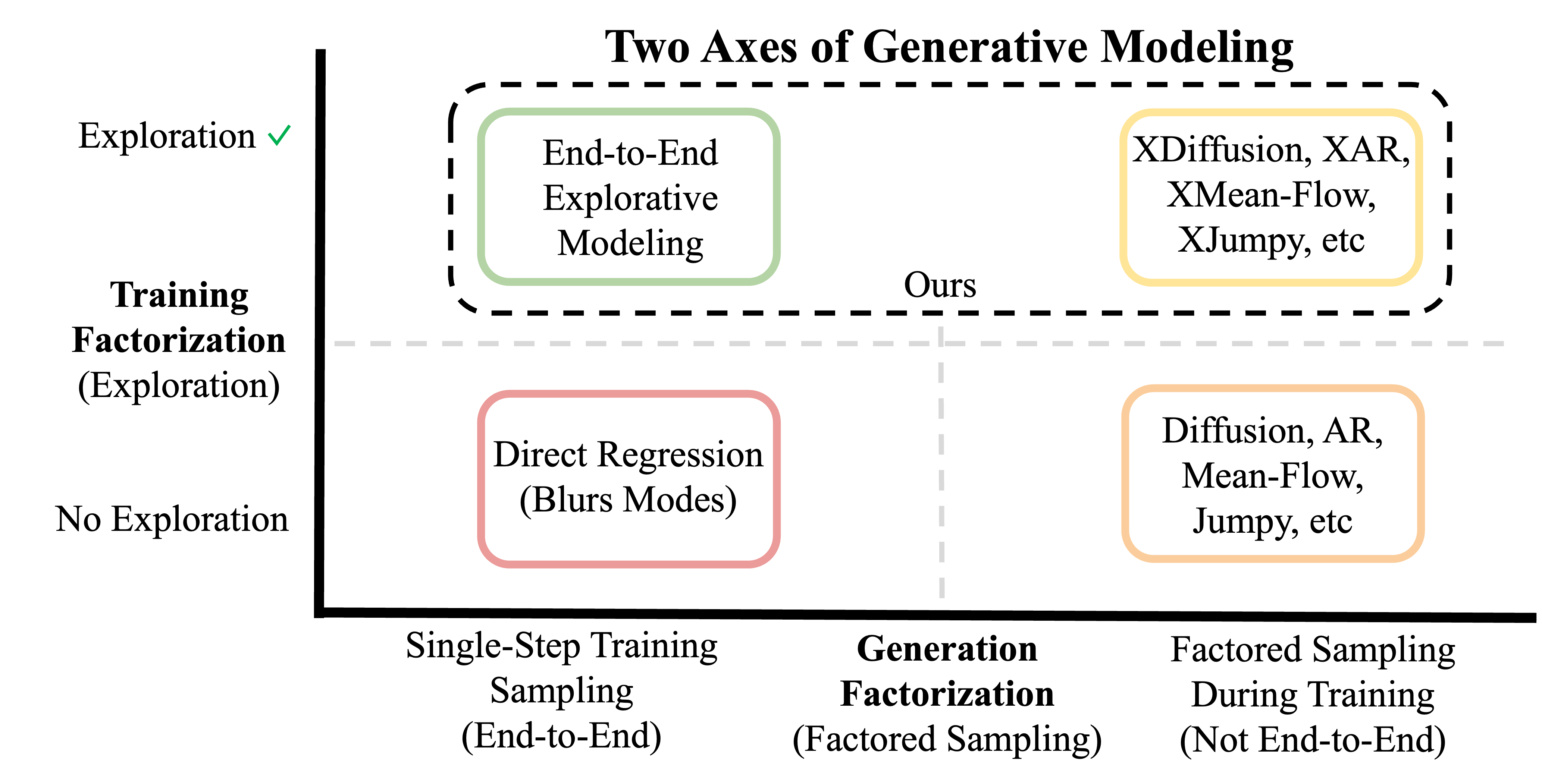
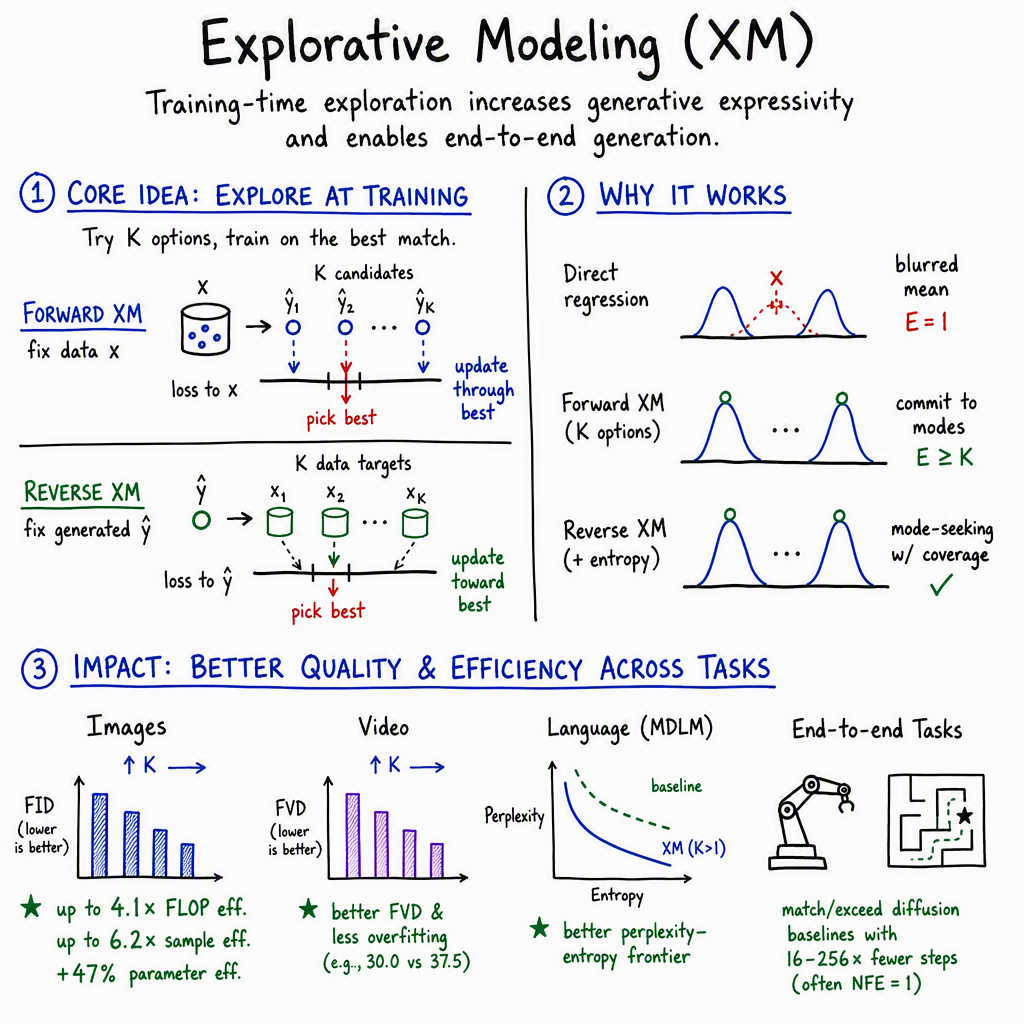
Abstract: The deep learning revolution, kicked off by AlexNet, taught us that end-to-end training beats decomposing a problem into hand-designed stages. Generative modeling, however, has remained the exception-despite generative models being remarkably capable, they are still not trained end-to-end. This is because, at its core, generative modeling is about handling distributions with many modes, and existing scalable approaches handle this the same way, by factoring the generation procedure, which prevents end-to-end generation. In this work, we introduce Explorative Modeling, a new paradigm that instead factors the training loop, exploring K candidate matches between model generations and data, and training on the best, so predictions commit to modes rather than blurring them. We find Explorative Models (XMs) useful in two settings. First, increasing exploration adds a third pretraining axis beyond parameters and data for existing generative models-where scaling exploration monotonically improves performance across both continuous and discrete domains (images, video, and language). Notably, gains from exploration increase with scale, climbing from 7% to 36% as data scales and from 13% to 23% as models grow, with efficiency gains more than doubling at 3x the compute. Concretely, exploration improves FLOP efficiency by 4.1x, sample efficiency by 6.2x, parameter efficiency by 47%, lifts the strongest of image-generation recipes to a near-state-of-the-art 1.43 FID on ImageNet without guidance, enables scaling how end-to-end existing models are, and unlocks scaling generalization. Second, XMs enable end-to-end reconstructive generative modeling, matching diffusion on control tasks with 16-256x fewer inference steps. Together, these results establish XMs as both a new pretraining axis for existing generative models and a standalone end-to-end generative modeling paradigm.
Paper Prompts
Sign up for free to create and run prompts on this paper using GPT-5.
Top Community Prompts
Explain it Like I'm 14
Overview
This paper introduces a new way to train AI systems that make things (like pictures, videos, or sentences). The big idea is called Explorative Modeling (XM). It helps the AI pick one of many good answers instead of averaging them into a blurry or boring result. XM also lets these models be trained and used in the same way end-to-end, which usually makes them work better and more reliably.
Key Goals and Questions
- Can we add a new “knob” to scale up generative AI besides just using bigger models and more data?
- Can we stop models from averaging many correct answers into one bad answer (like a blurred photo)?
- Can we make generative models truly end-to-end—so they practice during training exactly how they’ll generate during use?
- Will this approach work across images, video, and language—and does it still help as things get bigger?
How the Method Works (in everyday terms)
First, two quick ideas:
- Generative tasks (like “draw a dog”) have many valid answers. This is called “multimodal” (many modes = many peaks of possibility).
- Today’s popular methods (like diffusion or autoregressive models) avoid blurring by breaking generation into many tiny steps. That works, but it means the model is trained and used differently (not end-to-end), which can cause mistakes to build up.
Explorative Modeling takes a different path: instead of breaking generation into steps, it “explores” choices during training.
Think of it like this:
- You’re trying to copy a picture from memory. Instead of making one guess and averaging everything, you make several guesses and then keep improving the one that’s closest to the real thing. Over time, different guesses specialize in different “looks” (modes), so you cover many possibilities well.
There are two simple flavors (you can use one or both):
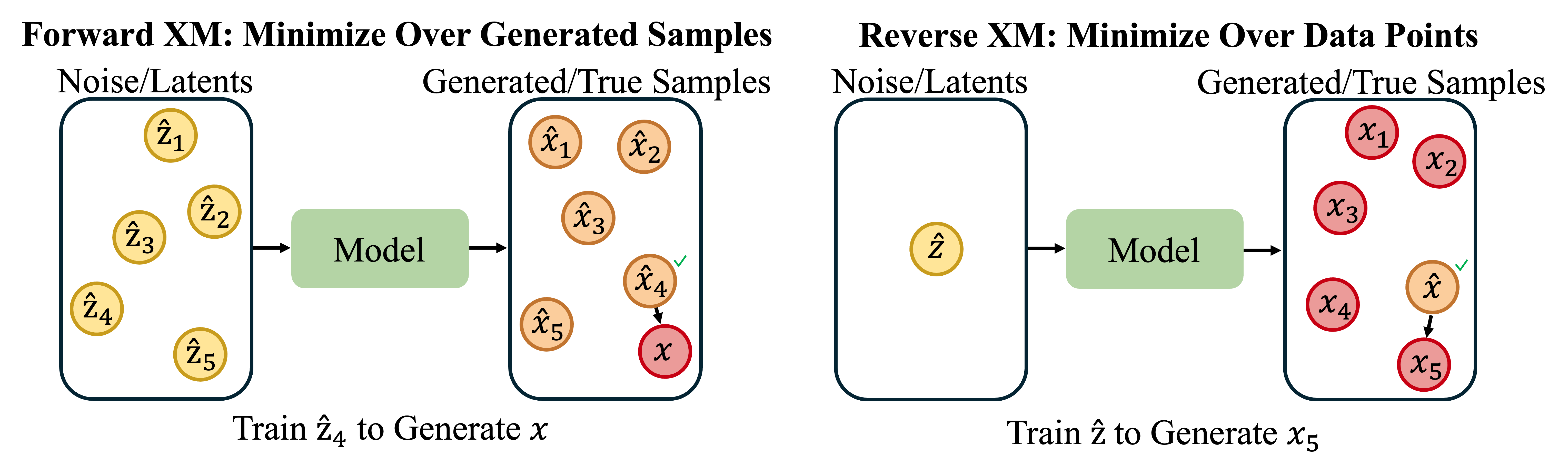
- Forward XM: For each real example, the model generates K candidates and learns from the one that matches best. This helps cover all parts of the data (good coverage/recall), but costs more compute.
- Reverse XM: The model generates one candidate and compares it to K real examples, learning from the closest one. This is cheaper and gives precise matches (good precision), but can ignore some modes unless combined with Forward XM or other safeguards.
Key term you’ll see:
- Generative expressivity: how many distinct “modes” a model can faithfully learn. Bigger K means the model can lock onto more different valid answers instead of averaging them.
How they tested it:
- They plugged XM into strong existing methods for images, video, and language without retuning everything—just adding exploration.
- They also used XM by itself as an end-to-end generator.
- They measured quality, speed, and efficiency across scales (more data, bigger models, more compute).
Main Findings and Why They Matter
Here are the highlights. Each point matters because it means better results, less cost, or both.
- Stronger results with less compute and data:
- Up to 4.1× better FLOP efficiency (same quality with about a quarter of the compute).
- About 6.2× better sample efficiency (reaching the same quality with far fewer training samples).
- About 47% better parameter efficiency (a smaller model with XM can beat a larger model without it).
- Improves as things get bigger:
- The benefits of exploration grow when you use more data, larger models, or more training time. In other words, XM is a true “third scaling axis” alongside model size and data size.
- Works across domains:
- Images: Better FID/FDr6, near state-of-the-art quality on ImageNet without extra “guidance” tricks.
- Video: Better FVD (video quality measure).
- Language: Better perplexity–entropy trade-offs (more fluent and informative text at the same time).
- Enables end-to-end generation:
- As a standalone approach, XM matched diffusion-based control and planning methods while needing 16–256× fewer steps at inference time. That means much faster generation without losing quality.
- Makes models “commit” to real modes:
- With K=1 (no exploration), models tend to average different valid answers into a blurry middle. As K increases, the model spreads its guesses across real modes and stops blurring.
What This Could Change
- A new way to scale: Beyond “bigger models” and “more data,” we can scale “exploration” (K) to capture more real-world variety. This reduces blurring and improves quality.
- More end-to-end training: The closer training matches real use, the fewer weird errors build up. XM helps bridge this gap, and with more exploration you can rely less on multi-step generation.
- Faster and cheaper AI: Matching or beating strong baselines with fewer steps and less compute means lower costs, less energy, and faster tools for users.
- Better generalization: Spending more training compute on exploration can directly improve how well models handle new situations.
- Broad impact: Because XM helps with images, video, and language, it could become a general recipe for building higher-quality, more reliable generative models.
In short, Explorative Modeling gives generative AI a powerful third “dial”—exploration—that helps models choose real, distinct answers instead of averaging them. It boosts quality, cuts cost, and opens a path to truly end-to-end generative systems.
Knowledge Gaps
Knowledge gaps, limitations, and open questions
Below is a single, concrete list of what remains missing, uncertain, or unexplored, framed to be actionable for future research.
- Theory: lack of formal convergence guarantees for best-of-K training beyond Gaussian/L2 settings; need proofs on when and how Forward/Reverse XM converge, and conditions ensuring global vs local minima.
- Theory: quantify the relationship between exploration K, model capacity, and recoverable mode count; provide tight bounds linking K and “generative expressivity” for realistic data distributions.
- Theory: extend the analysis of Forward/Reverse XM objectives to non-Euclidean losses (e.g., perceptual, cosine, token-level cross-entropy), discrete spaces, and structured outputs.
- Theory: formalize XM as hard-EM or multiple-choice learning; characterize when XM avoids VAE-style posterior collapse and when it degenerates.
- Metrics: operationalize “generative expressivity” with an estimable metric; report precision/recall for generative models, coverage, and manifold-coverage measures in addition to FID/FVD/FDr6.
- Metrics: evaluate likelihood and calibration (bits/dim, NLL, ECE) to test the hypothesized decoupling of sample quality vs likelihood under XM.
- Metrics: justify and validate FDr6—report correlations to human judgments, variance, and robustness; compare against standard suites (e.g., Precision/Recall, IS, CLIPScore, aesthetic scores).
- Optimization: analyze the non-smooth min operator—gradient bias/variance, stability, and sensitivity to soft-min temperatures; ablate smooth vs hard min.
- Optimization: study learning dynamics when only the “best” candidate gets gradients—risk of under-training unselected latents, dead latents, or premature specialization.
- Compute: provide wall-clock time, GPU-days, and memory overheads for various K; quantify end-to-end training time vs FLOP proxies and report practical throughput.
- Compute: develop compute-optimal policies to allocate K across steps/epochs; derive schedules for K that adapt to training progress.
- Adaptive exploration: design per-example or curriculum-based K (harder or more multimodal examples get larger K); learn policies that predict when extra exploration is beneficial.
- Search quality: XM currently uses random candidate sampling; compare to gradient-based latent refinement, cross-entropy method, evolutionary strategies, or learned proposal/inference networks.
- Reverse XM: risk of mode collapse acknowledged but unaddressed at scale; specify effective entropy regularization, precision–recall balancing with Forward XM, and provide large-scale ablations.
- Reverse XM: data-side search currently random; evaluate approximate nearest-neighbor retrieval in learned embedding spaces; study quality–privacy trade-offs.
- Privacy/memorization: Reverse XM “pull to nearest data” can increase memorization risk; run membership-inference/attribute-inference audits and dedup-sensitive analyses.
- Coupling alternatives: empirically compare XM against scalable OT proxies (e.g., Sinkhorn, sliced-Wasserstein, minibatch-OT variants) on coupling quality, bias, and compute.
- Loss design: ablate reconstruction losses (pixel L2 vs LPIPS, diffusion v-prediction losses, token cross-entropy) and measure their effect on coupling fidelity and final quality.
- End-to-end-ness: provide a concrete metric for “how end-to-end” a model is; quantify train–inference mismatch reductions when combining XM with different numbers of diffusion/jumpy steps.
- Hybrid design: formalize the trade-off between factoring generation (jumps/steps) and factoring training (K); propose an automated scheduler that co-optimizes both under a fixed compute budget.
- Generalization: substantiate “compute–generalization trade-off” with OOD benchmarks (e.g., ImageNet-A/O, WILDS), controlled synthetic shifts, and fixed-data overfitting curves.
- Guidance: systematically test interactions with classifier-free guidance and autoguidance—does XM reduce guidance dependence or compound gains? Provide guidance-scale sweeps.
- Scalability: evaluate XM on high-resolution image generation (≥1024px), long-horizon video, and 3D/NeRF or multi-view synthesis; report quality, diversity, and compute.
- Modalities: extend to audio, speech, molecular/3D graphs, and multimodal text–image; identify domain-specific coupling strategies and losses.
- Conditioning: test XM in text-to-image/video and instruction-following settings; study prompt adherence vs diversity; assess controllability under XM.
- Language modeling: explore XM for autoregressive LMs (sequence-level best-of-K vs token-level)—feasibility, compute cost, and effects on perplexity, calibration, and long-context coherence.
- Inference policy: clarify how many samples are needed at inference for XM-trained models; does training with large K require multi-sample decoding to realize gains?
- Safety/fairness: assess whether XM shifts distribution toward/away from minority or sensitive modes; integrate content filters and run bias/toxicity audits under increased exploration.
- Robustness: analyze sensitivity to K, batch size, latent noise distributions, and initialization; provide practical defaults and failure modes.
- Diversity control: study mechanisms that encourage complementary specialization across latents (e.g., repulsive priors, diversity bonuses) to avoid redundant candidates.
- Reverse XM data handling: quantify the cost of maintaining/searching large candidate pools; evaluate streaming vs cached datasets; measure retrieval scalability.
- Baselines: include comparisons to multiple-choice learning, self-consistency, rejection sampling training, min-risk sequence training, and MoE/mixture-of-experts with gating.
- World-modeling/control: validate end-to-end XM beyond behavior cloning and goal-conditioned planning—e.g., long-horizon RL, stochastic dynamics, safety constraints, offline–online transfer.
- Reproducibility: release full configs, seeds, and logs for XM variants; report run-to-run variance due to stochastic “best-of-K” selection.
- Data curation: examine how dataset cleanliness and near-duplicates affect XM coupling and memorization; test with and without deduplication.
- Sigma/scale selection: the kernel width implicit in the loss sets effective blur; provide principled methods to choose/anneal it and analyze sensitivity.
- Theoretical limits: characterize regimes where realistic mode counts would require impractically large K; propose principled approximations that bound compute while preserving expressivity.
Practical Applications
Immediate Applications
- Healthcare — data augmentation and simulation
- Use XMs to generate diverse, high-fidelity synthetic medical images (CT/MRI/ultrasound) to balance rare-condition modes without heavy guidance or multi-step sampling.
- Train end-to-end world models for medical workflows (e.g., instrument trajectory prediction in robotic surgery) with 16–256× fewer inference steps for real-time assistance.
- Tools/workflows: “XM-Augment” module for PACS-integrated research pipelines; XDiffusion finetuning scripts that explore K candidates per target; precision–recall dial via Forward/Reverse XM mix.
- Assumptions/dependencies: Clinician-validated fidelity metrics beyond FID; de-identification and privacy audits (Reverse XM may increase memorization risk); regulatory clearance for clinical use.
- Robotics and industrial automation — low-latency policies and planning
- Replace multi-step diffusion policies with end-to-end XM policies for behavior cloning that match performance at drastically lower latency, enabling embedded and edge deployment.
- Train goal-conditioned world models via XMs for faster model-predictive control or motion planning in warehouses and manufacturing cells.
- Tools/products: “XM-BC” drop-in trainer for Diffusion Policy repos; ROS2 nodes exporting single-forward-pass policies; on-device inference for drones/AMRs.
- Assumptions/dependencies: Real-robot sim-to-real gap; safety validation; scheduler for K and compute budget on constrained hardware; robustness under domain shift.
- Media, creative, and marketing — efficient image/video generation
- Swap guidance-heavy or many-step samplers with XM-augmented training to reduce inference cost while maintaining or improving quality; use XMs to increase mode coverage for diverse ad creatives.
- Tools/workflows: XDiffusion and XJumpy training recipes; “exploration schedule” (K warmup) integrated into current diffusion/flow training pipelines; per-project compute–quality knobs.
- Assumptions/dependencies: Asset licensing compliance; color-management and upscaling integration; sustained benefits at higher resolutions.
- Software and ML infrastructure — cost and efficiency wins
- Achieve target quality with smaller models by scaling exploration (reported +47% parameter efficiency and 4.1× FLOP efficiency); cut training runs and cloud bills.
- Tools/products: PyTorch/TRL “XMTrainer” wrappers (Forward/Reverse); approximate nearest neighbor (ANN) backends for Reverse XM over large target pools; dashboards plotting compute–generalization tradeoffs.
- Assumptions/dependencies: GPU memory/time overhead for Forward XM at large K; stable gradient routing to “winner” sample; mixing ratios to avoid Reverse XM collapse.
- Education and productivity — better assistants and authoring
- Add exploration to masked or reconstructive LLMs to reduce mode-averaging (“blurry” outputs) and surface multiple concrete solution modes (e.g., alternative outlines, code fixes).
- Tools/workflows: XM-augmented MDLM checkpoints; UI patterns that show K-best diverse options; classroom tools generating varied problem sets/solutions.
- Assumptions/dependencies: Alignment and safety layers; evaluation beyond perplexity (perplexity–entropy frontiers).
- Finance and forecasting — scenario generation and tail coverage
- Train XM-based generative models for time series to better capture multi-modal market regimes; generate diverse stress scenarios without unstable guidance tricks.
- Tools/workflows: XM modules for sequence models; Reverse XM with entropy bonus to avoid mode-seeking on rare events.
- Assumptions/dependencies: Domain-specific losses beyond MSE; rigorous backtesting; controls for leakage and overfitting.
- Research and academia — a third pretraining axis for broad use
- Adopt exploration as a standard scaling knob (alongside data and parameters) across image, video, and language; run ablations on compute-optimal K schedules.
- Tools/workflows: Benchmark suites reporting FLOP/sample/parameter efficiency vs K; open-source XM layers for diffusion/flow and jumpy models.
- Assumptions/dependencies: Reproducible metrics (FID saturation; use FDr6 or domain metrics); dataset governance for Reverse XM.
- Sustainability and policy-facing engineering — greener training
- Reach target quality with fewer FLOPs and data via exploration scaling; reallocate compute to generalization (as observed) rather than sheer size.
- Tools/workflows: Internal sustainability dashboards attributing energy savings to XM adoption; procurement guidance prioritizing XM-capable training stacks.
- Assumptions/dependencies: Benefits scale with problem multimodality; careful reporting to avoid double counting savings when K increases training cost (Forward XM).
Long-Term Applications
- Fully end-to-end generative stacks replacing multi-step samplers
- One-pass, end-to-end image/video/audio generation for real-time applications (AR/VR, live broadcast effects, interactive design tools) leveraging XM-trained models.
- Products: On-device content engines for mobile and wearables; creative suites with real-time preview at production quality.
- Assumptions/dependencies: SOTA parity at high resolutions; memory-efficient architectures; compression-friendly decoders.
- Healthcare decision support and digital twins
- XM-trained, end-to-end world models of patient trajectories enabling rapid what-if simulations and treatment planning with reduced exposure bias.
- Products: Clinical simulators for training/triage; synthetic cohorts with controllable mode coverage for rare conditions.
- Assumptions/dependencies: Prospective validation; bias audits on subpopulations; regulatory frameworks for generative clinical tools.
- Autonomous systems at the edge
- XM policies for autonomous driving, drones, and household robots with low-latency inference, robust multi-modal behavior coverage, and reduced compounding-error risks.
- Products: XM policy chips/accelerators; dynamic K controllers that adapt exploration during training to safety-relevant modes.
- Assumptions/dependencies: Certification for safety; adversarial robustness; long-horizon credit assignment integration.
- Foundation models with exploration-aware pretraining
- Large multimodal FMs (text–image–video–action) pretrained with exploration as a first-class axis, reducing reliance on guidance and complex decoding heuristics.
- Products: Enterprise-grade FMs that meet quality SLAs with smaller parameter counts; inference services priced by target quality at fixed K.
- Assumptions/dependencies: Scalable Reverse XM with entropy control; efficient K-sampling primitives in distributed training.
- RegTech and sustainability policy impact
- Industry standards encouraging exploration-aware efficiency reporting (compute saved vs. baseline quality) to reduce AI’s carbon footprint at scale.
- Policies: Incentives or disclosures tied to efficiency improvements from exploration; best-practice docs for precision–recall control in safety-critical domains.
- Assumptions/dependencies: Community consensus on metrics (e.g., beyond FID); verifiable logging of training choices.
- Safety, alignment, and attribution
- Use Reverse XM’s nearest-target search to build better attribution and memorization auditing tools; couple with entropy bonuses to avoid collapse while tracking data influence.
- Products: Compliance suites that monitor mode coverage across sensitive attributes; red-teaming tools probing collapse/mode-averaging failure modes.
- Assumptions/dependencies: Privacy-preserving search indexes; legal clarity on using proximity to training samples; fairness constraints in selection losses.
- Hardware–algorithm co-design
- GPU/ASIC features optimized for multi-sample candidate evaluation (efficient best-of-K reductions, ANN accelerators) to make Forward/Reverse XM cheap at scale.
- Products: “K-sampler” cores, memory layouts for shared activations across candidates, on-chip reduction ops for min-loss selection.
- Assumptions/dependencies: Vendor uptake; standardized APIs in major DL frameworks; demonstrable ROI on large training runs.
- New theoretical and methodological advances
- Gradient-based latent search replacing random exploration; principled entropy regularization for Reverse XM; hybrid OT–XM couplings for scalable, unbiased matching.
- Outputs: Libraries that learn task-dependent exploration schedules; diagnostics of generative expressivity and its interaction with likelihood.
- Assumptions/dependencies: Stable training under non-smooth min operators; generalization proofs under multimodality; agreement on expressivity metrics.
Glossary
- AlexNet: A pioneering deep convolutional neural network that catalyzed modern deep learning by demonstrating end-to-end training superiority. "AlexNet kicked off the deep learning revolution when end-to-end training beat hand-designed layer-wise training, demonstrating that learning everything performs better than hand-engineering~\cite{krizhevsky2012imagenet}."
- Autoguidance: A technique that improves sample quality by steering generation away from a weaker, more collapsed model’s predictions. "Autoguidance~\cite{karras2024guiding} reinforces this perspective even further, improving samples by pushing away from a deliberately worse, more mode-collapsed version of the model, demonstrating that the core functionality of guidance is to push away from the conditional mean due to challenges in capturing the true distribution."
- Autoregressive models: Generative models that produce outputs one element at a time, conditioning each prediction on previously generated elements. "For instance, autoregressive models reconstruct a target one element at a time, predicting each element from the ones already revealed, which means there is rich conditioning to make the prediction over the next element nearly unimodal."
- Behavior Cloning: A policy learning paradigm that imitates expert actions from demonstrations. "We find end-to-end XMs match Diffusion Policy~\cite{chi2023diffusion} on behavior cloning and Diffuser~\cite{janner2022planning} on goal-conditioned world modeling, while taking as little as a single forward pass in place of hundreds ($16$- fewer)."
- Best-of-K: A training strategy that samples K candidates and optimizes only the best-matching one to handle multimodality. "In their simplest form, XMs are just best-of-, an idea that has appeared many times in prior work~\cite{lee2016stochastic, li2018implicit, vahabpour2024diverse} (Section~\ref{sec:related_work})."
- Classifier-free guidance: A sampling-time technique that improves fidelity by interpolating between conditional and unconditional model outputs. "Classifier-free guidance~\cite{ho2022classifier} sharpens samples by pushing them away from the unconditional model, which, with less conditioning to pin down each prediction, blurs modes more than the conditional model."
- Compute-generalization tradeoff: The observation that allocating more training compute to exploration can directly improve generalization. "We find exploration enables a compute-generalization tradeoff, where spending more training compute on exploration directly improves generalization."
- Compute-optimal scaling: A regime where data and parameters are balanced to maximize performance per compute budget. "Under compute-optimal scaling, parameters and data have to grow together: increasing one while holding the other fixed becomes increasingly suboptimal~\cite{hoffmann2022training}."
- Contrastive divergence: A training method for energy-based models using short-run Markov chains to approximate gradients. "Contrastive generative models, such as GANs~\cite{goodfellow2014generative} and contrastive-divergence energy-based models (CD EBMs)~\cite{hinton2002training, du2019implicit}, are trained by contrasting generated data against true data—leveraging relative supervision from comparing samples with no explicit target—but have struggled with scalability."
- Contrastive generative models: Models trained by distinguishing real data from generated samples rather than reconstructing explicit targets. "Contrastive generative models, such as GANs~\cite{goodfellow2014generative} and contrastive-divergence energy-based models (CD EBMs)~\cite{hinton2002training, du2019implicit}, are trained by contrasting generated data against true data—leveraging relative supervision from comparing samples with no explicit target—but have struggled with scalability."
- Coupling: The (unknown) pairing between a model’s input (e.g., noise) and the target data it should reconstruct. "This pairing of an input with the target it should map to is called the coupling, and the challenge with reconstructive models is that we do not know this coupling beforehand, so a single input is typically coupled to many valid targets across the dataset."
- Diffuser: A diffusion-based planning and control method used as a baseline for goal-conditioned tasks. "We find end-to-end XMs match Diffusion Policy~\cite{chi2023diffusion} on behavior cloning and Diffuser~\cite{janner2022planning} on goal-conditioned world modeling, while taking as little as a single forward pass in place of hundreds ($16$- fewer)."
- Diffusion Policy: A diffusion-based imitation learning approach for control. "We find end-to-end XMs match Diffusion Policy~\cite{chi2023diffusion} on behavior cloning and Diffuser~\cite{janner2022planning} on goal-conditioned world modeling, while taking as little as a single forward pass in place of hundreds ($16$- fewer)."
- Diffusion models: Generative models that iteratively denoise a sample from noise to data through many steps. "For example, autoregressive and diffusion models are trained to predict a single step, but used at inference as recurrent neural networks over hundreds to thousands of predicted tokens or denoising steps, so per-step errors feed into the next step, drifting inputs off the training distribution and compounding errors~\cite{ranzato2016sequence, bengio2015scheduled, zhang2023snowball, ning2023elucidating, li2023alleviating}."
- End-to-end generative modeling: Training generative models so that training and inference use the same sampling procedure without mismatches. "The term end-to-end generative modeling is often used loosely."
- Energy minimization (implicit): Viewing training as minimizing an implicit energy landscape over data–generation pairings. "Exploration can also be seen as implicit training-time energy minimization, where the loss acts as an implicit energy over pairings of a generation with the data, so searching for the lowest-loss match is a search for the minimum-energy, best-coupled samples."
- Energy-based models (EBMs): Models that assign an unnormalized energy to configurations, with lower energy indicating higher likelihood. "Contrastive generative models, such as GANs~\cite{goodfellow2014generative} and contrastive-divergence energy-based models (CD EBMs)~\cite{hinton2002training, du2019implicit}, are trained by contrasting generated data against true data—leveraging relative supervision from comparing samples with no explicit target—but have struggled with scalability."
- Entropy bonus: An additional term encouraging higher-entropy (more diverse) model distributions to prevent collapse. "One solution is to add an entropy bonus that cancels the model's entropy term and leaves the pure reverse KL; another is to combine Reverse XM with Forward XM, which is mass-covering."
- Exposure bias: The train–test mismatch where models are exposed to gold inputs during training but their own predictions at test time, compounding errors. "End-to-end generative modeling also inherits the practical benefits of end-to-end training, where it removes exposure bias~\cite{ranzato2016sequence, bengio2015scheduled, zhang2023snowball, ning2023elucidating, li2023alleviating} and the train-inference mismatch that drifts a model onto out-of-distribution inputs and compounds errors~\cite{recht2019imagenet, hendrycks2019benchmarking, koh2021wilds}, while as a byproduct enabling inference to be more efficient."
- Explorative Modeling (XMs): A paradigm that factors the training loop by exploring K candidate matches and training on the best to handle multimodality end-to-end. "In this work, we introduce Explorative Modeling, a new paradigm that instead factors the training loop, exploring candidate matches between model generations and data, and training on the best, so predictions commit to modes rather than blurring them."
- FDr6: A representation-averaged Fréchet distance metric that replaces saturated FID at high performance levels. "Our largest image generation experiments report because FID has saturated at this performance level~\cite{yang2026representation, singh2026improved}; works by averaging the Fr"
- FLOPs: A measure of computational cost in floating-point operations. "Exploration reaches the baseline's best performance with less data (Figure~\ref{subfig:xrae_data_eff}) and fewer FLOPs (Figure~\ref{subfig:xrae_flop_eff})—more than doubling the gains of similar experiments using a third of the compute (Figure~\ref{fig:xm_flop_data_scaling})—demonstrating that gains from exploration grow with scale."
- Flow Matching: A training objective for diffusion/flow models that learns the velocity field of a continuous-time transformation from noise to data. "Because Diffusion and Flow are equivalent formulations~\cite{gao2025diffusionmeetsflow}, we use the terms interchangeably throughout, and every Diffusion model over continuous data in this work is trained with the Flow Matching objective, as Flow has generally performed best~\cite{ma2024sit}."
- Forward XM: An explorative variant that fixes a data target and minimizes loss over K generated candidates. "Forward XM fixes a data target and explores its own generations: it draws candidates and trains on the one closest to the target, implemented as a simple for loop (Algorithm~\ref{alg:min_samples}), which we denote $\mathcal{L}_{\text{Forward}$."
- Fréchet Inception Distance (FID): A distributional similarity metric between generated and real images using Inception features. "Concretely, exploration improves FLOP efficiency by , sample efficiency by , parameter efficiency by , lifts the strongest of image-generation recipes to a near-state-of-the-art $1.43$ FID on ImageNet without guidance, enables scaling how end-to-end existing models are, and unlocks scaling generalization."
- Fréchet Video Distance (FVD): A metric analogous to FID for evaluating video generation quality. "For both image and video generation, increasing exploration monotonically improves performance as measured by FID and FVD respectively (Figure~\ref{fig:xm_explore_fid_fvd_scaling}), with some models seeing a greater than 20\% performance boost."
- Generative expressivity: The number of distinct modes a model’s training objective allows it to capture. "Generative Expressivity: The number of distinct modes a generative model's training objective allows it to capture."
- Goal-conditioned world modeling: Learning dynamics and planning models conditioned on specified goals. "We find end-to-end XMs match Diffusion Policy~\cite{chi2023diffusion} on behavior cloning and Diffuser~\cite{janner2022planning} on goal-conditioned world modeling, while taking as little as a single forward pass in place of hundreds ($16$- fewer)."
- Jumpy generative models: Models that interpolate between single-step regression and continuous-time flow by varying the number of denoising “jumps.” "Second, we experiment with Jumpy generative models~\cite{gladstone2026jumpy}, which generalize the idea of Diffusion/Flow by varying the number of steps, or jumps, interpolating between direct end-to-end regression (a single jump, the most end-to-end) and continuous-time flow (infinitely many jumps)."
- Kullback–Leibler (KL) divergence: A measure of divergence between probability distributions; the reverse direction is mode-seeking. "Reverse XM targets the reverse KL, the mode-seeking direction."
- Latent variable models: Models that introduce unobserved variables to capture underlying structure or mode assignments. "The challenge with latent variable models is that we do not know which latent goes with which datapoint in advance."
- Masked Diffusion Language Modeling (MDLM): A masked modeling approach for language using diffusion-style objectives. "and masked diffusion language modeling (MDLM)~\cite{sahoo2024simple} (bottom)."
- Mode collapse: A failure where a generative model covers only a few modes of the data distribution. "Autoguidance~\cite{karras2024guiding} reinforces this perspective even further, improving samples by pushing away from a deliberately worse, more mode-collapsed version of the model,"
- Mode Forcing: A perspective that scalable reconstructive models avoid averaging by ensuring each step’s target is nearly unimodal. "Recent work on Mode Forcing~\cite{gladstone2026mode} points out that every scalable reconstructive model is built to dodge exactly this blur, with the central thesis that modern generative modeling is the art of designing a reconstructive objective whose loss minimizer captures modes instead of averaging them."
- Multimodal distribution: A probability distribution with multiple distinct peaks (modes). "By multimodal we mean a probability distribution with many modes (distinct peaks), not data of different modalities such as text and images."
- Optimal transport (OT): A framework for computing cost-optimal couplings between distributions; exact solutions are computationally expensive. "Computing a better coupling directly does not scale: exact optimal transport is cubic in the number of samples, and its minibatch approximations~\cite{tong2023improving} only match within a batch, a biased proxy for the true global pairing~\cite{fatras2020learning}."
- Parameter efficiency: The performance achieved per parameter count, reflecting how effectively parameters are used. "Exploration also improves parameter efficiency—a Large model exploring 5 modes outscales an XLarge model with more parameters and no exploration (Figure~\ref{fig:xm_param_eff})."
- Perplexity-entropy frontier: The tradeoff curve assessing LLM generation quality versus diversity. "This benefit carries over to discrete data, where adding exploration to a masked diffusion LLM (MDLM) improves its perplexity-entropy frontier\footnote{This frontier has become the standard evaluation in this setting, as generative perplexity alone can be gamed by low-entropy sampling~\cite{zheng2024masked, pynadath2026generative}.} across the board (Figure~\ref{fig:mdlm_xm_scaling}), demonstrating that exploration helps in both continuous and discrete spaces."
- Posterior collapse: A VAE failure mode where the latent variables become uninformative and are ignored by the decoder. "Variational Autoencoders (VAEs)~\cite{kingma2013auto} learn an encoder to infer this latent, which adds a KL term and risks posterior collapse, and consequently VAEs have struggled to scale well as standalone generative models~\cite{vahdat2020nvae, xiao2021tackling}."
- RAE: A strong image generation recipe used as a baseline for scaling experiments. "We add exploration to RAE~\cite{zheng2025representation}, the state-of-the-art image generation recipe as of three months before this work (we report , as FID at this performance level is saturated~\cite{yang2026representation, singh2026improved})."
- Reconstructive generative models: Models trained to reconstruct targets from corrupted or partial inputs (e.g., autoregressive, diffusion, flow). "We therefore focus on reconstructive generative models—the most common family that has scaled best thus far—which are trained by mapping a self-produced input, such as noise or a corrupted sample, back to an explicit data target that supervises each prediction, and include autoregressive, diffusion~\cite{ho2020denoising}, and flow~\cite{lipman2022flow} models."
- Reverse KL: The KL divergence oriented as KL(model || data), which tends to be mode-seeking. "Reverse XM targets the reverse KL, the mode-seeking direction."
- Reverse XM: An explorative variant that fixes a generated sample and minimizes loss over K data targets, favoring precision. "Reverse XM fixes a generated model sample and searches the data: it draws a single sample and trains it toward the closest of data targets (Algorithm~\ref{alg:min_data}), flipping the objective to"
- SiT baseline: An optimally tuned image generation baseline (SiT) used to evaluate exploration’s efficiency gains. "We add exploration to an optimally tuned SiT baseline~\cite{ma2024sit}, training at roughly a third of the compute of Figure~\ref{fig:xm_rae_flop_step_eff}."
- Variational Autoencoders (VAEs): Latent-variable generative models optimized via a variational bound with a KL regularizer. "Variational Autoencoders (VAEs)~\cite{kingma2013auto} learn an encoder to infer this latent, which adds a KL term and risks posterior collapse, and consequently VAEs have struggled to scale well as standalone generative models~\cite{vahdat2020nvae, xiao2021tackling}."
Collections
Sign up for free to add this paper to one or more collections.

