- The paper introduces a two-stage Coupling Model that maps discrete sequences to Gaussian latents to enable parallel one-step generation, overcoming factorial structure limitations in direct decoders.
- It demonstrates improved quality-diversity tradeoffs with lower perplexity on language tasks and superior performance on image and biological sequence generation relative to existing one-step baselines.
- The method enables efficient conditional generation via latent guidance, substantially reducing computational evaluations compared to multi-step models, though scaling challenges remain.
Coupling Models for One-Step Discrete Generation: A Technical Overview
Motivation and Background
Discrete generative modeling is foundational for applications including language generation, biological sequence design, code synthesis, and image modeling. Most high-performance models in these domains rely on multi-step inference: either sequential (autoregressive) decoding or iterative refinement as in discrete diffusion and flow-based models. While effective, these approaches impose latency constraints, especially for long sequences, as multiple model evaluations are necessary to produce a sample.
Recent research on accelerating discrete generation has advanced one-step and few-step generation regimes, either via distillation, trajectory rectification, or direct endpoint mapping on continuous relaxations. Despite progress, there remain fundamental representational constraints inhibiting truly parallel one-step generation: specifically, direct one-step token-wise discrete decoders are provably incapable of representing the complex global dependencies of real data distributions due to their factorial structure, an issue formally articulated in the paper's theoretical analysis.
This work proposes Coupling Models, a novel two-stage framework designed to enable expressive and sample-efficient one-step generation over discrete structures by leveraging learned couplings between discrete sequences and continuous Gaussian latents.
Model: Two-Stage Coupling for One-Step Discrete Generation
The Coupling Model circumvents the expressivity barrier of direct one-shot decoders by introducing a shared informative latent derived from a learned sequence-latent coupling:
Stage A: Discrete Sequence → Gaussian Latent
- Each discrete sequence is first encoded into a continuous representation and then mapped—via a likelihood-based normalizing flow—into a Gaussian latent.
- The encoder and flow are trained to (1) preserve sequence-level information (reconstruction loss), (2) regularize latent representations (KL term), and (3) align the latent marginal with the standard Gaussian prior (flow likelihood).
- This process yields a paired dataset of (z,x), where z∼N(0,I) is informative for x.
Stage B: Gaussian → Discrete Sequence
- A parallel decoder is trained to emit all output tokens in a single forward pass conditioned on the latent variable.
- Importantly, while the decoder's emission is factorial conditioned on z, the joint distribution over x (marginalizing over z) captures global dependencies, sidestepping the factorial limitation of vanilla one-step models.
- At inference, only a single sample from N(0,I) is required; decoding is performed in parallel.
This design is formalized with an explicit error decomposition: the divergence between the true data distribution and the generated distribution can be tightly controlled by (1) the accuracy of latent-conditioned decoding, and (2) the quality of the latent marginal alignment. Full theoretical details and bounds are provided in the paper.
Empirical Evaluation Across Modalities
The framework is validated on three challenging benchmarks—controlled binary image generation (MNIST-Binary), biological sequence generation (Fly Brain enhancer), and open-ended text generation (LM1B).
Quality–Diversity Frontier in Language Generation
On LM1B, a standard language generation benchmark, the Coupling Model is shown to shift the one-step entropy–perplexity frontier: it achieves strictly lower generative perplexity for a given entropy compared to previous one-step baselines, indicating improved quality without sacrificing sample diversity.

Figure 1: On LM1B, Coupling Model shifts the one-step entropy–perplexity frontier toward the low-perplexity, high-entropy region, outperforming prior one-step baselines.
Specifically, at Gen-PPL 45.82 and entropy 3.61, it surpasses previous one-step models such as "One-step Language Modeling via Continuous Denoising" (Lee et al., 18 Feb 2026) and "Categorical Flow Maps" (Roos et al., 12 Feb 2026) in perplexity while closely tracking the real-data entropy. The model delivers a substantially improved quality–diversity tradeoff—an explicit empirical contradiction to the typical collapse–diversity dichotomy seen in prior one-step methods.
Image and Biological Sequence Generation
In unconditional MNIST-Binary generation, the Coupling Model achieves FID 5.5, significantly outperforming strong one-step and few-step baselines and approaching multi-step model quality. For Fly Brain enhancer design, it reduces the Fréchet distance of generated DNA sequences from 15.8 to 12.9 in the one-step setting, improving upon distilled Dirichlet Flow Matching (Stark et al., 2024). However, iterative baselines still retain a gap on the most challenging biological settings.

Figure 2: Example unconditional generations on MNIST-Binary from the Coupling Model, demonstrating high sample quality in the one-step regime.
Guidance and Controllability
A major advantage of the proposed approach is the latent interface, which allows efficient and effective conditional generation using standard guidance mechanisms:
- Classifier-free guidance (CFG) is implemented via conditioning dropout, applied at the logit level.
- Classifier guidance is performed by optimizing the latent z with respect to a differentiable relaxation of the reward or classifier signal before decoding.
- Reward fine-tuning adjusts generator parameters for reward-maximizing generations.
The empirical results show that the one-step Coupling Model achieves target conditioning with orders of magnitude fewer model evaluations compared to multi-step masked diffusion models (e.g., 2–6 function evaluations vs. 256–512 for comparable FID/accuracy).
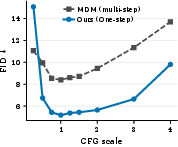
Figure 3: Left: Coupling Model achieves lower FID and class-conditional accuracy with vastly fewer function evaluations than MDM baselines for all guidance methods. Right: Quality–guidance tradeoff is strictly better with Coupling Model.
This efficiency facilitates practical, controlled discrete generation scenarios (e.g., label-controlled MNIST), indicating the method's utility for conditional design tasks.
Extensions and Limitations
The authors demonstrate that the latent-coupling construction can extend beyond direct one-step decoding. Specifically, a few-step variant employing latent-conditioned masked denoisers benefits from the same latent structure, enabling further sample refinement with minimal extra cost.
Nevertheless, the method's primary limitation is scaling: results are obtained on moderate model sizes and sequence lengths. While compelling evidence is provided for the practical utility of the coupling approach at this scale, significant performance gaps remain in the hardest sequence design settings and at maximal model scales frequented in large-scale NLP.
Implications and Future Prospects
The Coupling Model shifts conceptual focus from compressing generative trajectories to constructing expressive data–noise couplings. The findings establish that, given appropriate latent supervision and alignment, one-step parallel discrete generation is not limited by the inference structure alone—representation is the primary obstacle. This non-autoregressive, non-iterative approach has potential to unlock low-latency sequence generation in interactive and batch settings, enabling new applications in protein engineering, code generation, and more.
Future directions include scaling studies, integration with richer latent variable priors, refinement of end-to-end trainable couplings, and broader deployment in real-world design automation scenarios. Continued empirical analyses will be necessary to determine the practical limits of the coupling approach as domain complexity and data size grow.
Conclusion
Coupling Models provide a principled and empirically validated route to parallel, one-step discrete generation. By leveraging a learned coupling between discrete structures and Gaussian latents, the approach overcomes representational barriers seen in direct one-step decoders and achieves new state-of-the-art quality/efficiency tradeoffs in one-step generative modeling across diverse modalities. The resulting latent interface offers efficient conditional generation and supports extensions to few-step refinement regimes, laying the groundwork for accelerated and controllable discrete generative modeling at scale.