LLM-as-a-Coach: Experiential Learning for Non-Verifiable Tasks
Abstract: Reinforcement learning (RL) on open-ended tasks compresses an LLM's rubric-based evaluation into a scalar reward, discarding rich textual feedback and conflating responses with distinct quality profiles. We propose Experiential Learning (EL), which repurposes the feedback model from an LLM-as-a-Judge into an LLM-as-a-Coach. The coach distills its assessment of each on-policy response into transferable experiential knowledge, which conditions a teacher model and is internalized by the policy through on-policy context distillation. Compared with scalar rewards, this higher-bandwidth feedback channel provides dense supervision and preserves fine-grained preferences among high-quality responses. Across two policy families, with feedback from the policy itself or a proprietary model, EL consistently outperforms rubric-based RL on held-out and unseen open-ended tasks. Notably, EL generalizes better beyond the training distribution, and mitigates reward hacking. These findings establish experiential knowledge as a richer and more generalizable learning signal for post-training on non-verifiable tasks.
Paper Prompts
Sign up for free to create and run prompts on this paper using GPT-5.
Top Community Prompts
Explain it Like I'm 14
What is this paper about?
This paper is about teaching LLMs (like chatbots) to do open-ended tasks better—things like explaining ideas, giving advice, or writing stories—where there isn’t just one correct answer. Instead of training with a simple “score” (like 8/10), the authors show how to train using rich, detailed feedback, more like a coach’s notes. They call this approach Experiential Learning (EL), and they show it often works better than traditional reinforcement learning (RL) for these kinds of tasks.
What questions did the researchers ask?
The authors focused on three main questions:
- Can LLMs learn better from detailed, text-based coaching instead of a single number score?
- Does this “coach-style” feedback help models improve on unseen tasks and avoid “reward hacking” (gaming the scoring system without truly getting better)?
- How should we turn the coach’s feedback into something the model can actually learn from?
How did they do it? (In simple terms)
Think of training a model like training a student to write a great essay.
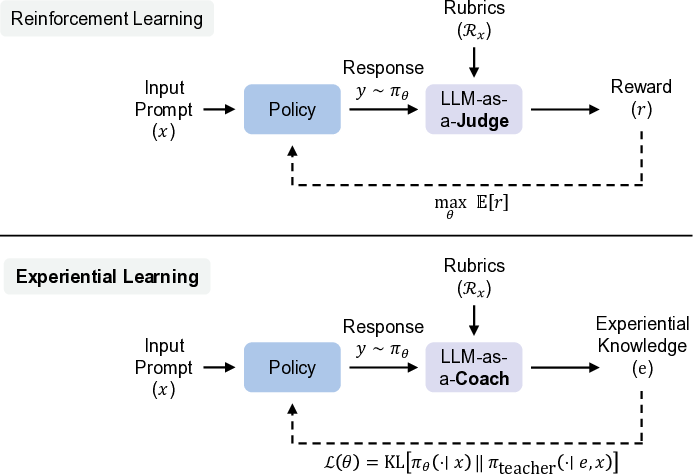
- The usual way (Reinforcement Learning with a Judge):
- The student writes an essay.
- A judge rates it with a single number (like 7/10).
- The student tries to get a higher number next time, but doesn’t see the judge’s detailed comments.
- The new way (Experiential Learning with a Coach):
- The student writes an essay.
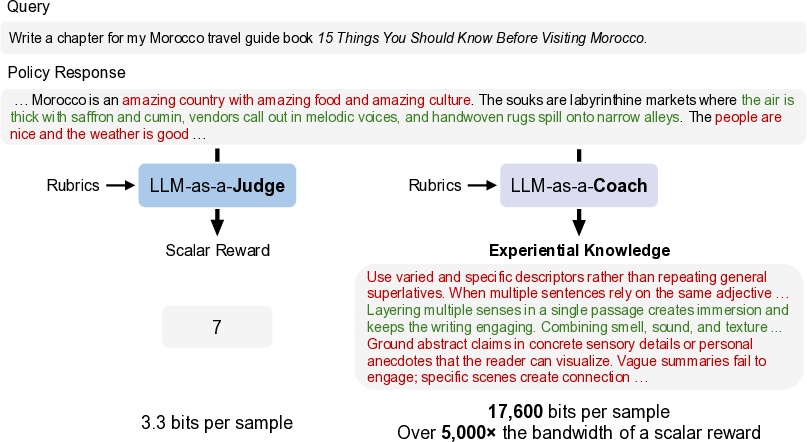
- A coach reads it and writes down specific, reusable tips—“experiential knowledge”—such as “use concrete examples,” “check facts,” or “organize into clear sections.”
- A teacher model takes those tips and shows how it would write the essay using them.
- The student then learns to write more like that teacher, step by step, word by word.
Here’s what’s happening under the hood, in everyday language:
- Rubrics: For each task, they prepare a checklist (rubrics) that says what “good” looks like (e.g., accurate, clear, complete, well organized).
- Coach feedback: Instead of just giving a score, the coach turns its evaluation into general tips that can help on similar tasks in the future. This avoids super-specific fixes and focuses on reusable strategies.
- Teacher-student practice (distillation): The teacher model is fed those tips as context, writes in a way that follows them, and the student model practices matching the teacher’s “next word” choices. Over time, the student absorbs those strategies into its own parameters, so it doesn’t need the coach at test time.
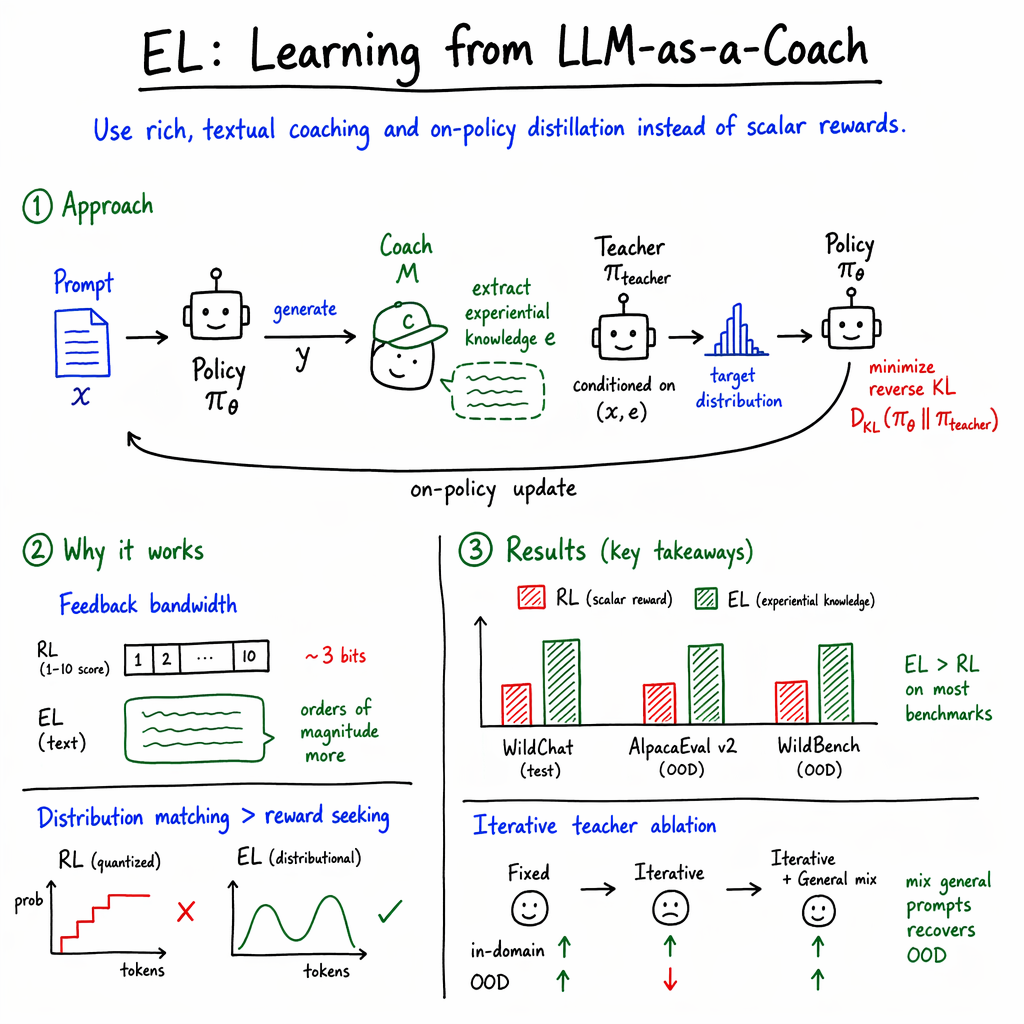
Why this is powerful: A single score is like a tiny straw for feedback—very low “bandwidth.” A page of tips is a wide pipe—much richer guidance. The paper shows this coach-style feedback can carry thousands of times more information than a single number and helps the model learn faster and smarter.
What did they find, and why does it matter?
In tests across different models and tasks, EL usually beat the standard RL approach that relies on scores:
- Better performance on the training domain and, importantly, stronger results on new, unseen benchmarks (like AlpacaEval v2.0, WildBench, ArenaHard v2.0, and CreativeWritingV3).
- Less “reward hacking.” With score-only training, models can learn shortcuts that raise the number without truly improving quality. The richer, coach-style feedback reduces this problem.
- More fine-grained improvements. When many answers all get the same top score, score-based training can’t tell them apart. EL preserves subtle preferences (like tone, organization, or detail level), so the model keeps improving even near the top.
They also ran careful checks:
- Iterative teacher updates (using the newly improved model as the next teacher) can boost scores but may cause the model to forget some general skills. Mixing in general practice prompts helps keep those broader abilities.
- Just pasting the coach’s full critique or only the rubrics is not as effective as extracting concise, reusable tips. Compressing feedback down to a single choice (like picking one improvement label) helps a bit but loses most of the benefit—again showing that richer feedback matters.
- A small “toy” experiment showed that turning rich targets into a few score levels creates a blocky, staircase learning signal. Direct distributional guidance (what EL aims to provide) recovers smoother, more accurate behavior.
What’s the bigger impact?
If we want helpful, trustworthy AI for open-ended tasks—teaching, brainstorming, summarizing, advising—then training with coach-style, text-based feedback seems a better path than relying on a single score. It helps models:
- Learn faster from fewer examples (because the feedback carries more detail).
- Generalize better to new tasks (since tips are reusable strategies).
- Avoid gaming the system (since the goal is to match good writing behavior, not just chase a number).
In short, this work suggests a shift from “judges that rate” to “coaches that teach,” which could make future AI systems more reliable, adaptable, and genuinely helpful across a wide range of real-world, non-verifiable tasks.
Knowledge Gaps
Below is a concise list of concrete knowledge gaps, limitations, and open questions that remain unresolved and could guide future research.
- Human-grounded validation: The study relies on GPT-4o (and occasionally other proprietary evaluators) for rubric generation and scoring. How do EL gains compare against expert human evaluations, and do improvements persist under diverse human raters with different preferences?
- Evaluator–coach circularity and bias: Using the same or family-related LLMs for coaching and evaluation risks evaluator-specific overfitting. How robust are EL improvements when assessed by multiple independent evaluators (including non-OpenAI models and human panels) and under evaluator distribution shifts?
- Effective information content vs. theoretical bandwidth: The paper provides a bandwidth upper-bound intuition but does not quantify the mutual information between experiential contexts and desired policy changes. Can we empirically estimate usable information in the coach’s text (e.g., via MI bounds or probing) and correlate it with performance gains?
- Reward hacking quantification: Claims of reduced reward hacking are supported by training/test generalization gaps but lack targeted adversarial tests. Can we design controlled reward-hacking stress tests (e.g., prompts that historically induce score inflation) to measure EL’s resilience relative to RL?
- Sensitivity to experiential context length and structure: The method uses long textual contexts (e.g., 1024 tokens). What is the scaling curve of EL performance with context length, and which structured forms (checklists, templates, schemas) retain most benefits at minimal token budget?
- Reverse KL design choices: EL uses reverse KL computed over the student’s top-256 tokens without renormalization. What is the impact of this truncation and lack of renormalization on stability and convergence, and how do alternatives (full support, forward KL, Jensen–Shannon, α-divergences) compare?
- Teacher selection and anchoring effects: The teacher is either a frozen checkpoint or iteratively updated from the student. How does teacher competence and diversity (multi-teacher, stronger external teachers, mixture-of-teachers) affect EL outcomes and prevent the student from inheriting suboptimal teacher biases?
- Forgetting and capability retention: Iterative teacher updates degraded IFEval accuracy, partially mitigated by mixing general-domain OPD. What principled curricula or regularizers best preserve broad capabilities (code, math, tools, safety) while optimizing open-ended instruction tasks?
- Cost and efficiency accounting: The paper states EL’s additional cost is small but provides no wall-clock or token-throughput measurements. What are the exact compute, latency, and memory costs of EL vs. RL under matched rollout budgets, and how do these scale with model size and training length?
- Generalization breadth: Evaluations focus on open-ended instruction-following benchmarks. Do EL’s benefits transfer to other regimes (verifiable math/programming, tool use, long-context QA, multi-turn agents), and where do they diminish?
- Coach quality and robustness: EL shows gains with GPT-4o and the initial policy as coach. How does performance vary with coach strength, calibration, or intentional degradation (noisy or adversarial coaching), and can EL self-correct under weak or biased coaching?
- Rubric quality and provenance: Rubrics are pre-generated by GPT-4o. How sensitive is EL to rubric granularity, correctness, and style, and do human-authored or domain-expert rubrics yield different outcomes (accuracy, transfer, safety)?
- Hybrid training objectives: Can EL be combined with scalar-reward RL (e.g., multi-objective optimization, schedule mixing) to exploit both distributional guidance and reward signals, and under what conditions does hybridization outperform either method?
- Scaling laws for EL: The study uses 7.5k WildChat-IF prompts. What are scaling trends with dataset size, number of on-policy samples per prompt, context length, and model size; do gains saturate or amplify with scale?
- Diversity and mode-collapse risks: Distribution matching toward a context-conditioned teacher may reduce output diversity. How does EL impact response entropy and topical/style diversity, and can diversity-preserving objectives or temperature scheduling mitigate collapse?
- Temperature and sampling strategy: Training rollouts use temperature 1 and 8 samples per prompt. How sensitive are EL gains to sampling temperature, number of samples, and nucleus settings, and what sampling policies best support experiential learning?
- Safety, fairness, and style conformity: Experiential contexts may steer models toward evaluator-preferred styles. Does EL inadvertently increase stylistic homogenization or amplify biases and harmful content, and which guardrails (e.g., safety rubrics, fairness constraints) are effective?
- Verifiable tasks with nuanced preferences: The paper posits limited EL benefit on binary-verifiable tasks. For tasks with verifiable endpoints but rich intermediate trade-offs (e.g., program synthesis with style/efficiency rubrics), can EL still provide measurable advantages?
- Toy analysis external validity: The distribution-matching toy study uses quantized rewards and a uniform KL penalty. Do the staircase artifacts persist under realistic RL pipelines (e.g., PPO/GRPO with baselines, learned reward heads, non-uniform priors), and can continuous rewards or better credit assignment close the gap?
- Data contamination and evaluator leakage: Although Tulu3 prompts are filtered for overlap, broader contamination across WildChat-IF, evaluation sets, and proprietary models is not ruled out. Can strict decontamination protocols and cross-evaluator checks confirm the robustness of reported gains?
- Multi-lingual and cross-cultural generalization: Experiments are primarily in English. How does EL perform across languages and cultural contexts where rubrics and preferences differ, and does rubric translation degrade guidance fidelity?
- Structured experiential knowledge: The multiple-choice ablation shows limited bandwidth benefits, but raw critiques hurt OOD capability. Can compact, structured representations (e.g., key-value guidance, prioritized error taxonomies) balance informativeness and alignment better than free-form text?
- Token-level weighting and curriculum: EL averages KL per token. Are there benefits to rubric-conditioned token weighting (e.g., emphasizing factual segments), or curricula that progressively increase guidance specificity?
- Robustness to prompt injections in contexts: The teacher conditions on coach-provided text. Are there failure modes where adversarial or malformed experiential contexts derail the teacher, and can context sanitization or verification prevent these?
- Reproducibility and open resources: Rubrics and some evaluations depend on proprietary GPT-4o. Can the community replicate EL with fully open-source coaches/evaluators and publicly released rubric datasets to validate claims independently?
Practical Applications
Immediate Applications
Below are concrete, deployable use cases that leverage EL’s LLM-as-a-Coach paradigm, experiential knowledge extraction, and on-policy context distillation to improve open‑ended tasks where quality is multi-dimensional and non-verifiable.
Software and IT
- Enterprise assistant post-training for customer support and IT help desks
- What: Fine-tune internal chatbots with rubrics (accuracy, empathy, compliance, brevity) and a coach that distills reusable guidance (e.g., “confirm user context before proposing fixes”).
- Tools/workflow: Rubric authoring + EL pipeline (policy rollouts → coach knowledge → context‑conditioned teacher → reverse‑KL distillation); integrate into existing RLHF/GRPO pipelines as a drop‑in alternative for non-verifiable flows.
- Dependencies/assumptions: High-quality, domain-specific rubrics; reliable feedback model (closed or open-source); budget for online rollouts and LLM API calls; governance to avoid leaking PII to coach APIs.
- Sector: Software, customer support.
- Code review and documentation assistants in CI/CD
- What: Train LLMs to produce higher-quality code comments, PR reviews, and internal docs using rubrics (correctness, clarity, security, testability).
- Tools/workflow: CI plugin that collects on-policy responses on internal repos; coach extracts coding heuristics (“explain security implications of changes”); distill to a local teacher.
- Dependencies/assumptions: Access to representative codebases; secure deployment (on-prem if needed); rubrics validated by security/infra teams.
- Sector: Software engineering.
- Knowledge base authoring and editorial QA
- What: Optimize models that draft/curate knowledge articles using rubrics (coverage, reading level, link hygiene, style).
- Tools/workflow: Editorial “rubric-as-code” + EL to create reusable editorial playbooks; audit logs of coach guidance for compliance.
- Dependencies/assumptions: Curated content samples; style guides; approval workflows.
- Sector: Software, media.
Healthcare
- Patient communication and discharge-instruction generation
- What: Train assistants for plain-language, empathetic summaries with rubrics (readability, empathy, safety disclaimers, adherence to clinical facts).
- Tools/workflow: Hospital-approved rubrics; coach generates experiential tactics (“use teach-back prompts,” “avoid jargon”); distill to on-prem model.
- Dependencies/assumptions: HIPAA/GDPR compliance; clinician sign-off on rubrics; de-identified data; reliable medical fact-checking pipeline for verifiable elements.
- Sector: Healthcare.
- Clinical documentation cleanup and coding support
- What: Improve completeness and coding alignment (ICD/CPT) on open‑ended notes using rubric-guided coaching.
- Tools/workflow: Integrate with EHR workflow; offline batch EL training on historical notes; iterative teacher updates with general-prompt OPD to reduce forgetting.
- Dependencies/assumptions: Legal permissions; robust rubric design by CDI/coding teams; safety gating for critical decisions.
- Sector: Healthcare, health IT.
Finance and Legal
- Analyst note drafting and risk disclosure augmentation
- What: Train LLMs to produce compliant, balanced narratives using rubrics (fairness, risk clarity, source attribution, compliance).
- Tools/workflow: Compliance-authored rubrics; coach extracts transferable compliance heuristics; fine-tune internal models.
- Dependencies/assumptions: Strong governance; domain-calibrated judge/coach to avoid bias; audit trails.
- Sector: Finance.
- Contract review assistants with rubric-aligned coaching
- What: Improve suggestion quality on clauses and summaries across dimensions (ambiguity, risk, client preferences).
- Tools/workflow: Law-firm style guides as rubrics; coach produces negotiation tactics; distill to firm’s secure model.
- Dependencies/assumptions: Strict confidentiality; expert-curated rubrics; human-in-the-loop approvals.
- Sector: Legal.
Education
- Intelligent tutoring systems and writing coaches
- What: Train tutors to give actionable strategies (not just grades) with rubrics (reasoning clarity, structure, evidence).
- Tools/workflow: Course- or discipline-specific rubrics; coach distills study strategies; EL internalizes guidance so no coach is needed at inference.
- Dependencies/assumptions: Age-appropriate safeguards; content moderation; educator oversight of rubrics and output.
- Sector: Education.
Public Sector and Policy
- Government virtual assistants and citizen-facing information portals
- What: Improve clarity, neutrality, accessibility (e.g., reading level) using rubrics and EL for open‑ended responses.
- Tools/workflow: Policy/risk rubrics authored by agencies; coach produces experiential rules; logs for auditability.
- Dependencies/assumptions: Bias audits; multilingual rubrics; procurement rules for proprietary coach models; privacy constraints.
- Sector: Government, public services.
- Audit-ready alignment workflows
- What: Replace opaque scalar rewards with textual experiential knowledge traces to support accountability and reduce reward hacking.
- Tools/workflow: Store coach outputs with versioned rubrics; compare distributional changes over time.
- Dependencies/assumptions: Policy acceptance of rubric-based supervision; evaluator calibration.
- Sector: Governance, compliance.
Creative and Consumer Productivity
- Brand-aligned marketing and copywriting assistants
- What: Train for tone, style, and compliance using brand rubrics; coach extracts voice guidelines; EL preserves fine-grained preferences.
- Tools/workflow: Brand style guide → rubric; A/B tests; automated rubric updates.
- Dependencies/assumptions: Robust preference capture; content review; minimal bias reinforcement.
- Sector: Marketing.
- Personal writing/communication coach in productivity apps
- What: Improve emails, resumes, proposals with rubrics (clarity, tone, organization).
- Tools/workflow: Client-side distillation from private data; no coach at inference; optional personal preference rubrics.
- Dependencies/assumptions: On-device or secure processing; user consent; cost controls.
- Sector: Consumer software.
Long-Term Applications
These applications require additional research, scaling, standardization, or infrastructure beyond what the paper demonstrates.
Cross-Domain and Multi-Modal Coaching
- Multi-modal EL for agents and robotics
- Vision/speech/action tasks augmented with textual experiential knowledge (e.g., “scan edges before grasping,” “verbalize plan before acting”).
- Dependencies/assumptions: Reliable rubric design for multi-modal quality; safe sim-to-real transfer; latency and context-length constraints.
- Hybrid EL + RL pipelines
- Combine scalar rewards for verifiable constraints (e.g., safety checks, unit tests) with EL for open-ended quality dimensions, reducing reward hacking while enforcing hard constraints.
- Dependencies/assumptions: Careful objective balancing; curriculum design; compute budgets.
Personalization and Continual Learning
- Lifelong, privacy-preserving personal coaches
- Continuous EL from user interactions to internalize evolving preferences; experiential knowledge extracted locally and distilled on-device.
- Dependencies/assumptions: On-device acceleration; differential privacy; rubric evolution and drift detection.
- Enterprise knowledge transfer at scale
- Extract experiential playbooks from senior staff interactions and distill into internal assistants (sales, support, SRE).
- Dependencies/assumptions: Consent and IP policies; bias/legacy practice filtering; change-management.
Standards, Policy, and Safety
- Rubric and coaching standards for regulated AI
- Sector-wide libraries of vetted rubrics (healthcare, finance, public sector) and coach prompts to create interoperable, auditable post-training.
- Dependencies/assumptions: Standards bodies and multi-stakeholder governance; evaluator calibration frameworks; red-team protocols.
- Audit and certification frameworks built on experiential traces
- Certify systems by reviewing coach-produced guidance and distributional matching metrics; track “reward hacking” risk via generalization audits.
- Dependencies/assumptions: Agreement on metrics; secure logging; third-party evaluators.
Research and Tooling
- Coach-as-a-service and rubric-management platforms
- Managed services that host feedback LLMs, rubric repositories, and EL pipelines; plug-ins for existing MLOps stacks.
- Dependencies/assumptions: Vendor lock-in considerations; data residency; cost and latency SLAs.
- Advanced knowledge extraction and iterative teachers
- Better prompts/models for extracting high-signal experiential knowledge; automated rubric refinement; safeguards against forgetting using general-prompt OPD.
- Dependencies/assumptions: Strong open-source coaches; evaluation benchmarks that reflect multi-dimensional quality; theoretical tools for feedback bandwidth analysis.
- Distributional evaluation and safety metrics
- Move beyond scalar scores to distributional matching diagnostics (e.g., divergence to coach-conditioned teacher), detecting mode collapse and over-optimization.
- Dependencies/assumptions: New tooling and benchmarks; practitioner adoption; compatibility with existing dashboards.
Notes on Feasibility and Dependencies (Global)
- Quality of rubrics and coach: Outcomes depend on domain-appropriate, independently checkable rubrics and a capable feedback LLM; miscalibrated evaluators can propagate bias.
- Compute and cost: EL shares rollout and feedback-generation costs with RL; additional distillation overhead is modest but still requires GPU time and large-context inference.
- Data governance: Training must comply with privacy, security, and IP constraints; prefer on-prem coaches/teachers for sensitive sectors.
- Generalization vs. forgetting: Iterative teacher updates can improve in-domain performance but risk forgetting; mixing in general prompts (OPD) mitigates this.
- Safety: EL reduces reward hacking by increasing feedback bandwidth but does not fix flawed evaluators; human oversight remains critical for safety-critical domains.
Glossary
- AlpacaEval v2.0: An open-ended instruction-following benchmark that evaluates model responses via pairwise comparisons against references. "We report win rate (\%) for AlpacaEval~v2.0 and ArenaHard~v2.0"
- ArenaHard v2.0: A challenging benchmark for instruction-following models using pairwise evaluations. "We report win rate (\%) for AlpacaEval~v2.0 and ArenaHard~v2.0"
- bfloat16 (bf16): A 16-bit floating-point format (Brain Floating Point) with 8 exponent bits and 7 mantissa bits, often used to reduce memory and increase throughput. "a learned reward head producing a bfloat16 (bf16) value provides at most 16 representational bits."
- Bimodal Gaussian mixture: A probability distribution composed of two Gaussian components, often used to model multi-peaked targets. "a bimodal Gaussian mixture quantized into reward levels."
- Context-conditioned teacher: A teacher model whose output distribution is conditioned on additional context (e.g., experiential knowledge) provided alongside the input. "a context-conditioned teacher distribution"
- CreativeWritingV3: A benchmark that scores creative writing responses directly using rubric-based evaluation. "CreativeWritingV3 uses direct rubric-based scoring, reported in ."
- Distributional guidance: Training signal that provides a target probability distribution to match, rather than a scalar reward. "(2) Distributional guidance (an idealized proxy for EL):"
- Distributional supervision: Supervision that operates over token-level or sequence-level distributions instead of scalar signals. "This converts natural-language feedback into dense distributional supervision"
- Distribution-matching: An optimization paradigm where the model is trained to match a target distribution rather than maximize scalar rewards. "EL is therefore distribution-matching."
- Experiential knowledge: Transferable, general guidance distilled from evaluations to improve future responses. "the coach analyzes the response and distills its assessment into experiential knowledge"
- Experiential Learning (EL): A training framework that learns from rich experiential knowledge provided by a coach model, internalized via on-policy context distillation. "We propose Experiential Learning (EL)"
- Feedback bandwidth: The representational capacity of the feedback channel from evaluator/coach to the learner, measured in bits. "This comparison is a feedback-bandwidth intuition rather than a measure of usable supervision."
- Feedback LLM: The LLM that evaluates or coaches the policy by providing assessments or guidance. "A feedback LLM then assesses the response"
- Frozen policy checkpoint: A fixed (non-updating) snapshot of the policy model used as a teacher or reference during training. "the initial frozen policy checkpoint"
- GRPO: A reinforcement learning algorithm (e.g., Group Relative Policy Optimization) used to optimize policies with scalar rewards. "We use GRPO~\citep{grpo} to implement the RL baseline."
- IFEval: A benchmark that measures instruction-following ability, often used to assess out-of-distribution generalization. "is the IFEval accuracy"
- LLM-as-a-Coach: A role for the evaluator model where it provides actionable, transferable guidance (experiential knowledge) rather than just scores. "EL repurposes the feedback model from an LLM-as-a-Judge into an LLM-as-a-Coach."
- LLM-as-a-Judge: A role for the evaluator model where it assesses responses and typically outputs scalar rewards based on rubrics. "Training on such tasks therefore often relies on an LLM-as-a-Judge that evaluates responses according to natural-language rubrics"
- Non-verifiable tasks: Tasks without a single correct answer, where quality is subjective and multi-dimensional (e.g., explanations, recommendations, creativity). "post-training on non-verifiable tasks."
- On-Policy Context Distillation (OPCD): A method that distills knowledge provided in context into the policy using on-policy samples and a context-conditioned teacher. "EL uses on-policy context distillation~\citep{opcd}."
- On-Policy Distillation (OPD): Distillation performed using the student’s own on-policy trajectories, often with a teacher guiding outputs. "use the initial frozen policy checkpoint as the OPD teacher"
- REINFORCE: A classic policy gradient algorithm for reinforcement learning that updates policies using sampled returns. "and is optimized via REINFORCE~\citep{reinforce} with a KL penalty toward the uniform distribution."
- Reinforcement learning (RL): A learning paradigm where a policy is optimized to maximize expected rewards, often provided as scalar signals. "Reinforcement learning (RL) on open-ended tasks compresses an LLM's rubric-based evaluation into a scalar reward"
- Reverse KL divergence: The Kullback–Leibler divergence D_KL(p || q) used in the “reverse” direction, often encouraging mode-seeking behavior in distribution matching. "minimize the token-level reverse KL divergence between the policy and the context-conditioned teacher."
- Reward hacking: Undesirable behavior where a model exploits imperfections in the reward signal to achieve high scores without truly improving quality. "and mitigates reward hacking."
- Rubric-as-Reward: A training approach that converts rubric-based evaluations into scalar rewards for reinforcement learning. "We use Rubric-as-Reward~\citep{rubric-as-reward} implemented with GRPO~\citep{grpo} as the baseline"
- Rubrics: Structured sets of criteria that decompose response quality into checkable dimensions for evaluation. "a set of rubrics that decompose quality into checkable criteria."
- Scalar reward: A single numeric value summarizing evaluation of a response, used as the optimization target in RL. "Standard RL reduces this evaluation to a scalar reward."
- Teacher model: A model (often fixed or iteratively updated) that provides distributions or outputs for the student to mimic. "The extracted experience is provided as context to a teacher model"
- Token-level reverse KL: Applying reverse KL divergence at each token position to align the student’s predictive distribution with the teacher’s. "minimize the token-level reverse KL divergence"
- Verifiable tasks: Tasks with objectively checkable correctness (e.g., code execution, math), suitable for automated validation. "It is particularly effective on verifiable tasks"
- WildBench: An open-ended benchmark reporting a preference score to evaluate model outputs. "and a preference score in for WildBench."
- WildChat-IF: A curated dataset of real user queries emphasizing diverse instructions for training and evaluation. "We source training prompts from WildChat-IF~\citep{wildchat,golf,rlmt}"
Collections
Sign up for free to add this paper to one or more collections.

