A Self-Evolving Agent for Longitudinal Personal Health Management
Abstract: Personal health management unfolds over repeated encounters, yet most health AI systems treat each request in isolation. We developed HealthClaw, an open-source agent architecture that updates support as a person's routines, preferences, measurements and risks change. It separates shared safety rules and medical knowledge from private longitudinal memory containing profile facts, reusable procedures and episodic traces. After each episode, induction determines what should update the profile, revise a procedure, remain episodic or be excluded. We evaluated HealthClaw with a synthetic year-long benchmark and nine 200-case biomedical tasks. Across 900 longitudinal support probes, answer accuracy increased from 0.2% with current-query prompting to 45.7% with HealthClaw, while prompt-side context exposure was 71.7% lower than with full-history prompting. In 100 privacy probes, HealthClaw produced higher privacy-aware answer quality and fewer unsafe disclosures than both baselines. Across the biomedical tasks, the mean absolute gain in the task-specific primary metric was 27.0 percentage points, and seven gains remained significant after false-discovery-rate correction. These offline benchmarks support governed, self-evolving memory for longitudinal personal health agents, although clinical effectiveness requires prospective evaluation. HealthClaw is publicly available at https://github.com/HC-Guo/HealthClaw.
Paper Prompts
Sign up for free to create and run prompts on this paper.
Top Community Prompts
Explain it Like I'm 14
What is this paper about?
This paper introduces HealthClaw, a new kind of AI “health helper” that learns about you over time and changes how it helps you as your life and health change. Instead of treating every question like it’s the first time you’ve asked, HealthClaw remembers important things (like allergies or routines), learns better ways to help (like improved meal-planning steps), and keeps short-term events (like a one-time headache) separate from long-term facts. It also tries to protect your privacy by not dumping your whole history into every reply.
What questions did the researchers ask?
The team focused on three simple questions:
- How can an AI give better health support when it remembers and updates what it knows about a person over months, not just minutes?
- How can it decide what to keep, what to update, and what to ignore from each conversation?
- Can it help well while sharing less of your private history and making fewer unsafe disclosures?
How did they build and test the system?
How HealthClaw “thinks” and remembers (an everyday analogy)
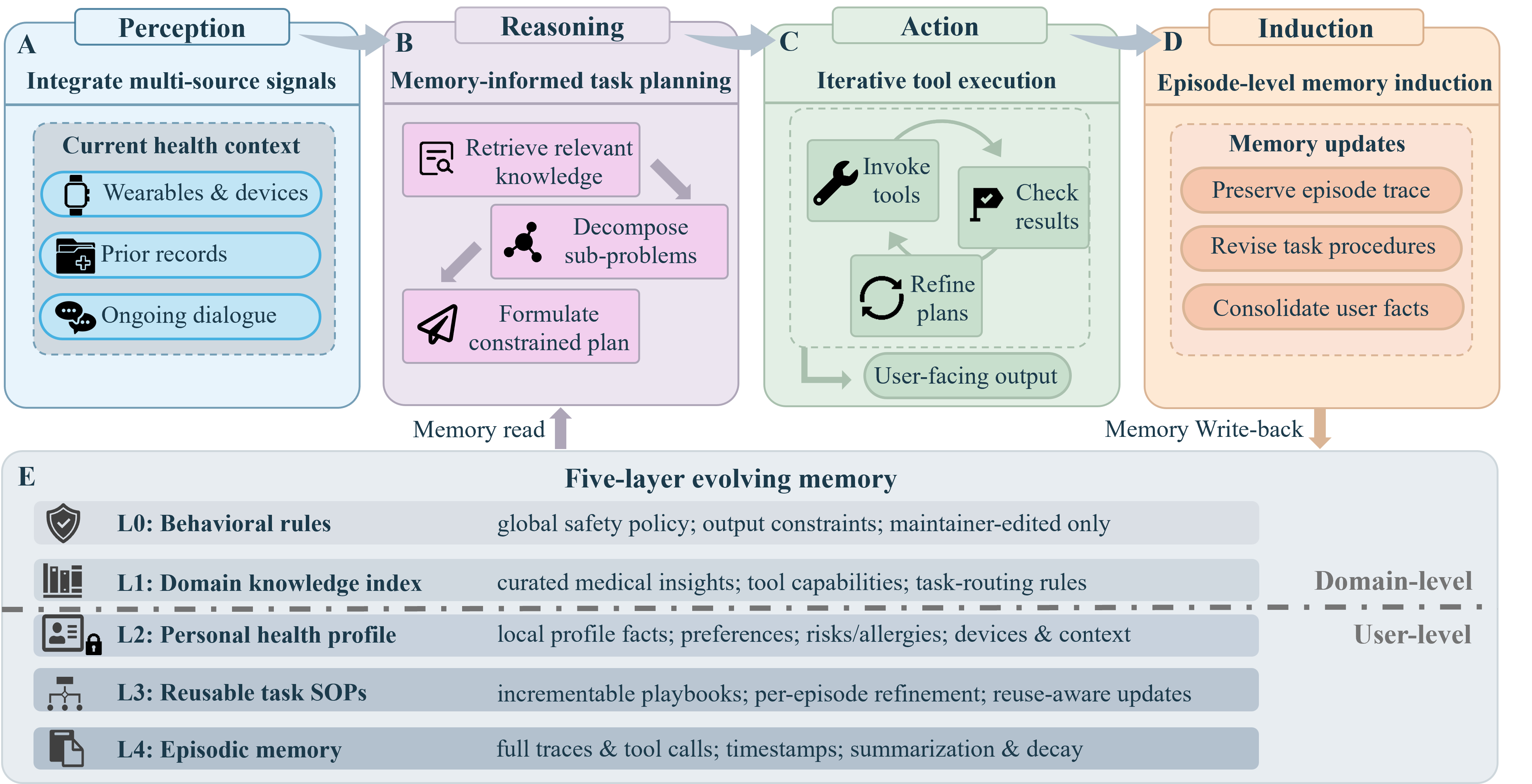
HealthClaw works in a loop every time you interact with it:
- Perception: It reads your current request and any useful signals (like wearables or recent logs).
- Reasoning: It plans what to do using general medical knowledge plus the specific things it knows about you.
- Action: It gives you advice or runs a step-by-step workflow (like checking a medication list or interpreting a report).
- Induction (the key step): After the conversation, it reviews what happened and decides what to keep for next time.
To make good choices about memory and privacy, HealthClaw uses five “folders,” each with a different purpose:
- L0: Behavioral rules (like safety and when to escalate). Think of these as the ground rules.
- L1: General medical knowledge. Like a shared textbook.
- L2: Your profile. Durable facts (e.g., allergies, long-term goals)—like your “ID and health card.”
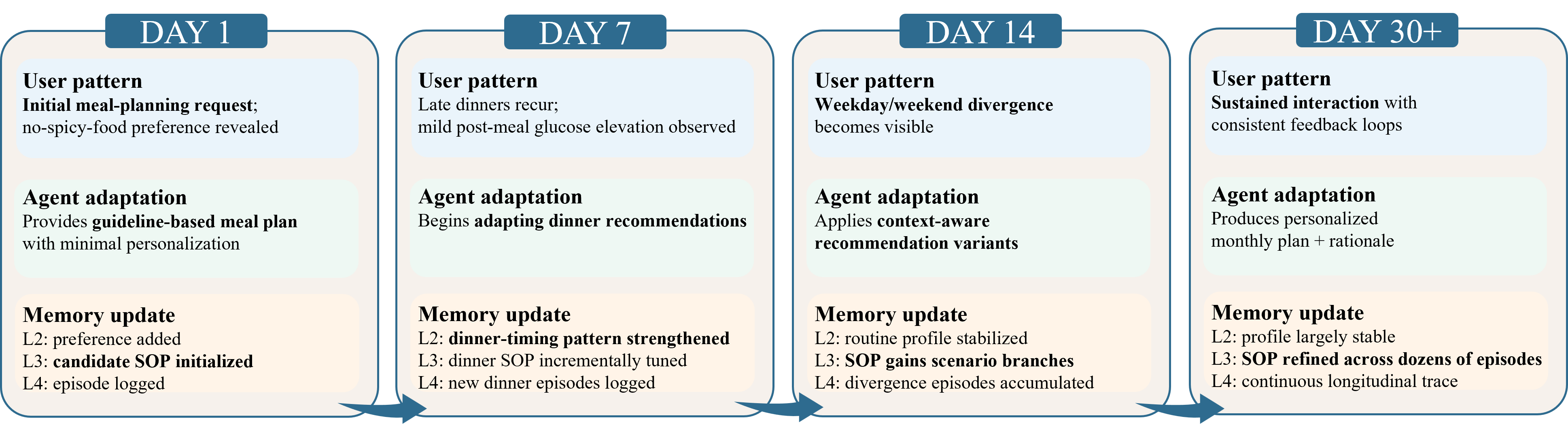
- L3: Reusable procedures. Step-by-step “recipes” it learns to help with repeated tasks (e.g., how you like to plan meals).
- L4: Episodic traces. A diary of what happened in a specific interaction.
Why this matters: a stable allergy and a one-time headache shouldn’t be treated the same. The allergy goes in the profile (L2), while the headache stays as a short-term diary entry (L4). An improved meal-planning trick becomes a reusable procedure (L3). Sensitive details can be kept local or not saved at all.
How they tested it
- Year-long simulations: They created 365-day “fake” (simulated) personal health timelines with daily routines, measurements, and follow-up questions. They asked 1,000 queries total: 900 regular support questions and 100 privacy tests.
- Comparisons: They tested three setups on the same questions:
- Current-only: The AI sees only the current question.
- Full-history: The AI sees the entire past history every time.
- HealthClaw: The AI uses its smart memory structure and selective retrieval.
- Grading: Answers were graded automatically by another AI using fixed rubrics (no human raters for these tests).
- Extra tasks: They also tried HealthClaw on nine different biomedical tasks (like reading medical images, using electronic records, and answering gene questions) to see if this architecture helps with many kinds of health evidence.
What did they find?
Here are the main results and why they matter:
- Long-term support improved a lot:
- On the 900 “longitudinal” questions:
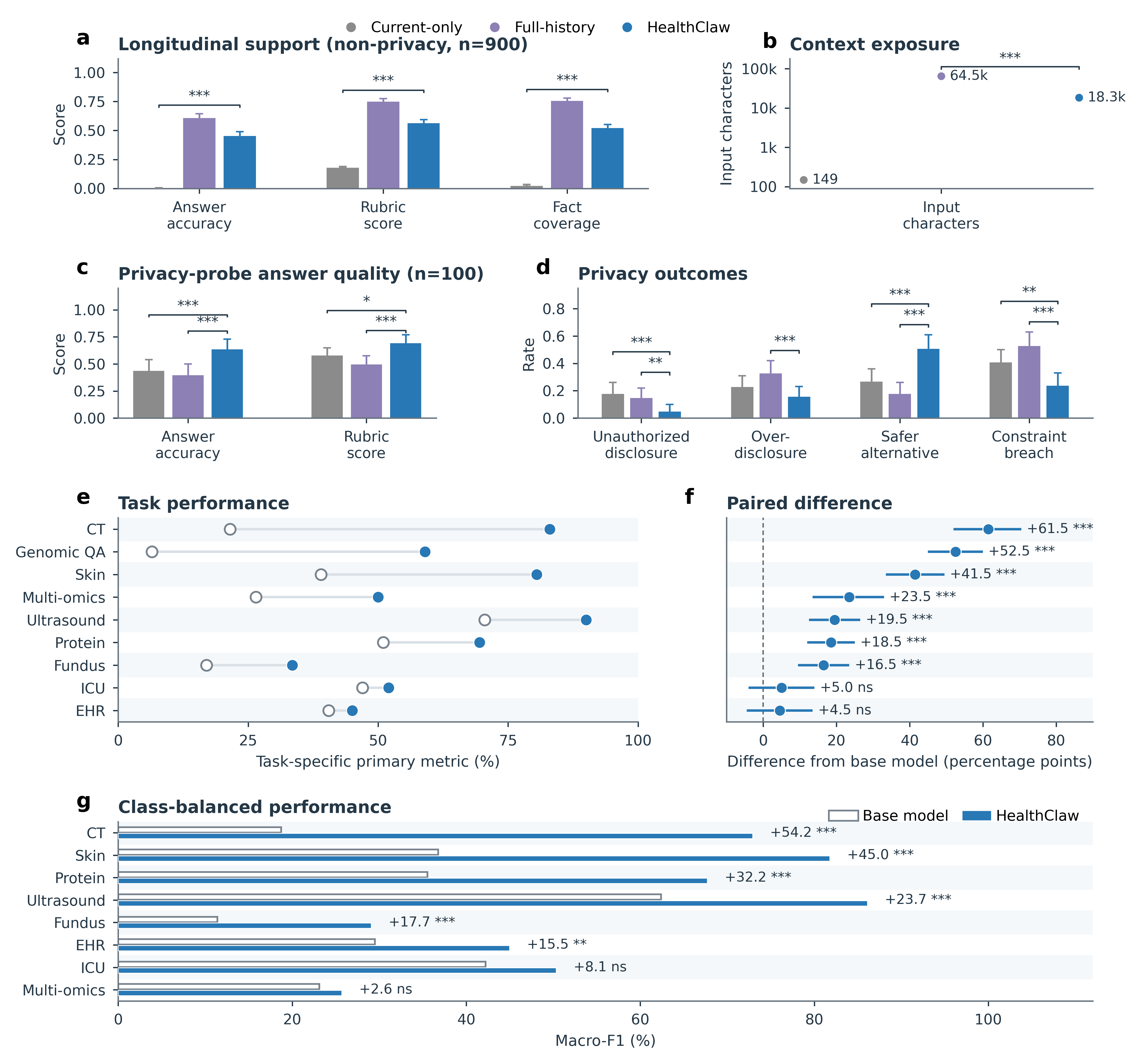
- Current-only accuracy: 0.2% (almost never correct).
- HealthClaw accuracy: 45.7% (much better).
- Full-history accuracy: 61.2% (best recall, but with big trade-offs below).
- HealthClaw needed far less text in the prompt than full-history (about 71.7% less), which means less noise, lower cost, and fewer chances to leak private details.
- Privacy got better:
- In 100 privacy test questions, HealthClaw gave the highest-quality answers and made fewer mistakes with private info:
- Unauthorized disclosure happened in 5% of HealthClaw’s answers, vs 18% (current-only) and 15% (full-history).
- It offered safer alternatives more often when direct disclosure was not appropriate (51% vs 27% and 18%).
- It broke constraints less often (24% vs 41% and 53%).
- Across nine biomedical tasks:
- HealthClaw increased the main performance measure by an average of 27 percentage points.
- Seven out of nine tasks had statistically significant gains after correcting for multiple tests.
- Biggest jumps were in lung nodule CT classification (NoduleMNIST3D, +61.5 points), genomic Q&A (GeneTuring, +52.5), and skin lesion analysis (PAD-UFES-20, +41.5).
- Some tasks showed smaller or non-significant improvements, like ICU SOFA prediction (+5.0) and diabetes readmission (+4.5), reminding us that gains aren’t uniform.
- A noted failure case (fatty-liver screening) showed that if early evidence is weak or biased, the system might reinforce a wrong guess—highlighting the need for better calibration and checks.
Why does this matter and what’s next?
- Why it matters:
- Real life is messy and changes over time. A helpful health AI shouldn’t start from scratch every day. HealthClaw shows a way to remember the right things, improve its “how-to” steps, and avoid oversharing private details.
- Selective memory is safer and more efficient than dumping your whole history into every answer.
- What it could change:
- Better long-term coaching and planning (e.g., sleep, activity, nutrition) that adapts to your actual routine.
- Smarter interpretation of mixed evidence (wearables, reports, lab trends, images) for more personalized guidance.
- Fewer privacy risks by pulling only the information needed for each task.
- Limits and next steps:
- These tests used simulations and an automated grader; there were no real-world trials in this paper.
- For clinical use, we need studies with patients and clinicians, strong privacy/security protections, and monitoring for mistakes, bias, or drift over time.
- The authors stress that HealthClaw is not proof of clinical effectiveness yet—it’s a promising design and open-source starting point for future, carefully governed studies.
HealthClaw’s code is publicly available, which means others can test it, improve it, and check it for safety. The big idea is simple: remember wisely, adapt carefully, and protect privacy—so support gets better the longer you use it.
Knowledge Gaps
Knowledge gaps, limitations, and open questions
Below is a single, consolidated list of what remains missing, uncertain, or unexplored in the paper, phrased to guide concrete next steps for future work.
- Prospective effectiveness: No real-world, longitudinal deployment studies (patient- or clinician-facing) to assess clinical outcomes, adherence, attrition, and sustained utility over months.
- Human evaluation: Reliance on an automated Qwen-3.7-based grader without human ratings or adjudication; unclear robustness of rubric scores to evaluator bias or drift.
- Simulation realism: Year-long trajectories are simulated; lack of validation that simulated routines, measurements, and privacy situations approximate real populations, comorbidities, and behavioral feedback.
- Generalizability across populations: No subgroup analyses (e.g., age, sex, race/ethnicity, language, socioeconomic status) to assess fairness, performance disparities, or disparate privacy risks.
- Memory induction transparency: The criteria and algorithms for deciding L2/L3/L4 writeback are not specified in detail (rule-based vs LLM heuristic vs learned), limiting reproducibility and auditability.
- Memory misclassification risk: No quantitative assessment of induction errors (e.g., stable facts mis-stored as episodic, sensitive content written to reusable procedures) or their downstream impact.
- Outdated/contradictory information: No mechanisms or metrics for detecting, deprecating, or reconciling stale, superseded, or contradictory profile facts and procedures over time.
- Error propagation and correction: No study of how incorrect advice or tool outputs propagate through memory layers and how the system detects and rectifies entrenched errors.
- Forgetting and pruning: Absence of retention schedules, pruning strategies, or human-in-the-loop controls for memory growth management and selective forgetting at L2–L4.
- Trust calibration of memory: No confidence/provenance tracking for items written to memory or weighting schemes to reflect uncertainty and source reliability.
- Feedback sparsity and delay: No evaluation under sparse, delayed, or noisy feedback—common in health self-management—and its effect on adaptation and decision quality.
- Adversarial and prompt-injection resilience: No threat model or tests for long-term prompt poisoning, tool-based attacks, or adversarial episodes that could manipulate L2/L3 content.
- Privacy governance enforcement: The paper asserts “local” L2 storage and selective retrieval, but lacks concrete enforcement mechanisms, access-control designs, or audit trail specifications.
- Privacy probe realism: Privacy tests disable writeback during probes; unclear how privacy behaves when writeback and normal operation are enabled.
- Formal privacy guarantees: No quantitative privacy frameworks (e.g., differential privacy, k-anonymity), reidentification testing, or formal leakage audits beyond rubric-based outcomes.
- Regulatory pathways: No mapping of the agent’s features to specific regulatory categories (e.g., CDS vs SaMD) or evidence requirements under FDA/EMA-type guidance.
- Auditability and user consent: Unspecified user interfaces for consent, granular sharing controls, memory-item review/approval, redaction, and right-to-delete workflows.
- Cross-identity boundaries: Limited evaluation of cross-identity leakage; no treatment of multi-user or family/caregiver scenarios, shared devices, or account linking.
- Multilingual and cultural context: No experiments in non-English settings or culturally diverse norms for advice and disclosure.
- EHR/device interoperability: No implementation details for integrating with FHIR/EHRs and heterogeneous wearable data sources, including provenance, synchronization, and conflict resolution.
- Knowledge updates: No process for keeping L0/L1 (safety rules, medical knowledge) current with evolving guidelines; no detection of outdated clinical knowledge.
- Safety and escalation validation: L0 behavioral rules and escalation conditions are not empirically validated against clinician-accepted pathways or outcome-based safety endpoints.
- Biomedical task confounding: Improvements may stem from task-specific tools close to benchmark sources; absence of same-model ablations or tool-free baselines to isolate HealthClaw’s contribution.
- External validity of task suite: Nine tasks (200 cases each) may not reflect clinical variability, prevalence, or class imbalance; selection and dataset shifts are not examined.
- Handling tool errors: No systematic study of how the agent detects, calibrates, or downweights erroneous or low-quality tool outputs across sessions.
- Counter-evidence requirements: The BEHSOF failure case reveals feedback-loop risks; no general mechanism to require strong counter-evidence before reinforcing prior labels across episodes.
- Distribution shift robustness: No evaluation under temporal, demographic, or device-driven shifts; stability under real-world drift is untested.
- Performance–cost–latency trade-offs: Context exposure is measured in characters, but not end-to-end latency, tokens, compute cost, memory footprint, or energy use, particularly at scale.
- Scalability and multi-year durability: No tests of memory growth, retrieval efficiency, or induction cost over multi-year histories and many users.
- On-device vs cloud constraints: No exploration of privacy–latency trade-offs for on-device L2 storage, limited compute, and intermittent connectivity.
- Explainability and user trust: No standardized explanations for retrieved memory items or tool routes; lack of user-facing rationales that build trust in longitudinal decisions.
- Comparative baselines: Only “current-only” and “full-history” prompting are compared; missing comparisons to state-of-the-art long-term memory/RAG systems (e.g., MemGPT, GraphRAG) under identical backbones.
- Robustness to missingness: No tests where crucial signals (e.g., wearables, labs) are missing or inconsistent, nor strategies for imputation or conservative fallback.
- Multi-objective planning: Unaddressed trade-offs between goals (e.g., privacy, safety, personalization, burden) and how the agent balances them over time.
- Governance of self-evolution: Lack of formal policies for when the system is allowed to alter reusable procedures (L3), and how changes are reviewed, versioned, and rolled back.
- Security posture: No penetration testing or security assessments for data at rest/in transit, key management, or incident response in multi-surface deployments.
- Ethical oversight: No plan for continuous monitoring, auditing, and post-deployment surveillance of harms, including processes for incident reporting and remediation.
- Reproducibility details: The public code is cited, but missing component-level ablations (e.g., disabling induction, L2 vs L3 only) to attribute gains and guide minimal viable designs.
- Longitudinal learning curves: No measurement of how performance improves with additional episodes (sample efficiency), plateaus, or degrades after saturation.
- Outcome alignment: Benchmarks emphasize answer correctness and classification metrics; downstream patient-centered outcomes (symptom improvement, engagement, safety events) are not measured.
Practical Applications
Based on the paper’s contributions—a closed-loop agent with governed, self-evolving memory (L0–L4), selective retrieval and writeback, tool-based execution, and demonstrated gains in longitudinal support and privacy—below are practical, real-world applications mapped to sectors, with feasibility categorizations and key dependencies.
Immediate Applications
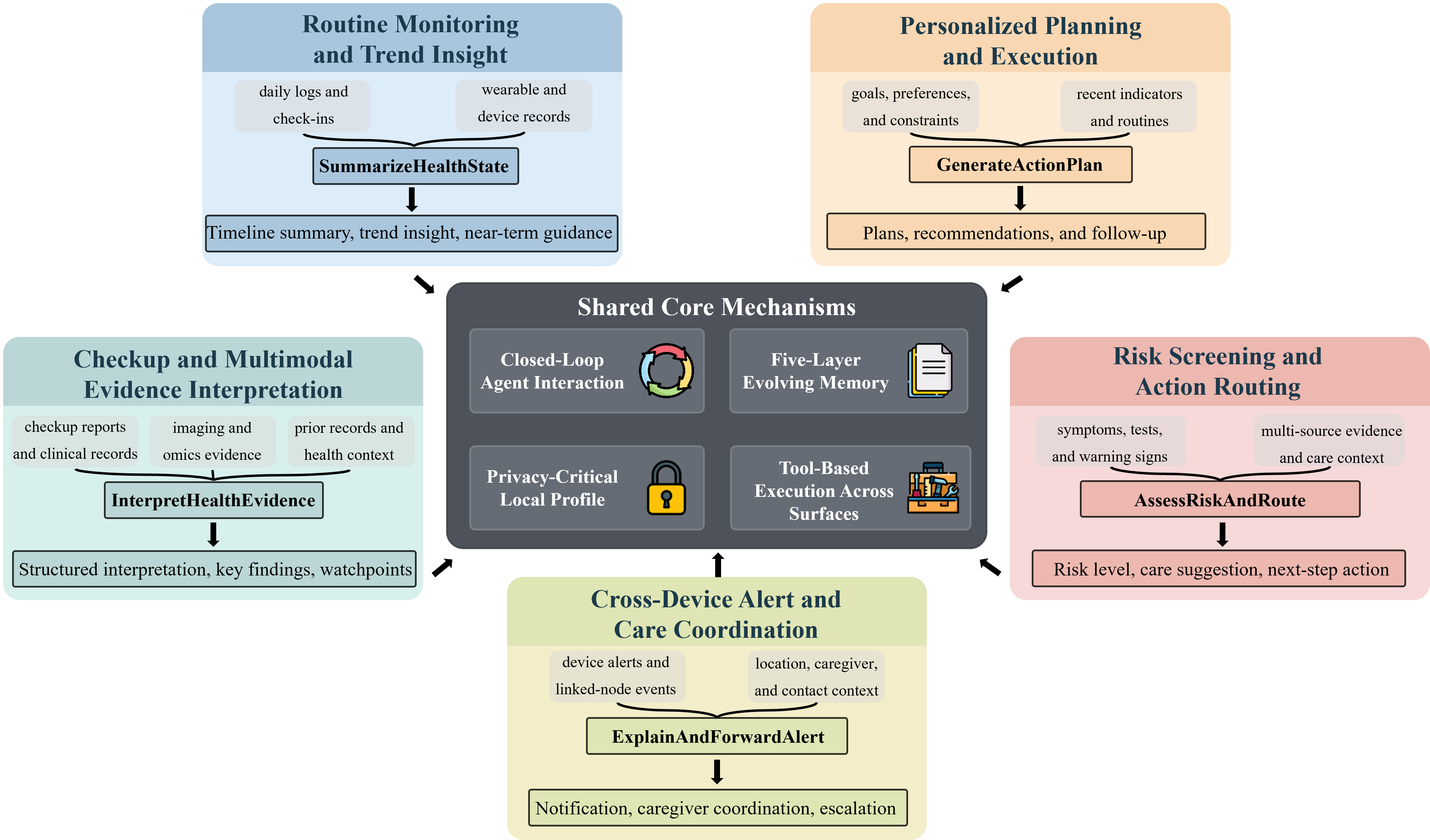
- Privacy-aware personal health assistants for wellness apps
- Sector: Consumer health software
- Use case: Deliver longitudinally personalized advice (diet, sleep, exercise) that adapts to routines and preferences using L2 (profile facts) and L3 (reusable SOPs), while restricting disclosure of sensitive details and minimizing prompt context.
- Potential tools/workflows: Wearable data ingestion; trend summarizer; meal-planning SOP builder; medication list manager; interaction checker; local encrypted L2 store; induction module to consolidate facts/procedures after each episode.
- Assumptions/dependencies: User consent and secure on-device/edge storage; reliable wearable APIs; clear non-clinical (wellness) scope and disclaimers; robust governance rules in L0.
- Chronic condition self-management (non-diagnostic)
- Sector: Healthcare (patient engagement), Consumer health
- Use case: Longitudinal support for diabetes, hypertension, asthma (e.g., reminders, adherence tracking, symptom diaries, trend-based nudges) with evolving SOPs and minimized exposure of sensitive data.
- Potential tools/workflows: Indicator tracking tool; calendar/smartphone reminders; escalation rules; interaction checking for OTC meds.
- Assumptions/dependencies: Categorized as general wellness or low-risk; clinical claims avoided without validation; configurable thresholds; multilingual support desirable.
- Privacy-aware health Q&A with safer alternatives
- Sector: Consumer health, Enterprise support
- Use case: Answer sensitive questions while limiting unnecessary disclosure, avoiding cross-identity leakage, and offering safer alternatives when disclosure is inappropriate (as demonstrated in privacy probes).
- Potential tools/workflows: L0 safety rules; privacy-probe guardrails; writeback suppression for sensitive episodes; retrieval filters limiting L2 exposure.
- Assumptions/dependencies: Well-defined privacy policies; strong identity and access management; audit logs.
- Cross-device alerts and care coordination
- Sector: Telehealth, Healthcare IT
- Use case: Interpret abnormal wearable/IoT signals and route alerts to caregivers, family, or patient portals with configurable SOPs and escalation conditions.
- Potential tools/workflows: Alert router; messaging and patient portal integrations; SOPs for escalation; consent management.
- Assumptions/dependencies: Integration with messaging/EHR APIs (e.g., FHIR-compliant endpoints for non-diagnostic notifications); thresholds tuned for false-alarm mitigation; user consent for sharing.
- Multimodal personal record summarization
- Sector: Patient engagement, Personal Health Records (PHRs)
- Use case: Combine imaging reports, labs, wearable trends, and self-reports into lay-friendly, longitudinal summaries with selective retrieval to reduce context cost and data exposure.
- Potential tools/workflows: Report interpreter; RAG for medical knowledge; induction to update stable facts vs. episodic traces.
- Assumptions/dependencies: Patient-controlled data access; privacy-preserving local processing; provenance and disclaimers.
- Developer SDK for governed longitudinal memory
- Sector: Software/DevTools
- Use case: Offer APIs for L2–L4 stores with read/write policies, induction hooks, and retrieval filters to add longitudinal personalization and privacy control to health apps.
- Potential tools/workflows: Memory governance library; policy templates; unit tests for writeback decisions; prompt-cost budgeting (leveraging the paper’s demonstrated ~71.7% context reduction vs. full-history prompting).
- Assumptions/dependencies: Language-model agnostic design; platform-specific secure storage; developer documentation and examples.
- Academic benchmarking and method development
- Sector: Academia
- Use case: Reproduce and extend the paper’s synthetic year-long benchmark and privacy probes; study memory governance, induction strategies, and tool routing across tasks (imaging, omics, signals).
- Potential tools/workflows: HealthClaw open-source repo; evaluators with rubric-based grading; ablations (e.g., different induction criteria, retrieval strategies).
- Assumptions/dependencies: Compute resources; IRB/ethics for prospective datasets; synthetic data generation reproducibility.
- Insurance wellness programs with data minimization
- Sector: Insurance/Insurtech
- Use case: Offer personalized lifestyle nudges and habit tracking without transferring raw identifiable health data by retaining sensitive profiles locally and sharing only necessary aggregates.
- Potential tools/workflows: On-device L2 storage; consent-controlled data summaries; privacy-aware API boundaries; audit trails.
- Assumptions/dependencies: Regulatory compliance (e.g., HIPAA/GDPR); explicit user opt-in; clear benefit design and incentives.
- Workplace wellness and student well-being programs
- Sector: Education, HR/Corporate wellness
- Use case: Longitudinal coaching and stress/sleep support with strict privacy boundaries and opt-in participation.
- Potential tools/workflows: Trend insights; SOPs for scheduling; anonymized aggregate reporting for organizations.
- Assumptions/dependencies: Data minimization; consent and transparency; separation of individual and organizational data.
Long-Term Applications
- Regulated clinical decision support with EHR integration
- Sector: Healthcare/Clinical software
- Use case: Memory-governed CDS for longitudinal risk screening, triage, medication reconciliation, and interpretation of evolving records; selective retrieval to reduce irrelevant/sensitive context.
- Potential tools/workflows: FHIR/EHR integrations; task-specific tools for imaging, lab trends, and clinical prediction; auditability of writeback decisions; clinician-in-the-loop review.
- Assumptions/dependencies: Prospective trials (SPIRIT-AI, CONSORT-AI, DECIDE-AI); FDA/CE marking for intended use; safety monitoring, versioning, and post-market surveillance.
- Remote patient monitoring with closed-loop care pathways
- Sector: Telehealth, Care management
- Use case: Detect patterns (e.g., heart failure weight changes, COPD exacerbations) and route to standardized care SOPs with configurable escalation and feedback-induced adjustments.
- Potential tools/workflows: RPM dashboards; nurse call center workflows; configurable L0 safety rules and escalation SOPs; integration with device vendors.
- Assumptions/dependencies: Clinical protocols; alarm fatigue mitigation; liability frameworks; equitable access and calibration.
- Multimodal precision medicine assistance
- Sector: Oncology, Genomics, Translational research
- Use case: Integrate multi-omics, imaging, and longitudinal EHR signals to recommend next tests or stratify risk using tool outputs (e.g., DeepLoc, MLOmics, GeneTuring-like modules) with calibrated evidence.
- Potential tools/workflows: Tool routers; evidence calibration and uncertainty reporting; counter-evidence checks to avoid label reinforcement (addressing failure mode noted in BEHSOF).
- Assumptions/dependencies: Clinical validity of tools; standardized data pipelines; interpretability; multidisciplinary oversight.
- Autonomous operational workflows in clinics
- Sector: Healthcare operations
- Use case: Automate routine, longitudinal tasks—pre-visit planning, refills, vaccination reminders, care gap closure—using evolving SOPs and selective retrieval to minimize sensitive data movement.
- Potential tools/workflows: Scheduling and eligibility checks; payer rules; secure messaging; audit logs for SOP changes via induction.
- Assumptions/dependencies: Interoperability with payers/EHRs; governance of automation; human oversight and rollback mechanisms.
- Federated, privacy-preserving personal agents
- Sector: Health IT, Data platforms
- Use case: Distribute agents across user devices and health systems with federated learning and secure computation to improve SOPs without centralizing raw personal data.
- Potential tools/workflows: Federated orchestration; differential privacy; secure enclaves; policy-compliant aggregation.
- Assumptions/dependencies: Mature FL infrastructure; standardization of model and memory updates; legal agreements across institutions.
- National/organizational guidelines for memory governance
- Sector: Policy/regulation
- Use case: Establish standards for longitudinal AI memory (what to persist, for how long, how to disclose), procurement criteria for health agents, and evaluation protocols for privacy and safety.
- Potential tools/workflows: Conformance test suites; memory-governance “fact labels”; certification programs aligned with CDS guidance.
- Assumptions/dependencies: Multistakeholder consensus; alignment with existing guidance (FDA CDS, SPIRIT-AI/CONSORT-AI/DECIDE-AI); international harmonization.
- Aging-in-place assistive robotics and smart homes
- Sector: Robotics, Home health
- Use case: Robots and home hubs use governed memory to adapt routines, prompt medications, and coordinate with caregivers across devices while limiting data exposure.
- Potential tools/workflows: Voice/dialogue interfaces; device orchestration; escalation SOPs; privacy-preserving on-device memory.
- Assumptions/dependencies: Robust speech and perception; safety certifications; fail-safe designs and liability coverage.
- Payer care management and dynamic risk programs
- Sector: Insurance/Payers
- Use case: Longitudinal risk stratification and outreach sequencing using memory-curated aggregates and SOPs for engagement.
- Potential tools/workflows: Risk routing; intervention scheduling; outcomes tracking with memory-induced updates.
- Assumptions/dependencies: Fairness auditing; consented data use; regulatory approvals for automated outreach.
- Longitudinal case simulators and AI safety curricula
- Sector: Academia/Medical education
- Use case: Train clinicians and data scientists on longitudinal decision-making, memory governance, and privacy-aware AI using year-long synthetic or de-identified trajectories.
- Potential tools/workflows: Scenario generators; rubric-based evaluation; ablation environments for governance policies.
- Assumptions/dependencies: Access to educational datasets; alignment with curricula; faculty training.
- Community-vetted marketplace of reusable SOPs
- Sector: Software ecosystem, Professional societies
- Use case: Share and version SOPs (e.g., lifestyle plans, triage pathways) that improve via induction with feedback from deployments; support provenance and rollback.
- Potential tools/workflows: SOP registries; version control; performance telemetry; governance committees.
- Assumptions/dependencies: Quality control and clinical governance; IP and licensing models; interoperability standards.
Notes on feasibility across applications:
- Many clinical uses require prospective evaluation and regulatory clearance; the paper’s evidence is from offline, synthetic or benchmark datasets and cannot be taken as clinical effectiveness.
- Success depends on accurate device data, robust identity/access control, secure local storage for L2, configurable L0 rules, calibrated tools, and careful induction policies to avoid reinforcing bias.
- Interoperability (e.g., FHIR, SMART on FHIR), explainability, multilingual support, and strong consent/data governance will materially impact deployment viability.
Glossary
- Action spaces: The set of permissible actions an agent can take within a defined environment or workflow. "Medical-agent research has also begun to formalize action spaces and workflow evaluation"
- Agentic routing: An agent-driven process that selects and orchestrates data sources, tools, or workflows to solve tasks. "the evaluation supports agentic routing and evidence integration rather than zero-shot clinical generalization."
- Benjamini--Hochberg FDR correction: A multiple-comparison procedure controlling the expected proportion of false discoveries (false positives). "Significance marks denote Benjamini--Hochberg FDR-corrected paired tests within each metric family."
- Clinical decision-support systems: Software that assists clinicians with assessments, triage, and recommendations using patient data and medical knowledge. "Symptom checkers and clinical decision-support systems structure assessment and triage"
- Closed-loop interaction: A cycle where perception, reasoning, action, and feedback (or induction) continuously inform subsequent decisions. "Unified architecture of HealthClaw: closed-loop interaction and five-layer evolving memory."
- Constraint violations: Instances where outputs breach predefined rules, safety boundaries, or policies. "Constraint violations occurred in 24\% of HealthClaw responses, compared with 41\% for current-only prompting and 53\% for full-history prompting."
- Digital biomarkers: Digitally collected measures (often via wearables) that serve as indicators of health or disease. "Wearable sensors, digital biomarkers and mobile self-management programmes have made these patterns easier to observe"
- Distribution shift: A change between training and deployment data distributions that can degrade model performance. "stability under sparse feedback, contradiction and distribution shift."
- Electronic health record (EHR): A digital system for storing and managing patients’ medical histories, diagnoses, and treatments. "structured electronic health record (EHR) prediction"
- Episodic memory: Stored traces of individual past interactions, including context and outputs, used for future reasoning. "L2 (privacy-critical personal profile), L3 (reusable task standard operating procedures, SOPs) and L4 (episodic memory) are personalized user-level layers."
- Episodic trace: A time-stamped record of a single interaction preserved for potential future reference. "remain as an episodic trace or be excluded from future use."
- False-discovery-rate correction: Statistical adjustment that controls the expected fraction of false positives among significant findings. "seven gains remained significant after false-discovery-rate correction."
- Foundation models: Large, pre-trained models adaptable to many downstream tasks through prompting or fine-tuning. "Foundation models and LLMs now support medical question answering, diagnostic reasoning and conversational diagnosis"
- Full-history prompting: Supplying the entire prior dialogue or record as context for a new query. "Full-history prompting received the complete visible pre-query dialogue and provided the strongest recall comparator."
- GeneTuring: A benchmark for genomic knowledge and question answering used to assess model capabilities. "The largest gains were observed for NoduleMNIST3D, GeneTuring and PAD-UFES-20"
- Governed memory retrieval: Controlled access to memory elements under explicit rules to manage relevance, safety, and privacy. "HealthClaw used a profile-initialized longitudinal agent with governed memory retrieval."
- Long-term memory: Persistent storage that enables an agent to recall and use information across extended interactions. "Retrieval-augmented generation and long-term memory improve access to previous information"
- Macro-F1: The average F1 score computed independently for each class and then averaged, treating all classes equally. "Among the eight tasks with defined label options, macro-F1 improved significantly in six after FDR correction."
- McNemar tests: A statistical test for paired nominal data to detect differences in proportions (e.g., in binary outcomes). "binary metrics used exact McNemar tests."
- Memory writeback: The process of committing selected information from an interaction back into persistent memory stores. "Memory writeback is determined by the expected future role of each item."
- Multi-omics: Integration of multiple “omics” data types (e.g., genomics, transcriptomics, proteomics) for analysis or prediction. "Task families included fundus imaging, skin imaging, CT, ultrasound, structured electronic health record (EHR) prediction, protein sequence analysis, multi-omics classification and gene question answering."
- NAFLD: Non-alcoholic fatty liver disease, a condition involving excess fat accumulation in the liver not due to alcohol. "The base model already favoured NAFLD, and weak or poorly calibrated evidence retrieved from memory and tools further reinforced this prior preference"
- NoduleMNIST3D: A 3D medical imaging benchmark for lung nodule classification used to evaluate model performance. "The largest gains were observed for NoduleMNIST3D, GeneTuring and PAD-UFES-20"
- Overdisclosure: Sharing more sensitive information than necessary in a given context. "unauthorized disclosure, overdisclosure, safer alternatives and constraint breaches."
- Paired bootstrap 95% confidence intervals: Non-parametric intervals derived by resampling paired observations to quantify uncertainty. "error bars denote paired bootstrap 95\% confidence intervals."
- Paired Wilcoxon signed-rank tests: A non-parametric test comparing paired samples to assess differences in distributions. "Continuous metrics used two-sided paired Wilcoxon signed-rank tests"
- Post-episode induction: A consolidation step after an interaction to decide what to retain, revise, or discard in memory. "Post-episode induction assigns each item a future role instead of appending the full dialogue to the next prompt."
- Privacy-critical personal profile: Sensitive, durable user information (e.g., conditions, allergies) stored with strict access controls. "L2 (privacy-critical personal profile), L3 (reusable task standard operating procedures, SOPs) and L4 (episodic memory) are personalized user-level layers."
- Privacy probes: Designed evaluations that test an agent’s ability to answer while minimizing unnecessary disclosure. "The benchmark contained 900 longitudinal support queries and 100 privacy probes."
- Privacy-preserving alternative: A response that meets the user’s needs while avoiding unnecessary exposure of sensitive data. "HealthClaw also offered a privacy-preserving alternative more often when direct disclosure was inappropriate (51\% versus 27\% and 18\%)."
- Reference-fact coverage: The proportion of ground-truth reference facts included in a model’s response. "reference-fact coverage rose from 0.027 to 0.524."
- Retrieval-augmented generation: A technique that augments generation by retrieving relevant knowledge to improve accuracy and grounding. "Retrieval-augmented generation and long-term memory improve access to previous information"
- Standard operating procedures (SOPs): Reusable, codified workflows for recurring tasks to ensure consistency and safety. "L3 (reusable task standard operating procedures, SOPs)"
- Task families: Groupings of tasks sharing similar data types and workflows for tool selection and routing. "Task families included fundus imaging, skin imaging, CT, ultrasound, structured electronic health record (EHR) prediction, protein sequence analysis, multi-omics classification and gene question answering."
- Task-tool router: A component that maps task context to an appropriate set of tools for execution. "a task-tool router mapped the visible task information to a task family"
- Tool-based execution: Performing parts of a workflow by invoking external tools or modules under the agent’s control. "tool-based execution across multiple surfaces."
- Tool invocation: Calling external tools during plan execution to obtain structured evidence or perform sub-tasks. "Action executes the plan iteratively through tool invocation, intermediate-result checking and plan refinement"
- Triage: The process of prioritizing patients or issues based on urgency and severity. "Symptom checkers and clinical decision-support systems structure assessment and triage"
- Unauthorized disclosure: Releasing sensitive information without appropriate authorization or necessity. "Unauthorized disclosure occurred in 5\%, 18\% and 15\% of responses, respectively."
- Zero-shot clinical generalization: Applying a model to clinical tasks it was not explicitly trained on without task-specific tuning. "the evaluation supports agentic routing and evidence integration rather than zero-shot clinical generalization."