- The paper introduces a GeV-scale axion model that uses charm coupling to eliminate leading isospin-violating operators and address strong CP issues.
- It employs QCD condensate dynamics and the SVZ sum rule to set precise parameters, ensuring perturbativity and compatibility with meson phenomenology.
- The model naturally suppresses dangerous Planck-scale PQ-breaking effects, yielding predictions testable through collider, astrophysical, and cosmological probes.
Naturally Quality-Safe GeV Axion with Charm Coupling: Technical Analysis
Overview and Motivation
The paper "Naturally quality-safe GeV axion with charm coupling" (2607.12956) proposes a novel solution to the strong CP problem in quantum chromodynamics (QCD) using a GeV-scale axion model, wherein Peccei-Quinn (PQ) symmetry breaking occurs at a scale fa∼O(1) GeV. This construction exploits QCD condensate dynamics to generate the axion and fundamentally differs from the standard 'invisible axion' paradigm (fa∼109–12 GeV), which is severely decoupled and presents detection challenges. The key advantage of the proposed framework is its resolution of both the axion quality problem and the structural isospin violation that plague earlier low-scale axion models.
Structural Isospin Problem: Diagnosis and Resolution
The Murayama model (Murayama, 5 Jan 2026) demonstrates that PQ symmetry broken by the QCD condensate, with direct coupling to light quarks (u,d,s), causes a problematic explicit breaking of SU(2)V isospin. Specifically, the PQ spurion IPQ induces a leading-order chiral perturbation theory (χPT) operator O1PQ, yielding a −15% π0--π± mass splitting and O(1) distortions in pion scattering amplitudes—both irreconcilable with experimental data.
The resolution advanced here is to couple the PQ scalar exclusively to the charm quark (fa∼109–120). Since the heavy-quark spurion does not enter the χPT Lagrangian for light mesons, this choice eliminates all isospin-violating operators at leading order. The PQ symmetry and charge assignments forbid bare charm mass terms while preserving Standard Model Yukawas for light quarks, thereby avoiding tree-level FCNCs and reconciling model building with observed low-energy QCD phenomenology.
Parameter Space and Model Construction
The self-consistency of the model relies on the SVZ sum rule for the charm condensate, relating the charm Yukawa fa∼109–121 to the PQ scalar mass fa∼109–122:
fa∼109–123
where fa∼109–124 GeVfa∼109–125. For fa∼109–126--fa∼109–127 MeV, fa∼109–128--fa∼109–129 is perturbative, u,d,s0--u,d,s1 GeV, and u,d,s2--u,d,s3 MeV. The axion-photon coupling u,d,s4 is substantial, u,d,s5 GeVu,d,s6, a direct consequence of the model’s KSVZ-like anomaly structure.
Axion Quality Problem: Natural Suppression
A central result is the suppression of Planck-suppressed PQ-breaking operators. For u,d,s7 GeV, even the dimension-six operator, u,d,s8, induces a shift u,d,s9, obviating the need for additional discrete symmetries (contrary to standard models requiring SU(2)V0 for safety). The quality problem is thus solved via scale selection alone.
Experimental and Cosmological Constraints
All ten major experimental, astrophysical, and cosmological constraints are satisfied for SU(2)V1--SU(2)V2 MeV. Key points include:
The predicted IPQ3 branching ratio at IPQ4 MeV (IPQ5) aligns with Belle II observation for IPQ6, accounting for the observed excess over SM expectations.
Phenomenological Signatures and Future Probes
The axion's strong photon coupling opens various detection channels:
- Neutral Meson Decays: IPQ7, IPQ8, searchable in fixed-target and collider setups (Belle II, BESIII, SHiP).
- Missing Energy Signals: IPQ9 yields a distinctive long-lived scalar escaping the detector, with decay length O1PQ0 tens to hundreds of meters.
Potential tension with NA64-e exclusions for axion-photon coupling is addressed; full interpretation requires dedicated simulations incorporating strong axion-nucleon interactions.
Theoretical Implications and Small Quartic Prediction
The model naturally predicts an anomalously small quartic coupling O1PQ1, far below the Coleman-Weinberg loop correction from the charm sector—this points toward a protecting symmetry, e.g., identifying the PQ scalar as a PNGB from a higher-scale O1PQ2 breaking.
Model extensions to the O1PQ3 and O1PQ4 quark are excluded by BBN and perturbativity, ensuring charm-specific phenomenology.
Outlook and Future Developments
The charm-coupled GeV axion paradigm offers a minimal, technically natural solution to the strong CP and quality problems. Characteristic signatures include:
- A negative O1PQ5, uniquely testable with future CMB-S4 sensitivity.
- Collider signatures through O1PQ6 and rare meson decay searches.
Future work will focus on:
- Precise Boltzmann calculations of cosmological signals.
- PNGB model completions for the small O1PQ7 issue.
- Lattice QCD computations for O1PQ8 mixing matrix elements.
- Continued Belle II analyses with kinematic discrimination between O1PQ9 and neutrino channels.
Conclusion
The GeV-scale charm-coupled axion model achieves a technically natural solution for both the CP and quality problems, with a viable parameter window tightly constrained yet phenomenologically rich. Its cosmological and collider signatures are accessible to current and upcoming experiments, and NP quartic predictions are amenable to future UV completions.
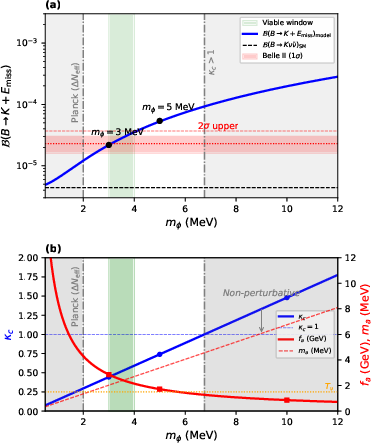
Figure 1: Total invisible branching ratio −15%0 as a function of −15%1, with Belle II measurement and theory constraints, indicating the viable window for −15%2--−15%3 MeV.