- The paper demonstrates that MCP-induced cooling in AGB stars significantly shortens the phase duration, enabling constraints on charges as low as 5×10⁻¹³.
- It employs detailed MESA simulations to model thermal emission processes like semi-Compton scattering and pair production under realistic globular cluster conditions.
- The derived R₂ parameter limits improve previous bounds by up to two orders of magnitude, impacting dark matter freeze-in and particle physics scenarios.
Millicharged Particle Constraints from Asymptotic Giant Branch Stars
Introduction and Motivation
The paper "Millicharged Particle Constraints from Asymptotic Giant Branch Stars" (2605.30422) develops a stringent probe of millicharged particles (MCPs) within the intermediate mass regime (10 keV≲mχ≲100 keV), leveraging the late-stage evolution of low-mass stars in globular clusters. MCPs are extensions of the Standard Model where new fermions χ charged under a hidden U(1)H, coupled to a kinetically mixed dark photon, acquire a small but nonzero electric charge (qe≪e). Such particles are generically motivated by failures of charge quantization in the SM or as dark matter candidates with a "freeze-in" cosmological production channel.
The work exploits the sensitivity of the R2 parameter---the number ratio of asymptotic giant branch (AGB) to horizontal branch (HB) stars in globular clusters---which directly counts population ratios tracing post-core-helium-burning stellar lifetimes. MCP-induced cooling alters these lifetimes, especially due to thermal emission processes that act differentially in distinct evolutionary phases, thus allowing precise exclusion limits on the MCP parameter space. Notably, the obtained constraints reach charges as small as q≃5×10⁻¹³ and exceed previous stellar bounds by up to two orders of magnitude in the $10 - 100$ keV mass window.
MCP Cooling and Evolutionary Impact in Globular Cluster Stars
MCPs couple weakly to SM charges and are thermally produced in stellar interiors, opening additional energy-loss channels beyond neutrino or standard photon emission. The two dominant emission processes relevant in post-core-helium-burning stars are:
- Semi-Compton scattering: e−+γ→e−+χ+χ
- Pair production: e−+e+→χ+χ
The volumetric cooling rates for these processes scale as q2 and are highly sensitive to the local temperature and density. Compton emission grows rapidly (χ0) in the relevant regime and is Boltzmann suppressed for large χ1; for χ2 (HB) and χ3 (AGB), this suppression is phase-dependent. Since the AGB phase features a helium-burning shell with higher temperatures than the HB phase, MCP emission is more efficient in the AGB, leading to a larger reduction in that phase’s duration and thereby affecting χ4 much more than traditional probes.
This effect is probed via MESA simulations with realistic parameters for stellar mass (χ5), metallicity (χ6), and helium abundance (χ7), representative of old globular cluster populations. The simulation pipeline includes fully consistent treatment of MCP energy losses and an accurate treatment of major sources of model uncertainty (nuclear rates, mixing prescriptions, timestep resolution).
χ8 as an Astrophysical Constraint on MCPs
The χ9 parameter is defined as
U(1)H0
where U(1)H1 is the number of stars and U(1)H2 the phase lifetime. Population counts in globular clusters thus act as direct integrals over the temporal durations of these respective stellar evolutionary phases. By simulating full stellar evolution tracks inclusive of MCP cooling, the authors compute theoretical PDFs for the luminosity difference U(1)H3, identifying HB and AGB phases as distinct peaks and extracting U(1)H4 as the ratio of their areas.
MCPs with U(1)H5 and U(1)H6 shorten the AGB much more than the HB, drastically reducing U(1)H7 in violation of observational constraints. By requiring that theoretical predictions not undercut the measured U(1)H8 by more than U(1)H9 (qe≪e0), exclusion regions in qe≪e1 can be robustly derived.
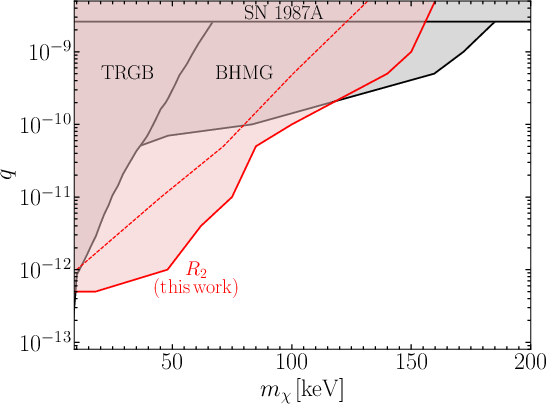
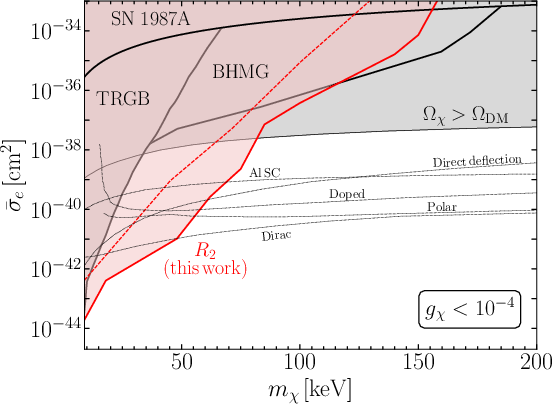
Figure 1: Observational and theoretical constraints on the fractional MCP charge qe≪e2 as a function of MCP mass qe≪e3, compared to previous astrophysical and experimental bounds.
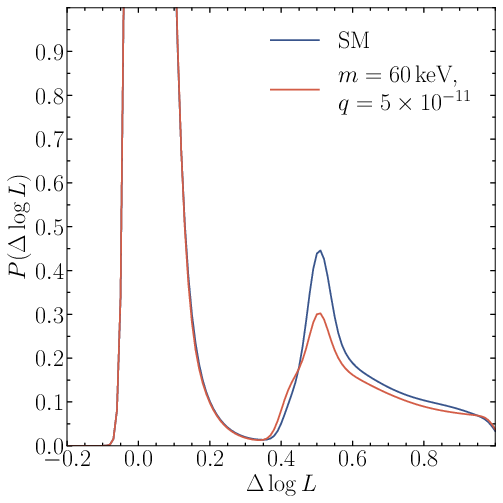
Figure 2: Theoretical PDFs for qe≪e4, showing the reduction of the AGB luminosity peak relative to HB for given MCP parameters.
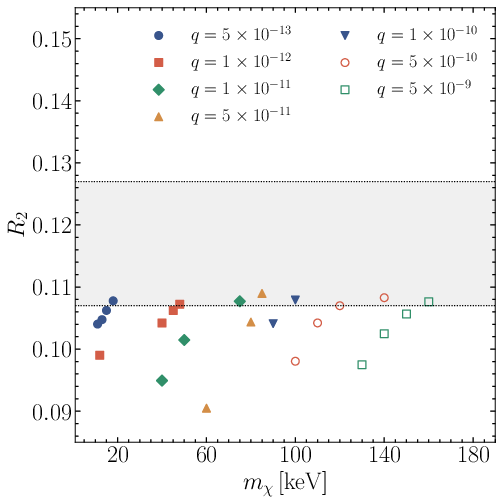
Figure 3: Predicted qe≪e5 as a function of qe≪e6 for selected qe≪e7. The 95% confidence region for observed qe≪e8 is shaded, with exclusions for parameters yielding smaller qe≪e9.
Numerical Results and Comparison with Other Constraints
The analysis yields several key results:
- Exclusion Reach: For R20, MCP charges as low as R21 are excluded—an improvement by factors of R22–R23 compared to red giant [Fung et al., (Fung et al., 2023)] and SN1987A bounds in the same mass window.
- Systematics: The authors implement stringent control over stellar modeling uncertainties by repeated simulations across timestep ranges, nuclear reaction rates, and convective prescriptions. Even with maximal systematic shifts (red dashed line in Figure 1), the constraints remain substantially stronger than all previous bounds.
- Complementarity: At R24, the red giant branch tip provides superior exclusion; above R25, supernova cooling dominates. The R26 probe is uniquely sensitive to the R27–R28 keV window, an intermediate regime previously poorly constrained.
Implications for Dark Matter and Particle Physics
The astrophysical sensitivity to fractional electric charges at the R29 level directly impacts scenarios with freeze-in production of millicharged dark matter. The cosmological overclosure bound, under typical hidden sector couplings (q≃5×10−130), sets q≃5×10−131 as excluded for q≃5×10−132 keV. The q≃5×10−133 constraint improves upon this by two orders of magnitude in the relevant mass regime, excluding MCPs as the dominant dark matter component in this window.
Sensitivity overlaps with future direct detection searches that target freeze-in dark matter parameter space using semiconductor, polar, and superconductor-based low-threshold detectors, as highlighted by projected experiment curves in Figure 1.
Theoretical and Experimental Outlook
This analysis underscores the importance of coupling precision astrophysical modeling with population-level stellar evolution data to probe dark sector candidates (MCPs, axions, dark photons, etc.) in regions inaccessible to laboratory searches. The q≃5×10−134 methodology is robust to modeling uncertainties when simulation chains and population counts are treated self-consistently, and it can be systematically extended to other weakly coupled light species with relevant stellar emission channels.
Future improvements will require:
- Further reduction in modeling systematics, chiefly those associated with the q≃5×10−135Cq≃5×10−136O reaction rate, mixing prescriptions, and envelope convection.
- Cross-validation with improved cluster photometry and updated catalogs to ensure population statistics robustness.
- Synthesis with cosmological and experimental search strategies for a comprehensive exclusion of weakly-interacting light new physics in the sub-MeV mass scale.
Conclusion
Through detailed modeling of globular cluster stellar evolution—including advanced simulation of MCP cooling—the q≃5×10−137 parameter sets the strongest available exclusion limits on millicharged particles in the q≃5×10−138–q≃5×10−139 keV mass range, with sensitivity to fractional charges $10 - 100$0. These bounds close critical gaps in cosmological dark matter parameter space and surpass all prior astrophysical constraints by up to two orders of magnitude. The approach establishes a new standard for indirect detection of weakly-interacting low-mass particles through population astrophysics and motivates further synergy with next-generation dark matter and stellar survey programs.