- The paper derives a robust lower bound on the QCD axion mass of approximately 0.5 neV by scanning extensive heterotic compactifications of Calabi–Yau manifolds.
- The analysis shows that mixing between model-independent and model-dependent axions cannot lower the mass below the MI value due to the quadratic summing of decay constants.
- The study highlights cosmological and experimental implications by narrowing the axion mass window and minimizing typical cosmological tensions in axiverse scenarios.
Heterotic String Theory Compactifications and the QCD Axion Mass
Motivation and Context
Heterotic string theory provides a compelling top-down framework for addressing fundamental questions related to particle physics and cosmology. The QCD axion, invoked to solve the Strong CP problem and as a dark matter candidate, is generically realized in string compactifications. However, the axion's mass is undetermined in bottom-up models, motivating the derivation of robust, theoretically grounded mass ranges. This work addresses a crucial question: How sharply can string theory, and in particular weakly coupled heterotic constructions, restrict the axion parameter space?
Axion Sector in Heterotic Compactifications
Heterotic E8×E8 string theory, compactified on Calabi–Yau (CY) threefolds, gives rise to axions through the dimensional reduction of the Kalb–Ramond field and its ten-dimensional dual. Upon compactification, there emerges a model-independent (MI) axion—with a decay constant set entirely by the GUT gauge coupling αGUT—and h1,1 model-dependent (MD) axions associated with harmonic 2-cycles. The MI axion couples universally to all unbroken gauge groups via the Green–Schwarz mechanism, while MD axions can couple non-universally, with precise couplings determined by the gauge bundle and topology of the manifold.
The decay constant of the MI axion is
fMI=2παGUTMP,
and for αGUT−1 in the unification-preferred range [25,30], this fixes the MI axion mass to [0.5,0.8] neV under QCD scaling.
Scan and Structure of the Compactification Landscape
The study systematically analyzes ∼3×10⁷ compactifications from the Kreuzer–Skarke (KS) database, covering a broad set of CY hypersurfaces in toric varieties and, independently, favorable complete intersection Calabi–Yau (CICY) threefolds. The analysis imposes standard consistency constraints: existence of a perturbative Kähler moduli region (the SKC), compatibility with unification (V6∼αGUT−1 in string units), and α′-expansion under control. For each αGUT0, the scan is topologically exhaustive for αGUT1, with localized sampling for higher αGUT2.
The search identifies only 2027 heterotic-compatible CY manifolds, with a sharp reduction in viable models as αGUT3 increases Figure 1.
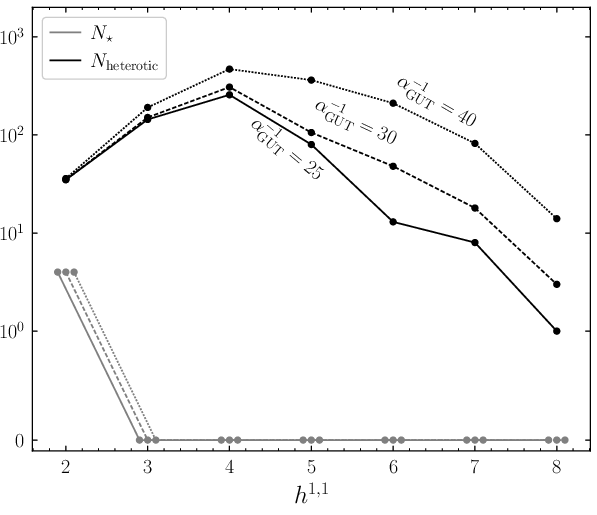
Figure 1: The number αGUT4 of Kreuzer–Skarke Calabi–Yau compactifications compatible with heterotic string theory as a function of αGUT5, demonstrating the strong constraints imposed by requiring control over the Kähler cone and unification.
Lower Bound on the QCD Axion Mass: Geometric Origin and Robustness
A central result is the derivation of a robust lower bound on the QCD axion mass in heterotic compactifications, αGUT6 neV for αGUT7:
- This bound reflects the fact that the MI axion, with decay constant set by αGUT8, always contributes to the QCD anomaly; mixing with light MD axions can only increase the QCD axion mass, as a consequence of the quadratic sum rule for decay constants.
- For all but a handful of geometries (six out of αGUT9 viable compactifications), the QCD axion is essentially the MI axion and its mass equals the MI value throughout the moduli space satisfying perturbative control.
- Achieving significant mixing between MI and MD axions that would lower the QCD axion mass below the MI value would require tuning a worldsheet instanton action h1,10, corresponding to an individual curve volume substantially exceeding the compactification volume allowed under unification constraints—a configuration not realized in this ensemble.
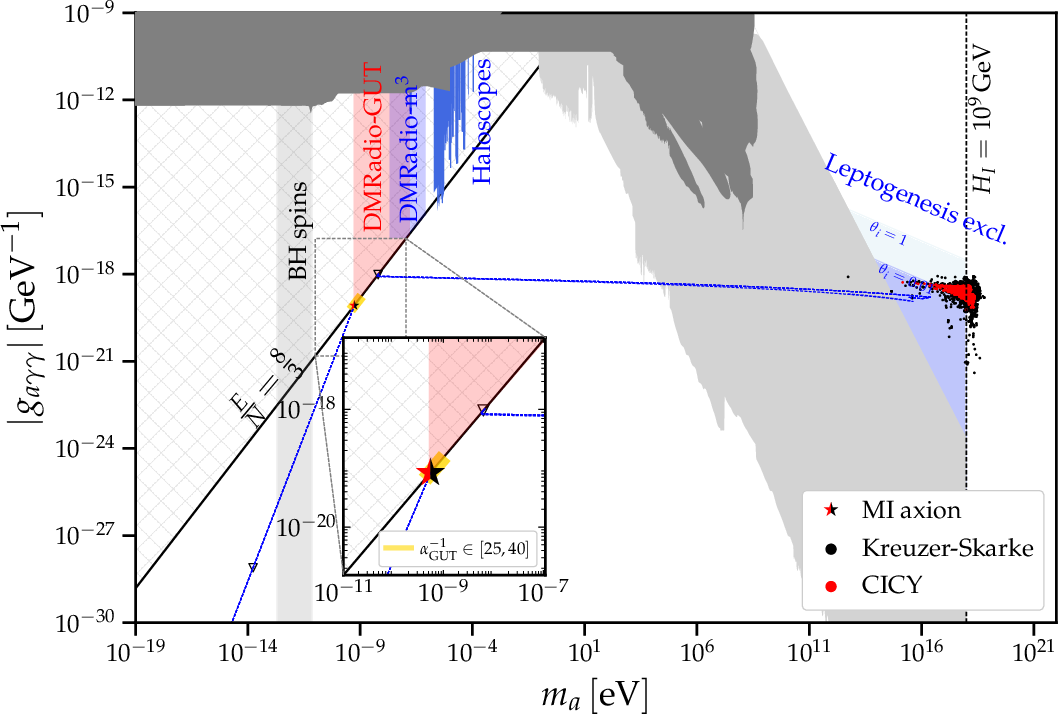
Figure 2: Axion-photon couplings for all axions in the GUT-compatible ensemble of KS and CICY heterotic compactifications. The MI QCD axion mass falls in the gold band; only a handful of compactifications (dotted curves) yield substantial deviation from the MI value. Most axions have higher masses and couplings, and astrophysical/cosmological constraints exclude regions shaded in gray.
Comparison with Type IIB/F-Theory Axiverse
Unlike Type IIB and F-theory constructions, where local cycle volumes controlling the gauge couplings can be decoupled from the bulk volume (permitting exponentially large volumes and broad axion spectra), in heterotic frameworks the total compactification volume is rigidly tied to the gauge coupling,
h1,11
in string units. Consequently, the required large individual curve volumes for light MD axions are unobtainable in almost all geometries. This sharpens the axion mass window relative to Type IIB/F-theory, in which a log-uniform distribution of masses is accessible, including ultralight and extremely heavy axions.
Heavy Axion Spectrum and Cosmological Implications
MD axions not participating in QCD are generically heavy, with masses above the TeV scale due to small volumes of wrapped cycles in established compactifications. These heavy axions rapidly decay prior to BBN and do not induce entropy dilution that would disrupt baryogenesis (particularly thermal leptogenesis). By contrast, in IIB axiverse scenarios, multiple quasi-stable heavy axions can overproduce dark matter or disrupt BBN. The lack of long-lived heavy axions in the heterotic ensemble makes these compactifications cosmologically clean.
Phenomenological Consequences and Experimental Targets
- Experimental target region: The axion mass window h1,12 neV (set by MI axion mass for reasonable h1,13) should be prioritized by next-generation lumped-element detectors such as DMRadio-GUT.
- Cosmological consistency: The allowed mass and coupling range is entirely compatible with cosmological and astrophysical constraints, as the heavy axion population decays early, and thermal leptogenesis is unaffected across most of the compactification scan. Dark matter is naturally accounted for in the allowed axion window.
String Landscape Dualities and Generality
The lower bound on the QCD axion mass extends, by string dualities, to all corners of the landscape where the gauge coupling is set by the bulk volume—heterotic h1,14, h1,15, Type I, and M-theory compactifications with suitable boundary conditions. In these cases, the MI axion is always present and sets the absolute lower bound on h1,16 and hence h1,17. In frameworks where the gauge coupling is set locally, as in Type II and F-theory, this bound does not apply and a broader axion spectrum is possible.
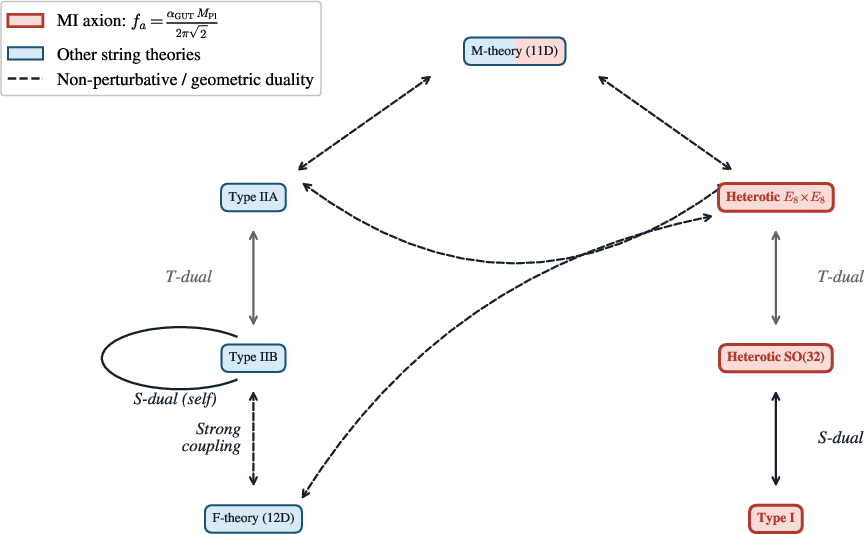
Figure 3: Map of dualities across string theories, with theories predicting the presence of a MI axion (red) and those lacking it (blue). The former set enforces a uniform lower bound on h1,18; in the latter, axion masses are highly model-dependent.
Robustness to Moduli Stabilization, Non-Toric Compactifications, and Threshold Corrections
- Moduli stabilization: The analysis holds for standard embeddings; moduli mixing or more complex gauge bundles (except in extreme tuning) leave the MI axion dominant.
- Non-toric CYs: Parallel analysis for favorable CICYs and product spaces (e.g., h1,19) confirm the rarity of light MD axions and that the MI lower bound is robust.
- Threshold corrections: GUT-scale threshold corrections and intermediate symmetry breaking patterns can shift fMI=2παGUTMP,0 modestly, but the axion window fMI=2παGUTMP,1 neV is stable under these variations.
Sensitivity to Parameters and Projections
An explicit analysis of the relationship between the SUSY scale, fMI=2παGUTMP,2, and the neutron EDM shows that for most of the SUSY range, Peccei–Quinn quality is maintained. Near-future EDM searches may be sensitive to the parameter space implied by the MI axion scenario for Split/MiniSplit SUSY, as shown below.
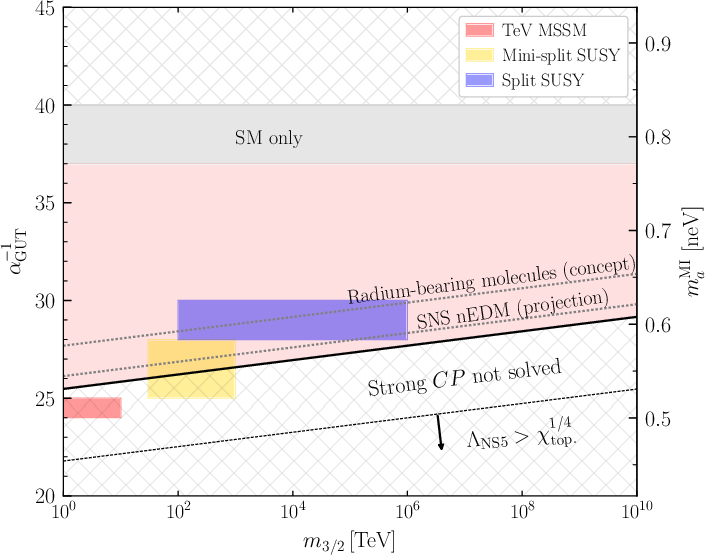
Figure 4: Relationship between fMI=2παGUTMP,3, fMI=2παGUTMP,4, and the neutron EDM from NS5-brane instantons breaking PQ symmetry. Regions with insufficient quality are excluded (hatched).
Future Directions and Open Problems
- Post-inflationary cosmology: Potential tuning of the compactification volume during inflation may ameliorate axion isocurvature constraints at small fMI=2παGUTMP,5 by enhancing the MI axion mass.
- Non-simply connected CYs: Modifications due to Wilson line breaking in quotient CYs could introduce rare cases where light invariant MD axions appear—requiring detailed equivariant cohomology analysis.
- Generalization to strong coupling and dual corners: The lower mass bound extends to strong coupling (Type I/M-theory) limits under duality, whenever the MI axion persists.
Conclusion
Heterotic string theory with GUT unification imposes a robust lower bound on the QCD axion mass, sharply localizing its value to the range fMI=2παGUTMP,6 neV over an immense swath of the string landscape. Practically, this motivates axion dark matter searches targeting this specific mass region and informs cosmological model building by demonstrating the absence of common axiverse cosmological tensions, such as entropy dilution and unwanted relics. The result is a rare case of string theory making a concrete, qualitative prediction directly accessible to laboratory experiments, while simultaneously constraining post-inflationary and baryogenesis scenarios.