- The paper presents the first continuum-extrapolated lattice QCD calculation of the QCD-induced axion-photon coupling, clarifying its model-independent contribution.
- It employs complementary gluonic and fermionic methods with rigorous statistical control, including jackknife resampling and AIC weighting for uncertainty estimation.
- Results show a 10% reduction compared to ChPT estimates, impacting axion phenomenology and guiding experimental search strategies by narrowing theoretical uncertainties.
First-Principles Determination of the QCD Contribution to the Axion-Photon Coupling via Lattice QCD
Introduction
The axion remains one of the leading candidates for both the solution to the strong CP problem and as a dark matter constituent. Its coupling to photons, gAγγ, is of central importance for astrophysical, cosmological, and laboratory searches. This coupling consists of both a model-dependent Peccei-Quinn (PQ) symmetry breaking sector contribution and a universal, model-independent term from QCD. Previous studies estimated the QCD contribution using various variants of chiral perturbation theory (ChPT), producing values with non-negligible variance and associated uncontrolled systematic errors. This paper presents the first non-perturbative, continuum-extrapolated lattice QCD calculation of the QCD-induced axion-photon coupling, establishing a reference value free from effective field theory truncations or assumptions.
Methodology
The QCD contribution to the axion-photon coupling, A, is extracted from the response of the vacuum to CP-odd electromagnetic backgrounds. Specifically, the calculation is formulated as a mixed second derivative of the vacuum energy (partition function) with respect to background axion (A) and electromagnetic fields (E,B), evaluated at vanishing field strengths. Two distinct lattice approaches are employed:
- Gluonic Method: This method directly computes the derivative using the QCD topological charge, exploiting improved gluonic lattice operators together with gradient flow for noise suppression and renormalization.
- Fermionic Method: This alternative leverages the axial Ward identity, expressing the same mixed derivative in terms of flavor-specific pseudoscalar condensates, enabling a cross-check of the gluonic calculations and partial cancellation of discretization artifacts.
Both methods necessitate careful, sequential extrapolations to vanishing electromagnetic field strength and the continuum limit. Statistical uncertainties are controlled using jackknife resampling and the Akaike Information Criterion (AIC) weighting for fit-systematics evaluation.
Numerical Results
The main result of this work is the extraction of the QCD-induced axion-photon coupling:
A=−0.0224(10)fAe2
AfA/e2=−0.0224(2)stat(2)def(5)a(8)EB(1)vol(2)m
where the error decomposition includes statistical, operator definition, continuum and zero-field extrapolation systematics, volume effects, and the correction for the quark mass splitting. This value constitutes a 10% reduction in magnitude relative to the PDG-adopted NLO ChPT two-flavor result.
A direct comparison of the gluonic and fermionic approaches demonstrates consistent continuum results, with the gluonic approach delivering superior control over systematics and thus the final quoted value.
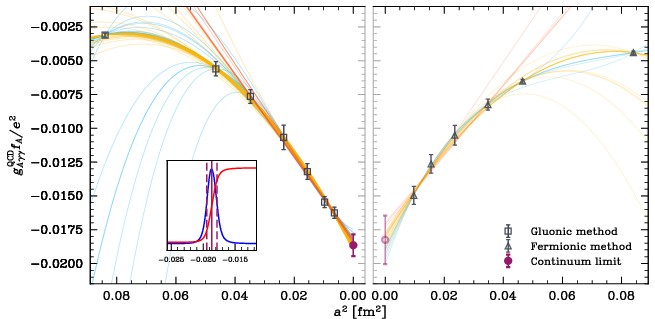
Figure 1: Continuum extrapolation of the QCD contribution to the axion-photon coupling using both gluonic and fermionic methods, showing polynomial fits and the combined final result.
Finite-size and temperature effects were found to be negligible compared to total uncertainties, as demonstrated by cross-volume studies.
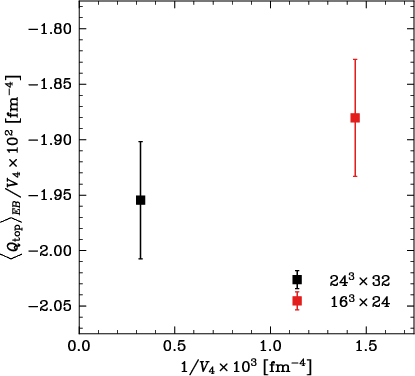
Figure 2: Topological charge expectation values on two lattice volumes indicate volume insensitivity within statistical errors.
The efficacy of gradient flow in suppressing UV artifacts and the flow-time independence of the extrapolated result in the physical region were confirmed in detail.
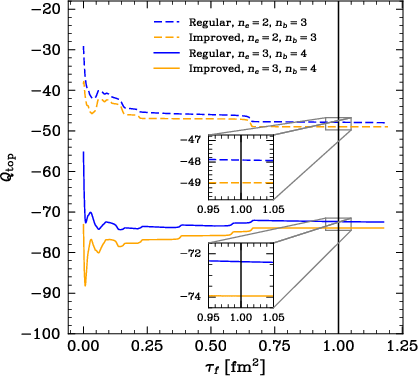
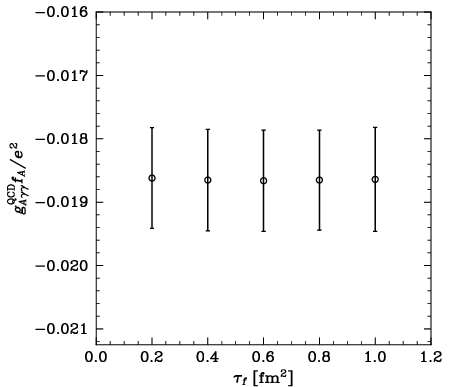
Figure 3: Stability of the topological charge definition and axion-photon coupling with respect to Wilson flow time on selected configurations.
Impact on Axion Phenomenology and Model Constraints
The QCD computation updates the interpretation of terrestrial and astrophysical axion limits by removing theoretical ambiguities on the model-independent component of gAγγ. The total axion-photon coupling is the sum of this result and the model-dependent term proportional to the electromagnetic (E) and color (N) PQ anomaly coefficients. Benchmarks (KSVZ: E/N=0, DFSZ: A0) and broader model ranges (e.g., A1) are considered.
The probability density over possible total couplings (encompassing both model-dependent and QCD terms) is mapped on the experimental exclusion plots. A substantial fraction of realistic axion models resides in parameter regions where the QCD contribution either partially or fully cancels the direct coupling, leading to "photophobic" axion scenarios near A2, in which traditional photon-based searches lose sensitivity.
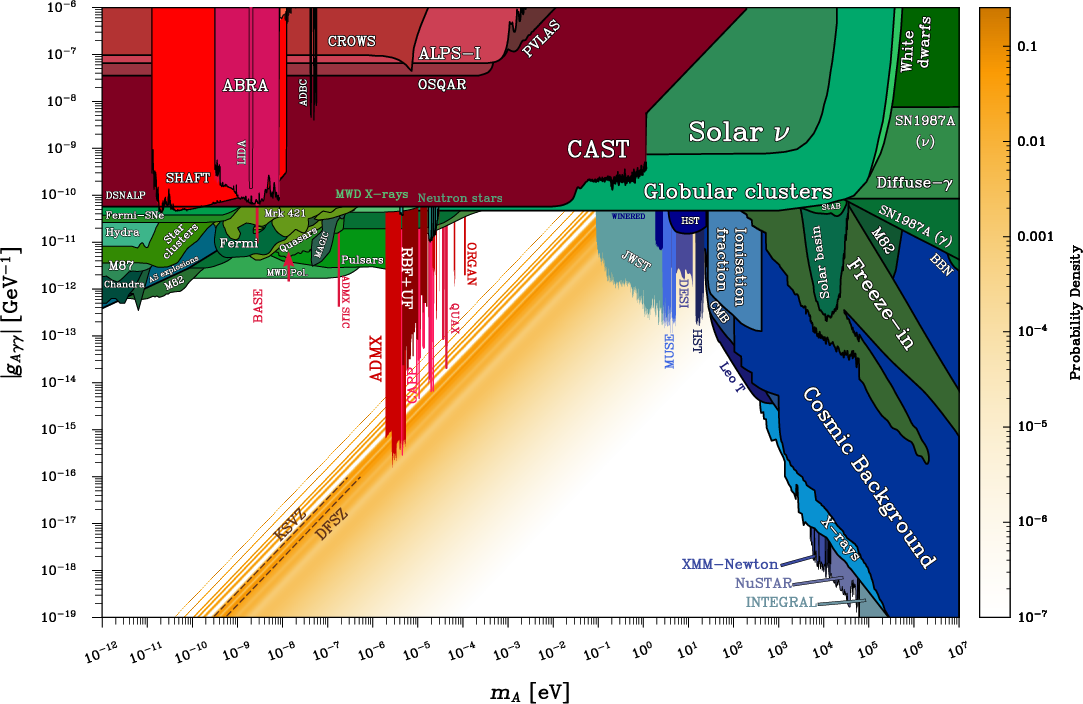
Figure 4: Updated axion exclusion plot including the first-principles QCD result for A3, with probability density for viable models indicated.
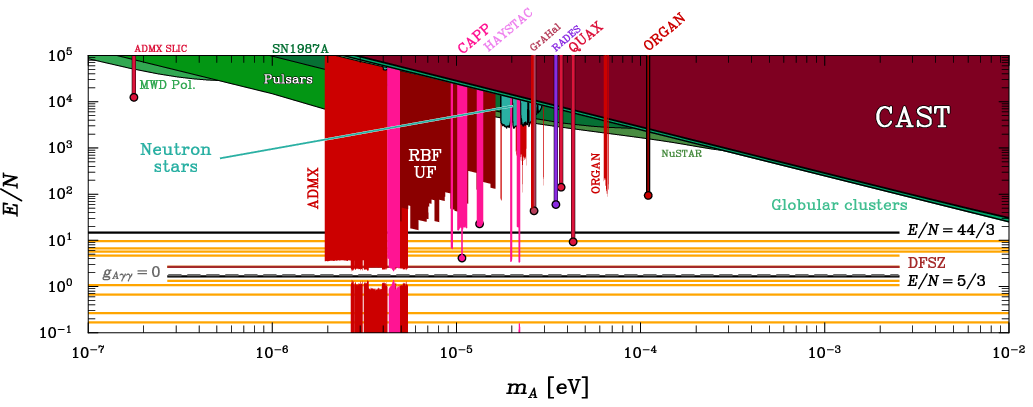
Figure 5: Allowed values of the model-dependent A4 coefficient as constrained by experiment and this work's result for the QCD contribution.
The non-perturbative result narrows the theoretical uncertainty bands on allowed axion parameter space, refines projections for the reach of ongoing and future experimental efforts, and shifts the theoretically allowed region at fixed axion mass. The remaining unexplored portion of the yellow band (cf. Figure 4) is now robustly predicted by QCD, motivating experimental prioritization.
Theoretical Implications and Future Prospects
This calculation sets a new precision benchmark for QCD effects in axion phenomenology. The concordance between the distinct, technically independent gluonic and fermionic strategies strengthens confidence in the result. The study also provides a template for further non-perturbative computations of other low-energy axion couplings, as well as extensions to theories with non-degenerate quark masses and full QED corrections.
Model-building implications are clear: the QCD contribution is negative and sizable, mandating its inclusion for any robust computation of axion signal rates in photon-coupled searches. The potential elimination of photon couplings for certain A5 realizations (accidental cancellations) emphasizes the need for searches in multiple detection modes and motivates theoretical surveys of the global axion parameter space with reduced model priors.
Further refinements are possible. Access to even smaller lattice spacings and improved control on isospin breaking and electromagnetic corrections could further reduce systematics. With next-generation exascale computing and algorithmic advances, future studies may incorporate full QED effects or extend these methods to other higher-dimensional axion interactions.
Conclusion
This work provides a rigorous lattice QCD determination of the model-independent axion-photon coupling, achieving substantially reduced uncertainties compared to chiral perturbation theory. The results directly impact axion model constraints, the interpretation of existing and future experimental limits, and inform the design and optimization of laboratory and astrophysical searches. This calculation establishes a reference for axion phenomenology and exemplifies the power of first-principles QCD in constraining physics beyond the Standard Model.

