Can LLMs Perform Deep Technical Comprehension of Computer Architecture Papers?
Abstract: Can LLMs perform deep technical comprehension of computer architecture papers -- not summarization, but structured critique that names the core mechanism, surfaces buried assumptions, and connects a contribution beyond its own scope? We study Gauntlet, an open-source pipeline that analyzes a paper through five independent expert-persona reviewers and an adversarial synthesis stage. On 20 ISCA 2025 and HPCA 2026 papers, ten researchers each wrote their own analyses and then judged, for papers other than their own, the human analysis against Gauntlet's. Across the 20 comparisons evaluators preferred Gauntlet in 15 (human in 4, one tie); its advantage is significant on per-analyst totals (paired Wilcoxon, p < 0.01) and largest on Critical Rigor, vanishing only on Calibration. Where humans win, it is on trust and usefulness rather than depth: a confident wrong claim, a mechanism described but not taught, or unprioritized breadth. A 98-paper automated ablation shows the gain comes from the multi-agent structure -- the pipeline beats the same model run as a single rich-persona agent on 96% of papers -- and specifically from its synthesis pass. We release all analyses, scores, and the rubric as a community resource.
Paper Prompts
Sign up for free to create and run prompts on this paper using GPT-5.
Top Community Prompts
Explain it Like I'm 14
What this paper is about
This paper asks a simple but important question: Can AI LLMs not just summarize a research paper, but really understand it like a skilled researcher—spotting the key idea, checking hidden assumptions, and linking it to related work?
To test this, the authors built a tool called Gauntlet. It’s like having five different expert reviewers read a computer architecture paper independently and then having a smart editor combine their notes without smoothing away disagreements. They compare Gauntlet’s write-ups to analyses written by human graduate students.
The main questions the paper asks
- Can a well-structured AI process do “deep technical comprehension” of computer architecture papers, not just surface-level summaries?
- Is using multiple, independent expert viewpoints better than using one AI “super-reviewer” persona?
- In head-to-head comparisons with human readers, when does the AI do better, and where does it still fall short?
How the study works (in everyday terms)
Think of reading a complex paper like inspecting a new car:
- One expert looks under the hood (the exact mechanisms).
- Another test-drives it on different roads (the workloads and benchmarks).
- Another checks the testing tools (how accurate the simulations are).
- Two more specialists are picked based on the car’s special features (matched to the paper’s topic).
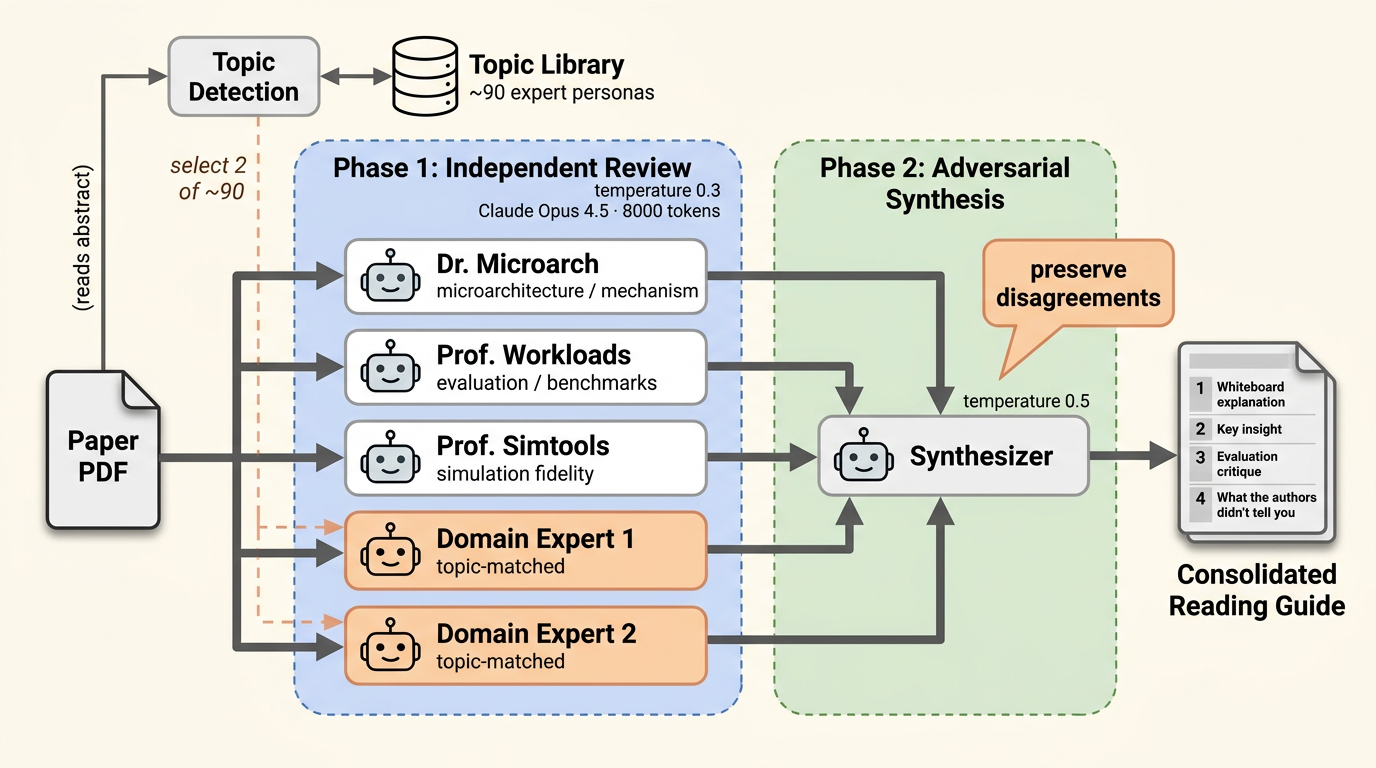
Gauntlet does the same, in two phases:
- Five independent reviewers
- Three fixed “personas” always show up:
- Dr. Microarch: How does the system actually work, bit by bit?
- Prof. Workloads: Are the tests fair and realistic?
- Prof. Simtools: Are the simulation tools reliable and reproducible?
- Two additional reviewers are chosen to match the paper’s topic from a library of about 90 expert personas (for example, a sparse-computation specialist for a sparse-tensor paper).
- Important: They do not see each other’s notes while reading. This prevents “groupthink” and helps surface different concerns.
- Adversarial synthesis (the editor step)
- A final “synthesizer” reads all five reviews and the paper.
- It writes a clear guide that:
- Explains the mechanism (how it works),
- States the key insight (why it works),
- Critiques the evaluation (how it was tested),
- Calls out what’s missing or assumed.
- Crucially, it preserves disagreements instead of averaging them away. If one reviewer praises a design but another doubts the tests, the final guide shows that tension.
How they tested it
- Human baseline: Ten grad students each analyzed two real papers from top architecture venues (ISCA 2025, HPCA 2026).
- Head-to-head judging: These students (and sometimes a senior reader), reading papers they didn’t analyze themselves, compared a human analysis to Gauntlet’s on five qualities:
- Mechanistic Accuracy: Did it describe the design correctly?
- Insight Depth: Did it capture the non-obvious “why”?
- Critical Rigor: Did it find real, specific weaknesses?
- Calibration: Was it appropriately cautious—confident only when correct?
- Usefulness: Would this prepare you for a meeting?
- Bigger automated test: For 98 papers, they also compared three versions using the same model:
- A: a simple “do a good analysis” prompt,
- B: a single, rich “skeptical expert” persona,
- C: the full Gauntlet pipeline.
- An AI judge (blind to which was which) scored the pairs to see which approach works best at scale.
A note on fairness
- The model used to generate Gauntlet’s analyses had a knowledge cutoff before these papers were published. That means it couldn’t just look up the answers; it had to actually read and reason from the provided paper text.
What they found (and why it matters)
Core results from the 20 human-judged comparisons
- Gauntlet’s analysis was preferred in 15 out of 20 cases (humans won 4, and 1 was a tie).
- Gauntlet was strongest on Critical Rigor (finding specific, meaningful weaknesses) and also did very well on Insight Depth and Mechanistic Accuracy.
- Gauntlet and humans were similar on Calibration (being appropriately confident). This is also where Gauntlet’s main failure showed up: sometimes it made a confident, specific claim that was wrong—hurting trust.
Where Gauntlet lost to humans (and what that teaches us)
- Trust: A single confident-but-wrong claim can sink the whole review. In one case, Gauntlet misread a timing detail and stated it at full confidence; the evaluator preferred the human as a result.
- Teachability: Sometimes Gauntlet described a mechanism correctly but not in a self-contained, step-by-step way. The human explanations were easier to learn from.
- Judgment and prioritization: Gauntlet sometimes listed too many issues without ranking what really matters. A focused human review that highlights the top 1–2 critical points was preferred.
Big 98-paper ablation (which approach really works best?)
- C > B > A: The full pipeline (C) beat the single rich persona (B) on 96% of papers, and both beat the one-line directive (A).
- This shows the structure—multiple independent reviewers plus a disagreement-preserving synthesis—drives the quality, not just clever prompting.
- The pipeline’s edge was largest on broad, multi-part papers and smallest on “single-trick” papers where one focused read can capture the main idea.
Why this is important
- Better first-pass reading: Gauntlet gives a high-quality first analysis that can help you decide which papers to dive into and how to approach them.
- Help in unfamiliar areas: If you’re new to a subfield, the multi-expert view can surface assumptions and pitfalls you might miss.
- Teaching aid: Students can compare their own reading to Gauntlet’s to see what they caught or missed. It’s like having an answer key for paper-reading skills.
- Tool, not a replacement: The authors stress that reading papers yourself is still essential. This is a reading assistant, not a substitute for learning.
Limits to keep in mind
- Human evaluators were graduate students, not senior experts, and they knew which analysis was machine-generated (which could bias judgments).
- Gauntlet sometimes over-claims with high confidence, or doesn’t teach the mechanism step-by-step, or fails to prioritize the most important critiques.
- The study uses one specific model and one pipeline; the main takeaway is the architecture of the process, not the brand of model.
Bottom line
Gauntlet shows that AI can do more than summarize: with the right structure—multiple independent expert views and an overview that keeps disagreements—it can produce deep, useful critiques of complex computer architecture papers. It’s not perfect and shouldn’t replace careful reading, but as a tool for triage, learning, and teaching, it’s surprisingly strong and often preferred over human first-pass analyses.
Knowledge Gaps
Below is a consolidated list of concrete knowledge gaps, limitations, and open questions the paper leaves unresolved, framed to guide future research:
- Strength of human baseline: Results are against graduate-student analysts; replicate with senior domain experts and area chairs to assess parity at higher expertise levels.
- Blinding and bias: Judges knew which analysis was machine-generated; run rigorously blinded studies (style-matched outputs, adversarial paraphrasing) to quantify the open-label bias and its direction.
- Judge reading depth: Judges read only abstracts/intros (10–15 minutes); re-run with full-paper reading and verification time to test whether preferences and per-dimension scores hold under deep scrutiny.
- Sample size and power: Human evaluation covers 20 papers and 10 judges; perform a larger, preregistered study with power analysis and stratified sampling across subfields.
- Rubric reliability: Report inter-rater reliability (e.g., Krippendorff’s alpha) and conduct a rubric validation study to ensure dimensions discriminate as intended; clarify whether “Calibration” fully captures trust failures.
- Generalization beyond mechanism papers: Evaluate on non-mechanism paper types (theory, surveys, empirical systems, negative results) and other venues (e.g., MICRO, ASPLOS, OSDI/NSDI) to assess scope.
- Model dependence: All analyses use Claude Opus 4.5; replicate with multiple families (GPT-4o/5, Gemini, Llama, Qwen) and open-weight models to separate pipeline benefits from model idiosyncrasies.
- Training-data leakage risk: Substantiate the “knowledge cutoff” claim by auditing for preprint exposure; evaluate on embargoed or newly accepted papers to rule out memorization.
- Automated judge validity: The 98-paper ablation relies on an LLM judge; calibrate against human judgments on a sizable overlapped subset and report agreement, error patterns, and sensitivity to verbosity/position biases.
- Cost-effectiveness: Quantify token/time/cost for multi-agent vs single-agent runs and compare to human effort to inform practical deployment and scaling tradeoffs.
- Persona coverage and selection: Specify and evaluate the sub-topic classifier and ~90-persona library coverage; study how persona choice/number affects quality and whether an adaptive selector can optimize agent sets per paper.
- Synthesis mechanism details: Openly detail the adversarial synthesis algorithm and compare against alternatives (multi-agent debate, Delphi-style aggregation, weighted rank fusion) on both quality and trust outcomes.
- Prioritization of critiques: Address the “breadth without prioritization” failure by designing and testing methods that rank weaknesses by impact and evidence strength; evaluate whether triaging improves usefulness.
- Teaching-oriented mechanism reconstruction: Add explicit “teachability” objectives (self-contained whiteboard derivations, glossary generation) and measure gains on novice comprehension and meeting preparation.
- Trust and confident-error mitigation: Integrate numeric/tool verification, retrieval-grounded fact checks, uncertainty estimation, and cross-agent contradiction flags; evaluate reductions in high-confidence wrong claims.
- Coverage of non-hardware contributions: Prevent decomposition bias by ensuring software/systems contributions are analyzed; add software/toolchain personas and completeness checks across contribution types.
- Adaptive complexity: Detect “single-idea” vs “multi-mechanism” papers and adapt agent count/scope to avoid dilution while preserving gains on complex papers; formalize the classifier and measure net benefit.
- Downstream impact studies: Beyond preference scores, measure effects on researcher workflows (triage accuracy/speed, baseline selection, replication planning) and student learning outcomes in controlled user studies.
- Statistical reporting: Provide effect sizes with confidence intervals, correct for multiple comparisons, and justify one-sided tests; include sensitivity analyses to scoring rubric variants.
- Reproducibility with open models: Demonstrate comparable gains using open-weight LLMs to facilitate transparent replication and broader community adoption.
- Bias and fairness analysis: Quantify whether knowing an analysis is machine-generated systematically affects ratings; test “style laundering” or adversarial paraphrasing to disentangle content from style effects.
- Review-process integration: The proposed “clarity phase” is speculative; pilot a controlled trial (e.g., course or workshop setting) to measure benefits/risks (anchoring, overreliance) and refine safeguards.
- Robustness and adversarial stress tests: Evaluate Gauntlet on papers with obfuscated methods, ambiguous baselines, or intentional traps to characterize failure distributions and harden the pipeline.
- External fact grounding: Systematically integrate and cite external data sources (e.g., PCIe/CXL latencies) and measure how grounding changes Critical Rigor and Calibration.
- Interactivity and human-in-the-loop: Explore workflows where authors or readers correct/confirm contentious points mid-pipeline; quantify how minimal human feedback shifts trust, prioritization, and accuracy.
Practical Applications
Overview
The paper introduces Gauntlet, a multi-agent, multi-persona LLM pipeline with an adversarial synthesis step that generates deep, structured critiques of computer architecture mechanism papers. Empirically, it outperforms single-agent prompts and is preferred over graduate-student analyses in most comparisons, especially on Critical Rigor. Below are practical applications derived from these findings, organized by deployment horizon.
Immediate Applications
- Literature triage and briefing for R&D teams — rapidly identify core mechanisms, buried assumptions, and evaluation gaps in new papers to decide what to read deeply and what to shelve.
- Sectors: semiconductors, AI hardware, cloud providers, edge/embedded systems
- Potential tools/workflows: “Gauntlet-as-a-Service” Slack/Teams bot; internal portal that ingests PDFs and posts a 1–2 page mechanism/insight/evaluation critique; weekly “what matters” digest
- Assumptions/dependencies: access to full-text PDFs; reliable, high-reasoning LLMs; domain-tuned personas; human-in-the-loop to catch rare but high-impact confident errors
- Competitive and technical due diligence — analyze competitor publications to surface favorable baselines, untested regimes, and claims sensitive to realistic deployment environments.
- Sectors: semiconductors, hyperscalers, IP licensing, corporate strategy
- Potential tools/workflows: diligence checklist auto-filled by Gauntlet; side-by-side baseline normalization reports; risk flags on headline claims
- Assumptions/dependencies: confidentiality controls; calibration oversight by domain experts
- Internal design/RFC critique — run the pipeline on internal design docs to stress-test evaluation plans, simulator fidelity, and workload representativeness before resource commitments.
- Sectors: hardware and systems engineering organizations
- Potential tools/workflows: “reviewer personas” embedded into design review templates (e.g., Prof. Workloads, Prof. Simtools); pre-tapeout sanity checks
- Assumptions/dependencies: secure on-prem or VPC deployment; permissions and audit logging; personas adapted to internal methodologies
- Teaching aid and “answer key” for paper reading assignments — provide students with expert-like analyses to compare against their own critiques, improving feedback in courses and reading groups.
- Sectors: higher education, professional training
- Potential tools/workflows: LMS plugins that attach structured reading guides; instructor dashboards showing common missed insights; reading-group facilitator that surfaces reviewer disagreements as discussion prompts
- Assumptions/dependencies: academic policies permitting LLM use; instructor curation to mitigate overreliance and address occasional miscalibration
- Reproducibility and benchmark audit support — assist artifact evaluation committees and internal verification teams by systematically probing simulator assumptions, baselines, and workload coverage.
- Sectors: academic conferences, industrial research labs
- Potential tools/workflows: checklist generation for artifact evaluation; “what authors didn’t tell you” sections pre-populated for committee review
- Assumptions/dependencies: artifacts/papers must be available; still requires human verification; rubric alignment with venue policies
- Reviewer assistance (non-decisional) — provide reviewers with a structured comprehension aid (mechanism, insight, critique) to reduce time spent reconstructing contributions.
- Sectors: academic publishing (ISCA/HPCA/MICRO, journals)
- Potential tools/workflows: optional reviewer sidebar in submission systems; auto-generated reading guides attached to submissions for reviewers
- Assumptions/dependencies: venue policies and ethics; explicit labeling; training for reviewers to avoid anchoring on machine critiques
- Reference manager and PDF reader integrations — generate structured critiques from PDFs directly within tools researchers already use.
- Sectors: software/tools for research (Zotero, Mendeley, ReadCube, arXiv overlays)
- Potential tools/workflows: “Deep Comprehension” button producing mechanism whiteboard, insight, evaluation critique, and open questions; tag-based indexing of mechanisms across a library
- Assumptions/dependencies: plugin APIs; efficient local/edge inference or secure cloud calls; legal use of PDFs
- Non-specialist executive briefings — produce trustworthy, mechanism-grounded briefings for product managers/execs entering technical meetings.
- Sectors: product management, business development, strategy
- Potential tools/workflows: 1-page “meeting prep” briefs emphasizing actionable implications and hidden dependencies; prioritized weakness lists
- Assumptions/dependencies: human review to ensure calibration and prioritization; simplified language modes without losing precision
- Cross-domain deployment within computing — adapt the persona library to adjacent areas (compilers, ML systems, networks, storage) to replicate the comprehension benefits.
- Sectors: software infrastructure, ML systems, networking
- Potential tools/workflows: domain-specific persona packs (e.g., Compiler IR specialist, Datacenter networking workloads analyst); shared adversarial synthesis core
- Assumptions/dependencies: creation/validation of domain personas and rubrics; access to full papers and artifacts
- Knowledge-base curation — auto-generate “reading guides” and map them to an internal wiki indexed by mechanisms, baseline assumptions, and evaluation regimes.
- Sectors: enterprise R&D knowledge management
- Potential tools/workflows: searchable index of critiques; cross-paper links (“papers relying on Ethernet-connected FPGAs”)
- Assumptions/dependencies: document store integration; taxonomy design for mechanism labels
Long-Term Applications
- Pre-submission “clarity phase” in conference workflows — authors run the pipeline pre-review, revise or attach a short Clarification addressing surfaced misunderstandings/assumptions.
- Sectors: academic publishing and peer review policy
- Potential tools/workflows: submission portal step invoking Gauntlet; author-provided ≤1000-word clarifications bundled for reviewers
- Assumptions/dependencies: community buy-in; guardrails to prevent anchoring; tooling and process changes; measured effect on review quality
- Meta-reviewer and deliberation support — use disagreement-preserving synthesis to surface tensions across human reviews and guide focused discussion.
- Sectors: conferences, journals
- Potential tools/workflows: meta-review dashboards highlighting reviewer disagreement on mechanisms/assumptions; suggested targeted rebuttal questions
- Assumptions/dependencies: privacy-preserving integration; clear role boundaries (assistive, not decisive)
- Sector-general persona libraries (healthcare, energy, robotics, finance) — port the independent multi-perspective + adversarial synthesis architecture to other domains for mechanism-heavy papers and whitepapers.
- Sectors: healthcare (medical devices), energy (grid controls), robotics (control stacks), finance (algorithmic trading systems)
- Potential tools/workflows: curated persona packs (e.g., clinical trial methods auditor, grid-simulation fidelity auditor, real-time controls specialist, market microstructure analyst); domain-specific rubrics
- Assumptions/dependencies: extensive domain curation and validation; regulatory and ethical considerations; higher stakes for miscalibration
- Continuous “AI literature clerk” for enterprises — always-on monitoring of venues/arXiv with push-based analyses, cross-paper synthesis of trends, and mechanism taxonomies.
- Sectors: enterprise R&D, competitive intelligence
- Potential tools/workflows: event-driven pipelines; dashboards with trendlines (e.g., evaluation shortcuts becoming common); alerting on risky assumptions
- Assumptions/dependencies: scalable compute; robust deduplication and de-biasing; cost control
- Claim verification and risk scoring — combine comprehension with external retrieval and artifact execution to score the fragility of claims to baseline choices or simulator fidelity.
- Sectors: research QA, standards bodies, procurement
- Potential tools/workflows: “risk of overclaim” scorecards; integration with code runners to replicate microbenchmarks; counterfactual baseline recomputation modules
- Assumptions/dependencies: reliable retrieval and code execution sandboxes; provenance tracking; improved LLM calibration and numeric reasoning
- Benchmark governance and policy tooling — support consortia and agencies in auditing adherence to benchmarking standards and surfacing systemic issues (e.g., overfitting to narrow workloads).
- Sectors: industry consortia, standards organizations, funding agencies
- Potential tools/workflows: automated compliance checklists; longitudinal reports on evaluation practices across venues
- Assumptions/dependencies: agreed-upon standards and rubrics; access to submissions and artifacts
- Automated hypothesis generation and design-space exploration — feed comprehension outputs into agentic systems that propose experiments or architecture variants (closing the loop with tools like ArchAgent).
- Sectors: architecture research, EDA/tools, automated discovery platforms
- Potential tools/workflows: pipeline handoff from “what works/why” to “what to try next” agents; experiment planners prioritizing high-leverage weaknesses
- Assumptions/dependencies: robust chaining between comprehension and planning agents; lab/compute orchestration; safety checks
- Advanced educational tutors — interactive, Socratic systems that teach mechanism reconstruction step-by-step, leverage preserved disagreements to cultivate judgment and calibration.
- Sectors: education (graduate programs, MOOCs), corporate upskilling
- Potential tools/workflows: adaptive tutors in IDE-like paper readers; auto-graded assignments using released rubrics/datasets; “whiteboard mode” walkthroughs
- Assumptions/dependencies: validated pedagogical design; measures to prevent shortcut learning; content licensing
- Legal/compliance and marketing claim audits — assess whether public whitepapers overstate performance due to selective baselines or unrealistic setups.
- Sectors: legal/compliance, investor relations, M&A
- Potential tools/workflows: pre-publication claim checks; investor diligence packs highlighting sensitivity to assumptions
- Assumptions/dependencies: policy frameworks for LLM use in compliance; human legal oversight
- Science communication and journalism — generate balanced, disagreement-aware explainers that highlight mechanism and where experts disagree.
- Sectors: media, public understanding of science
- Potential tools/workflows: newsroom tool that converts preprints into structured explainers with “what to be skeptical about”
- Assumptions/dependencies: editorial standards; fact-checking layers; domain adaptation
Cross-Cutting Assumptions and Dependencies
- Model capabilities and access: high-reasoning LLMs with long context windows and predictable costs; privacy-preserving deployment options.
- Persona library quality: performance depends on well-engineered, domain-specific reviewer personas and an overview prompt that preserves disagreement.
- Human oversight: necessary to mitigate rare but consequential confident errors and to prioritize critiques (a documented failure mode).
- Data and IP: secure handling of proprietary documents; licensing for full-text processing.
- Community and policy acceptance: especially for peer-review–adjacent uses, clear labeling, ethics guidelines, and guardrails to avoid over-anchoring on machine output.
Glossary
- Ablation: A controlled study that removes or varies components of a system to isolate their effect on outcomes. "A 98-paper automated ablation shows the gain comes from the multi-agent structure---the pipeline beats the same model run as a single rich-persona agent on 96\% of papers---and specifically from its synthesis pass."
- ADC (Analog-to-Digital Converter): A component that converts analog signals into digital values; often a power or precision bottleneck in mixed-signal systems. "an ADC power breakdown"
- Adversarial synthesis: A synthesis step that integrates multiple independent reviews while preserving points of disagreement rather than averaging them away. "five independent expert-persona reviewers and an adversarial synthesis stage."
- Calibration: The alignment between stated confidence and actual correctness in an analysis or prediction. "Calibration (appropriately confident, not wrong at full confidence)"
- Coherence: The property that ensures all processors observe a consistent view of shared-memory data. "near-memory processing, accelerators, coherence, security, and ML compilation."
- Critical Rigor: An evaluation dimension assessing whether critiques are specific, evidence-based, and identify genuine weaknesses. "Critical Rigor (specific, genuine weaknesses)"
- CXL (Compute Express Link): A cache-coherent, high-speed CPU–device interconnect standard for low-latency memory and accelerator attachment. "PCIe, or CXL at 100\,ns--1\,s."
- Decomposition bias: A tendency to focus on components that are easy to describe or quantify while neglecting other load-bearing parts of a system. "The Qtenon tie shows a related decomposition bias"
- FPGA (Field-Programmable Gate Array): A reconfigurable hardware fabric used to prototype or accelerate computations. "Ethernet-connected FPGA (10\,ms latency, Table~1)"
- HPCA (IEEE International Symposium on High-Performance Computer Architecture): A top-tier conference for computer architecture research. "HPCA 2026"
- Insight Depth: An evaluation dimension measuring how well an analysis uncovers the non-obvious reasons a mechanism works. "Insight Depth (the non-obvious why)"
- ISCA (International Symposium on Computer Architecture): The flagship conference of the computer architecture field. "ISCA 2025"
- Knowledge cutoff: The latest date of training data a model has seen, beyond which it cannot rely on memorized facts. "whose May 2025 knowledge cutoff predates the proceedings"
- Last-level branch predictor: A branch prediction component that operates at the final stage of a hierarchy to improve control-flow speculation. "LLBP-X (last-level branch predictor)"
- LLM-as-judge: The practice of using a LLM to evaluate or compare outputs, often in pairwise preference tests. "LLM-as-judge."
- Mechanistic Accuracy: An evaluation dimension checking whether the described mechanism matches what was actually built. "Mechanistic Accuracy (is what was built described correctly?)"
- MARG (Multi-Agent Review Generation): A multi-agent approach that divides paper sections among agents to address context limits in review generation. "The closest precedent is MARG, which splits a paper's sections across agents to beat context limits and cuts generic comments from 60\% to 29\% versus a single-agent GPT-4 baseline."
- Microarchitecture: The concrete, implementation-level organization of hardware structures beneath the ISA (e.g., pipelines, caches). "a microarchitecture specialist"
- Multi-agent debate: A prompting/evaluation method where multiple model instances critique each other to improve reasoning and factuality. "Multi-agent debate improves factuality and reasoning by having instances critique one another over rounds"
- Near-memory processing: Performing computation close to memory arrays to reduce data movement and latency (often called processing-in-memory). "near-memory processing, accelerators, coherence, security, and ML compilation."
- NeRF (Neural Radiance Fields): A neural scene representation technique often used for novel view synthesis; here, an accelerator workload. "a single-dataflow NeRF engine"
- Open-label evaluation: An evaluation setting where judges are aware of the source or identity (e.g., human vs. machine) of the items being assessed. "Open-label evaluation."
- Paired Wilcoxon test (Wilcoxon signed-rank test): A nonparametric statistical test used to compare two related samples, often reporting one-sided p-values. "paired one-sided Wilcoxon test"
- PCIe (Peripheral Component Interconnect Express): A high-speed serial bus standard used to attach accelerators and devices to host systems. "A PCIe-attached baseline would shrink the reported $5000$-- communication speedups to 1001000\times$."</li> <li><strong>Persona</strong>: A role-specific, domain-informed prompt profile that shapes an LLM’s perspective or expertise during generation. "from a $\sim$90-persona library"
- Photonic ML accelerator: A machine learning accelerator that uses photonic (optical) devices to perform computation. "LightML (photonic ML accelerator) --- Human somewhat better."
- Position bias: A bias in judging where the order or placement of options affects preferences regardless of content. "We mitigate position bias with randomized order over three runs"
- Prefetching: The technique of fetching data or instructions before they are needed to hide memory latency. "Prophet (profile-guided temporal prefetching) --- Human somewhat better."
- QuArch: An expert-curated question-answering benchmark designed to measure computer-architecture knowledge in models. "QuArch contributes an expert-curated question-answering benchmark for computer architecture"
- Self-enhancement bias: A tendency for a model or system to favor or overrate its own outputs during evaluation. "self-enhancement biases"
- Simulation fidelity: The degree to which a simulator accurately reflects the behavior and performance of real hardware systems. "audits simulation fidelity and reproducibility"
- Solo Performance Prompting: A technique where a single model simulates multiple personas to capture diverse reasoning styles. "Solo Performance Prompting has a single model simulate multiple personas"
- Synthesizer: A component that consolidates multiple independent reviews into a structured analysis while retaining disagreements. "A synthesizer then produces a structured reading guide"
- Usefulness: An evaluation dimension assessing whether the analysis prepares a reader for practical tasks like meetings or paper discussions. "Usefulness (would it prepare you for a meeting?)"
Collections
Sign up for free to add this paper to one or more collections.

