- The paper introduces the HNCC algorithm which leverages BCH expansion for ancilla-free Trotter error compensation with polylogarithmic precision scaling.
- The paper demonstrates that HNCC achieves optimal (2K+1)-order time scaling and significantly reduces gate counts compared to standard product-formula methods.
- The paper shows that channel-level error mitigation via randomized Pauli rotation channels circumvents the need for ancilla qubits while preserving commutator structure.
High-order Nested-commutator Compensation for Trotter Error Mitigation in Hamiltonian Simulation
Introduction
The paper "Trotter error compensation with polylogarithmic precision and nested-commutator scaling without ancillas" (2607.11856) introduces the High-order Nested-commutator Compensation (HNCC) algorithm for Hamiltonian simulation, specifically improving the precision and resource scaling of product-formula-based quantum simulation. Product formulas, notably the Suzuki–Trotter method, have been widely adopted due to their low circuit depth, commutator-based error bounds, and ancilla-free implementation. However, their gate complexity scales polynomially with inverse precision and simulation time, preventing efficient long-time or high-accuracy simulations.
HNCC leverages the Baker–Campbell–Hausdorff (BCH) expansion to address this limitation, designing a compensation algorithm that achieves polylogarithmic precision scaling and effective (2K+1)-order time scaling, preserving the desirable commutator scaling and eliminating the need for ancillary qubits or Hadamard tests. The algorithm performs error mitigation at the quantum channel level, utilizing randomized linear combinations of Pauli-rotation channels.
Suzuki–Trotter formulas approximate the evolution e−iHt by sequentially applying exponentials of individual terms Hγ in the Hamiltonian H=∑γHγ. These formulas’ error bounds exploit nested commutators, yielding better system-size scaling for local systems. However, their gate count depends polynomially on 1/ε and t, and high-order formulas become impractical due to exponential growth in the number of stages.
Several error mitigation strategies for observable estimation have emerged:
- Richardson Extrapolation: Combines measurements at multiple step sizes for polylogarithmic precision scaling but increases sample complexity due to noise amplification and SPAM errors.
- Compensation via Linear Combination of Unitaries: NCC and PSTC methods [zeng2025simple] compensate Trotter remainder at the unitary level, preserving commutator scaling (NCC) and polylogarithmic precision (PSTC), but require ancilla qubits and controlled operations.
HNCC advances these ideas by providing an ancilla-free, channel-level compensation with optimal scaling.
HNCC Algorithm Construction and Complexity Analysis
HNCC compensates for the error induced by the product formula by constructing a quantum channel that approximates the Trotter remainder VK(x)=U(x)SK†(x), where U(x) is ideal evolution and SK(x) is the product formula. The BCH expansion expresses VK(x) as exponentials of nested commutators, which are then truncated to control error and converted into a linear combination of quantum channels (LCQC), each implemented as compositions of Pauli rotations.
The compensation is applied after each Trotter step, with randomized sampling of Pauli channels according to norms derived from the BCH terms. This approach preserves the commutator structure, enables polylogarithmic scaling in the required precision, matches the time complexity of e−iHt0-order formulas, and remains ancilla-free.
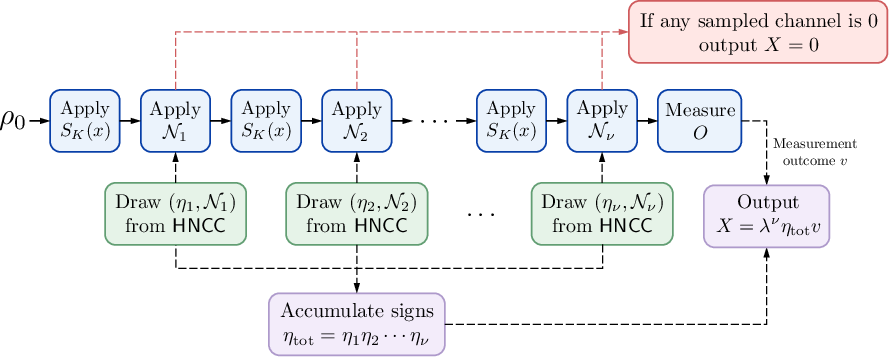
Figure 1: One sampled circuit from Algorithm~HNCC, showing channel-level Trotter compensation with product-formula segments and sampled Pauli-rotation channels.
Main Complexity Results
For a e−iHt1-local Hamiltonian with e−iHt2 qubits, e−iHt3 Pauli terms, and local interaction strength e−iHt4, HNCC estimates e−iHt5 to additive precision e−iHt6 using e−iHt7 repetitions. The maximum per-circuit gate count is
e−iHt8
matching the step count scaling of e−iHt9-order product formulas. The compensation at the channel level avoids cross-terms inherent in unitary-level mitigation, eliminating the requirement for ancilla qubits and controlled gates.
Sampling and Implementation
HNCC divides total simulation time into Hγ0 segments, each consisting of a product-formula evolution followed by random channel compensation. The channel is constructed by efficiently sampling nested commutator terms using the light-cone procedure, ensuring only local interactions contribute to error terms. The parameter-shift rule converts adjoint-Pauli factors into differences of Pauli-rotation channels, and pairing the linear BCH terms with the identity reduces LCQC norm and overall sampling overhead.
Higher-order BCH terms are efficiently sampled according to their Hγ1-norm bounds, with truncation parameters chosen to balance overhead against accuracy. The paired and unpaired variants are analyzed, with the paired variant yielding Hγ2-order scaling and the unpaired variant matching the original Hγ3-order product formula up to logarithmic precision factors.
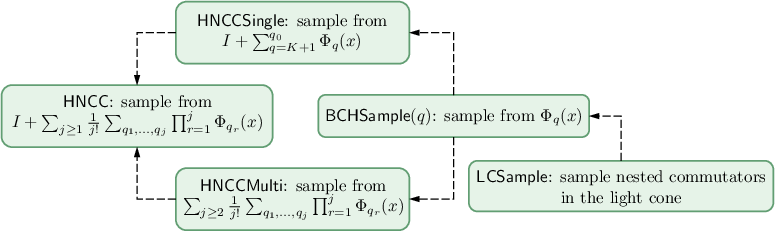
Figure 2: Overview of sampling routines for one HNCC step, partitioned into linear and higher-order BCH terms, each calling light-cone and commutator samplers.
Numerical Resource Estimates
Finite-size resource benchmarks demonstrate HNCC's substantial reduction in circuit depth for the periodic Heisenberg chain. For second-order product formulas (S2), HNCC achieves a Hγ4 reduction in CNOT count and Hγ5 in Hγ6-gate count per circuit relative to uncompensated S2. The repetition overhead remains bounded, as reflected in normalized repetition cost plots.
HNCC consistently outperforms standard and extrapolation-based product-formula methods across precision and simulation time regimes, maintaining the lowest gate counts and efficient sample complexity.
Implications and Future Directions
HNCC constitutes a significant advancement in Hamiltonian simulation, demonstrating that channel-level error mitigation can simultaneously achieve commutator scaling, polylogarithmic precision dependence, and ancilla-free implementation. This enables practical high-precision and long-time quantum simulations under realistic circuit-resource constraints, especially for systems with locality and structured commutators.
Potential extensions include applying channel-level compensation to eigenstate preparation, Lindbladian dynamics, and quantum singular value transformation, subject to future investigation. Further reductions in LCQC norm via more refined preprocessing or clustering and optimization of BCH truncation bounds could enable even more efficient implementations. Comparison with strategies like probabilistic Trotter error reversal (PTER) [murota2026unbiased] and applications to large-scale many-body systems will be pivotal for advancing quantum algorithmic design.
Conclusion
HNCC provides a theoretically robust and practically efficient framework for Trotter error mitigation in Hamiltonian simulation. By leveraging BCH expansions, commutator structure, and randomized channel sampling, HNCC achieves polylogarithmic precision scaling and optimal time dependence without ancillary resources, representing a strong step toward scalable quantum simulation. Continued development and integration with broader algorithmic tools will further accelerate progress in quantum computational science.

