- The paper introduces an explicit quantum circuit for 3D elastic wave equations using a finite-difference discretization to form a Schrödinger-form ODE.
- It utilizes first- and second-order Trotter-Suzuki approximations to decompose Hamiltonians, providing detailed error bounds and gate complexity estimates.
- Numerical validations show high fidelity and demonstrate a near cubic quantum speedup over classical methods for simulating complex vector-valued PDEs.
Explicit Quantum Hamiltonian Simulation of 3D Elastic Wave Equations: Methods, Complexity, and Validation
This work systematically constructs explicit quantum circuits for simulating the time evolution of the three-dimensional elastic wave equation in homogeneous isotropic media, specifically using the first-order velocity--stress formulation. The study addresses the gap in prior research, where explicit gate complexity of quantum circuits for such vector-valued 3D PDEs is rarely quantified due to reliance on black-box Hamiltonian access. Here, the authors start from a concrete finite-difference discretization and achieve a Schrödinger-form ODE amenable to quantum Hamiltonian simulation.
The core state representation isolates a 9-component state (velocity and Voigt-reduced stress tensor) per spatial site, embedded via zero-padding in a 16-dimensional register for circuit convenience. The system is represented on a tensor-product Hilbert space, distinguishing the local component register from spatial indices. Crucially, spatial derivatives are implemented as matrix product operators (MPOs) of low bond dimension acting separately on each axis.
Hamiltonian Decomposition and Quantum Circuit Construction
The quantum circuit synthesizes the time evolution operator e−iHt using first- and second-order Trotter-Suzuki approximations. The authors exploit the block structure induced by separating component and spatial registers: the Hamiltonian is decomposed into sums of axis-specific terms, each diagonalizable in the component subspace. For each term, the spatial derivative acts as Sk(α) (single-axis MPO) controlled by the corresponding component-projection.
The single-step first-order Trotter operator is
U1(τ)=α=1∏3j=0∏15k=1∏nexp(−iHjk(α)τ)
with each Hjk(α) realized as a projector-controlled spatial rotation. All circuit elements---basis changes, projectors, and controlled rotations---are decomposed into standard one- and two-qubit gates. The basis change to eigenbases (and their inverses) is explicitly counted in CNOT complexity.
For second-order (symmetric) Trotterization, the structure is analogous but symmetrized in operator order, improving asymptotic error scaling.
Explicit Error and Gate Complexity Estimates
The authors derive formal upper bounds for both first- and second-order Trotterized simulation. Bounds are exact in discretization parameter n (resolution per axis), simulation time T, target accuracy ϵ, and physical material parameters (density ρ, compliance Scomp, encapsulating Young’s modulus E and Poisson ratio Sk(α)0).
First-order Trotter (using commutator scaling):
The cumulative circuit CNOT count for final-time evolution is bounded by
Sk(α)1
with qubit count Sk(α)2.
Second-order Trotter:
Sk(α)3
Material parameters, e.g., Sk(α)4 (bulk and shear modulus), appear explicitly, offering a way to interpret complexity in the context of physical stiffness and density.
Notably, compared to norm-based ("worst-case") error bounds, the commutator-based scaling yields improved Sk(α)5-dependence (from Sk(α)6 to Sk(α)7) for the Trotterized CNOT complexity.
Classical-Quantum Complexity Comparison
An exact resource scaling comparison is made against a classical explicit integrator (partitioned leapfrog/Strang splitting) applied to the identical semidiscrete ODE. Aside from the exponential reduction from Sk(α)8 classical memory to Sk(α)9 qubits, the quantum algorithm's time complexity (CNOT count) scales as nearly cubic less in U1(τ)=α=1∏3j=0∏15k=1∏nexp(−iHjk(α)τ)0 compared to the classical U1(τ)=α=1∏3j=0∏15k=1∏nexp(−iHjk(α)τ)1. Specifically, the classical arithmetic count is
U1(τ)=α=1∏3j=0∏15k=1∏nexp(−iHjk(α)τ)2
with U1(τ)=α=1∏3j=0∏15k=1∏nexp(−iHjk(α)τ)3.
| Method |
Memory |
Time Complexity |
| Classical leapfrog |
U1(τ)=α=1∏3j=0∏15k=1∏nexp(−iHjk(α)τ)4 |
U1(τ)=α=1∏3j=0∏15k=1∏nexp(−iHjk(α)τ)5 |
| Quantum (1st-order Trotter) |
U1(τ)=α=1∏3j=0∏15k=1∏nexp(−iHjk(α)τ)6 |
U1(τ)=α=1∏3j=0∏15k=1∏nexp(−iHjk(α)τ)7 |
| Quantum (2nd-order Trotter) |
U1(τ)=α=1∏3j=0∏15k=1∏nexp(−iHjk(α)τ)8 |
U1(τ)=α=1∏3j=0∏15k=1∏nexp(−iHjk(α)τ)9 |
This demonstrates that the quantum construction offers a polynomial (almost cubic in Hjk(α)0) speedup in time-complexity for the same discretization---a strong formal result absent black-box oracles.
Numerical Circuit Validation
Numerical experiments using Qiskit validate the Trotterized quantum circuit framework. Exact gate-level simulation was performed for a three-dimensional finite-difference grid with each axis resolved by Hjk(α)1 qubits, isotropic medium parameters Hjk(α)2, and various pulse, P-, and S-wave initial states.
State fidelity between the Trotterized circuit and exact matrix exponentiation remains high Hjk(α)3 for sufficiently small step sizes Hjk(α)4.
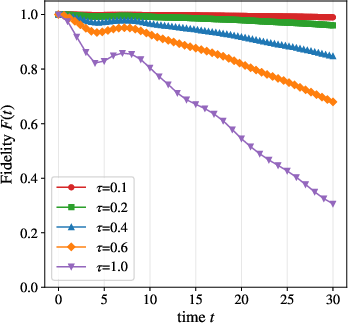
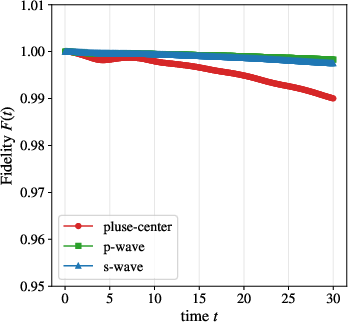
Figure 1: Fidelity Hjk(α)5 between the exact state and the Trotterized state, showing trajectory over time and dependence on the Trotter step size Hjk(α)6 and initial state.
At the field variable level (velocity and stress), the physical observables reconstructed from the quantum circuit evolution closely match their exact counterparts.
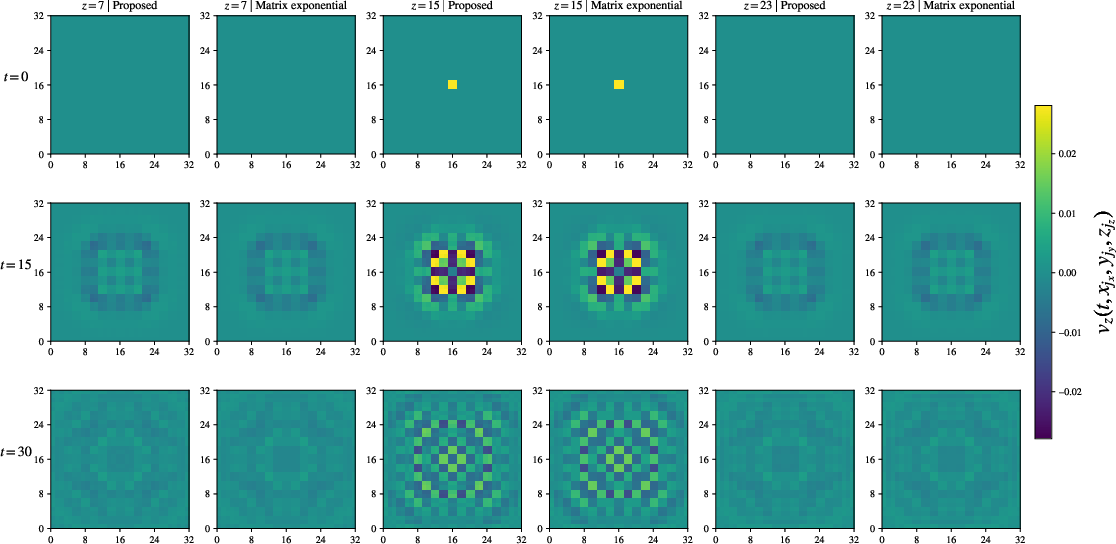
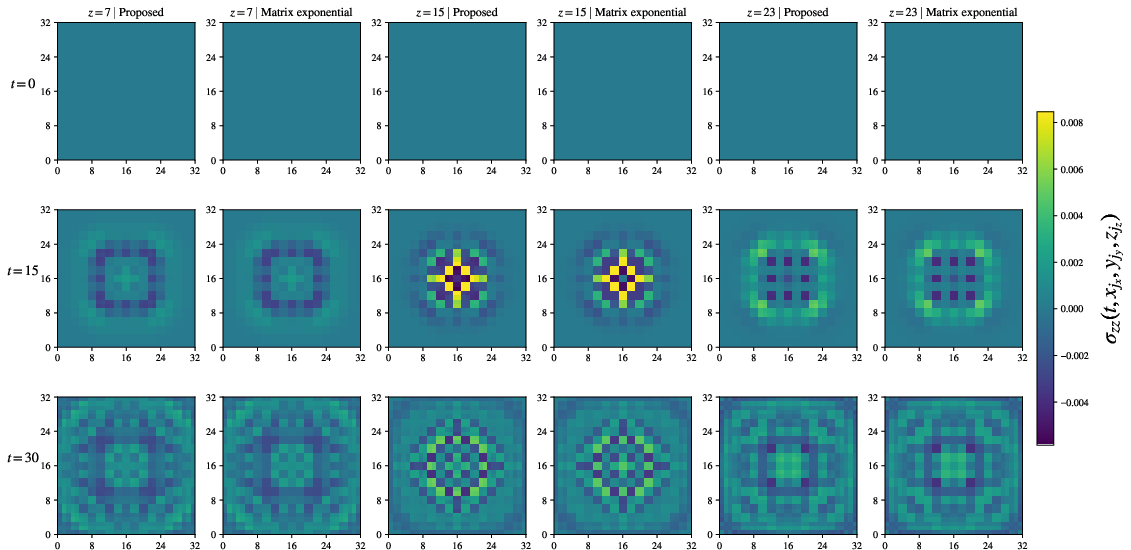
Figure 2: Comparison of the reconstructed fields Hjk(α)7 and Hjk(α)8 between exact and circuit-based simulation for a localized pulse initial condition, demonstrating agreement of the physical wave features.
Implications, Limitations, and Prospects
This work establishes the possibility of constructing explicit, parameter-sensitive quantum circuits for three-dimensional, vector-valued PDEs---in this case, the elastic wave equation in a homogeneous medium. The method generalizes to similar structure-preserving discretizations (e.g., Maxwell, fluid, and other hyperbolic PDEs).
On the theoretical side, the analysis gives strong, closed-form error and complexity bounds, crucial for assessing feasibility on near-term quantum architectures and for resource estimation in fault-tolerant quantum simulation.
Practically, the approach provides a template for further development:
- Extensions to Variable Media: Adapting the Hamiltonian decomposition and encoding to spatially varying coefficients or more complex boundary conditions.
- Encoding and Readout: While complexity analysis focuses on unitary evolution, future work must address state preparation and physical measurement extraction for PDE simulation applications.
- Algorithmic Overlap: Techniques here can inform the application of more advanced simulation protocols (e.g., quantum signal processing, LCHS) by providing optimized decompositions exploitable by these higher-level primitives.
Conclusion
This work delivers a rigorous, explicit method for quantum circuit implementation of 3D elastic wave equations, including detailed parameter-dependent resource and error analysis. The separation of structure via tensor-product decomposition advances the state of the art in explicit quantum PDE simulation, offering a concrete pathway toward realizing polynomial quantum speedup for physically relevant high-dimensional wave dynamics. The work provides numerical and analytical evidence of high-accuracy simulation within a formal quantum circuit model, and constitutes a benchmark for the practical adaptation of quantum simulation to multidimensional vector PDEs.