- The paper provides explicit operator-norm error bounds for truncated BCH and Zassenhaus formulas in unitary problems.
- It employs operator differential equations and nested commutator analysis to derive polynomial error estimates with clear scaling behavior.
- Numerical validations demonstrate tight error bounds, informing quantum simulation and algorithmic error control.
Introduction
The Baker–Campbell–Hausdorff (BCH) and Zassenhaus formulas constitute foundational tools in the analysis of noncommuting operator exponentials within Lie group and Lie algebra theory, with broad deployment in quantum mechanics, numerical integration, and quantum simulation. Operators of interest are frequently skew-adjoint or self-adjoint, leading to unitary propagators essential in time evolution and algorithmic composition schemes. This paper provides a comprehensive derivation of rigorous, explicit error bounds for truncated BCH and Zassenhaus expansions in the unitary regime, focusing on bounds expressed in terms of operator commutators and demonstrating their scaling behaviors.
Theoretical Framework
Given two noncommuting operators A,B, the BCH formula provides an explicit expression for Φ(A,B) such that
eAeB=eΦ(A,B),
where Φ(A,B) is an infinite Lie series comprising homogeneous polynomial commutators. The combinatorial complexity of these expansions rapidly grows with order, imposing a restriction on practical computation which necessitates series truncation for numerical or analytic use. In parallel, the Zassenhaus formula expands eA+B into a right-ordered product of exponentials
eA+B=eAeB∏n≥2eCn(A,B),
where each Cn(A,B) is a homogeneous Lie polynomial involving nested commutators of A and B. Both constructs are central in the decomposition of time propagators and operator splitting methods.
Error Quantification Upon Truncation
Truncation induces a deviation from the exact operator exponentials, requiring sharp operator-norm error quantification, particularly for skew-adjoint or self-adjoint operators (ensuring unitarity). The working regime thus is that of finite-dimensional Hilbert space and spectral norm, with extensions to Banach or Lie algebra settings via submultiplicative and unitarily invariant norms.
Main Results
BCH Truncation: Bounds for Two Operators
By employing operator differential equation analysis and expansion of the associated time-dependent propagators, explicit polynomial-in-t bounds for the error between Φ(A,B)0 and the Φ(A,B)1-term truncated BCH exponential are derived. For Φ(A,B)2, the optimal bound is:
Φ(A,B)3
This form persists at higher orders, each additional term contributing higher polynomial degree nested commutators to the error bound, see Corollary (paper eq. (bound_pol)).
The general bound for Φ(A,B)4-th truncation has the structure:
Φ(A,B)5
with Φ(A,B)6 explicitly computable as linear combinations of independent nested commutators and their operator norms.
Generalization to Φ(A,B)7 Operators and Palindromic Schemes
The framework extends, by recursive operator expansion and commutator calculus, to sequences of Φ(A,B)8 exponentials and to symmetric (palindromic) operator splittings. In the symmetric case relevant to Strang splitting, the error bound for truncating all but the first term (Φ(A,B)9) is:
eAeB=eΦ(A,B),0
For the truncated Zassenhaus product (after eAeB=eΦ(A,B),1 nontrivial factors), the approach yields, e.g. for eAeB=eΦ(A,B),2:
eAeB=eΦ(A,B),3
This bound is proven to be optimal with respect to the coefficients of the commutators. At higher eAeB=eΦ(A,B),4, all error terms are expressed as polynomials in eAeB=eΦ(A,B),5 with coefficients provided in terms of norms of commutators arising in the recursive computation of eAeB=eΦ(A,B),6.
Numerical Validation
The paper includes a comprehensive numerical study validating the tightness of the error bounds.
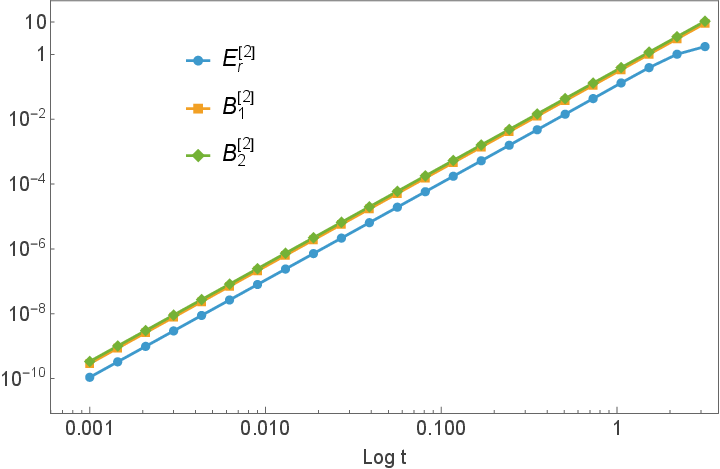
Figure 1: Actual and theoretical error for the second-order BCH truncation (eAeB=eΦ(A,B),7) for eAeB=eΦ(A,B),8 skew-adjoint random matrices, with the established theoretical bounds showing less than a factor-3 overestimation for operator-norm errors over a wide range of eAeB=eΦ(A,B),9.
At Φ(A,B)0, the ratio between the actual error and the error bound stabilizes near Φ(A,B)1 across hundreds of trials, indicating effective tightness and practical value of the derived analytic expressions.
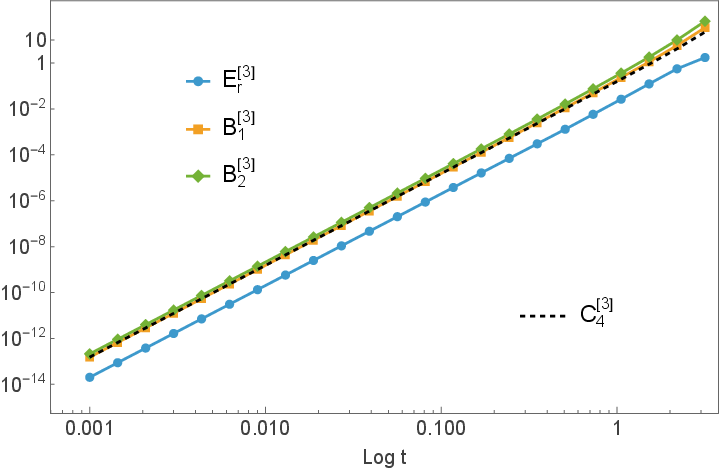
Figure 2: Actual and theoretical error for the third-order BCH truncation (Φ(A,B)2), illustrating that the leading term in the provided error bound is already very sharp for practical values of Φ(A,B)3.
Higher-order truncations were found empirically to maintain the structure of the derived bounds, with contributions from leading commutator terms dominating at smaller Φ(A,B)4.
Implications and Extensions
Algorithmic and Simulation Consequences
The explicit error bounds are of significant consequence for quantum simulation and matrix exponential approximation. They inform Trotter–Suzuki product formula errors, gate complexity estimations, and provide benchmarks for automatic selection of truncation depth according to precision requirements. The commutator-structured bounds are particularly advantageous for weakly non-commuting or nearly commuting pairs, and for models featuring local Hamiltonian hierarchies.
Theoretical Implications
This framework fills a notable gap, as rigorous commutator-structured error analysis for truncated Zassenhaus and high-order BCH expansions was previously unavailable, with prior literature almost entirely devoted to Lie–Trotter and Strang formula errors. The explicit recursive formulas in terms of Hall or Lyndon bases for the free Lie algebra not only enable symbolic computation at higher orders but also clarify the dependence of error on algebraic structure.
Directions for Further Research
Extensions to infinite-dimensional and unbounded operator settings, incorporation of operator resolvent norm techniques, and adaptation to time-ordered exponentials or Magnus-based expansions are immediate areas for future work. Moreover, the methodology suggests avenues for optimal splitting scheme design and resource estimation in quantum algorithms, especially as the structure of error bounds permits refined control in weak-coupling and structured-sparsity scenarios.
Conclusion
This work delivers a systematic derivation of explicit, rigorous, and optimally-scaled error bounds for truncated BCH and Zassenhaus series in unitary settings. The main results provide analytic and numeric guidance for both mathematical analysis and algorithmic implementation in quantum simulation, numerical analysis, and related operator-algebraic computations. The structure of the bounds, as polynomials in the expansion parameter with coefficients given by operator-normed nested commutators, will facilitate their further employment in Lie-theoretic and quantum computational applications.