Qwen-Music Technical Report
Abstract: In this report, we introduce Qwen-Music, a powerful music generation model capable of producing highly musical and high-fidelity songs with complete vocal singing. Qwen-Music supports two core tasks: Text to Music Generation, which create entirely new songs from text descriptions, lyrics, and musical attributes, and Cover Song Generation, which reinterprets existing songs with different styles and vocal characteristics. Architecturally, Qwen-Music integrates three core components: Qwen-Music-Tokenizer, Qwen-Music-LLM, and Qwen-Music-Render. Qwen-Music-Tokenizer compresses audio into a 25 Hz single-codebook stream of Music Semantic Tokens that preserve semantic and melodic information for LLM prediction. Based on these tokens, Qwen-Music-LLM performs autoregressive music semantic modeling, with a key novelty being a melody-token-based chain-of-thought (Melody-CoT) mechanism that plans melodies before full-song generation, improving creativity, musicality, structural coherence, and reference-audio-based melody cloning. To overcome the fidelity limitations of discrete semantic tokens, Qwen-Music-Render performs generative stereo rendering, enriching acoustic details and producing high-fidelity stereo waveforms. Finally, we train Qwen-Music-LLM on more than 5 million hours of multilingual music data covering hundreds of languages. We first apply quality-aware pre-training curriculum, then use progressive post-training, comprising supervised initialization, offline DPO, and online GSPO, to further improve musicality and instruction-following ability. Across 600 Chinese and English prompts, Qwen-Music achieves state-of-the-art results in 13 of 16 objective musicality and audio-quality metrics. Professional evaluators also prefer Qwen-Music over leading proprietary systems. For cover song generation, Qwen-Music preserves reference melodies more accurately than leading proprietary systems.
First 10 authors:


Paper Prompts
Sign up for free to create and run prompts on this paper using GPT-5.
Top Community Prompts
Explain it Like I'm 14
A simple explanation of “Qwen-Music”
What is this paper about?
This paper introduces Qwen-Music, an AI system that can create full songs with singing. It can:
- Make brand‑new songs from a text description and lyrics.
- Make “covers” of existing songs by keeping the original melody but changing the style or singer’s voice.
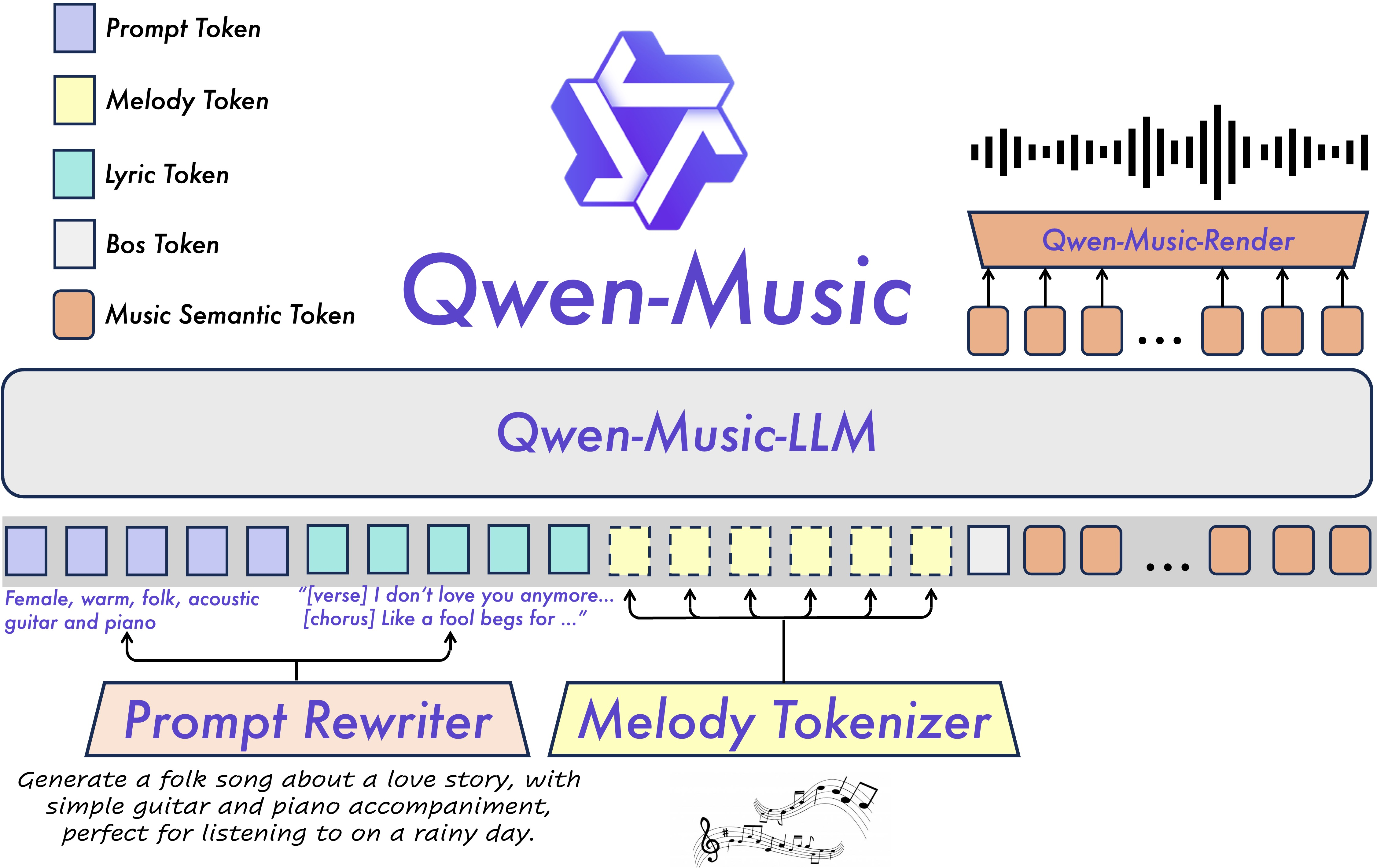
Think of Qwen-Music like a team that writes a song, sketches it, and then records it in a studio:
- One part plans the tune and structure.
- Another part turns that plan into a simplified “music language.”
- A final part turns that language into high‑quality stereo sound.
What did the researchers want to achieve?
In everyday terms, they wanted to answer:
- How can we make AI music that sounds musical, follows the lyrics, and feels like a real song (not just noise)?
- How can we control things like genre, mood, instruments, or whether the singer is male or female?
- How can we make covers that keep the original melody but change the style and voice?
- How can we make the final audio sound as rich and clear as studio recordings?
How does Qwen-Music work? (Explained simply)
The system has three main parts. Imagine writing a song, then making a sheet‑music sketch, then recording it with a full band and singer.
- Qwen-Music-Tokenizer: compressing music into simple “tokens”
- What it is: It turns real music audio into a stream of tiny symbols called “Music Semantic Tokens,” about 25 tokens per second. You can think of tokens like simplified notes and instructions in a compact code that an AI “LLM” can understand.
- Why: It’s much easier for the AI to plan a whole song using these compact tokens than working directly with the messy, detailed sound waves.
- Qwen-Music-LLM: planning and writing the song
- What it is: A LLM that writes music in token form, guided by your text description and lyrics.
- Key idea: Melody-CoT (Melody Chain‑of‑Thought)
- Before writing the full song, the model first plans a rough melody—like humming the main tune—so the final song is more coherent, catchy, and consistent.
- For covers, it takes the melody from a reference song and keeps that shape while allowing changes in style, instruments, and the singer’s voice.
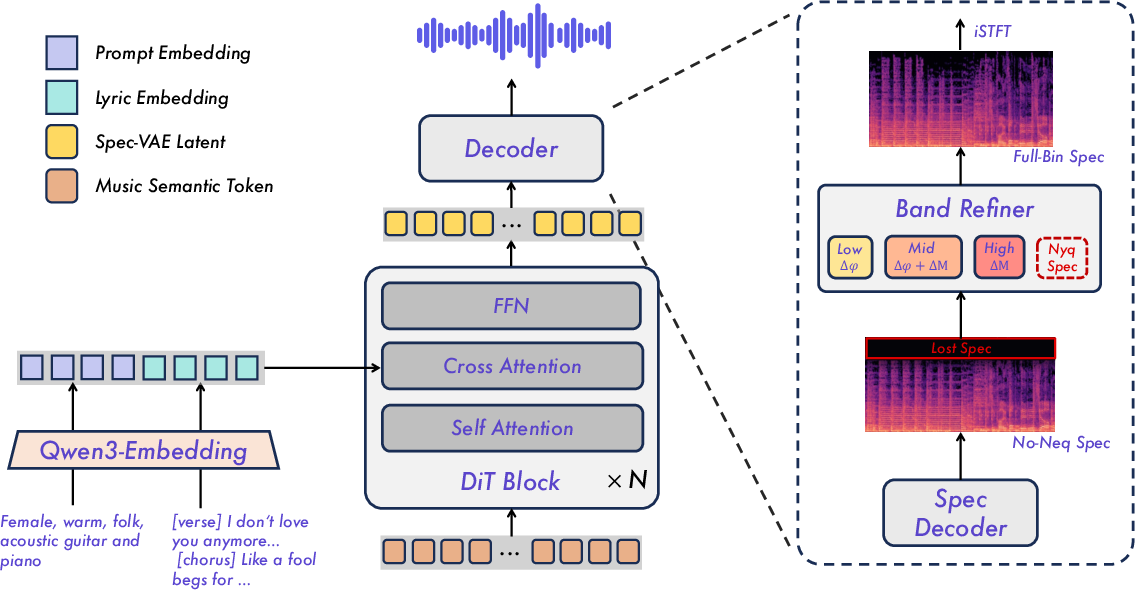
- Qwen-Music-Render: turning the plan into high‑fidelity sound
- What it is: A “renderer” that takes the tokens (the sketch) and produces rich stereo audio at 48 kHz (that’s high quality).
- How it helps:
- A Diffusion Transformer adds realistic sound details conditioned on the tokens and text.
- A Spectrogram VAE decodes the overall sound.
- A Band‑Mode Refiner polishes different frequency ranges (bass, mids, treble) to fix fine details in loudness and timing, much like a studio engineer.
Training and data strategy in plain language:
- The model learned from more than 5 million hours of music across many languages and styles.
- It was trained in stages, starting with broad and mixed‑quality music to learn variety, then focusing more on higher‑quality songs to improve musicality and clarity.
- After basic training, they aligned the model to human preferences using methods that teach it to better follow instructions and produce more musical results.
- They also carefully filtered audio data so the renderer learned from real, clean, high‑quality recordings.
What were the main results and why do they matter?
- Better text‑to‑music: Across 600 prompts in Chinese and English, Qwen‑Music scored best on 13 out of 16 musicality and audio‑quality tests using public benchmarks.
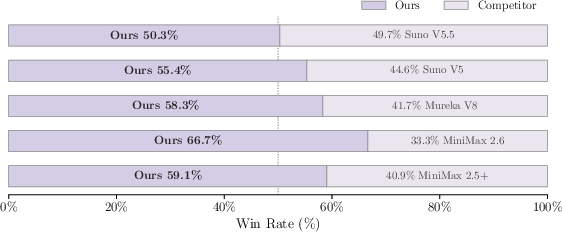
- Human preference: Professional music evaluators often preferred Qwen‑Music’s songs over several well‑known systems (like Suno V5 and others), or found it comparable to the latest versions.
- Strong cover generation: It kept the original melody more accurately than some other systems and still allowed flexible changes in style and singing voice.
- High fidelity and clear vocals: The final audio sounds polished, and the singing is understandable, with natural instrumental backing.
Why this matters:
- Making a convincing full song—with lyrics, melody, structure, and real‑sounding vocals—is much harder than making a short sound clip. These results show a big step forward in making controllable, long‑form, high‑quality songs with AI.
What could this mean for the future?
- More creative tools: Musicians, hobbyists, and creators could quickly draft songs, try different styles, or explore covers while keeping control over genre, mood, instruments, and vocal timbre.
- Better human‑AI collaboration: The “plan first, render later” approach makes AI music more organized and musical, which helps when people want to guide or edit the model’s output.
- Multilingual music: Since it learned from many languages, it can help create songs for global audiences.
- Responsible use: As with all generative music tools, it’s important to use them ethically, especially when making covers or imitating voices.
In short, Qwen‑Music separates “what the song should be” from “how it should sound.” By planning melodies first and rendering sound later, it creates songs that are catchy, coherent, and high‑quality—bringing us closer to AI that can write and perform music like a skilled human team.
Knowledge Gaps
Below is a single, consolidated list of concrete knowledge gaps, limitations, and open questions left unresolved by the paper; each item is phrased to be actionable for future research.
- Data: The composition of the “5+ million hours” corpus is not disclosed (source types, licensing status, language/genre breakdowns, vocal/instrumental ratios, era/region distribution), hindering reproducibility and bias analysis.
- Data: No description of deduplication, near-duplicate detection, or leakage prevention across train/val/test and external benchmarks; risk of memorization and evaluation contamination remains unquantified.
- Data: Handling of copyrighted material (especially for cover generation) and rights management is unspecified; guidelines for provenance tracking and opt-out mechanisms are missing.
- Data: The proportion and characteristics of high-quality subsets (Q1–Q2) versus lower-quality ones (Q3–Q6) are not quantified, nor is the exact curriculum sampling schedule released for replication.
- Data quality pipeline: The high-frequency cutoff and other acoustic quality detectors lack validation metrics (precision/recall, false positive/negative rates) across genres, masters, and noisy domains; decision thresholds are not justified empirically.
- Data quality pipeline: Sensitivity to legitimate artistic choices (e.g., low-treble vintage masters, intentional mono, creative clipping) is not analyzed, risking over-filtering of certain styles.
- Tokenizer: No ablation of the 25 Hz, single-codebook VQ design versus multi-codebook/RVQ or higher token rates for capturing rapid vocal articulations, dense instrumentation, or transient detail.
- Tokenizer: Reconstruction fidelity and information retention of the semantic tokens are not reported (e.g., token perplexity, ABX tests, lyric intelligibility, melody/harmony retention metrics).
- Tokenizer: The tokenizer is trained on 24 kHz mono, while the renderer targets 48 kHz stereo; the impact of this mismatch on retained spatial/timbre semantics is unmeasured.
- Tokenizer: The insertion layer position for VQ and its effect on semantics versus acoustics is not explored; guidelines for optimal insertion depth are absent.
- Melody-CoT: The 6.25 Hz melody-token frame rate may be too coarse for rapid melodic motion, rap prosody, or ornamented singing; no analysis quantifies failure modes or best-use regimes.
- Melody-CoT: Relative-semitone tokens discard absolute key/register information; it is unclear how reliably the system chooses musically appropriate keys, handles modulations, or supports user-specified key/scale.
- Melody-CoT: Section labeling and selection (verse/chorus detection) for Melody-CoT are not operationalized (how labels are obtained/learned, accuracy); robustness to mis-segmentation is untested.
- Melody-CoT: No ablations quantify the contribution of Melody-CoT versus plain text-to-music on creativity, long-range structure, lyric alignment, and melody adherence.
- Melody-CoT: The risk of over-conditioning and melody leakage when using reference audio is discussed conceptually but not measured; controllability trade-offs are unquantified.
- Control and conditioning: Explicit control over tempo, meter, key, chord progression, song form templates, and arrangement graphs is not supported or evaluated; adding structured music-theory controls remains open.
- Control and conditioning: Instrument-level or stem-level controllability (e.g., muting instruments, rebalancing, or re-instrumentation post hoc) is not addressed.
- Control and conditioning: The “prompt rewriter” is a key component but is under-specified (model choice, training data, errors, and bias); its effect on downstream controllability and style fidelity is unevaluated.
- Control and conditioning: Robustness to ambiguous, adversarial, or contradictory prompts (e.g., mismatched genre/lyric tone) and graceful degradation strategies are not reported.
- Renderer (DiT + Spec-VAE + Refiner): The benefit of classifier-free guidance only on the text branch (keeping tokens fixed) is not compared to CFG over both modalities; optimal guidance scales are not studied.
- Renderer: No quantitative breakdown of spectral fidelity across bands or instruments; the specific gains from Spec-SnakeBeta and the Band-Mode Refiner per frequency region are not ablated.
- Renderer: Latent dimensionality, diffusion steps, and inference-time vs. quality trade-offs are not reported; real-time or low-latency feasibility is unknown.
- Renderer: Training is capped at 6-minute tracks; scalability and coherence for longer songs or medleys are untested.
- Renderer: Stereo imaging control (width, placement), mastering targets (LUFS, PLR), and loudness consistency across outputs are not evaluated or controllable.
- Training and alignment: The pre-training/post-training hyperparameters, batch schedules, and compute budgets are not provided, limiting reproducibility and scaling insights.
- Training and alignment: Details of preference optimization (DPO/GSPO) are incomplete (reward definitions, rollout sampling, diversity controls, anti-reward-hacking safeguards, stability diagnostics).
- Training and alignment: Trade-offs between musicality rewards and instruction-following (genre/lyric adherence) are not quantified; evidence of mode collapse or reward gaming is not reported.
- Training and alignment: Effects of language balancing and inclusion of instrumental tracks (20%) are not ablated; multilingual generalization beyond Chinese/English is insufficiently evaluated.
- Lyrics and vocals: Objective lyric-alignment metrics (e.g., ASR-based lyric-following rate, phone error rate, word intelligibility) are not reported; failure modes (slurring, timing drift) are not analyzed.
- Lyrics and vocals: Support for phoneme-level control, explicit syllabification, or syllable-to-note assignment is not presented; this limits precise vocal prosody control.
- Lyrics and vocals: Handling of code-switching, low-resource languages, non-Western phonologies, and languages with complex prosody is not characterized.
- Cover song generation: Melody preservation and style-transfer metrics are referenced but not defined; objective measures (e.g., pitch-tracking similarity, key-consistent transposition, timbre/style similarity) need full operationalization and release.
- Cover song generation: Robustness of RMVPE-based melody extraction under heavy accompaniment, live recordings, or noisy references is untested; failure detection and fallback strategies are unspecified.
- Cover song generation: Safeguards against replicating unique singer identities from references (voice likeness) are not discussed; voice-identity privacy and misuse prevention remain open.
- Evaluation: The 600-prompt evaluation set, exact metrics (13/16 wins), and computation details (confidence intervals, effect sizes, inter-rater reliability, statistical significance) are not released.
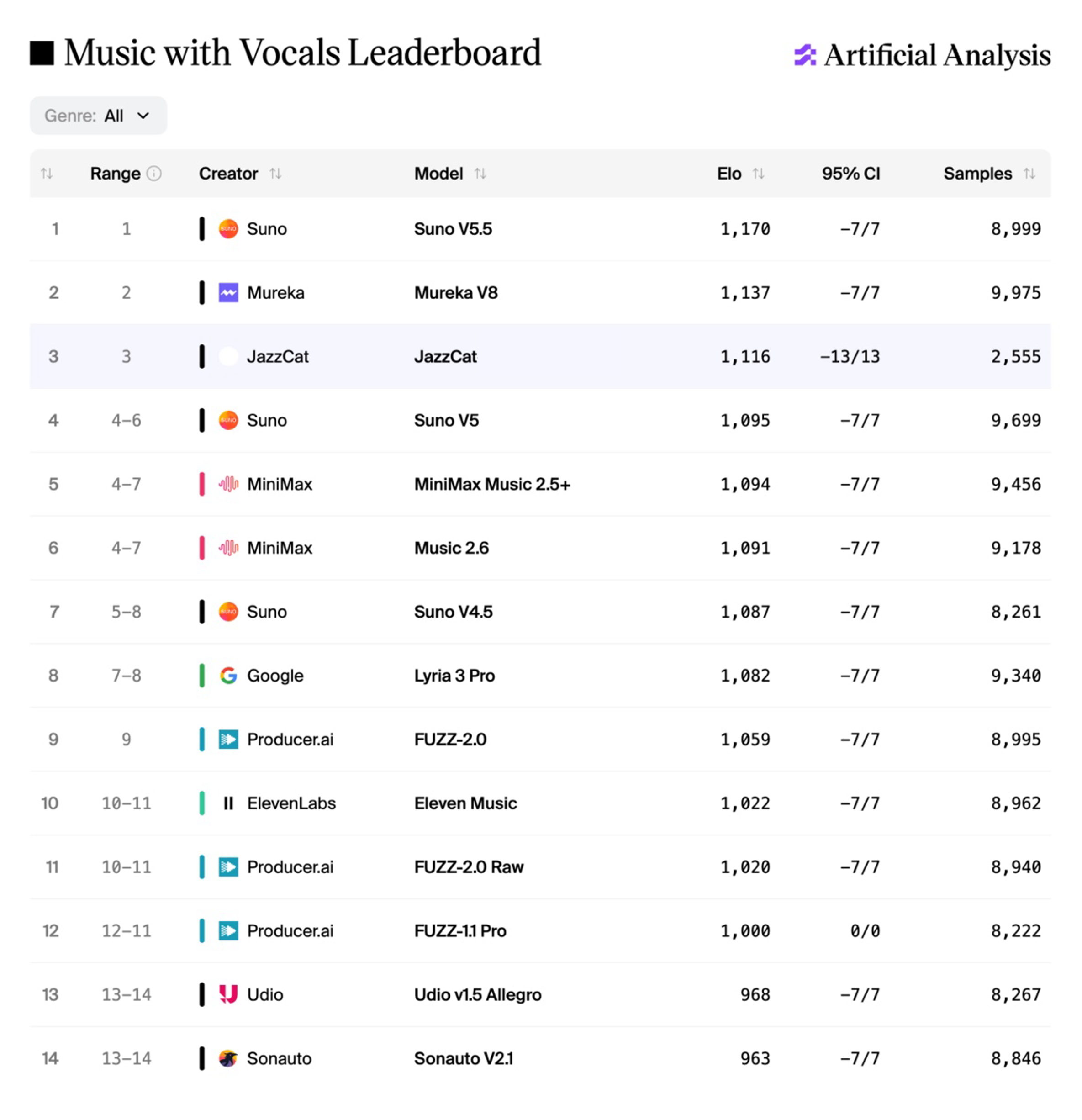
- Evaluation: External leaderboard participation as “JazzCat” lacks disclosure of model settings, sampling parameters, and prompt set; comparability is uncertain.
- Evaluation: No stress tests on rare genres (microtonal, non-Western scales, ragas, maqam, odd meters), extreme tempos, or unconventional forms; generalization limits remain unknown.
- Evaluation: Diversity metrics (e.g., repetition rates, chord/structure variety, novelty vs. training set) and plagiarism/memorization checks are not reported.
- Safety, ethics, and governance: There is no discussion of watermarking, provenance tagging, or detection of AI-generated audio to mitigate misuse (e.g., deepfake vocals).
- Safety, ethics, and governance: Content moderation policies (e.g., harmful/explicit content in lyrics), cultural/style biases, and fairness across languages and genres are not presented.
- Safety, ethics, and governance: User data handling (uploaded references/lyrics), privacy protections, and abuse prevention in cover generation are unspecified.
- Deployment and efficiency: Inference latency, memory footprint, and hardware requirements for end-to-end generation (LLM + DiT + decoder + refiner) are not provided; on-device or streaming use cases remain open.
- Deployment and efficiency: Strategies for streaming/interactive generation (bar-by-bar preview, editable stems, or iterative refinement loops) are not discussed.
- Theory and representations: The chosen semantic token rate and single-codebook design lack a principled analysis of the information bottleneck for music; criteria for optimal bitrate vs. controllability are open.
- Theory and representations: Absence of explicit rhythm/beat/downbeat/time-signature tokens suggests rhythm is implicit; evaluating explicit rhythmic/planning tokens as complementary CoT remains an open avenue.
Practical Applications
Immediate Applications
Below are concrete, deployable use cases that can be built now from Qwen-Music’s current capabilities (text-to-music, cover generation, Melody-CoT planning, 25 Hz Music Semantic Tokens, and high‑fidelity 48 kHz stereo rendering).
- Text-to-song creation for creators and marketers (sectors: media, advertising, social platforms)
- What: Generate complete, vocal songs from prompts, lyrics, and style tags for ads, trailers, influencer content, and rapid A/B testing of musical directions.
- Tools/products/workflows: “Jingle/Promo Generator” web app; cloud API; a DAW plugin that accepts a brief, mood, and lyrics and returns a stereo master.
- Assumptions/dependencies: Rights for generated lyrics/music must be clear in downstream usage; prompt quality impacts outcomes; cloud GPU availability for rendering; content moderation policies for public platforms.
- Cover song restylization for catalog owners (sectors: music industry, labels, publishing)
- What: Reinterpret catalog songs (melody preserved via Melody-CoT) with different arrangements, genres, and vocal timbres for anniversary releases, regional editions, and playlist refreshes.
- Tools/products/workflows: “CoverLab” batch service that ingests reference audio + target tags and outputs new covers; label-side QA with internal style guides.
- Assumptions/dependencies: Requires appropriate mechanical and sound recording rights; vocal timbre changes must avoid unauthorized likeness/voice rights; reference audio quality affects melody token extraction.
- Multilingual song localization (sectors: media localization, education)
- What: Generate versions of a song in different languages with preserved melody and culturally adapted instrumentation.
- Tools/products/workflows: Localization pipeline that inputs original track + translated/adapted lyrics, uses Melody-CoT to keep melody shape, and outputs localized mixes.
- Assumptions/dependencies: Quality of lyric translation/poetic meter is critical; cultural review steps needed; rights to derivative works must be secured.
- UGC soundtrack generation at scale (sectors: social/video platforms, creator tools)
- What: On-demand background songs aligned to themes, moods, and durations for short videos and livestreams.
- Tools/products/workflows: “Auto-Score” API integrated into video editors; preset mood packs for consistent brand sound; duration-constrained generation via section labels.
- Assumptions/dependencies: Latency and throughput constraints for platform-scale use; content policies (e.g., avoid impersonation of named artists/styles).
- Karaoke and backing tracks with melody-preserving covers (sectors: consumer apps, education)
- What: Produce instrumental/backing versions that preserve the melody contour for practice, classroom, or karaoke use, optionally switching genre/style.
- Tools/products/workflows: Mobile app that takes a song reference and outputs a karaoke version in the learner’s preferred style and key; practice loops per section.
- Assumptions/dependencies: Melody extraction uses RMVPE and works best with clear vocals; licensing for distributing derivatives; key/tempo control may need additional post-processing.
- Songwriting prototyping and ideation (sectors: music production, indie creators)
- What: Turn draft lyrics and style tags into rapid demos with coherent sections; generate alternative melodies via Melody-CoT planning.
- Tools/products/workflows: DAW plugin that generates multiple “melody plans” and renders top N variants; collaborative “co-writer” interface for section-by-section iteration.
- Assumptions/dependencies: Human editorial oversight remains essential; genre-specific nuances may require curated prompts; export stems may require future renderer capabilities.
- Sonic branding and micro‑logos (sectors: advertising, product design, UX)
- What: Create short musical signatures and mnemonic hooks that align with brand descriptors and target feeling.
- Tools/products/workflows: Brief-to-jingle pipeline; batch generation for brand testing panels; versioning by region.
- Assumptions/dependencies: Short-form output control (duration, cadence) via tags/sectioning; brand safety/legal review.
- Asset packs for games and apps (offline) (sectors: gaming, software)
- What: Pre-generate themed packs (menu, battle, calm, victory) with shared motifs and vocal or instrumental variants.
- Tools/products/workflows: Batch generation using consistent tag templates; Melody-CoT motifs reused across tracks for cohesion; packaged as loopable files.
- Assumptions/dependencies: Loop-point handling may require post-processing; true runtime adaptivity belongs under long-term applications.
- Audio data quality screening pipeline (sectors: audio engineering, dataset curation, academia)
- What: Apply the paper’s noise-floor-aware cutoff detection and rule-based checks to filter lossy transcodes, fake stereo, clipped masters, and upsampled content.
- Tools/products/workflows: “Audio QA” CLI/SDK to grade corpora (HiRes/High/Med/Low/Trash), flag issues, and automate curation.
- Assumptions/dependencies: Thresholds may need tuning per catalog; false positives possible for intentionally band-limited content; upstream metadata quality varies.
- Research and analysis using Music Semantic Tokens and Melody-CoT (sectors: academia, MIR)
- What: Use 25 Hz tokens for sequence modeling studies, structure analysis, and reproducible melody planning benchmarks.
- Tools/products/workflows: Tokenization toolkit; Melody-CoT datasets for section-aware melody modeling; evaluation on SongBench/SongEval-style metrics.
- Assumptions/dependencies: Access to tokenizer/LLM weights or APIs; licensing for derived datasets; cross-genre generalization may vary.
- Renderer components for TTS/vocoder pipelines (sectors: speech/audio synthesis, software)
- What: Adopt Spec-SnakeBeta activations and band‑mode refinement strategies to improve high-frequency detail and phase consistency in existing vocoders.
- Tools/products/workflows: Forks/patches to open-source vocoders; ablation tooling for spectral fidelity gains.
- Assumptions/dependencies: Engineering integration effort; gains depend on training data and model architecture match.
- API integration into creative suites (sectors: software, SaaS)
- What: Offer “Qwen‑Music Studio” API with text/lyric/melody inputs and configurable genre/vocal timbre, embedded in NLEs/DAWs and no‑code creator tools.
- Tools/products/workflows: REST/gRPC endpoints; preset libraries; job queue for batch renders; usage analytics.
- Assumptions/dependencies: Cost control for 48 kHz stereo diffusion rendering; SLA/throughput provisioning; governance for user prompts and outputs.
Long-Term Applications
These opportunities likely require further R&D, scaling, productization, or policy frameworks (e.g., real-time performance, robust controllability, licensing standards).
- Real-time or low-latency interactive music for games/VR (sectors: gaming, XR)
- What: Adaptive scoring that responds to gameplay/biometrics with seamless transitions, leveraging Melody-CoT for motif continuity.
- Tools/products/workflows: On-device/lightweight renderer variants; incremental token generation; runtime section planners.
- Assumptions/dependencies: Significant latency reduction and memory optimization; streaming token-to-audio rendering; robust evaluation of perceptual continuity.
- Personalized therapeutic music with biofeedback (sectors: healthcare, digital therapeutics)
- What: Generate individualized, lyric-aware music for anxiety, pain management, sleep, with adaptive tempo/harmony based on physiological signals.
- Tools/products/workflows: Clinician dashboards; device integrations (wearables) guiding real-time controls; validated therapeutic protocols.
- Assumptions/dependencies: Clinical trials for efficacy/safety; regulatory clearance; ethical safeguards around lyrical content and voice/persona.
- Scalable, compliant cover/localization factories (sectors: music, localization)
- What: Industrial-scale pipelines to produce legally cleared covers and localized versions, including catalog-wide style refreshes.
- Tools/products/workflows: Rights-aware orchestration; audit trails; batch QA with automated lyric alignment and melody adherence scores.
- Assumptions/dependencies: Industry standards for derivative licensing and royalties; model watermarking/provenance; artist consent for vocal timbre emulation.
- Virtual artists and interactive performances (sectors: entertainment, live events)
- What: AI-native vocal acts that release songs, adapt setlists live, and engage audiences in co-creation using Melody-CoT planning.
- Tools/products/workflows: Show control systems interfacing with token generation; audience prompt moderation; visual sync pipelines.
- Assumptions/dependencies: Real-time stability; legal/ethical frameworks for virtual personas; content safety and rights management.
- Automatic dubbing/singing voice retargeting for film/TV musicals (sectors: media, post-production)
- What: Preserve original song melodies while producing accurate, emotive vocal lines in new languages with matched timing and prosody.
- Tools/products/workflows: Lyric metrical adaptation; alignment tools; director-in-the-loop review systems.
- Assumptions/dependencies: Higher-precision control of syllabic timing and pitch register; licensed vocal timbres; union and guild compliance.
- Fine-grained controllability and stem-level production (sectors: music production, software)
- What: Generate separate stems (lead vocals, drums, bass, harmony) with precise control over arrangement, mix, and effects.
- Tools/products/workflows: Multi-stream tokenization/rendering; DAW-native automation lanes mapped to model controls.
- Assumptions/dependencies: Extensions to tokenizer/renderer for multi-stem outputs; UX for producers; compute/storage overhead.
- Cross-domain “melody/prosody‑CoT” planning for speech and audio (sectors: speech tech, education)
- What: Apply chain‑of‑thought style planning to speech prosody in expressive TTS, language learning aids, and audiobook narration.
- Tools/products/workflows: Prosody tokenizers and planners; prosody-aware renderers; alignment with text semantics.
- Assumptions/dependencies: Robust prosody token schemes; datasets with high-quality prosody annotations; evaluation metrics for prosodic naturalness.
- Standards for dataset quality, provenance, and disclosure (sectors: policy, platforms)
- What: Adopt the paper’s acoustic QA pipeline as part of industry standards for training data audits; introduce provenance tags and disclosure for AI‑generated music.
- Tools/products/workflows: Open benchmarks; certification programs; platform enforcement APIs for provenance/watermark checks.
- Assumptions/dependencies: Multi‑stakeholder governance; interoperable watermarking/signing; incentive alignment for adoption.
- Revenue-sharing and rights accounting for AI-assisted works (sectors: finance in media, policy)
- What: Automatic tracking of derivative relationships (e.g., melody-preserving covers) and royalty splits based on model logs and provenance.
- Tools/products/workflows: Token-level lineage records; rights registries integration; smart-contract-based payouts.
- Assumptions/dependencies: Legal acceptance of provenance records; standardized identifiers; secure logging with privacy safeguards.
- Edge/on-device creative assistants (sectors: consumer devices, mobile)
- What: Offline songwriting and practice aids on laptops/phones for travelers/students without cloud access.
- Tools/products/workflows: Distilled/token-cached models; partial on-device renderers; hybrid edge-cloud fallback.
- Assumptions/dependencies: Aggressive model compression/distillation; battery/perf constraints; UX for partial renders.
- Educational co‑tutors for composition and ear training (sectors: education)
- What: Interactive systems that propose melodies, reharmonizations, and critiques, with section-aware lesson plans driven by Melody‑CoT.
- Tools/products/workflows: Curriculum-linked modules; analytics dashboards; export to notation.
- Assumptions/dependencies: Alignment with pedagogy; content filters; accessibility/localization breadth.
Notes on Cross-Cutting Dependencies and Risks
- Legal and ethical considerations: Licensing for covers/derivatives; consent for vocal timbre resemblance; avoidance of artist impersonation; provenance/watermarking for platform safety and consumer transparency.
- Computational resources: High-fidelity rendering (48 kHz stereo diffusion) is GPU-intensive; latency and cost constraints influence deployment choices; real-time applications require model and pipeline optimization.
- Data and prompt quality: Accurate, meter-aware lyric inputs and well-formed style tags materially affect outcomes; multilingual edge cases may need domain prompts or fine-tuning.
- Generalization limits: Niche genres, rare vocal techniques, or unconventional structures may underperform without targeted data; evaluation across hundreds of languages demands continuous QA.
- Safety and moderation: Guardrails to avoid harmful content in lyrics and prompts; user-level policy enforcement on public platforms.
These applications leverage the paper’s main innovations—Music Semantic Tokens for tractable long-form composition, Melody‑CoT for melody planning and cover control, and a high‑fidelity renderer with Spec‑SnakeBeta and band‑mode refinement—while acknowledging the operational and governance requirements for real-world impact.
Glossary
- AdaLN: Adaptive LayerNorm conditioning used to modulate Transformer blocks with diffusion timestep information. "all modulated by AdaLN parameters derived from the diffusion timestep."
- AdamW: An optimizer that decouples weight decay from gradient-based updates. "We use AdamW for optimization,"
- Autoregressive: A modeling approach that predicts the next token conditioned on previous tokens in a sequence. "Qwen-Music-LLM performs autoregressive music semantic modeling,"
- Band-Mode Refiner: A post-decoder module that applies band-specific magnitude/phase corrections to improve spectral fidelity. "the Band-Mode Refiner corrects frequency-dependent magnitude and phase detail before waveform synthesis."
- BestRQ: A self-supervised masked-prediction objective that uses a frozen random quantizer as targets. "bidirectional self-supervised pretraining with BestRQ"
- Causal adaptation: Converting a bidirectional model to use only left-context (causal) attention to align with autoregressive inference. "Stage 2: Causal Adaptation"
- Causal self-attention: Attention restricted to past context so the model cannot see future frames. "This short adaptation stage converts the encoder to causal self-attention"
- Chroma: A 12-dimensional pitch-class representation capturing harmonic content independent of octave. "a ConvNeXt chroma head predicting the $12$-bin chroma feature."
- Chromagram: A time-frequency representation of pitch classes; often used for melody/harmony analysis. "We also explored chromagram-based representations"
- Classifier-free guidance (CFG): A diffusion sampling technique that trades off conditional and unconditional predictions to improve adherence to prompts. "To enable classifier-free guidance (CFG) at inference time, we introduce a learnable null context"
- Commitment loss: A regularization term in vector quantization encouraging encoder outputs to stay close to chosen codebook entries. "trained with a straight-through estimator and a commitment loss."
- Conformer: A Transformer-Conv architecture optimized for sequence modeling in audio. "a $24$-layer, $0.6$B-parameter Conformer"
- ConvNeXt: A modern convolutional architecture used here for spectral and chroma prediction and 1D refinement. "The Band-Mode Refiner is a lightweight ConvNeXt-1D module"
- CQT (Constant-Q Transform): A time-frequency transform with geometrically spaced frequency bins suited for music. "CQT disc"
- CTC (Connectionist Temporal Classification): A sequence labeling objective that aligns unsegmented inputs to target sequences. "a linear CTC head"
- Diffusion Transformer (DiT): A Transformer architecture used to parameterize diffusion/flow models over latent sequences. "The first stage is a Diffusion Transformer (DiT)"
- Direct Preference Optimization (DPO): A preference-learning method that aligns model outputs to human or reward preferences without RL. "Direct Preference Optimization (DPO)"
- Flow matching: A training objective for generative flows/diffusions that learns velocity fields between data and noise. "through conditional flow matching."
- GSPO: An online policy optimization method used here for preference-aligned post-training. "online GSPO,"
- Hann window: A tapering window used prior to FFT to reduce spectral leakage. "Hann-windowed $8192$-point RFFTs"
- hz2midi: The Hz-to-MIDI conversion used to map pitch in Hertz to MIDI note numbers. "\operatorname{hz2midi}(\tilde f_i)"
- IF/GD phase loss: A loss using instantaneous frequency and group delay to improve phase reconstruction quality. "IF/GD phase loss"
- iSTFT: Inverse Short-Time Fourier Transform for reconstructing waveforms from complex spectrograms. "iSTFT synthesis."
- K-weighting: A perceptual weighting curve used in loudness-related audio evaluation. "K-weighting perceptual filtering"
- KL regularization: Kullback–Leibler divergence used to regularize latent distributions in VAEs. "and KL regularization."
- LSGAN: Least Squares GAN, which stabilizes adversarial training via least-squares loss. "LSGAN adversarial loss with feature matching"
- LUFS: Loudness Units relative to Full Scale, the unit of integrated loudness in EBU R128. "\,LUFS"
- Median pooling: A temporal downsampling method using median aggregation, robust to outliers. "{$8$ with median pooling}"
- Melody-CoT: A chain-of-thought strategy that plans a discrete melody token sequence before full music token generation. "a melody-token-based chain-of-thought (Melody-CoT) mechanism"
- Melody Tokenizer: The component that converts a pitch contour into discrete relative melody tokens. "Melody Tokenizer"
- MOS (Mean Opinion Score): A subjective quality score used here via a learned reward model for musicality. "an internal MOS-based reward model."
- MSLR stereo decomposition: A stereo processing technique separating Mid/Side and Left/Right aspects for loss computation. "MSLR stereo decomposition"
- Muon optimizer: An optimization algorithm used for generator/discriminator training in the decoder stages. "Muon"
- Nyquist frequency: Half the sampling rate; the maximum representable frequency. "Nyquist freq ratio"
- Quality-graded pre-training curriculum: Scheduling data by estimated quality buckets to progressively refine generation. "Qwen-Music adopts a quality-graded pre-training curriculum"
- Random-projection quantizer: A fixed, randomly initialized quantizer used to generate self-supervised targets. "random-projection quantizer"
- Relative MIDI representation: Encoding melody as semitone offsets relative to a median pitch to avoid leaking key/register. "we use a relative MIDI representation."
- RMVPE: A robust pitch estimation model used to extract vocal F0 contours. "using RMVPE"
- RoPE (Rotary positional embeddings): A positional encoding method enabling extrapolation and improved attention with rotations. "Rotary positional embeddings (RoPE)"
- SAME: A method providing adaptive log-magnitude normalization for spectral losses. "adaptive log-magnitude normalization from SAME"
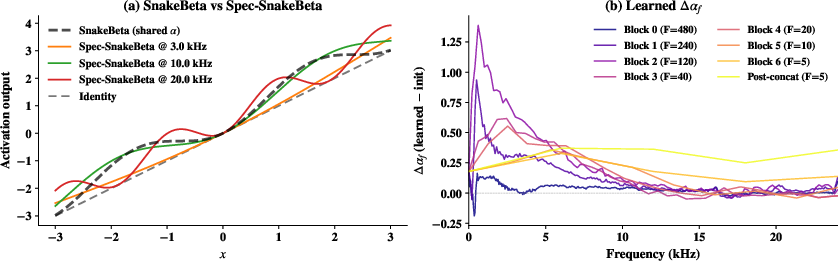
- SnakeBeta: A periodic activation function used in neural vocoders; baseline for its spectrogram-aware variant. "the standard SnakeBeta (black dashed)"
- Spec Decoder: The decoder in Spec-VAE that reconstructs complex spectrograms from latents. "Spec Decoder"
- Spec Encoder: The encoder in Spec-VAE that compresses spectrograms into latents. "Spec Encoder"
- Spec-SnakeBeta: A frequency-aware SnakeBeta activation tailored for spectrogram frequencies. "Spec-SnakeBeta"
- Spec-VAE: A variational autoencoder operating in the spectral domain for audio reconstruction. "Spec-VAE"
- Spectral convergence: A loss term measuring relative error in the magnitude spectrogram to aid reconstruction. "a spectral-convergence term"
- Spectral-domain discriminators: Adversarial discriminators that operate on spectrogram representations. "spectral-domain discriminators"
- STFT: Short-Time Fourier Transform, a time-frequency analysis for audio. "Stereo audio at 48~kHz is transformed by STFT into a complex spectrogram"
- Straight-through estimator: A gradient estimator allowing backpropagation through non-differentiable quantization. "with a straight-through estimator"
- Vector quantization (VQ): Discretization via a learned codebook used to produce token sequences. "VQ tokenizer training."
- VQ bottleneck: The insertion point where activations are quantized into codebook indices. "inserting a single VQ bottleneck"
- Welch spectrum: An averaged periodogram method for estimating power spectral density. "The blue curve is the Welch spectrum of a 10~s verification segment"
Collections
Sign up for free to add this paper to one or more collections.