SalientGS: Unified SfM-to-3DGS with Importance-Guided MCMC Gaussian Allocation
Abstract: Reconstructing 3D scenes from unordered images remains bottlenecked by expensive Structure-from-Motion (SfM) preprocessing and frozen pose interfaces. We present SalientGS, a unified SfM-to-3D Gaussian Splatting (3DGS) pipeline. Its central contribution is importance-guided Markov Chain Monte Carlo (MCMC) Gaussian allocation, which aggregates multi-view residuals into per-Gaussian underfit and redundancy signals. These signals define a smooth importance-weighted sampling distribution that biases both birth and relocation toward underfit regions. This reallocates capacity from well-fit areas without altering the underlying stochastic gradient Langevin dynamics (SGLD). SalientGS achieves end-to-end reconstruction in 15 minutes with state-of-the-art perceptual quality. The supplementary material provides dedicated sections for Per-Scene Qualitative Comparisons and Per-Image Learned Perceptual Image Patch Similarity (LPIPS) Analysis, including failure cases. Code and evaluation scripts are available at https://github.com/Six-Bit-TX/SalientGS.
Paper Prompts
Sign up for free to create and run prompts on this paper.
Top Community Prompts
Explain it Like I'm 14
What is this paper about?
This paper introduces SalientGS, a new way to build a 3D model of a scene from a bunch of photos taken from different angles. It combines two big steps into one smooth pipeline:
- figuring out where each camera was when the photos were taken (called Structure‑from‑Motion, or SfM), and
- creating a fast, realistic 3D representation using “3D Gaussian Splatting” (think of the scene as made of many tiny, colored, semi‑transparent blobs).
SalientGS is designed to be both fast and accurate, and it avoids relying on a slow, separate camera‑finding step that many other methods need.
What questions are the researchers trying to answer?
In simple terms, they ask:
- Can we rebuild a 3D scene quickly and accurately from unordered photos without running a slow, separate camera‑estimation tool first?
- If we have a limited “budget” of blobs to represent the scene, can we smartly place them where the model is still “wrong” so the final result looks better?
- Can we improve both the 3D model and the camera positions at the same time so they help each other?
How does the method work?
Think of reconstructing a 3D scene like making a sculpture from many photos:
- Pick which photos go together
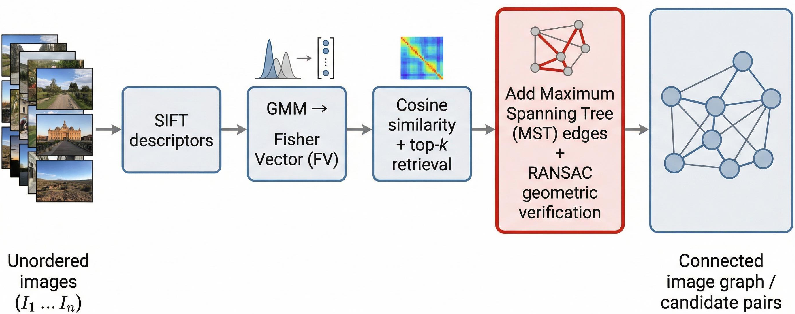
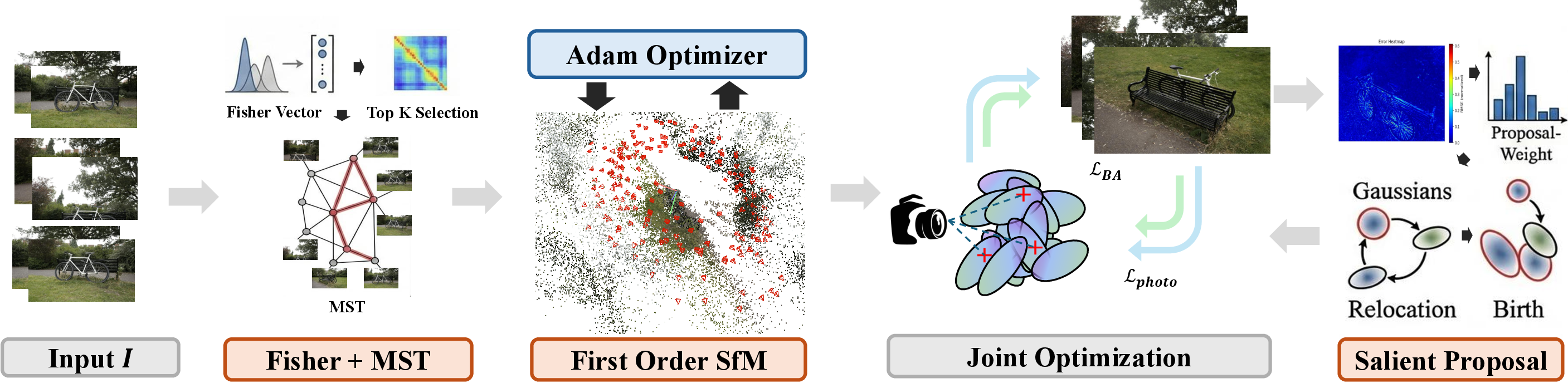
- The system quickly finds which images likely see the same parts of the scene (like matching similar book covers in a pile), using compact image summaries.
- It builds a connected “map” of photo pairs so all cameras relate to each other without comparing every photo to every other one.
- Estimate camera positions fast
- It uses a quick version of SfM that estimates where each camera was and roughly how the scene is shaped, without heavy, slow math.
- This gives a good starting point: not perfect, but fast.
- Build the 3D scene with Gaussian “blobs”
- The scene is represented by many tiny, colored, transparent 3D ellipsoids (imagine soft, glowing bubbles).
- When these are projected onto a 2D image, they “splat” (blend) to produce a photo‑like view.
- Put blobs where they matter most (importance‑guided allocation)
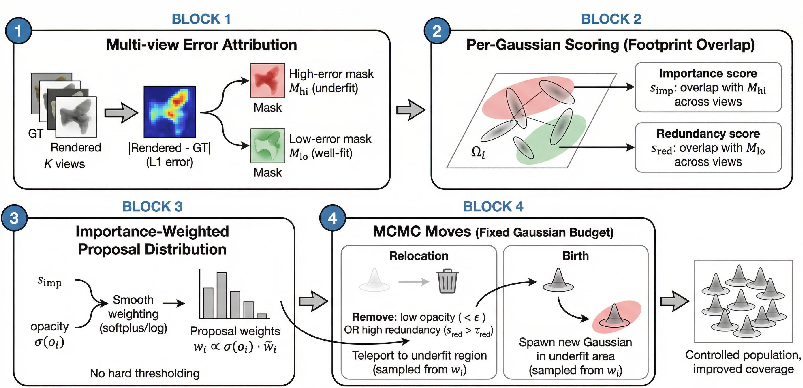
- The system checks where its rendered images differ from the real photos, across many views.
- It scores each blob: are the areas it covers underfit (still wrong) or already well fit (redundant)?
- With a limited number of blobs, it “recycles” blobs from well‑fit areas and “spawns” or moves blobs into the underfit areas. You can imagine moving your limited stickers to cover the spots that still show through, rather than piling them where coverage is already good.
- This relocation and birth process is guided by probabilities (a kind of smart shuffling), so more capacity goes to the parts that need it most.
- Refine cameras and the model together
- The system keeps adjusting both the blob parameters and the camera positions so the rendered images match the real ones.
- It uses two guides:
- Photometric loss: make the rendered picture look like the real photo (match colors and brightness).
- Geometric loss (bundle adjustment): keep certain tracked points consistent when projected into different images, so the cameras don’t “drift” into a wrong configuration.
By combining these steps, SalientGS stays fast while steadily improving both the model and the camera poses.
What did they find?
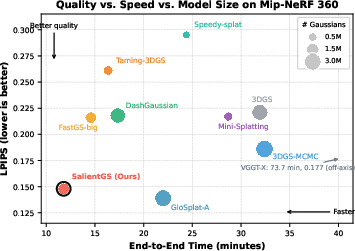
- Better overall quality and speed: Across 13 scenes and three standard test sets, SalientGS achieved the best average quality scores (higher PSNR/SSIM, lower LPIPS, which means cleaner, sharper, and more realistic images) and the fastest end‑to‑end time. It finished in about 10–12 minutes on average while using a fixed budget of 1.5 million blobs.
- No separate slow preprocessing: Unlike many methods that rely on a separate, time‑consuming camera‑estimation tool, SalientGS handles this inside the pipeline, saving time and avoiding errors that would otherwise “lock in.”
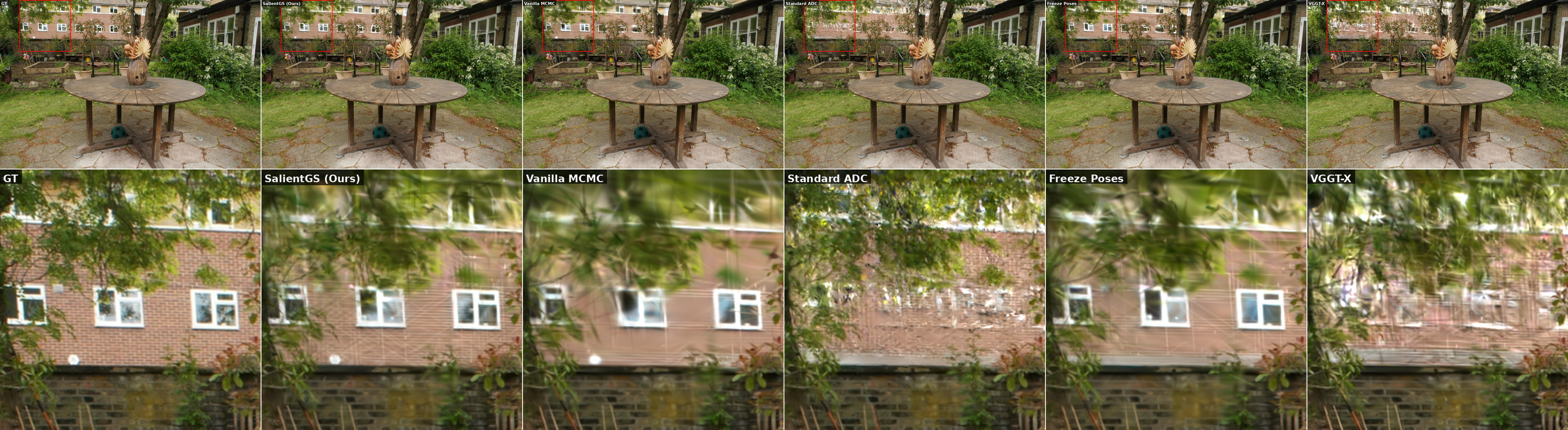
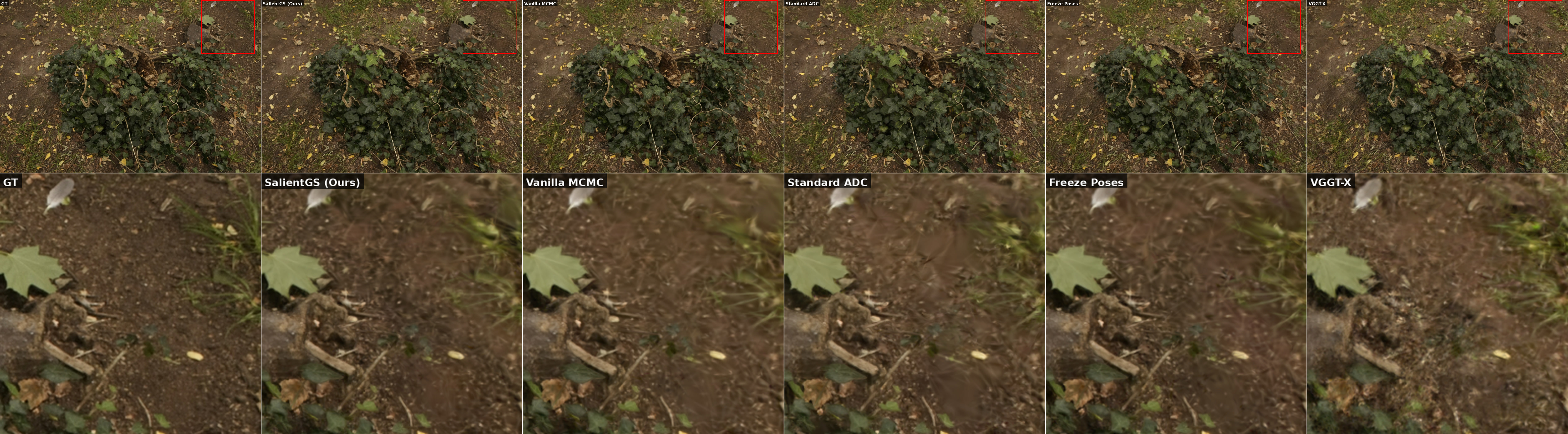
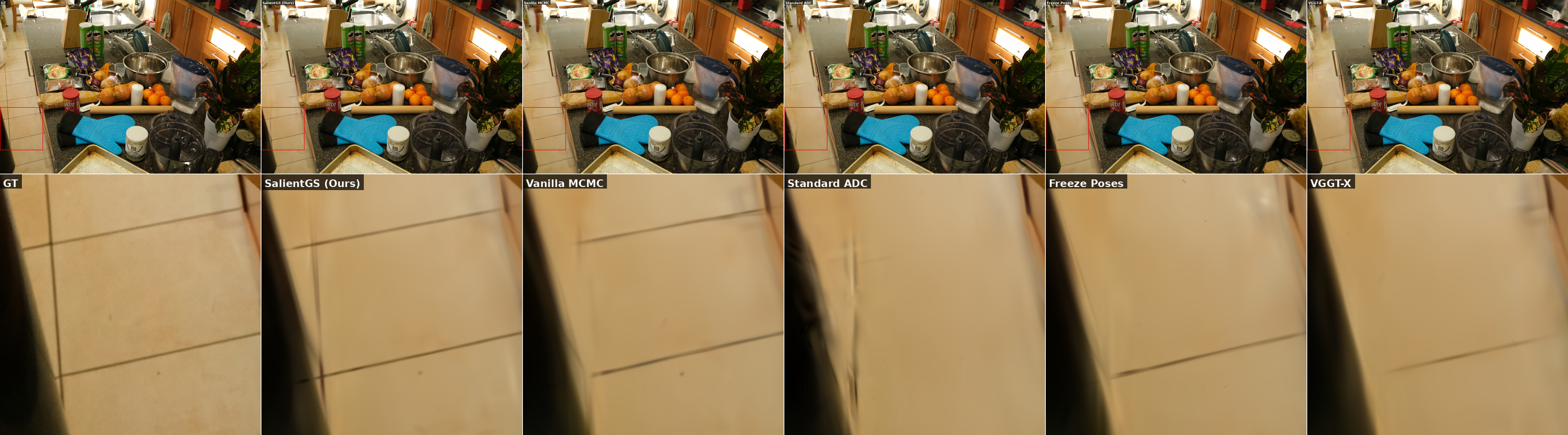
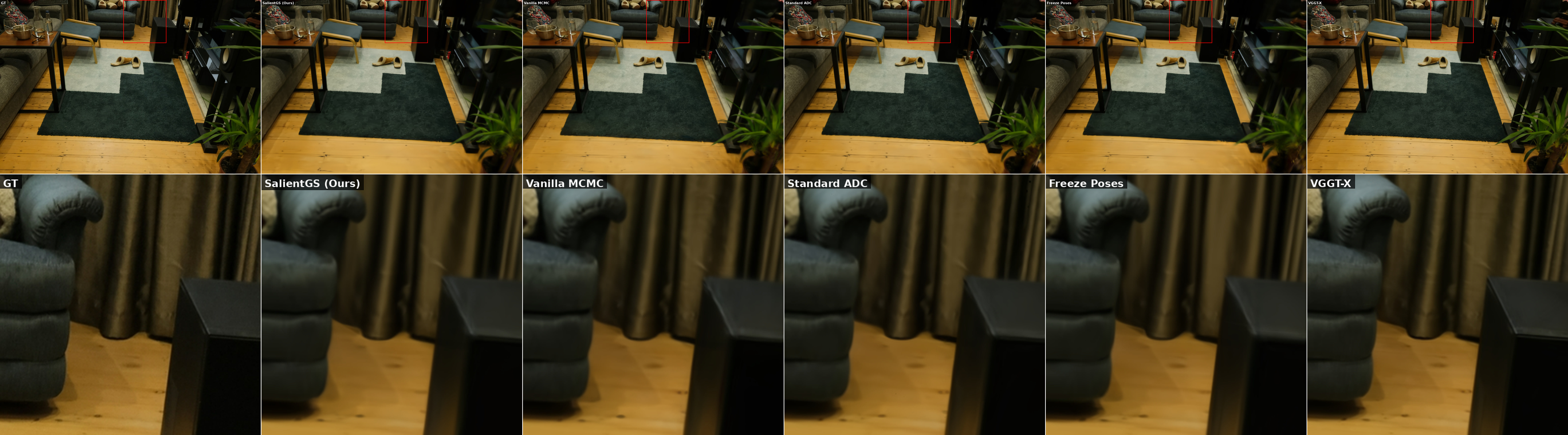
- Smarter use of a limited model: The importance‑guided blob placement consistently helped, especially when the blob budget was small. It puts effort where the model is still making mistakes, leading to better results with the same number of blobs.
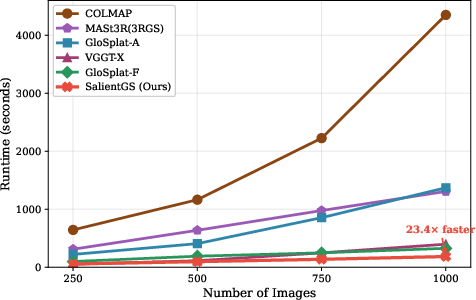
- Faster camera estimation: The quick SfM module ran up to 23× faster than a common baseline tool (COLMAP) on tests, while still being accurate enough to refine later.
- Joint pose refinement helps: Refining camera positions and the 3D model together improved camera accuracy and final image quality compared to keeping camera poses fixed.
Why does this matter?
- Practical speedups: This approach makes 3D reconstruction faster and more convenient, which is useful for VR/AR, robots navigating spaces, digital twins, and preserving real‑world places.
- Stable quality with fewer resources: By smartly placing and moving blobs, the method gets better visual quality without endlessly growing the model—a good fit for time and memory limits.
- Robustness: Keeping geometric constraints during training (not just matching image appearance) helps avoid incorrect camera poses and keeps the model anchored to the real scene.
- A template for future systems: SalientGS shows that combining quick camera initialization with importance‑guided model updates and joint optimization can deliver both speed and accuracy, pointing the way for future 3D reconstruction methods.
In short, SalientGS is like a careful, fast sculptor that keeps checking photos from different angles, uses its limited materials where they’re needed most, and keeps adjusting the camera positions and the sculpture together until the result looks right—quickly and reliably.
Knowledge Gaps
Knowledge gaps, limitations, and open questions
Below is a single, concrete list of unresolved issues that future work could address to strengthen, generalize, or theoretically ground SalientGS.
- Theoretical grounding of importance-guided MCMC: No convergence guarantees are provided; how does the heuristic sampling distribution affect SGLD mixing and stationary behavior, and can it be framed as a valid Metropolis–Hastings proposal with acceptance to preserve target distributions?
- Error-signal design: The importance and redundancy signals rely on L1/SSIM photometric residuals; how robust are they to exposure, white balance, tone‑mapping, rolling shutter, and non-Lambertian effects, and would exposure-invariant or radiometric-calibrated losses reduce bias?
- Visibility- and uncertainty-aware aggregation: Multi-view error attribution averages across K views without explicit visibility or uncertainty modeling; can per-view visibility weights, occlusion-aware masks, or heteroscedastic uncertainty improve the fidelity of underfit attribution?
- Footprint estimation bias: Importance scoring uses approximate projected radii rather than exact covered pixels; what is the impact of this approximation on selection bias (especially for elongated/anisotropic Gaussians), and can faster exact coverage or stratified sampling reduce bias?
- Hyperparameter sensitivity and auto-tuning: The pipeline fixes quantiles (ℓ/h, q_hi/q_lo), thresholds (τ_imp, τ_red), opacity mixing (λ_mix), K views, and recomputation period T; can these be made adaptive (e.g., by monitoring gradient norms, residual distributions, or pose uncertainty) to generalize across scenes without manual tuning?
- Birth/relocation policy optimization: The paper does not detail rates or scheduling for birth vs relocation beyond qualitative guidance; what is the optimal allocation policy (frequency, quotas, parent selection) under different budgets or scene complexities, and can it be learned (e.g., bandits/RL)?
- Interaction with SGLD schedule: How do noise levels, step sizes, and annealing schedules in SGLD interact with importance guidance, and can jointly optimized schedules improve mixing and sample-efficiency without introducing bias?
- Capacity budgeting: Results use a fixed 1.5M Gaussian cap; how should the budget be chosen per scene (or adaptively per region) based on complexity estimates, and can automatic budget schedulers match quality at lower memory/time?
- Shape-aware allocation: Importance guidance focuses on placement, not covariance/shape; would coupling allocation with anisotropy/scale proposals (e.g., axis-aligned vs full covariance updates guided by residual structure) improve fine-detail recovery?
- Joint optimization overhead: Pose refinement improves quality but increases training time; can sparse/structureless BA, pose sub-sampling, low-rank updates, Gauss–Newton warm starts, or alternating schedules reduce overhead without degrading geometric correction?
- Fixed track set in BA: The BA loss uses triangulated tracks that are never updated; should tracks be re-triangulated, reweighted, or pruned during training (e.g., via robust M‑estimators, dynamic outlier rejection, or confidence-based sampling) to avoid locking in early SfM errors?
- Dynamic and nonrigid scenes: The method assumes static scenes; how can motion segmentation, track grouping, or per-object splat sets extend the pipeline to dynamic content without corrupting pose/geometry?
- Intrinsics and distortion modeling: The first-order SfM uses a one-parameter division distortion model and assumes consistent intrinsics; how does the pipeline perform with per-image varying intrinsics, fisheye lenses, strong distortions, or rolling-shutter cameras, and what models are needed?
- Retrieval and view-graph robustness: Fisher Vector + MST provides speed and connectivity but may fail under severe viewpoint/illumination changes; how do learned global descriptors (e.g., NetVLAD, DELG) or hybrid retrieval affect accuracy and runtime, and can cycle-consistency or spectral pruning reduce fragile MST edges?
- Adaptive pair selection: Sensitivity to top‑k is high (large drops at k=10 or 5); can k be chosen adaptively per image based on retrieval confidence, or can active pair augmentation target under‑constrained regions indicated by the importance map?
- Scaling to very large image sets: SfM scaling is near‑linear up to ~1000 images, but end‑to‑end training/VRAM for multi‑thousand image scenes remains untested; what are the limits, and can multi‑GPU/distributed or out‑of‑core splat management maintain quality and speed?
- Online/streaming reconstruction: The pipeline is batch over unordered sets; can the method be made incremental (streamed images), with online pose updates, splat allocation, and retrieval updates while preserving stability?
- Failure case analysis and fallback: Six of 45 ETH3D sequences fail (2 SfM, 4 joint training), and texture‑poor views degrade; which failure modes dominate (e.g., poor matching, degeneracy, photometric ambiguity), and can fallback strategies (e.g., learned priors, local dense matching, depth priors) mitigate them?
- Photometric modeling under real capture: The loss assumes consistent appearance; does modeling exposure/response functions, vignetting, rolling shutter, or per-image color calibration measurably improve importance attribution and pose refinement?
- Geometry-specific evaluation: Novel view metrics (PSNR/SSIM/LPIPS) do not directly measure geometric accuracy/completeness; how does SalientGS fare on depth/normal errors, mesh quality, or surface completeness versus ground truth (e.g., LiDAR, MVS-based meshes)?
- Integration with learned cues: The method purposefully avoids learned retrieval/matching; to what extent would learned keypoints/descriptors, depth/normal priors, or feed-forward pose initializers improve robustness without sacrificing generality or speed?
- Region- and view-aware K selection: Importance is computed over a fixed K views; can K be selected per-region based on visibility and parallax (e.g., using view-entropy) to better capture underfit areas at minimal overhead?
- Pairwise verification and robustness: The RANSAC-based verification is not analyzed for failure under repetitive patterns or low-texture; would stronger geometric checks (e.g., multi-view consistency, loop closures) or robust scoring reduce erroneous tracks that later bias BA?
- Background/sky handling in unbounded scenes: The approach does not discuss background models (e.g., infinite planes or sky domes); does importance guidance misallocate capacity to sky/empty regions, and can specialized background priors prevent this?
- Domain and sensor generalization: The benchmarks focus on common datasets and a single GPU; performance under low light, motion blur, wide-baseline panoramas, smartphone auto-exposure, or different hardware remains unquantified.
- Automated hyperparameter selection: Minimal per-scene tuning trades performance for simplicity; can meta-learning or Bayesian optimization select quantiles, thresholds, and schedules on-the-fly using small validation splits or self-supervised proxies?
- Quantifying trade-offs vs alternative densification: Guided MCMC outperforms standard ADC by ~1.15 dB on one benchmark; broader comparisons across more datasets/budgets and hybrid strategies (ADC for early growth, MCMC for steady-state) remain unexplored.
Practical Applications
Overview
SalientGS introduces a unified, end-to-end pipeline that replaces heavy, stand‑alone SfM preprocessing (e.g., COLMAP) with fast retrieval-based matching, first‑order SfM, and joint pose–appearance optimization for 3D Gaussian Splatting (3DGS). Its importance‑guided MCMC allocation reallocates Gaussian capacity toward persistently underfit regions, improving quality under a fixed budget while keeping runtime low. Below are concrete, real-world applications that leverage these findings, grouped by immediacy.
Immediate Applications
These can be deployed with the released code and commodity GPU hardware today, assuming scenes are mostly static, images have sufficient overlap, and SfM succeeds.
- Media/Entertainment (software, creative tools)
- Use case: On‑set and post‑production environment capture for VFX, games, and VR/AR.
- Why: End-to-end reconstruction in ~10–12 minutes from unordered images, delivering high-quality view synthesis with 1.5M Gaussians and no separate COLMAP step.
- Tools/workflow: A plug‑in or CLI that ingests set photos → runs Fisher Vector retrieval + first‑order SfM → joint 3DGS optimization → exports splats and optional mesh via downstream meshing tools; integration with Unreal/Unity/Blender viewers.
- Assumptions/dependencies: Static scenes; sufficient view overlap; GPU (e.g., NVIDIA RTX‑class); meshing quality depends on downstream tools; texture‑poor regions may need more coverage.
- AEC/Digital Twins (construction, facilities management)
- Use case: Rapid site/as‑built documentation and change tracking from handheld/drone photo sets.
- Why: Near‑linear SfM scaling and ~10‑minute end‑to‑end runtime make frequent captures feasible; joint BA stabilizes poses; importance maps reveal under‑captured areas.
- Tools/workflow: Field photo capture → batch SalientGS → 3D viewer for QA → optional mesh for BIM workflows.
- Assumptions/dependencies: Overlap/connectivity in view graph; outdoor lighting changes manageable but extreme variation may degrade FV retrieval; larger sites may require tiling/multi‑GPU.
- E‑commerce/Retail (product digitization)
- Use case: Fast 3D assets of products from casual studio photos for web AR previews.
- Why: Eliminates heavy SfM preprocessing; competitive perceptual quality and small model sizes enable snappy web experiences.
- Tools/workflow: Photo booth app → SalientGS backend → splat viewer or mesh export for GLTF/USDZ.
- Assumptions/dependencies: Static products; controlled lighting improves results; require GPU server or workstation.
- Real Estate/PropTech and Insurance/Forensics
- Use case: Property walk‑throughs and incident scene reconstructions from staff or claimant photos.
- Why: Quick turnaround for viewer‑ready 3D tours; importance maps flag areas needing additional photos for evidence completeness.
- Tools/workflow: Guided photo capture → SalientGS → browser viewer for adjusters/agents → optional measurement/annotation tools.
- Assumptions/dependencies: Privacy/compliance for image handling; sufficient coverage in narrow spaces; minimal moving objects.
- Cultural Heritage and Museums
- Use case: Digitization of artifacts/exhibits with limited compute on‑site.
- Why: Reduced preprocessing burden and robust performance across datasets; reproducible, code‑released pipeline.
- Tools/workflow: Curatorial photo sets → SalientGS → archival 3D assets for virtual exhibits.
- Assumptions/dependencies: Controlled capture recommended; mesh conversion for long‑term archival standards may be required.
- Robotics (offline mapping and QA)
- Use case: Post‑mission 3D reconstruction and pose refinement from unordered robot/drone images.
- Why: Joint photometric and BA optimization improves pose accuracy; importance maps highlight underfit areas for re‑tasking.
- Tools/workflow: Mission photo dump → SalientGS → mapping QA → plan recapture of underfit regions.
- Assumptions/dependencies: Primarily offline; dynamic scenes can reduce fidelity; ensure view graph connectivity.
- Public Sector & Disaster Response
- Use case: Rapid 3D documentation of affected sites using responders’ photo sets.
- Why: Fast, unified pipeline produces actionable 3D overviews; importance maps guide additional photo collection where needed.
- Tools/workflow: Field collection (smartphones/UAVs) → laptop/GPU node runs → quick 3D for situational awareness.
- Assumptions/dependencies: Connectivity and coverage are key; ruggedized GPU hardware or mobile data upload.
- Education & Research (academia)
- Use case: Teaching and benchmarking in 3D vision, photogrammetry, and rendering.
- Why: Open code, deterministic runner with fixed hyperparameters, and strong performance simplify instruction and reproducible experiments.
- Tools/workflow: Coursework labs comparing SfM variants and allocation strategies; ablations for research baselines.
- Assumptions/dependencies: GPU access in labs; datasets with adequate coverage.
- Capture Quality Assurance (cross‑sector)
- Use case: Immediate feedback on what parts of a scene are under‑reconstructed.
- Why: The importance/redundancy signals double as an interpretable QA layer.
- Tools/workflow: After an initial run, visualize underfit heatmaps to drive targeted re‑capture.
- Assumptions/dependencies: Requires a short initial optimization pass; effective when scenes aren’t heavily dynamic.
Long‑Term Applications
These require additional research, scaling, or product engineering beyond the paper’s current scope.
- Live/On‑Device Reconstruction for AR (software, XR)
- Use case: Near‑real‑time scene capture on AR headsets or smartphones for persistent AR content.
- Why: SalientGS reduces preprocessing and training time; further acceleration and incremental optimization could enable live feedback.
- Potential products/workflows: Streaming, incremental splat updates; on‑device inference with mobile‑class GPUs/NPUs.
- Assumptions/dependencies: Significant optimization for memory/compute; robust handling of rolling shutter, auto‑exposure, motion blur.
- Active View Planning Guided by Importance (robotics, inspection, energy)
- Use case: Drones/robots plan next best views using underfit maps to close coverage gaps autonomously.
- Why: The importance signal is a capture‑quality prior that can inform exploration.
- Potential workflows: Closed‑loop capture (plan → capture → quick SalientGS update → re‑plan).
- Assumptions/dependencies: Tight integration with navigation stacks; efficient, incremental score updates; dynamic obstacle handling.
- City/Facility‑Scale Digital Twins (GIS, smart cities, utilities)
- Use case: Large‑scale, multi‑session reconstructions with frequent updates.
- Why: Near‑linear scaling in SfM is promising; unified optimization could cut operational costs.
- Potential workflows: Tiled processing; cross‑tile alignment; periodic re‑training for deltas.
- Assumptions/dependencies: Distributed training, multi‑GPU clusters; robust multi‑session registration and drift control.
- Dynamic/4D Scene Reconstruction (media, robotics)
- Use case: Handling non‑rigid or moving objects over time for events, crowds, or machinery.
- Why: 3DGS has emerging 4D variants; importance‑guided allocation and joint pose refinement could extend to temporal models.
- Potential workflows: Time‑aware splats; motion segmentation and per‑region budgets.
- Assumptions/dependencies: New formulations for temporal consistency and occlusion; data association across time.
- Healthcare & Clinical Training (healthcare, education)
- Use case: Patient‑safe clinical space models and training simulators from ad hoc photos.
- Why: Rapid recon beneficial for training spaces or non‑patient assets; with validation, may extend to certain anatomical recon tasks.
- Potential workflows: Facility mapping for simulation; future research into controlled clinical imagery.
- Assumptions/dependencies: Strict privacy/regulatory compliance; clinical validation; texture/lighting constraints in clinical environments.
- Standardized Deliverables and QA Policies for 3D Capture (policy, procurement)
- Use case: Procurement guidelines that include reconstruction speed/quality and QA heatmaps.
- Why: Deterministic pipeline with built‑in QA can anchor SLAs and audits.
- Potential tools: Reporting dashboards that include PSNR/SSIM/LPIPS proxies and underfit coverage metrics.
- Assumptions/dependencies: Agreement on metrics for non-Lambertian, in‑the‑wild scenes; standard viewers/interchange formats for splats.
- Robustness via Learned Retrieval and Hybrid Front‑Ends (software, research)
- Use case: Improved matching under severe appearance changes (weather, seasons, exposure).
- Why: The paper’s Fisher Vector retrieval is fast but can fail under large appearance gaps; swapping in NetVLAD/MegaLoc‑style descriptors may generalize better.
- Potential workflows: Pluggable retrieval layer; adaptive k‑NN tuning guided by reconstruction confidence.
- Assumptions/dependencies: Training/maintaining descriptor models; domain‑shift mitigation.
- End‑to‑End Asset Pipeline: Splat→Mesh→PBR (media, e‑commerce)
- Use case: Robust mesh/textured asset extraction for downstream engines.
- Why: Broad adoption hinges on mesh/PBR deliverables; maturing splat‑to‑mesh pipelines with material baking would bridge gaps.
- Potential workflows: Automatic meshing, UVs, and texture baking from optimized Gaussians; quality gating with importance/LPIPS.
- Assumptions/dependencies: Meshing remains a research/engineering challenge for thin structures and view‑dependent effects.
- Privacy‑Preserving or Federated Reconstruction (public sector, enterprise)
- Use case: Organizations reconstruct sensitive spaces without centralizing raw imagery.
- Why: A fast, unified optimizer is a good base for federated or on‑prem deployments with encrypted intermediate states.
- Potential workflows: On‑device feature extraction with encrypted sharing of minimal statistics; local joint optimization.
- Assumptions/dependencies: Cryptographic protocols and federated learning infrastructure; performance overheads.
Cross‑Cutting Assumptions and Dependencies
- Input coverage: Requires well‑connected view graphs with sufficient image overlap; failure modes increase at low retrieval k or in degenerate camera motions.
- Scene characteristics: Best for mostly static scenes with enough texture; texture‑poor or highly dynamic scenes can reduce quality.
- Hardware: Reported runtimes use a high‑end GPU (e.g., RTX PRO 6000 Blackwell). Lower‑end hardware will be slower; memory limits may require smaller Gaussian budgets or tiling.
- Upstream success: Joint optimization refines but does not replace successful SfM initialization; if SfM fails entirely, downstream recovery is limited.
- Retrieval robustness: Fisher Vector retrieval is fast and network‑free but less robust to extreme appearance changes; learned descriptors can improve resilience (at the cost of training/maintenance).
- Deliverable format: Many downstream workflows still expect meshes; additional meshing/baking steps may be needed.
- Compliance: For regulated domains (e.g., public sector, healthcare), ensure data consent, privacy, and security practices are in place.
Glossary
- 3D Gaussian Splatting (3DGS): A real-time scene representation and rendering technique that models radiance with many anisotropic 3D Gaussian primitives. "We present SalientGS, a unified SfM-to-3D Gaussian Splatting (3DGS) pipeline."
- Adaptive density control (ADC): A 3DGS heuristic that densifies (clone/split) or prunes Gaussians based on gradients and opacity thresholds. "which differs fundamentally from standard 3DGS adaptive density control (ADC)."
- Anisotropic Gaussians: Gaussian primitives with direction-dependent covariance used as rendering elements in 3DGS. "3DGS~\cite{kerbl3Dgaussians} enables real-time rendering via anisotropic Gaussians but is sensitive to initialization quality."
- Approximate nearest-neighbor (ANN) search: A fast, approximate method for finding nearest vectors in high-dimensional spaces. "via FAISS~\cite{faiss} approximate nearest-neighbor (ANN) search in time,"
- Bag-of-Words: An image retrieval representation that quantizes local features into a histogram of visual words. "image-level descriptors such as Fisher Vectors~\cite{perronnin2010fisher}, Bag-of-Words~\cite{sivic2003video,jegou2010aggregating}, and learned methods like NetVLAD~\cite{arandjelovic2016netvlad} and MegaLoc~\cite{megaloc}."
- Birth (MCMC): In MCMC-based population management, the operation that adds new Gaussians by sampling from existing ones. "two operations: relocation (teleporting low-value Gaussians to new positions) and birth (adding new Gaussians by sampling from existing ones)."
- Bundle adjustment (BA): Joint non-linear optimization of camera parameters and 3D structure to minimize reprojection error. "reprojection-based bundle adjustment (BA) loss on triangulated feature tracks,"
- COLMAP: A widely used incremental Structure-from-Motion system for pose and sparse point-cloud estimation. "most commonly performed with COLMAP~\cite{colmap}."
- Division distortion model: A simple lens distortion parameterization using a single division parameter. "a one-parameter division distortion model;"
- Epipolar adjustment: First-order optimization that refines camera poses using epipolar geometry without explicitly reconstructing points. "first-order epipolar adjustment, achieving near-linear scaling and up to 23 SfM speedup."
- Epipolar constraints: Geometric relations between corresponding points in two views that must satisfy the epipolar equation. "from epipolar constraints:"
- Essential matrix: A 3×3 matrix encoding the relative rotation and translation between two calibrated views. "focal length is recovered by maximizing the singular value ratio of the essential matrix."
- FAISS: Facebook AI Similarity Search; a library for efficient similarity search and ANN indexing. "via FAISS~\cite{faiss} approximate nearest-neighbor (ANN) search"
- Feature tracks: Multi-view correspondences linking the same 3D point across images, used to constrain geometry. "reprojection-based bundle adjustment (BA) loss on triangulated feature tracks,"
- Fisher Vector (FV): A global image descriptor formed by gradients of the log-likelihood of local features under a GMM. "Fisher Vector (FV) retrieval with Maximum Spanning Tree (MST) connectivity"
- Gaussian Mixture Model (GMM): A probabilistic model that represents data as a mixture of Gaussian distributions. "with respect to an -component Gaussian Mixture Model (GMM) trained on the image collection."
- Geodesic distances on SO(3): Distances measured along the rotation manifold, used for robust rotation optimization. "Global rotations are solved by minimizing geodesic distances on SO(3)"
- GLOMAP: A global SfM pipeline emphasizing speed while maintaining high pose accuracy. "GLOMAP~\cite{pan2024glomap} achieves COLMAP-level accuracy with significant speedups."
- Global SfM: Structure-from-Motion approaches that estimate all poses jointly rather than incrementally. "Global SfM methods~\cite{moulon2017openmvg,sweeney2015theia} solve all poses simultaneously via rotation~\cite{hartley2013rotation,wilson2020distribution} and translation averaging~\cite{govindu2001combining,martinec2007robust};"
- kNN graph: A graph connecting each image to its k nearest neighbors (by descriptor similarity) to guide matching. "producing a sparse NN graph."
- LPIPS: A learned perceptual image similarity metric that correlates with human judgment. "LPIPS~\cite{zhang2018unreasonable}"
- Macro-average: Averaging metrics across datasets by giving each dataset equal weight, not weighted by size. "we additionally macro-average the three dataset-level entries, giving each benchmark equal weight."
- Markov Chain Monte Carlo (MCMC): A sampling framework; here used to manage and allocate a population of Gaussians. "importance-guided Markov Chain Monte Carlo (MCMC) Gaussian allocation,"
- Maximum Spanning Tree (MST): A spanning tree with maximum total edge weight, ensuring connectivity in a sparse graph. "Maximum Spanning Tree (MST) connectivity"
- Neural Radiance Fields (NeRF): A neural field representation for novel view synthesis from images. "Neural Radiance Fields (NeRF)~\cite{mildenhall2021nerf}"
- Opacity mixing: A weighting trick that mixes opacity into sampling weights to avoid undersampling low-opacity but underfit regions. "The opacity mixing term $\lambda_{\text{mix}$ prevents under-sampling Gaussians that are underfit but initially low-opacity (weak coverage),"
- Photometric loss: An image-space loss combining pixel-wise error and structural similarity for supervision. "Photometric Loss"
- Pose drift: The gradual accumulation of pose error during optimization or reconstruction. "leading to pose drift in challenging scenarios."
- Procrustes alignment: A rigid alignment procedure to compare estimated poses with ground truth after removing similarity transforms. "after robust Procrustes alignment:"
- PSNR: Peak Signal-to-Noise Ratio; a fidelity metric measuring reconstruction accuracy in decibels. "PSNR, SSIM, and LPIPS (27.65~dB / 0.876 / 0.147)"
- Quantile normalization: Scaling data using quantiles to make statistics robust and comparable across views or stages. "we avoid per-view min-max ... and instead use robust quantile normalization:"
- RANSAC: Random Sample Consensus; a robust estimator for model fitting used to verify geometric matches. "then apply RANSAC-based geometric verification to filter spurious matches."
- Relocation (MCMC): In MCMC population management, reassigning low-value Gaussians to new positions to reuse capacity. "relocation (teleporting low-value Gaussians to new positions)"
- Scale-Invariant Feature Transform (SIFT): A local keypoint detector/descriptor robust to scale and orientation changes. "we extract Scale-Invariant Feature Transform (SIFT) features"
- Signed-square-root normalization: A vector normalization that applies sign-preserving square root element-wise before L2 normalization. "The resulting vectors are L2- and signed-square-root normalized for retrieval."
- SO(3): The Lie group of 3D rotations; the manifold on which camera rotations lie. "Global rotations are solved by minimizing geodesic distances on SO(3)"
- Stochastic Gradient Langevin Dynamics (SGLD): An optimization scheme that injects noise into gradients to approximate Langevin sampling. "without altering the underlying stochastic gradient Langevin dynamics (SGLD)."
- Structure-from-Motion (SfM): Recovering camera poses and sparse 3D structure from multiple images. "Structure-from-Motion (SfM) preprocessing, most commonly performed with COLMAP~\cite{colmap}."
- Translation averaging: The process of globally reconciling pairwise translation directions into consistent camera translations. "Global SfM methods ... solve all poses simultaneously via rotation~\cite{hartley2013rotation,wilson2020distribution} and translation averaging~\cite{govindu2001combining,martinec2007robust};"
- Triangulation: Estimating 3D point locations from multiple 2D observations and known camera poses. "triangulate a coarse 3D structure,"
- View graph: A graph whose nodes are images and edges indicate verified matches, used to structure SfM. "Joint optimization therefore cannot replace a connected, reliable view graph."

