- The paper presents an analytic treatment of gravitational waves induced by a box-shaped curvature spectrum, detailing both narrow and broad spectral regimes.
- It derives closed-form expressions that isolate the effects of sharp spectral boundaries and simplify convolution computations in the radiation era.
- Findings provide practical diagnostics for PTA analyses and primordial black hole research through robust spectral feature identification.
Scalar-Induced Gravitational Waves from a Box-Shaped Curvature Power Spectrum
Overview and Motivation
The paper "Scalar-induced gravitational waves from a box-shaped curvature power spectrum" (2607.10730) presents a rigorous analytic treatment of the stochastic gravitational wave (GW) background generated at second order in cosmological perturbation theory by a primordial curvature power spectrum with box-type support in logarithmic wavenumber. The motivation is twofold: (1) box-shaped spectra are a practical and minimal template for parameter scans in stochastic GW searches—including direct applications in Pulsar Timing Array (PTA) studies—and (2) the top-hat form fully isolates the effects of sharp boundaries, enabling transparent analytic control over spectral features and simplifying convolution computations.
The authors build on the established connection between enhanced small-scale curvature perturbations and scalar-induced GWs, noting the dual relevance for primordial black hole (PBH) formation and for stochastic GW interpretations in PTA and space-based detector data. The study systematically addresses both narrow (Δ≪1) and broad (Δ≫1) spectral regimes, providing closed-form expressions and precise asymptotic results for the induced GW spectrum.
The analysis employs the conformal Newtonian gauge, with GWs generated by quadratic scalar perturbations in the radiation-dominated universe. The energy density of induced GWs is computed via a time-averaged kernel convolution of the primordial curvature spectrum, parameterized in the wavenumber domain:
ΩGW(k)=∫0∞dv∫∣1−v∣1+vduT(u,v)Pψ(ku)Pψ(kv)
where T(u,v) is the radiation-era kernel, and Pψ(k) is the box-shaped spectrum centered at k∗ with height proportional to 1/(2Δ) and support [k∗e−Δ,k∗e+Δ].
Narrow Box Regime: Geometric Factorization and Infrared Tail
For Δ≪1, the spectrum approaches a Dirac delta in logk, retrieving the monochromatic case. The convolution reduces to a simple geometric overlap problem between the momentum triangle and the narrow box, yielding a factorized form:
Δ≫10
where Δ≫11 is the overlap fraction dependent only on kinematics:
Δ≫12
Key results include:
- Infrared Scaling: For Δ≫13, the spectrum steepens from Δ≫14 (monochromatic case) to Δ≫15, controlled by boundary support. The break scale is Δ≫16.
- Resonance Regularization: The spectrum regularizes the monochromatic resonance by integrating over the finite box window, with peak height scaling as Δ≫17 for small Δ≫18.
- Shape Robustness: Comparison with lognormal and Gaussian peaks reveals that the overlap factor mimics the error function behavior seen in lognormal templates, confirming that the infrared break and peak-to-break frequency ratio are insensitive to detailed spectral shape.
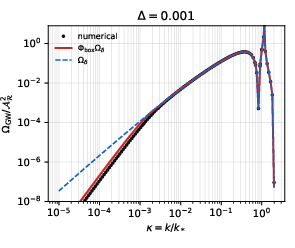
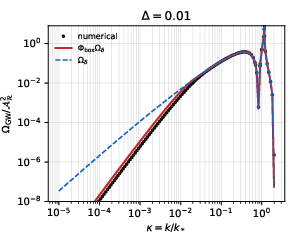
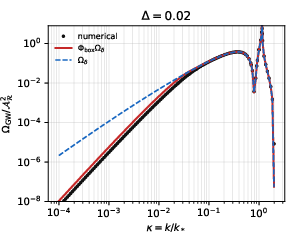
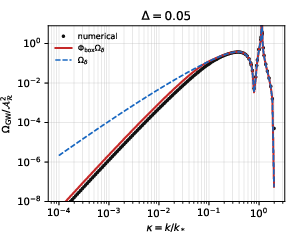
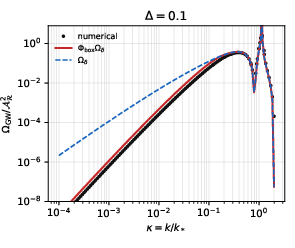
Figure 1: Narrow box spectra for various Δ≫19, highlighting the transition from ΩGW(k)=∫0∞dv∫∣1−v∣1+vduT(u,v)Pψ(ku)Pψ(kv)0 to ΩGW(k)=∫0∞dv∫∣1−v∣1+vduT(u,v)Pψ(ku)Pψ(kv)1 at the infrared break ΩGW(k)=∫0∞dv∫∣1−v∣1+vduT(u,v)Pψ(ku)Pψ(kv)2.
Broad Box Regime: Edge Functions and Spectral Structure
For ΩGW(k)=∫0∞dv∫∣1−v∣1+vduT(u,v)Pψ(ku)Pψ(kv)3, the box has a wide, locally scale-invariant interior with sharp edges. The authors define universal edge functions ΩGW(k)=∫0∞dv∫∣1−v∣1+vduT(u,v)Pψ(ku)Pψ(kv)4 and ΩGW(k)=∫0∞dv∫∣1−v∣1+vduT(u,v)Pψ(ku)Pψ(kv)5, encoding the lower (ΩGW(k)=∫0∞dv∫∣1−v∣1+vduT(u,v)Pψ(ku)Pψ(kv)6) and upper (ΩGW(k)=∫0∞dv∫∣1−v∣1+vduT(u,v)Pψ(ku)Pψ(kv)7) boundaries respectively:
ΩGW(k)=∫0∞dv∫∣1−v∣1+vduT(u,v)Pψ(ku)Pψ(kv)8
where ΩGW(k)=∫0∞dv∫∣1−v∣1+vduT(u,v)Pψ(ku)Pψ(kv)9 and T(u,v)0. Three distinct regions emerge:
- Lower Edge (IR): Universal T(u,v)1 scaling as T(u,v)2, independent of the box height.
- Interior Plateau: Constant spectrum for T(u,v)3, with amplitude T(u,v)4 (normalized), representing the response to a scale-invariant source.
- Upper Edge (UV): Quartic cutoff in the hard endpoint T(u,v)5, with the spectrum declining as T(u,v)6.
An explicit integral-free surrogate for T(u,v)7 and T(u,v)8 is constructed for computational efficiency in parameter scans.
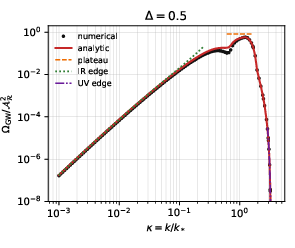
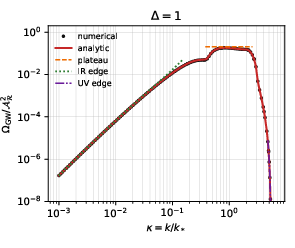
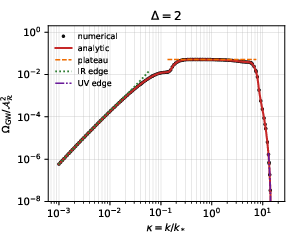
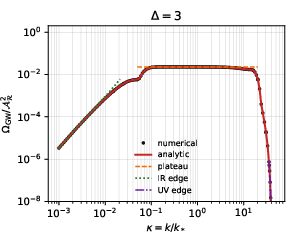
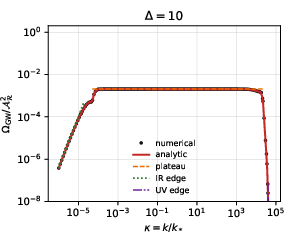
Figure 2: Broad box spectra for increasing T(u,v)9, with the analytic uniform formula accurately capturing the lower-edge, plateau, and upper-cutoff behaviors.
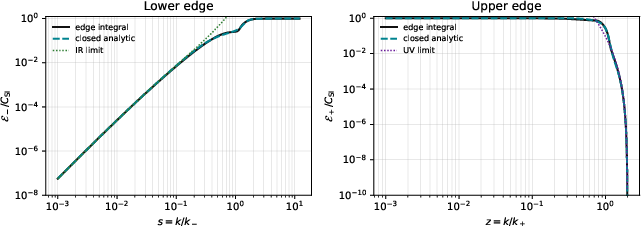
Figure 3: Edge functions normalized by box height, showing the universal lower (Pψ(k)0) and upper (Pψ(k)1) boundary responses.
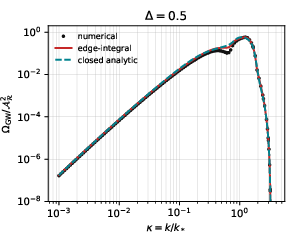
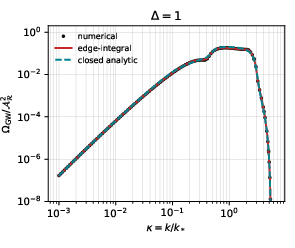
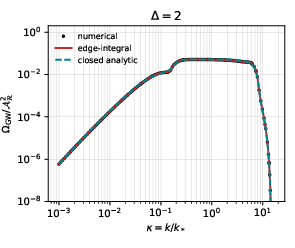
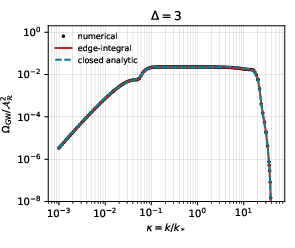
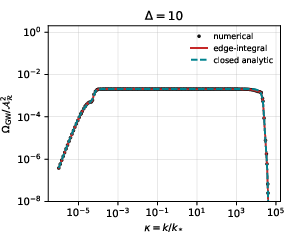
Figure 4: Comparison of spectra produced by the edge-integral composite and the surrogate closed-form analytic expression, validating the parameter-free template across box widths.
Implications and Applications
The box template provides several concrete advantages:
- Physical Transparency: The spectral features—break scale, plateau amplitude, and cutoff—are analytically trackable, directly tying GW observables to curvature power support and amplitude.
- Robust Diagnostics: The break-to-peak frequency ratio Pψ(k)2 is universal across box and lognormal spectral shapes, enabling width estimation independent of peak details.
- Practical Relevance: Box-shaped spectra are actively used in PTA analysis (e.g., NANOGrav), and analytic templates facilitate rapid inference, model discrimination, and spectrum reconstruction tasks.
- Generalizability: The analytic framework supports extension to composite or piecewise-constant spectra, more general equations of state, and soft boundary scenarios, broadening its utility for GW parameter studies and PBH abundance calculations.
Conclusion
This paper establishes a comprehensive analytic catalogue for scalar-induced GW spectra generated by box-shaped curvature power spectra. The combination of geometric factorization, universal edge function construction, and explicit closed-form interpolation supports both physical interpretation and practical data analysis requirements in stochastic GW searches and cosmological reconstruction. The framework clarifies which spectral features are dictated by support versus weighting, and sets the stage for more complex spectrum modeling and inference in primordial cosmology and GW astrophysics.

