- The paper establishes an effective Bayesian evidence framework to rank low order monomial potentials in a warm inflation context.
- The authors demonstrate that thermal occupancy via Bose-Einstein statistics enables quartic potentials to overcome cold inflation constraints.
- Robust numerical sampling confirms the quartic model’s preference, highlighting the role of composite dissipative sectors.
Bayesian Evidence Ranking of Low Order Monomial Potentials in Low Temperature Warm Inflation
Introduction and Framework
This study presents a comprehensive Bayesian evidence ranking of single-field inflationary models characterized by low order monomial potentials Vp(ϕ)=λpϕp/p (p=2,3,4) within the context of low temperature warm inflation, where dissipation is modeled via a cubic temperature-dependent coefficient Υ=CϕT3/ϕ2. Contrasting sharply with cold inflationary dynamics where monomial potentials are strongly constrained, especially by the upper limits on the tensor-to-scalar ratio r, the warm inflation scenario modifies the scalar power spectrum through dissipative and thermal effects, potentially alleviating those constraints.
Central observables for model discrimination are the amplitude of curvature perturbations As, scalar spectral index ns, and tensor-to-scalar ratio r at a CMB pivot scale. The key innovation is the establishment of an effective Bayesian evidence Zeff, which integrates the likelihood of matching these observables over structure-conditioned, physically motivated prior volumes for each model. All calculations explicitly include backreaction of radiation, verification of the regime's validity (weak dissipation, low temperature), and parameter sampling consistent with the required number of e-folds.
Analytic Cold Inflation Reference and Warm Inflation Modifications
Analytic benchmarks for the monomial models in the cold inflation limit show increasing tension at higher p values: r is directly proportional to p=2,3,40, and the predicted p=2,3,41 too falls outside observational constraints for cubic and quartic terms at typical p=2,3,42. This is summarized by a systematic increase in both p=2,3,43 and the deviation of p=2,3,44 from the observational central value as p=2,3,45 increases, rendering particularly p=2,3,46 (quartic) non-viable in cold single-field slow-roll inflation.
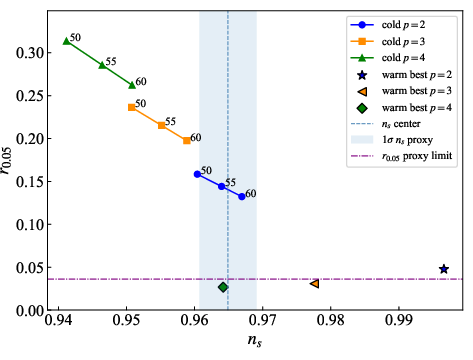
Figure 1: Positions of the cold inflation analytic reference points and the warm representative high likelihood points in the p=2,3,47--p=2,3,48 plane; warm inflation brings quartic models into the observationally viable region, evading the p=2,3,49 constraints.
In warm inflation, however, continuous energy dissipation from the inflaton into a thermal bath—along with an enhanced scalar spectrum via thermal fluctuations and Bose-Einstein occupation—decouples Υ=CϕT3/ϕ20 from the simple cold-inflation slow-roll formula Υ=CϕT3/ϕ21. In this framework, Υ=CϕT3/ϕ22 governs the relative strength of dissipation, and crucially, in the CMB window explored, Υ=CϕT3/ϕ23 but Υ=CϕT3/ϕ24, enabling significant spectral modifications via thermal effects rather than frictional (dissipative) suppression.
Bayesian Evidence Computation and Model Comparison
The paper performs a systematic nested sampling Bayesian evidence computation for each Υ=CϕT3/ϕ25, integrating over five-dimensional prior spaces tailored to each monomial model. Priors are constructed via global parameter space exploration and include only regions compatible with warm inflation's physical requirements. The likelihood function combines Gaussian constraints on Υ=CϕT3/ϕ26, Υ=CϕT3/ϕ27, and an upper bound penalty on Υ=CϕT3/ϕ28, implemented as a softened one-sided constraint.
Strong numerical results are reported:
| Model |
Υ=CϕT3/ϕ29 (relative to r0) |
| r1 (quadratic) |
r2 |
| r3 (cubic) |
r4 |
| r5 (quartic) |
r6 |
These substantial effective evidence differences robustly favor the quartic potential among the tested monomial branches within the low temperature warm inflation class. The results are stable against variations in r7 (number of e-folds), prior widths, and treatment of the r8 upper bound.
Overlaps of high-likelihood regions for the quartic branch, as determined by different inference techniques (MCMC, nested sampling, normalizing flows), corroborate posterior robustness and convergence.
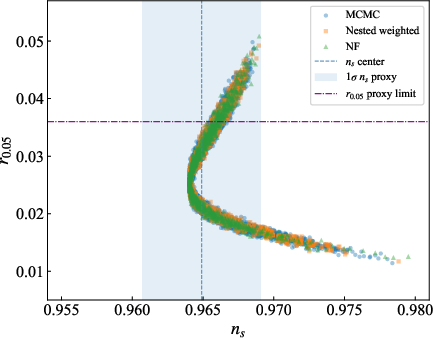
Figure 2: Overlap of the posterior regions for the quartic potential branch in the r9-As0 plane demonstrates consistency across inference methodologies.
Physical Mechanism: Origin of the Quartic Preference
A critical analysis demonstrates that the quartic branch's high evidence does not primarily derive from strong dissipative friction during inflation (As1) but rather from the enhancement of the scalar perturbation amplitude by thermal occupation effects—specifically, Bose-Einstein statistics when As2 during the CMB window. Removal of the thermal occupation term (As3) severely suppresses the scalar spectrum and pushes As4 well above observational constraints for all As5, eliminating any advantage for the quartic model.
Thus, the quartic model's reemergence as the statistically preferred monomial in warm inflation is conditioned upon the validity and efficacy of thermal occupancy of inflaton fluctuations during the relevant phase.
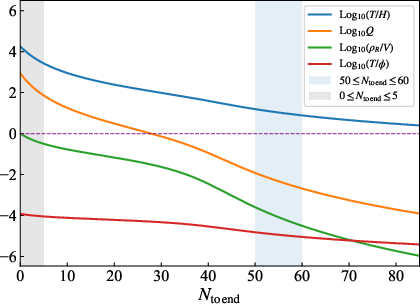
Figure 3: Validity diagnostics for the representative trajectory of the quartic potential, confirming the regime of weak dissipation and significant thermal occupancy during the CMB window.
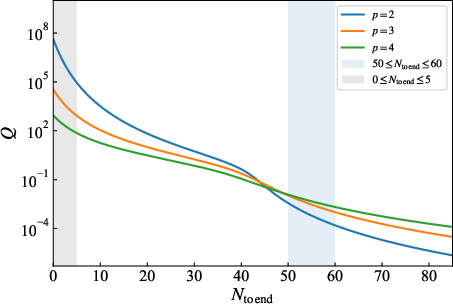
Figure 4: Evolution of the dissipation ratio As6 for all representative monomial potentials, with As7 during the CMB window and rapid increase approaching the end of inflation.
Implications and Theoretical Significance
The work's key implication is that within the fixed low temperature, weakly dissipative warm inflation framework, and with observational constraints modeled through a compressed likelihood, the quartic potential—excluded by tensor amplitude measurements in cold inflation—becomes the most statistically supported low order monomial. This has significant consequences for inflationary model building, emphasizing the role of detailed microphysical modeling of dissipation and the necessity for consistent treatment of thermal perturbations.
However, the preference for the quartic branch is conditional: a large effective dissipation parameter (As8–As9) is required, interpretable as arising from large numbers of dissipative channels or composite sectors, rather than a single coupling; the thermal occupancy assumption is essential. The result is not generically extensible to all classes of warm inflation, but delineates a well-defined region in the parameter and model space where quartic monomials are viable and even preferred.
The Bayesian model comparison framework established in this study provides a rigorous template for future comparative analyses of inflationary models with more general potential forms or dissipation structures, particularly as cosmological data continue to improve.
Conclusion
The Bayesian ranking of low order monomial inflationary potentials in the low temperature warm inflation scenario, incorporating rigorous backreaction and parameter consistency constraints, finds that the quartic model (ns0) strongly dominates over quadratic and cubic alternatives, contingent on thermally occupied, weakly dissipative dynamics during the CMB window. This outcome strongly contrasts with cold inflation predictions, highlighting the transformative impact of warm inflation microphysics on inflationary model selection and motivating further exploration of composite dissipative sectors and their phenomenological signatures.