Lottery and Sprint Arcade: Enabling Player-Driven Game Editing with Generative AI
Abstract: LLMs are shifting game generation from offline automation toward play-driven modification through natural language interaction. In this work, we present a play-driven game editing system that enables players to modify a retro Space Invaders - style arcade game through voice-based natural-language commands during play. Spoken instructions are interpreted by an LLM and translated into structured updates of internal configuration parameters, allowing iterative play - edit - feedback cycles in an invader-style game environment without exposing underlying system details. The game includes approximately 100 editable configuration fields controlling mechanics, visuals, interaction patterns, and audio behavior, enabling gameplay transformation through incremental parameter changes. To investigate how users experience play-driven AI-mediated editing (RQ1) and how emergent editing patterns relate to variations in player experience (RQ2), we conducted a user study combining subjective evaluations, workload measures, and log-based analysis of editing behavior. Participants were able to modify gameplay with generally positive experiences and moderate workload, and interaction outcomes did not strongly depend on prior programming experience. Editing-log analysis revealed distinct experiential tendencies: adjustments to immediately perceptible parameters were associated with higher usability, whereas edits affecting core gameplay structures were more closely associated with enjoyment. Post-session reflections further identified diverse editing strategies, including exploratory experimentation, goal-driven structural modification, and iterative parameter tuning. These findings demonstrate that voice-driven editing can support accessible, play-driven human - AI co-creation within a structured invader-style arcade game environment.
Paper Prompts
Sign up for free to create and run prompts on this paper.
Explain it Like I'm 14
What this paper is about
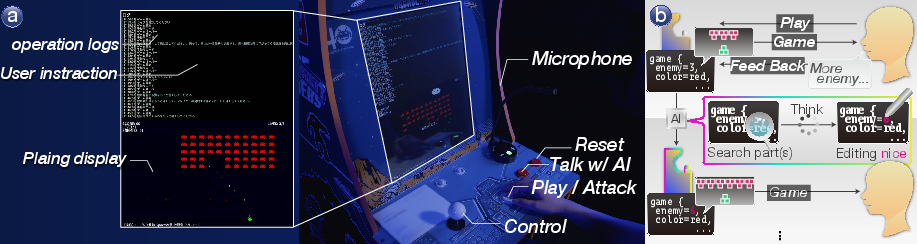
This paper shows a new way to let players change a video game while they’re playing it—just by talking. The game is a simple, retro, Space Invaders–style arcade game. Players press a button, say things like “make it faster” or “change the bullet color,” and an AI turns those words into changes inside the game. The goal is to make game editing feel like turning easy “dials” by voice, instead of writing code.
The main questions the researchers asked
- How do people feel about changing a game by talking to an AI while they play? Is it easy or tiring?
- Do people with programming experience do better or enjoy it more than people without that background?
- What kinds of changes do players make most, and how do those choices relate to how fun or easy the game feels?
How the system works (in everyday language)
Think of the game as having about 100 “settings” (like knobs), such as:
- How fast enemies move
- How often bullets are fired
- Colors and sounds
- How tough barriers are
- When a special UFO appears
These settings live in a structured list the computer reads (like a neatly labeled checklist).
Here’s the process, step by step:
- You hold a button and speak a command (e.g., “make enemies move faster”).
- A speech tool turns your voice into text.
- A LLM—a smart text-based AI, like a super-powered chatbot—figures out which settings to change.
- The AI first “plans” the changes (which settings, why, and what effect they’ll have), then “applies” them safely, one by one.
- The game restarts so you can immediately feel the difference (this makes it easy to compare “before” vs. “after”).
This ran on a real arcade cabinet with a Raspberry Pi inside, a microphone for voice input, and a repurposed button for “voice mode.”
Simple definitions:
- LLM: An AI that understands and writes human language.
- Configuration/parameters: The game’s behind-the-scenes settings that control how it behaves.
What the researchers did (the study)
- 21 adults played five short rounds each on the arcade machine.
- During each round, they could issue voice commands to change the game.
- After each round, they answered quick questions about how easy, clear, and enjoyable it felt.
- At the end, they also filled out standard questionnaires about workload (how mentally/physically demanding it felt) and user experience.
- The system kept logs of the changes people made to see patterns in how they edited the game.
What they found and why it matters
- The system was reliable: Out of 715 spoken commands, about 97% were successfully turned into game changes. Only a tiny fraction were safely rejected (no crash or weird side effects).
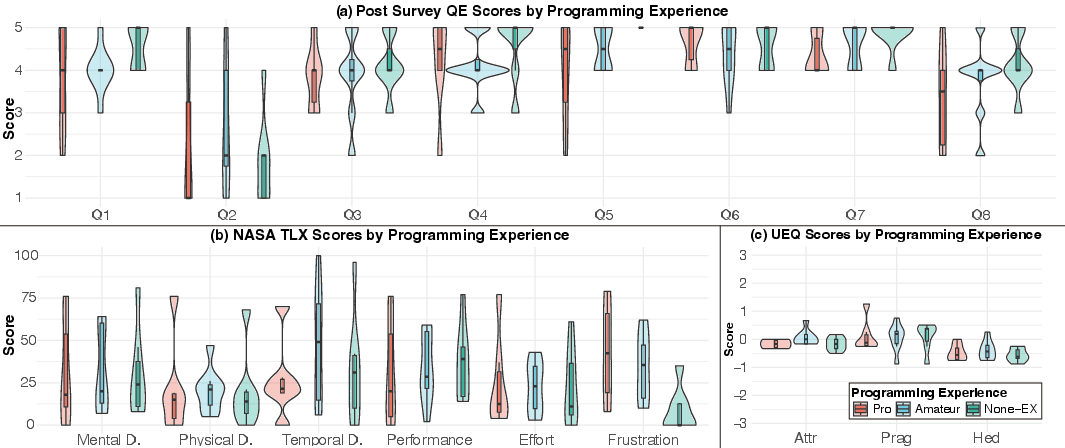
- It wasn’t too hard: Overall, people reported a moderate (not heavy) workload. Most found it natural and positive to edit by voice while playing.
- Background didn’t matter much: People with and without programming experience had similar experiences—no strong differences in how hard it felt or how much they liked it. That suggests this approach is accessible to non-coders.
- Different kinds of edits felt different:
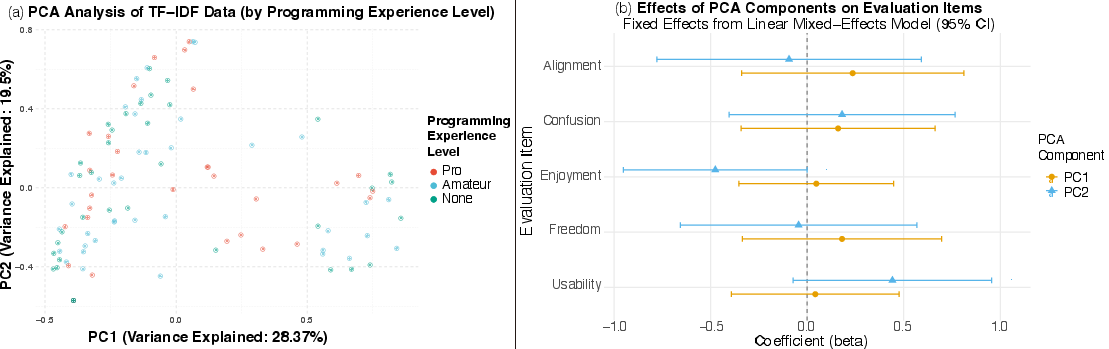
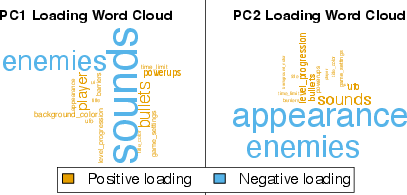
- Edits that are instantly obvious (like colors, bullet speed, UFO behavior) tended to make the system feel more usable and clear.
- Edits that change deeper parts of the game (like enemy behavior or level progression) tended to be linked with more enjoyment, even if they felt a bit less straightforward.
- Players showed three editing styles:
- Exploratory: “Let’s try stuff and see what happens.” They enjoyed surprises and discovering possibilities.
- Structural: “I have a specific goal,” like making it feel like a bullet-hell game or a psychedelic style.
- Iterative tuning: “I’ll adjust this bit by bit,” like a careful fine-tuning process to get the feel just right.
Why that’s important: It shows that talking to an AI can be a friendly, low-barrier way for everyday players to co-create and reshape a game on the fly—not just professionals.
What this could mean in the future
- More accessible creativity: Voice editing could let anyone tweak games without learning code or complex tools—great for classrooms, arcades, and casual players.
- Faster experimentation: Because changes show up right away, players and designers can rapidly try ideas and see what works.
- Player-driven experiences: Games might become more personal, with players shaping their own challenges, looks, and sounds.
Limits to keep in mind:
- This worked well in a simple, retro-style game with well-defined settings. More complex games might be harder.
- The study didn’t compare voice editing to other methods (like menus or typing), so we don’t know which is best overall.
- The group size was modest, so bigger studies would help confirm the results.
In short
The paper shows that players can talk to an AI to change a game while playing, and it feels doable and fun—even if you’ve never programmed before. Quick, voice-based tweaks can make games more personal and creative, pointing toward a future where players and AI build game experiences together in real time.
Practical Applications
Immediate Applications
The following applications can be deployed now by leveraging the paper’s demonstrated pipeline (voice → Whisper transcription → LLM plan/action → JSON patch → safe reset), the evidence of usability for non-programmers, and the reliability observed in the study.
- Voice-to-config live modding for LiveOps and game studios (gaming industry)
- Apply natural-language parameter tweaks during internal playtests to rapidly iterate difficulty curves, enemy speeds/shoot rates, power-up rates, and audiovisual polish without exposing raw config files.
- Potential tools/workflows: Unity/Unreal editor plugin that exposes a schema-driven “Voice Edit” panel; build-time toggle for “reset-after-edit” to preserve causal clarity; a “quick knobs vs deep changes” toggle informed by the paper’s usability/enjoyment findings.
- Assumptions/dependencies: Game systems must expose a parameter schema; stable LLM function-calling or structured output; acceptable latency/cost for cloud inference; guardrails to prevent breaking builds.
- In-venue interactive arcade/museum exhibits (entertainment, museums, public engagement)
- Deploy retrofitted cabinets (Arcade1Up + Raspberry Pi 5–class device) where visitors issue voice commands to co-create evolving game variants on the fly.
- Potential tools/workflows: Turnkey “Co-Creative Cabinet Kit” with microphone, push-to-talk, Wi‑Fi provisioning, content rotation scheduler, session reset logs, and daily usage analytics.
- Assumptions/dependencies: Reliable speech capture in noisy spaces; content moderation for open microphones; local caching for resilience to network dropouts.
- Player-facing modding in casual and sandbox titles (gaming industry, UGC platforms)
- Offer a safe, parameter-bounded “Edit While You Play” mode for players to customize pacing, aesthetics, and difficulty with voice/chat without breaking core rules.
- Potential tools/workflows: JSON-schema-based “mod surface” per game; per-field safety ranges; versioned edit history with one-tap rollback; “presets” sharing.
- Assumptions/dependencies: Clear separation of cosmetic/mechanical parameters; rate limits; anti-abuse moderation; telemetry for balancing.
- Classroom labs for game design and HCI (education)
- Use voice-driven editing to teach iterative design, systems thinking, and A/B testing. Students can test hypotheses (“increase UFO spawn to see risk–reward”) and observe before/after states.
- Potential tools/workflows: Curriculum modules, editable schema files per lesson, reflection prompts tied to log analytics (PCA-like dashboards), rubric templates.
- Assumptions/dependencies: School network access to LLM APIs or local models; FERPA/GDPR-compliant logging; multilingual transcription if needed.
- UX research testbeds for co-creation and interface studies (academia, HCI/UX)
- Recreate the study’s pipeline to evaluate workload, agency, and editing strategies in other parameterized experiences (VR scenes, simple sims).
- Potential tools/workflows: Reusable “Voice-to-Config Testbed” with built-in NASA-TLX/UEQ surveys, TF‑IDF/PCA log analysis modules, and mixed-effects analysis templates.
- Assumptions/dependencies: IRB/ethics approvals; standardized logging schemas; participant privacy management.
- Rapid “difficulty wizard” for onboarding and accessibility (gaming industry, accessibility)
- Let new or disabled players say “make it easier/more forgiving” to auto-adjust player lives, fire rate, enemy bullets, and barrier durability.
- Potential tools/workflows: Accessibility profile presets mapped to config ranges; one-shot voice calibration; per-setting explanations (“we raised barrier health”).
- Assumptions/dependencies: Robust language mapping of subjective requests to concrete parameters; auditability; option to confirm changes.
- QA parameter fuzzing and regression triage (software/game QA)
- Use LLM-planned edits to systematically probe edge values (as some participants did) and surface balance or stability issues faster.
- Potential tools/workflows: Headless “fuzz runner” that generates JSON patches within safe ranges, runs short simulations, and flags anomalies.
- Assumptions/dependencies: Deterministic seeds for reproducibility; safety rails for extreme values; CI/CD integration.
- Analytics dashboards for edit behavior and session outcomes (gaming analytics, product ops)
- Leverage the paper’s TF‑IDF/PCA approach to segment editing behaviors (e.g., perceptual tweaks vs structural changes) and correlate with enjoyment/usability.
- Potential tools/workflows: “Co-Creation Analytics” dashboards visualizing edit clusters, trial-level subjective ratings, and outcome metrics.
- Assumptions/dependencies: Structured logs, consistent field taxonomies, privacy safeguards.
- Voice-driven parameter editors for creative software (software/tools, media production)
- Apply the same plan/action, schema-constrained approach to DAWs, shader editors, or VFX graphs to tweak parameters via natural language (“make the reverb warmer,” “increase particle spread”).
- Potential tools/workflows: Voice-to-Config SDK; schema converters for popular tools; “quick preview with reset” to preserve causal comparisons.
- Assumptions/dependencies: Clear mapping from lay language to parameter semantics; reversible, atomic patching; safety in professional workflows.
- Lightweight devkits for indie teams (gaming industry, indie)
- Package the pipeline for Raspberry Pi/desktop to enable cheap playtesting stations that non-technical teammates can use to shape feel/pacing.
- Potential tools/workflows: Dockerized service with offline speech (Vosk/Whisper small) and selectable LLM backends; project starter templates.
- Assumptions/dependencies: Local or low-cost inference; model licensing; simplified setup guides.
Long-Term Applications
The following applications depend on scaling to more complex games and domains, deeper code-generation capabilities, robust safety/guardrails, lower latency/cost, and/or standardization.
- Generalized in-engine co-creative editing across complex genres (gaming industry, engines)
- Extend from parameter-only edits to multi-system changes in RPGs, shooters, and sims, possibly spanning AI behaviors, level logic, and UI flows.
- Potential tools/products: “Live Co-Creation SDK” for Unity/Unreal with schema registries, typed function-calling, sandboxed code gen, and realtime previews.
- Assumptions/dependencies: Reliable, safe code generation and hot-reload; cross-subsystem schemas; performance budgets; strong rollback/versioning.
- Code-level mechanic authoring with guardrails (gaming industry, tools)
- Move beyond JSON to synthesize new scripts/behaviors (“add dash mechanic with cooldown”) with formal verification or constraint checks.
- Potential tools/products: Policy-checked code synthesis, behavior sandboxes, unit-test autogeneration, static analysis for safety.
- Assumptions/dependencies: Verified toolchains, permission systems, compositional testing; developer-in-the-loop approvals.
- Personalization and dynamic difficulty at runtime via language (gaming industry, AI personalization)
- Let players or the system articulate preferences in natural language, then translate those to continuous parameter adaptation during play.
- Potential tools/workflows: On-device preference models; adaptive controllers blending perceptible tweaks (for usability) with structural shifts (for enjoyment) guided by the paper’s findings.
- Assumptions/dependencies: Real-time adaptation without disorienting players; explainability; safeguards against exploitative tuning.
- Cross-domain voice-to-config for simulations, robotics, and training (robotics, digital twins, enterprise)
- Tune sim parameters or human-in-the-loop training scenarios through natural language to speed scenario creation and what-if studies.
- Potential tools/products: “Voice Scenario Builder” that emits reproducible JSON patches and scenario manifests; audit logs for regulated domains.
- Assumptions/dependencies: High-fidelity parameter surfaces; traceability; domain ontologies; safety certification where applicable.
- Standardization of schema, safety ranges, and audit trails (industry consortia, policy)
- Define open schemas for AI-editable parameters, validation ranges, and patch provenance to enable interoperability and oversight.
- Potential tools/workflows: Open spec (e.g., “AI-Editable Config 1.0”), conformance suites, signed patch manifests, and audit UIs.
- Assumptions/dependencies: Multi-stakeholder buy-in; governance for updates; legal clarity for AI-assisted authorship.
- Privacy-preserving, low-latency on-device inference (software, edge AI)
- Replace cloud APIs with efficient local ASR and LLMs to reduce cost, latency, and data exposure for home, classroom, and venue use.
- Potential tools/products: Edge-optimized models, quantized inference on consoles/PCs/arcade hardware, fallback cloud augmentation.
- Assumptions/dependencies: Model quality at small footprints; hardware acceleration; energy and thermal limits.
- Marketplace for co-created presets and “edit recipes” (UGC economy, platforms)
- Shareable bundles of JSON patches plus natural-language descriptions that convert baseline games into themed variants.
- Potential tools/workflows: Trust and safety review; diff/merge tools; creator monetization; compatibility validators per game version.
- Assumptions/dependencies: IP/licensing policies; moderation pipelines; versioning strategy.
- Moderation and safety frameworks for voice-driven UGC (policy, trust & safety)
- Establish policies and tooling to prevent harmful edits (e.g., seizure-inducing flashes, griefing difficulty) and toxic voice inputs.
- Potential tools/products: Real-time content filters, physiological safety checks (flicker rates), community standards, red-team evaluations.
- Assumptions/dependencies: Accurate risk detection; appeals and transparency; alignment with regional regulations.
- Multimodal co-creation (speech + gesture + sketch) for design tools (software, creative industries)
- Combine natural language with pointing/dragging or quick sketches to disambiguate intent for complex edits.
- Potential tools/workflows: Multimodal grounding modules aligning voice phrases to selected objects/regions; “show, then say” workflows.
- Assumptions/dependencies: Reliable cross-modal alignment; UI conventions; accessibility considerations.
- Learning analytics for creativity education (education, learning science)
- Use edit logs and derived components (e.g., PCA-like dimensions) to assess student strategies (exploratory vs structural vs tuning) and scaffold instruction.
- Potential tools/workflows: Instructor dashboards, automated feedback, reflective prompts based on edit patterns and outcomes.
- Assumptions/dependencies: Ethical data use; student consent; validated rubrics across disciplines.
- Therapeutic and rehabilitation gameplay tailoring (healthcare, digital therapeutics)
- Clinicians/patients voice-tune motor or cognitive challenge parameters to match therapy goals, with clear before/after comparators.
- Potential tools/products: HIPAA/GDPR-compliant logging, clinician dashboards, parameter templates per protocol.
- Assumptions/dependencies: Clinical validation; safety thresholds; regulated-device pathways where required.
- Esports/sports training scenario generator (sports tech, performance)
- Rapidly author practice drills by describing stressors (“faster volleys,” “narrow safe zones”) and iterating via resets.
- Potential tools/workflows: Scenario libraries, difficulty ramp scripts, analytics linking edits to performance metrics.
- Assumptions/dependencies: High-fidelity or abstract training sims; coach oversight; standardized metrics.
- Research on human–AI co-creation roles and agency (academia, HCI)
- Extend the study to richer domains to quantify how “perceptible tweaks vs structural edits” affect perceived control, flow, and creativity.
- Potential tools/workflows: Cross-genre datasets, shared benchmarks, open-source reimplementations, and standardized survey batteries.
- Assumptions/dependencies: Comparable schemas across domains; reproducible protocols; cross-lab collaboration.
- Safety-critical simulation tuning with formal constraints (aviation/auto, policy)
- Allow natural-language scenario editing in regulated sims with formal verification of parameter bounds and system invariants.
- Potential tools/products: Constraint solvers tied to schema bounds, change impact analyses, audit-ready reports.
- Assumptions/dependencies: Domain certifications; interpretable mappings; human-in-the-loop approvals.
These applications build directly on the paper’s contributions: a reliable voice-to-config pipeline with structured JSON schemas and plan/action guardrails; evidence that non-programmers can co-create with moderate workload; and insights that fast, perceptible edits aid usability while structural edits can enhance enjoyment. Together, they suggest immediate opportunities for safer, more inclusive co-creation and clear pathways to richer, cross-domain systems as tooling, standards, and safeguards mature.
Glossary
- Abstraction gap: A mismatch between users’ high-level intents and the formal system representations needed to act on them. "Research on end-user programming with LLMs has identified a persistent abstraction gap between users' high-level intent and the formal representations a system can act upon"
- Algorithmic content generation (ACG): The automated creation of game content using algorithms outside of ML/LLM approaches. "Digital game generation has been explored for many years through procedural content generation (PCG), algorithmic content generation (ACG), and machine learning -- based approaches."
- Atomic JSON patch operations: Minimal, discrete edits that modify specific paths in a JSON configuration. "In the action stage, planned changes are converted into atomic JSON patch operations that modify the game configuration (e.g., game.enemies.speed: 1.2 â 1.6) (Fig.~\ref{fig:hardware}(c))."
- Confidence interval (95% CI): A statistical range that likely contains the true effect size with 95% confidence. "PC2 showed trend-level associations with usability (, 95\% CI , ) and enjoyment (, 95\% CI , )"
- Design Sprint framework: A structured, time-bounded process for ideation, prototyping, and testing used to guide co-creative workflows. "the structured Design Sprint framework to support human -- AI co-creation."
- End-user programming: Programming-like tasks performed by non-experts to achieve outcomes without traditional coding. "Research on end-user programming with LLMs has identified a persistent abstraction gap between users' high-level intent and the formal representations a system can act upon"
- Evolutionary algorithms: Optimization methods inspired by natural selection used to iteratively improve designs. "GAVEL extended this further, combining evolutionary algorithms with LLMs to automatically generate complete board games with novel rules and mechanics."
- Fine-tuned LLM: An LLM adapted on task-specific data to improve performance for a particular domain. "MarioGPT demonstrated that a fine-tuned LLM could generate playable Super Mario Bros.\ levels from short text prompts"
- Function-calling capabilities (of LLMs): Mechanisms allowing LLMs to invoke structured functions to produce consistent, schema-conforming outputs. "LLMaker proposed a chat-based level design interface that uses the function-calling capabilities of LLMs to produce consistent, rule-compliant game content from natural language input."
- Human–AI co-creation: Collaborative creation processes where humans and AI systems jointly contribute to design or content. "These findings demonstrate that voice-driven editing can support accessible, play-driven human -- AI co-creation within a structured invader-style arcade game environment."
- LLMs: Neural models trained on vast text corpora that can understand and generate natural language. "LLMs are shifting game generation from offline automation toward play-driven modification through natural-language interaction."
- Linear mixed-effects models (LMMs): Statistical models that include both fixed effects and random effects to analyze repeated or grouped data. "To examine how different editing patterns relate to experiential variation, we analyzed editing logs using TF--IDF features followed by principal component analysis (PCA) and linear mixed-effects models (LMMs)."
- Mixed-initiative level design: Design processes where human and AI agents iteratively contribute to shaping levels. "Charity et al.~\cite{charity2020baba} explored collaborative mixed-initiative level design in Baba Is Y'all, where game rules themselves are manipulable gameplay objects."
- NASA-TLX: A multidimensional workload assessment tool measuring mental, physical, and temporal demands, among others. "NASA-TLX scores remained within a moderate range across all participants."
- Principal component analysis (PCA): A dimensionality-reduction technique that transforms features into orthogonal components capturing maximal variance. "To examine how different editing patterns relate to experiential variation, we analyzed editing logs using TF--IDF features followed by principal component analysis (PCA) and linear mixed-effects models (LMMs)."
- Procedural content generation (PCG): Automated creation of game content such as levels, rules, or assets via algorithms. "Digital game generation has been explored for many years through procedural content generation (PCG), algorithmic content generation (ACG), and machine learning -- based approaches."
- Random intercepts: Subject-specific baseline terms in mixed-effects models accounting for individual differences. "Trial-level ratings () were analyzed using linear mixed-effects models with participant random intercepts."
- Spatial augmented reality: Projection-based AR that augments real-world surfaces without head-mounted displays. "Oswald et al.~\cite{oswald2014realAR} demonstrated a real-time video game level editor in a spatial augmented reality environment, allowing users to incorporate everyday physical objects into game content during play."
- TF-IDF: Term weighting that reflects how important a word is to a document in a corpus, balancing frequency and rarity. "To capture edit type, logs were encoded as TF-IDF features based on second-level configuration paths and reduced via PCA."
- User Experience Questionnaire (UEQ): A standardized instrument assessing pragmatic and hedonic aspects of UX across multiple scales. "UEQ scores showed mid-to-high ratings for Attractiveness, Pragmatic Quality, and Hedonic Quality."
- Wilcoxon tests: Nonparametric statistical tests comparing paired or independent samples without assuming normality. "pairwise Wilcoxon tests with multiple-comparison correction revealed no statistically reliable differences between groups for NASA-TLX, Post Survey items, or UEQ scales"

