- The paper demonstrates a novel LLM-powered framework that develops strategic game-playing agents via collaborative prompt engineering and reinforcement learning.
- It extends Shannon’s taxonomy by employing LLM inference for dictionary, symbolic, heuristic, and learning-based games, reducing computational overhead.
- Empirical evaluations show rapid strategy acquisition, low-sample efficiency, and scalable interactive deployment in educational and AI research settings.
Nemobot Games: Agentic Engineering of Strategic Game AI via LLMs
Introduction
The paper "Nemobot Games: Crafting Strategic AI Gaming Agents for Interactive Learning with LLMs" (2604.21896) presents Nemobot, a novel agentic engineering environment for constructing LLM-powered game-playing agents. Anchored in Shannon's taxonomy of game-playing machines, Nemobot operationalizes a programmable, collaborative approach to AI game development. It employs LLMs for strategy synthesis and refinement, crowd-driven prompt engineering, and reinforcement learning, thereby pushing Shannon's foundational vision of self-programming machines into the context of contemporary LLMs.
Extending Shannon’s Game-Playing Taxonomy with LLMs
Shannon's taxonomy delineates four foundational classes of game-playing machines: dictionary-based machines, rigorously solvable machines, heuristic-based machines, and learning machines. Nemobot systematically extends these paradigms by leveraging the generative, symbolic, and learning capabilities of LLMs.
- Dictionary-based Games: LLMs compress state-action dictionaries into parameter-efficient inferential models, supporting generalization in environments with tractable state spaces like Tic Tac Toe.
- Rigorously Solvable Games: LLMs perform symbolic reasoning to solve analytically tractable games (e.g., Nim), while providing step-wise, human-readable explanations via code generation and chain-of-thought prompting.
- Heuristic-based Games: By integrating minimax and MCTS with crowd-sourced input, LLMs synthesize data-driven, context-sensitive heuristics for combinatorial games where full analysis is infeasible.
- Learning-Based Games: LLMs are used in conjunction with RLHF and imitation learning, establishing a pipeline for iterative strategy refinement. Crowdsourced data collection and feedback foster robust exploration and sample-efficient learning.
This reinvigorates Shannon's classical scheme through programmable prompt engineering, neuralized memoization, and modular agent design Figure 1.
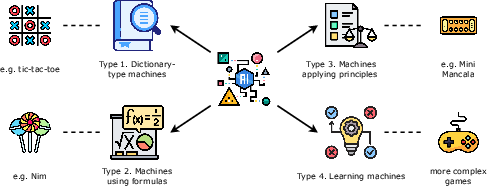
Figure 1: Shannon's four types of game-playing machines and their prototypical applications.
Nemobot Framework: Architecture and Functional Design
Nemobot is architected as a model-agnostic, cloud-enabled environment with three principal layers:
- Model Integration: Any LLM accessible via API (“bring your own key”) can be used, enabling fast adaptation to new model advances.
- State Management: In-memory, local state handling minimizes inference latency, decoupling core game logic from LLM bottlenecks.
- Crowdsourced Data Pipeline: Batched, asynchronous data synchronization enables scalable aggregation of gameplay traces, strategies, and feedback, supporting collaborative prompt engineering Figure 2.
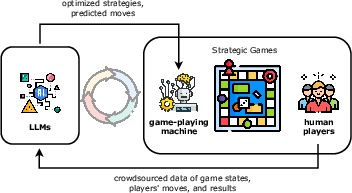
Figure 2: Feedback-driven cycle of crowdsourcing and strategy optimization in LLM-based game-playing agents.
The user interface is structured to support both textual programming and interactive deployment. Developers write or describe heuristics in a coding pad, execute synchronous games in a chat playground, and iterate via performance analytics Figure 3.
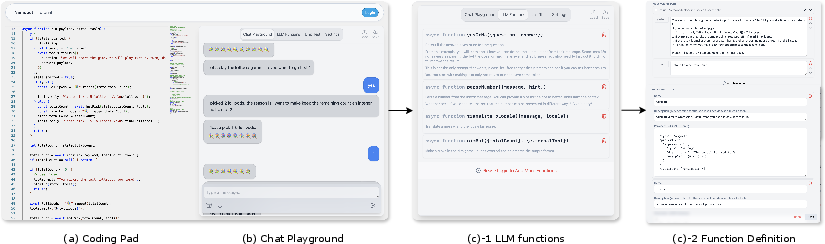
Figure 3: Nemobot UI for coding, execution, and LLM function orchestration.
Collaborative Prompt Engineering and Human-in-the-Loop Strategy Refinement
Programmable prompts underpin Nemobot's LLM functions, supporting the modularization, benchmarking, and iterative improvement of strategic reasoning capabilities. Crowdsourcing is central: it scales the pool of strategic prompts, move explanations, and error critiques, producing a high-diversity, high-coverage repository to bootstrap RLHF and prompt selection.
Notably, this pipeline implements several forms of "neuralized memoization": semantic retrieval for analogous game states, procedural caching for recurring agentic workflows, and distributed sharing for multi-agent optimization. These mechanisms jointly accelerate learning, support explainable AI through state/action attributions, and facilitate rapid curriculum updates.
Case Studies Across Shannon's Taxonomy
Tic Tac Toe: Dictionary Compression via LLM
For small, fully analyzable games (Tic Tac Toe), Nemobot uses LLMs in place of explicit lookup tables or deep nested rules. Game state serialization allows the LLM agent to consistently produce optimal or near-optimal moves, achieving strong coverage of state space with substantially reduced memory and computational overhead compared to classical approaches.
Nim: Symbolic Reasoning and Code Generation
In rigorously solvable environments (Nim), Nemobot exploits LLMs for both mathematical computation (Nim-sum logic) and didactic explanation. Game state prompts yield not only the optimal move but also chain-of-thought explanations and/or executable code fragments for the underlying mathematical algorithm, bridging human-AI comprehensibility.
Mancala: Heuristics and Human Data Integration
For combinatorial games resistant to full analysis (Mancala), LLMs interface with traditional search (e.g., minimax) to provide move recommendations. The system supports both pure LLM heuristics and hybrid LLM-guided search, with game-tree depth as a tunable difficulty lever. Crowdsourced gameplay data Figure 4 powers prompt library expansion and supports continual heuristic enhancement.
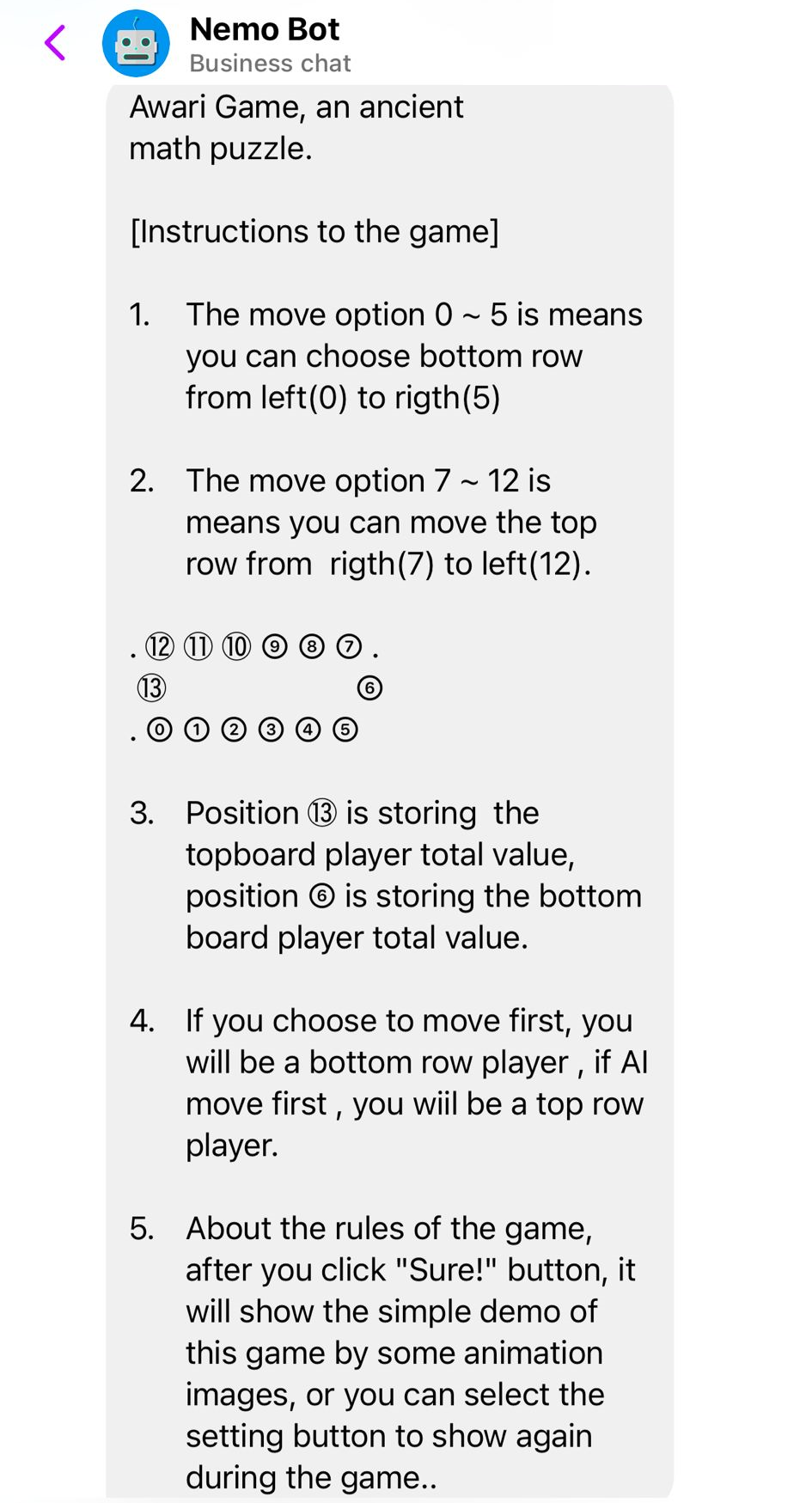
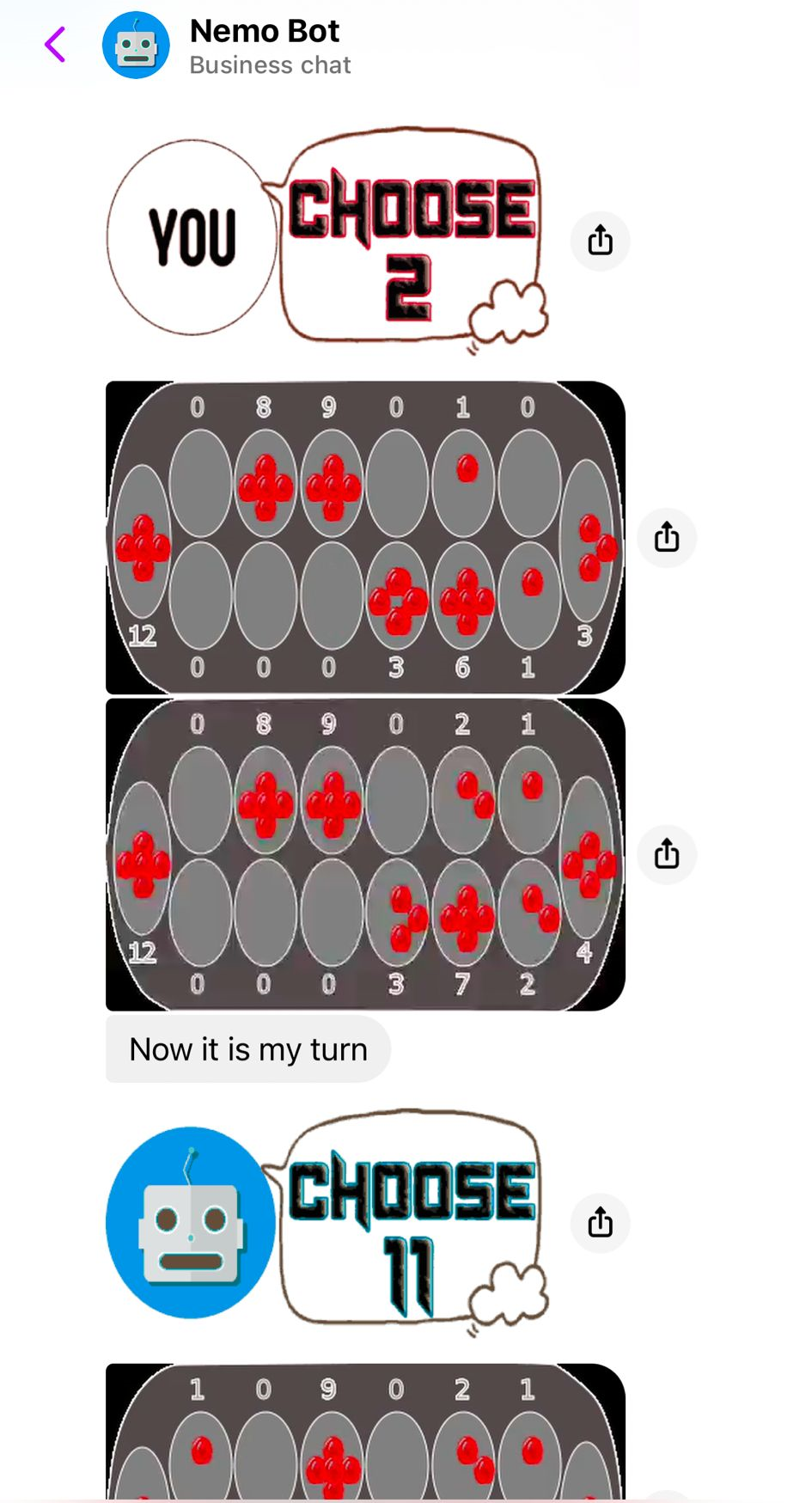
Figure 4: Chatbot interface for human-agent interaction in the Mancala game within Nemobot.
Learning Machines: RLHF-Driven Agents
For adaptive learning agents, Nemobot executes classic RL protocols (e.g., Michie's Boxes) and supports trial-and-error acquisition of optimal strategies. Simulation-based training cycles, as shown for Nim Figure 5, produce empirical data used to fine-tune LLM functions. The system demonstrates low-sample regime adaptation and automated critique/pedagogical feedback.
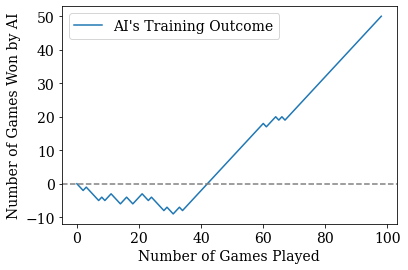
Figure 5: Training curve for a Nim agent achieving competence through simulation-driven trial-and-error using Michie’s algorithm.
Implications and Relation to Existing Literature
Nemobot distinguishes itself through its explicit programmability, modularity, and pedagogy-focus relative to autonomous LLM agents (e.g., Voyager [wang2023voyager], Generative Agents [park2023generative], ChessGPT [feng2024chessgpt]). Unlike systems that treat LLMs as black-box players, Nemobot empowers users as co-programmers, enabling tailored intervention in agent logic and iterative improvement via collaborative prompt engineering.
The framework also exemplifies principled connections to neuralized memoization and multi-agent learning theory: cached knowledge is dynamically retrieved, extended, and distributed in a scalable, transparent pipeline. In educational contexts, Nemobot's architecture aligns with the requirements of adaptive, feedback-driven knowledge tracing and metacognitive “learning-to-learn” frameworks [cotutor].
Numerical Results and Claims
Nemobot was evaluated in multiple academic settings (n > 350 students), demonstrating:
- Rapid strategy acquisition in learning-based games (e.g., single-run RL sufficient for strong Nim play).
- Successful prompt-driven strategy refinement based on human gameplay data in heuristic-intensive environments.
- Demonstrated scalability: bring-your-own-LLM support, crowdsourcing integration, low-latency operation, and interactive deployment on messaging platforms.
These claims are supported by qualitative data and student project outcomes. The framework claims that LLMs, when architected as programmable, collaborative modules, can exceed classical hard-coded game agents in both flexibility and accessibility. The authors also emphasize, with empirical support, that crowdsourced prompt engineering accelerates exploration and learning relative to closed-system RL.
Theoretical and Practical Implications; Future Directions
Nemobot’s integration of agentic LLMs, programmable prompts, and collective intelligence provides a template for future AI agent engineering and education. The framework highlights new directions:
- Hierarchical abstraction: Extension to games with long-horizon strategies via hierarchical predicate induction and external dynamic memory.
- Hybridization: Automated fine-tuning protocols integrating real-time human feedback with self-play, bootstrapping LLM agents for novel, domain-specific environments.
- Scalability and ethics: Addressing challenges in feedback quality, adversarial play, computational cost, and ethical governance in large-scale agent deployment.
Broader application to knowledge tracing, educational diagnostics, and personalized AI tutoring systems is a clear future avenue.
Conclusion
Nemobot operationalizes Shannon’s self-programming vision with state-of-the-art LLMs, defining a research and educational platform wherein AI agents are not only players but also collaborators with human users in the iterative construction of strategic intelligence. Collaborative prompt engineering, rigorous agentic architecture, and modular LLM functions together enable reproducible, extensible, and interpretable AI game programming. This synthesis provides a robust blueprint for advancing future AI research in both scientific and applied pedagogical domains.