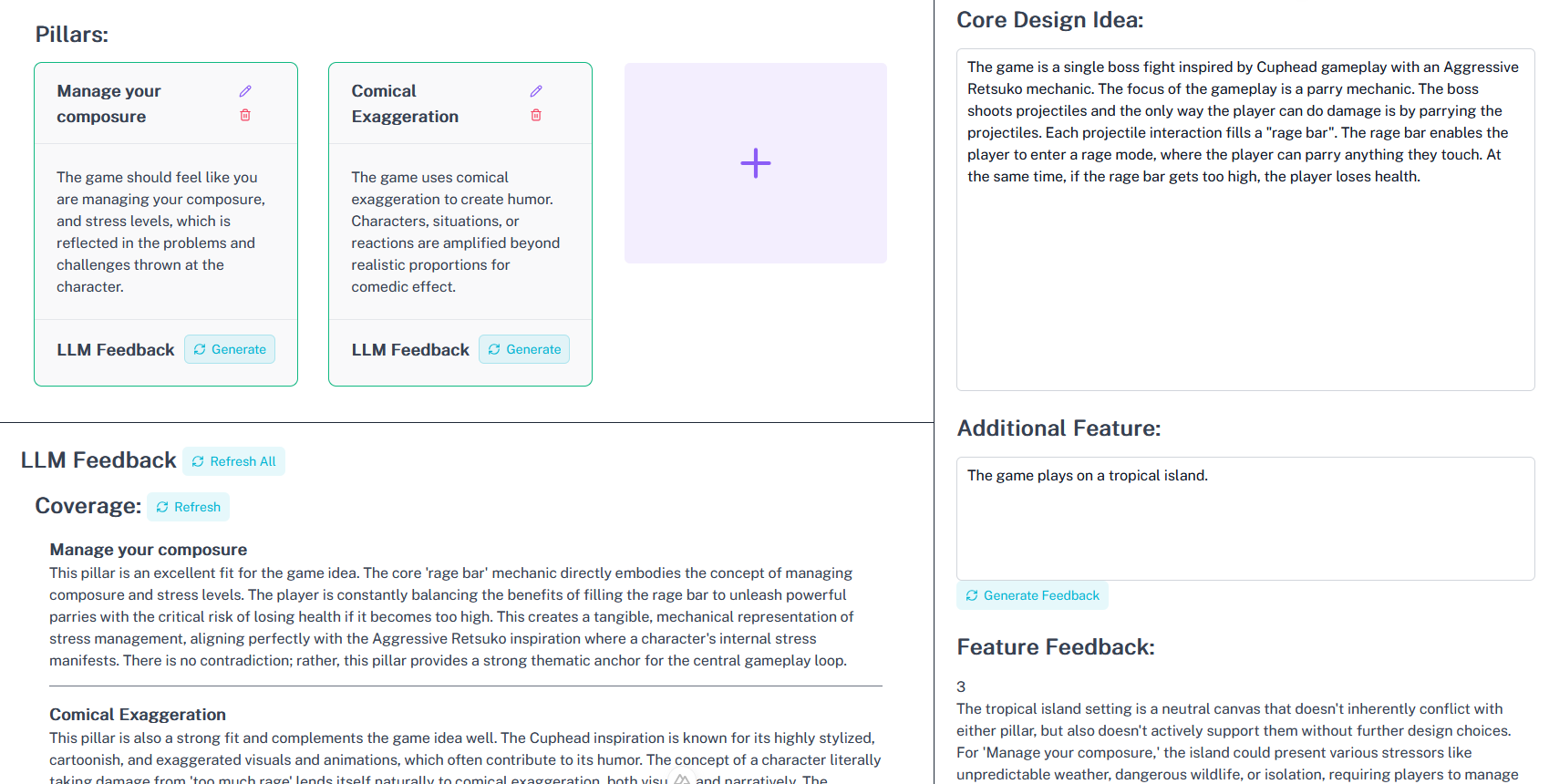
- The paper establishes a formal definition of game design pillars and introduces SPINE as a mixed-initiative toolkit for interactive pillar management.
- It compares LLMs like Gemini and GPT-4o-mini, showing Gemini’s superior structural analysis and concise pillar repair performance.
- User studies confirm SPINE’s utility in enhancing ideation, iterative refinement, and reflective game design in practical settings.
LLMs as Mixed-Initiative Agents for Game Design Pillar Workflows
This paper establishes a computationally grounded formalism for game design pillars, treating pillars as structured, normative constructs that serve as guiding principles throughout development. Each pillar consists of a succinct title and an expository statement characterizing either experiential or structural properties of the game. The authors enumerate quality criteria—clarity, unicity, conciseness, actionability—and system-level constraints such as mutual non-contradiction, completeness, and bounded size, substantiated by a dataset of real-world pillars from commercially successful titles.
The formal definition advances pillar-driven workflows by enabling systematic generation, analysis, and processing with LLMs. By restricting pillars to well-formed, actionable units, the paper situates pillar management as a tractable problem for computational intervention and mixed-initiative augmentation.
Architecture and Features of SPINE
Building on the formalization, the authors present SPINE, a mixed-initiative toolkit optimized for pillar-centric workflows. The backend leverages Django for robustness, interfacing flexibly with API-accessible LLMs—enabling rapid experimentation and model switching. The Nuxt4 frontend offers a minimal, accessible interface focused on three content types: core design ideas, pillar sets, and feature ideas.
SPINE operationalizes LLMs for four functional stages:
Comparative Model Evaluation
The paper conducts a methodologically robust pre-study evaluating Gemini-2.0-flash and GPT-4o-mini on their ability to analyze and repair pillar sets from both a student project and an established commercial game (Sea of Thieves). Both models demonstrated basic capacity for pillar evaluation; however, Gemini outperformed GPT in structural analysis, exhibiting greater consistency and output variety. Gemini produced concise reformulations, addressed structural issues more reliably, and demonstrated substantive improvement in post-repair assessments.
Notably, Gemini was more sensitive to redundant or convergent pillars, while GPT produced longer, often explanatory texts and struggled with issue differentiation. Neither model reliably detected subtle contradictions arising from pillar similarity, exposing prompt limitations. For set and feature validation, coverage and addition suggestions were sensible across both models, but Gemini’s contradiction analysis was more nuanced.
User-Centered Evaluation: Case Study and Expert Interviews
SPINE was piloted in a 42-hour game jam, with a researcher integrating the tool into collaborative pillar authoring and feature validation. Documentation revealed positive reception: users found the tool valuable for ideation, clarification, and structure. LLM-driven pillar repairs supported iterative refinement, while feature evaluation aided decision-making in context. However, LLM-generated rephrasings were sometimes verbose or overly general. Participants requested guidance, streamlined outputs, and enhanced feedback interpretability.
Expert interviews with four studio-affiliated practitioners further validated the approach. Participants expressed diverse attitudes toward LLMs—ranging from skepticism to cautious interest—but uniformly recognized utility in pillar structure and documentation. LLM-driven contradiction checks prompted reflective reconsideration, and feature evaluation was specifically called out as valuable. However, participants highlighted desiderata including contextual grounding, nuanced contradiction handling, and adaptive feedback mechanisms.
Practical and Theoretical Implications
SPINE’s evaluation substantiates the claim that LLMs can meaningfully augment pillar-driven workflows, particularly at the ideation and early design stages, supporting articulation, reflection, and rapid iteration. The structured approach to pillar authoring represents a substantive advance toward standardized documentation practices, facilitating knowledge transfer, team coherence, and reproducibility in game development.
The paper’s qualitative results reveal clear limits: output quality, interpretability, and domain grounding require further optimization. Participants indicated that contradiction feedback must accommodate intentional rule-breaking and productive tension. Transparency, trust, and adaptation in LLM outputs remain critical challenges. The findings reinforce the need for prompt engineering, dataset curation, fine-tuning, and retrieval-augmented generation to scaffold contextually relevant LLM behavior.
Directions for Future Research
Future work should expand technical breadth via prompt refinement and fine-tuning on domain-specific datasets. Retrieval augmentation and agentic workflows are recommended to enhance contextual knowledge and actionable output. Interaction design must foreground reflective “nudging” and user agency, aligning system feedback with creative intent. Integration with complementary concept-authoring tools, iterative evaluation in larger-scale professional teams, and rigorous quantitative benchmarking are critical for advancing adoption and evidentiary support.
Conclusion
This paper systematically demonstrates that LLMs are viable, practical agents for mixed-initiative pillar workflows in game design. By formalizing game design pillars, deploying SPINE, and evaluating both computational and user-centered performance, the authors provide detailed evidence that LLMs can meaningfully contribute to early-stage design and documentation practices. The structured, pillar-centric approach foregrounds actionable design reasoning and offers avenues for standardization, co-creative support, and reflective decision-making in game development. Limits observed in output quality and interpretability motivate ongoing research, iterative refinement, and deeper integration of domain-adapted models—charting a clear path toward more robust, context-aware AI-assisted game design workflows.