- The paper demonstrates a dualistic pipeline integrating LLMs and image diffusion models to generate both visual and mechanical aspects of Pokémon cards.
- It employs retrieval-augmented generation with cosine similarity over embeddings to ensure semantic alignment and schema-compliant mechanical completion.
- Empirical results show high participant satisfaction, with aesthetics averaging 4.25 and mechanics 4.04, underscoring strong player ownership in design.
LLM-Driven Procedural Content Generation of Trading Cards: Player-Centric Pokémon Generation and Relatedness
Technical Pipeline and System Architecture
This paper presents a dualistic, player-centric pipeline for procedural trading card generation, specifically targeting the Pokémon Trading Card Game as a case study. The authors integrate LLMs with image diffusion models to enable the generation of both visual and mechanical facets of card design from minimal inputs: a card name, type, and description. The pipeline comprises five stages: extensive database mining, retrieval-augmented generation (RAG) via custom embeddings, structured mechanical completion using LLMs, parallel artwork creation through image diffusion guided by LoRA-adapted tokens, and synthesis into a print-ready card format.
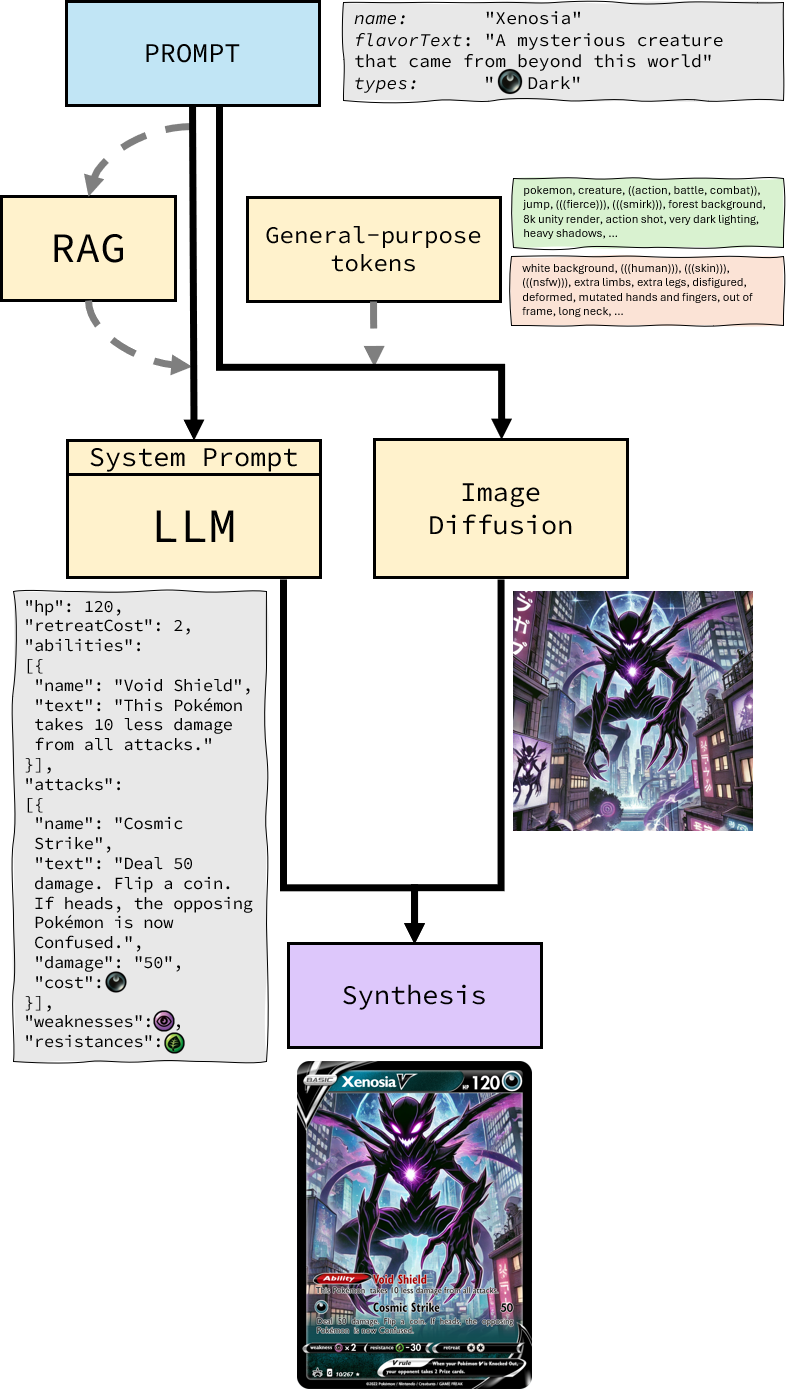
Figure 1: Flowchart depicting end-to-end generation—user prompt is augmented with RAG context for LLM-based card mechanics and diffusion-based visual synthesis, outputting a unified, customized Pokémon card.
Database mining extracts structured mechanical features from 993 unique basic Pokémon cards (filtering reprints and duplicates from an original set of over 15,000), which are represented as JSON data structures suitable for both semantic embedding and downstream LLM prompting.
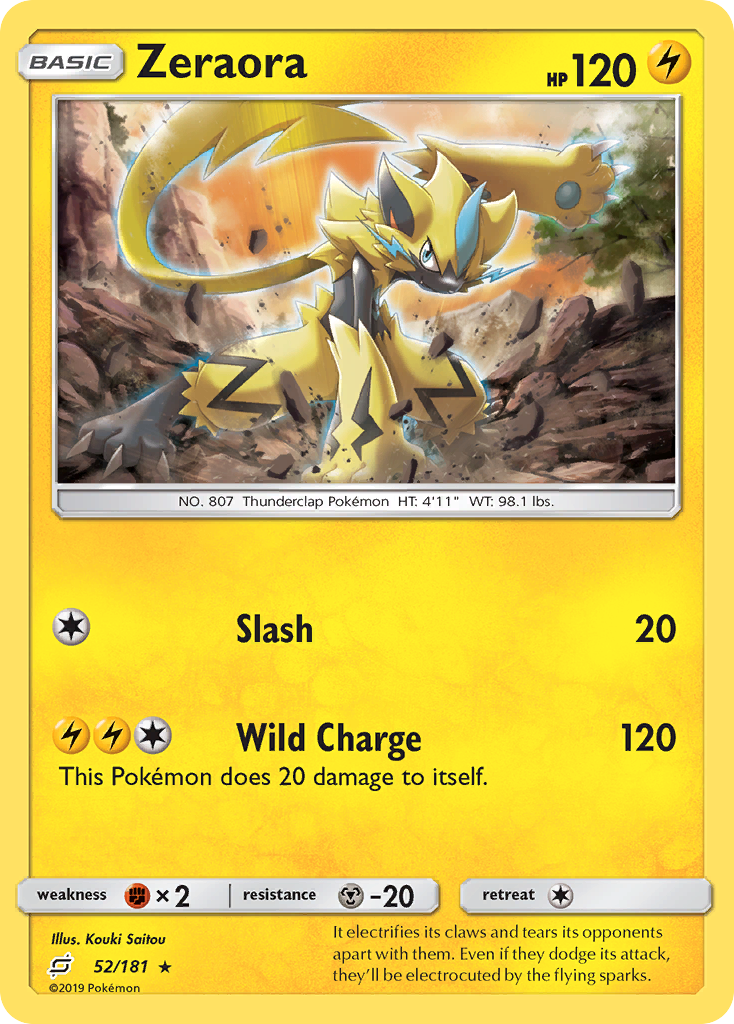
Figure 2: Exemplifies the retrieval of ground-truth mechanical card structure, illustrating the granularity of features used for embedding and generation.
RAG is implemented via cosine similarity over embeddings, ensuring that semantically aligned reference examples are supplied to the LLM alongside the user prompt. The mechanical component employs Qwen3-14B due to its schema compliance, output standardization, and context adaptability, instructing the LLM to populate missing fields such as hp, abilities, attacks, resistances, and weaknesses. Parallel image generation is handled by FLUX.1-dev-Q8 using ComfyUI, fine-tuned with LoRA models towards the Pokémon art style, and further guided by domain-specific auxiliary prompts.
Mixed-Methods Evaluation and Empirical Results
A mixed-methods evaluation was conducted involving 49 technically literate participants (primarily AI and games technology graduate students), who generated a total of 196 Pokémon cards using the pipeline. Quantitative assessment employed 5-point Likert scales for three categories: image aesthetics, image representativeness, and mechanical representativeness.
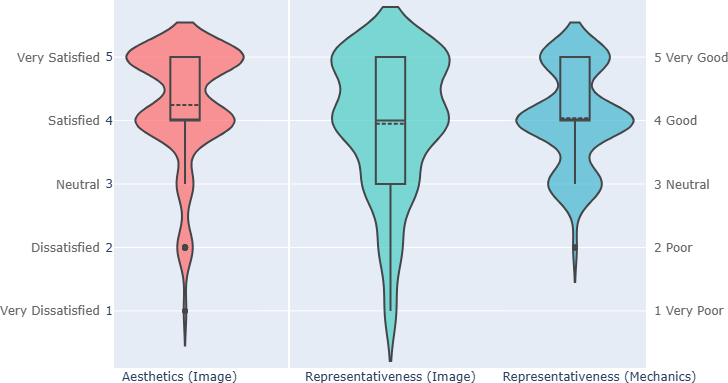
Figure 3: Violin chart summarizing participant ratings of aesthetics and representativeness, with most responses skewed toward high satisfaction (scores 4-5) across all metrics.
Visual outcomes achieved a mean satisfaction of 4.25 (SD=0.9), while mechanical representativeness scored 4.04 (SD=0.75). 88.4% of generations converged rapidly to visually convincing results, and 89.8% of mechanical generations matched participant expectations after minimal iteration or prompt adjustment.
Qualitative thematic analysis highlighted several adaptation strategies: prompt refinement (51.8%), iterative regeneration (18.8%), and occasional parameter tuning (6.3%). Notably, only 8.9% abandoned the generation process. Idea attribution was overwhelmingly "own idea" (93.5%), underscoring the pipeline's capacity to preserve player agency and procedural relatedness.
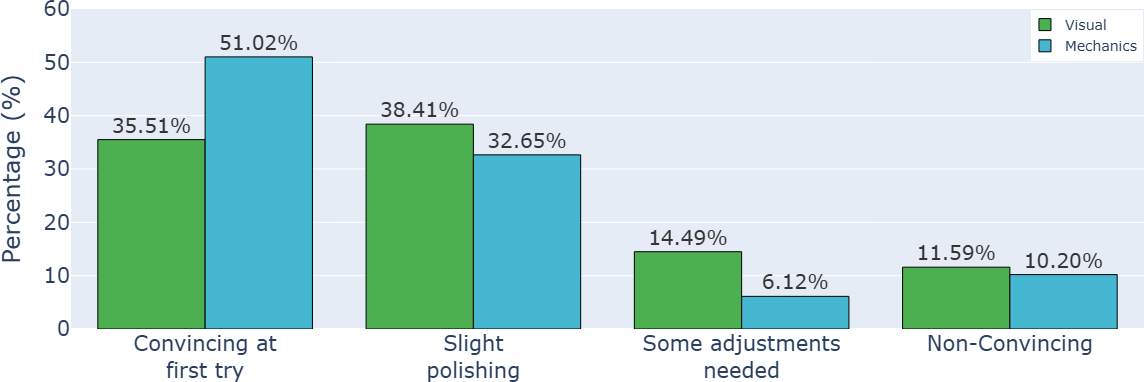
Figure 4: Distribution of expectation match codes—higher blue and green bars indicate direct and iterative alignment of visual and mechanical outcomes with user expectations.
A small fraction of outputs exhibited systematic flaws, such as mechanical under-specification, imbalances, or semantic hallucinations. Nevertheless, emergent mechanics leveraging implicit world knowledge and nuanced mappings from natural language to functional game logic comprised a notable portion of the successful generations.
Adaptation Methods and Attribution of Creative Ownership
Comprehensive qualitative code distributions further characterized user adaptation and idea attribution. The predominant method was prompt adjustment, correlating closely with enhanced expectation match.
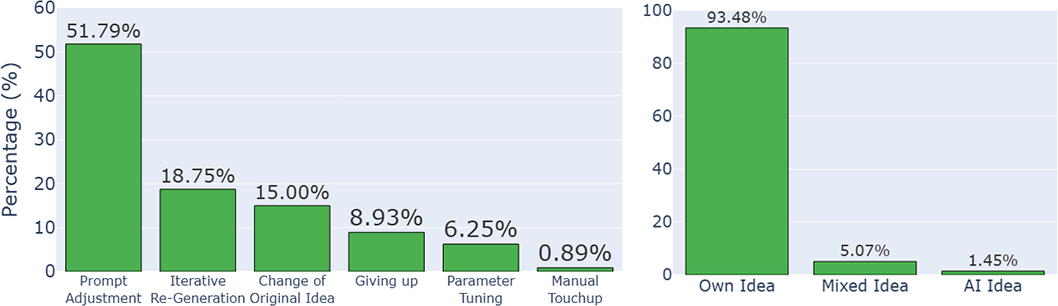
Figure 5: Left—adaptation method distribution; Right—attribution of design source between player and AI.
Participants frequently reported exceeding expectations in both visual and mechanical domains, particularly when generative outputs presented emergent or co-creative enhancements over initial concepts. Manual editing and advanced parameter modifications were rarely employed, suggesting that the system default performed robustly for its intended audience.
Implications, Limitations, and Future Directions
This player-centric procedural generation approach facilitates both limitless content diversity and restoration of player-card relatedness, addressing longstanding industry challenges related to metagame stagnation and power creep. The alignment between prompt-driven ideation and generative realization proposes new frameworks for procedural relatedness, enabling individualized bond formation similar to narrative-dominated TCG examples.
From a practical perspective, the pipeline's modularity admits straightforward adaptation to other TCG contexts (e.g., Magic: The Gathering, Yu-Gi-Oh!), given the dominance of natural language in mechanical design and the scalability of embedding-based RAG. Theoretical implications extend to game user research, automated balance evaluation, and the abstraction of game-agnostic mechanical logics for procedural generation across genres.
Limitations include LLM-induced hallucinations, non-deterministic output, and absence of embedded balance constraints. Imbalances primarily arise when mechanical context is insufficient or the generative process operates outside set-wise balance paradigms. Future work will investigate chain-of-thought prompting and integrated balance simulation, including the use of combat simulators and set-level context to constrain generative distributions. Ethical considerations pertain to environmental cost, risk of harmful output, and intellectual property—especially in embedding construction and data mining.
The absence of playtesting in this study restricts the inference to representational alignment and satisfaction, rather than gameplay feasibility. Expansion to additional card archetypes and non-TCG domains is anticipated, leveraging the pipeline's generalizability.
Conclusion
The paper demonstrates that LLM-driven procedural content generation, supported by embedding-based retrieval and player-centric prompt engineering, enables high-fidelity, customizable synthesis of both visual and mechanical components for trading card games. Empirical evidence from direct player involvement shows robust expectation alignment, emergent creativity, and high attribution of design ownership, laying the groundwork for richer, player-driven procedural relatedness and opening new directions for scalable, individualized game content generation (2604.27972).