- The paper introduces a first-principles derivation of direct wave formation in Schwarzschild ringdown using a rational-filtered Green's function approach.
- It isolates anti-causal contributions from near-horizon plunge dynamics, reproducing the filtered waveform with a residual error of approximately 0.1%.
- The study demonstrates that direct waves are sensitive to deformations in near-horizon source motion, offering new insights for refined gravitational waveform modeling.
Foundations of Direct Waves in Schwarzschild Ringdown
Introduction and Context
The gravitational-wave (GW) signal from binary black hole (BH) coalescence can be canonically segmented into inspiral, merger, and ringdown. Extraction of physical information, particularly during ringdown, relies on understanding the behavior of gravitational perturbations of the newly formed BH. Traditionally, the ringdown signal is modeled as a sum of quasinormal modes (QNMs), whose frequencies and decay rates encode the spacetime geometry and are essential for BH spectroscopy.
Recent studies, especially those utilizing numerical relativity (NR) and mode-filtering techniques, have identified previously unresolved structures in merger-ringdown waveforms—most notably, a "direct wave" component that persists after the dominant QNMs have been filtered out. This component exhibits oscillatory, decaying cycles near the strain peak. The origin, interpretation, and theoretical status of direct waves, particularly whether they probe exotic near-horizon or horizon-blueshifted physics, have been debated, and a principled derivation within classical general relativity has remained outstanding. The paper "Foundations of Direct Waves in Schwarzschild Ringdown" (2607.06677) provides the first systematic, first-principles theoretical foundation for direct waves in Schwarzschild ringdown.
The work utilizes the causal structure of the rational-filtered Green's function for perturbations in Schwarzschild spacetime, focusing on the ℓ=m=2 Zerilli waveform for a point-particle plunge. The framework builds on advanced techniques for decomposing the time-domain Green's function into physically distinct contributions, extending the methods of [Arnaudo:2025uos, Su:2026fvj, Kuntz:2025gdq, Ma:2026prompt].
Upon filtering out selected QNMs in the frequency domain, the modified Green's function contains new poles in the upper-half plane, which are not present in the original, retarded solution. For a given observer time, the total time-domain response can be rigorously decomposed into three regimes: anti-causal, prompt, and tail, according to their distinct causal origins:
- Anti-causal contribution: Sourced from the segment of the particle trajectory in a region that, according to the original retarded Green's function, lies outside the causal past of the observation event. The appearance of this region is a direct artifact of the rational filter, which imposes advanced (anti-causal) poles. This segment is shown to be responsible for the direct wave cycles, and its structure is completely determined by near-horizon source dynamics.
- Prompt response: The region causally connected to both the source and observation point via null geodesics.
- Tail contribution: Dominated by propagation effects and late-time power-law decays (backscattering by the spacetime curvature).
A Penrose diagram provided in the paper delineates these regions and emphasizes the crucial role of the anti-causal trajectory—extending down to the horizon—for direct wave generation.
A central numerical result of the study is exemplified by the ISCO plunge calculation with a rational filter removing up to five overtones. The waveform exhibits the standard QNM-dominated oscillation, but upon filtering, reveals secondary decaying cycles (the direct wave). The authors perform an explicit decomposition of the filtered waveform:
- The anti-causal component alone reproduces the entire direct wave pattern, with a residual of only ∼0.1% attributable to prompt and tail components (statistically insignificant at the waveform level).
- This result demonstrates that the direct wave, as isolated by rational filtering, is not a spurious artifact but is determined by the late-time, near-horizon plunge of the source.
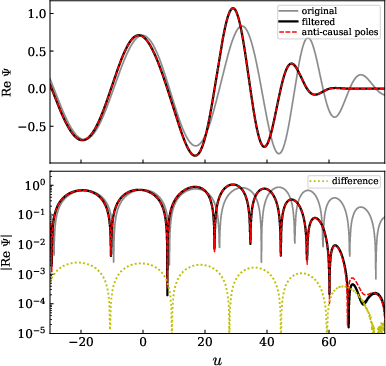
Figure 2: The ℓ=m=2 Zerilli waveform for an ISCO plunge: unfiltered and filtered with overtones up to n=5 removed; the anti-causal contribution alone accurately reproduces the filtered waveform.
Dissecting the anti-causal poles further reveals that each individual component decays on the timescale of the surface gravity (i.e., with a rate set by the horizon redshift), and only their coherent sum reproduces the observed cycles; no single anti-causal pole captures the waveform's global behavior.
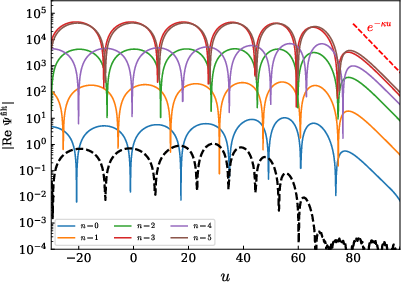
Figure 4: Individual anti-causal poles ωˉn contributing to the direct wave, each decaying as a horizon mode, but collectively summing to produce the observed direct wave pattern.
Moreover, parametric deformation of the near-horizon plunge (e.g., slowing the orbital phase evolution via Φ(R)→Φ(R/α)) systematically shifts the instantaneous frequency, real part, and amplitude of the direct wave cycles, confirming the direct sensitivity of the direct wave to the immediate pre-horizon source dynamics.
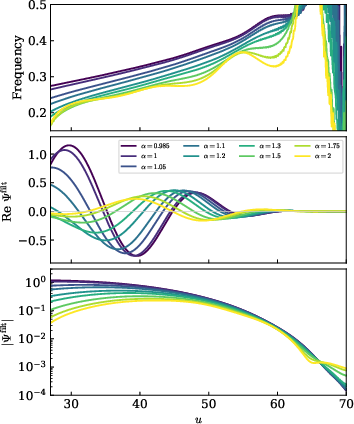
Figure 1: Dependence of the direct wave on the near-horizon source motion as the plunge dynamics are deformed; increasing α lowers the instantaneous frequency and shifts the phase of the cycles.
Theoretical Interpretation and Contradictory Claims
A major theoretical conclusion is that direct waves, as defined by filtered waveform analysis, are rigorously accounted for in linear perturbation theory: they are determined by the collective sum of anti-causal (advanced) poles in the filtered Green's function. In Schwarzschild, the analysis unambiguously demonstrates that these cycles are not equivalent to the instantaneous "light-cone" horizon modes whose vanishing has been claimed in [Kuntz:2026xep]. Instead, the direct wave is a cumulative anti-causal effect, not annihilated by the same cancellation mechanisms.
The direct wave's characteristic frequency and decay rate are not simple horizon parameters, but are functionals of the near-horizon source trajectory. This is demonstrated both by analytic expansion and by the dependence of waveform features on source deformation. Thus, the modeling of direct waves with pure horizon modes (as in [Chung:2026eph]) is not supported. The paper challenges recent assertions that direct waves are null tests of horizon properties [Kankani:2026kst], and instead clarifies their robust status as probes of the near-horizon plunge.
Practical and Theoretical Implications
- Direct wave observability: Direct waves are a generic and recoverable feature of filtered GW data, both in perturbative and NR waveforms [Lu:2025vol, Oshita:2025qmn]. Their properties are robustly linked to post-merger/plunge dynamics.
- Waveform modeling: Any attempts to ascribe direct wave features in NR or experimental data to physical horizon modes without accounting for anti-causal filtering and cumulative source dynamics are theoretically incomplete and in some cases incorrect.
- Filtering and information content: The rational filter applied to the frequency-domain waveform has unit modulus on the real axis, so it does not discard information, but redistributes it temporally by altering the causal support. This is crucial for direct wave isolation and analysis, and similar filtering constructions are advocated for more nuanced GW data interpretations.
- Extension to Kerr and strong-field gravitational physics: Applying the framework to rotating (Kerr) spacetimes, as well as to cases with nonlinearities beyond first order, is highlighted by the authors as a necessary next step for direct wave interpretation in astrophysically realistic mergers. Since the anti-causal contribution is sensitive to source dynamics in the near-horizon regime, inclusion of frame-dragging and nonlinearity will likely reveal richer phenomenology.
- Connection to NR and effective-one-body modeling: The findings provide a rigorous underpinning for effective-source strategies adopted in NR waveform modeling and hybrid approaches, justifying post-merger treatments as perturbed BHs sourced by remnant dynamics.
Conclusion
"Foundations of Direct Waves in Schwarzschild Ringdown" (2607.06677) establishes a robust theoretical basis for the emergence of direct waves as filtered anti-causal responses in Schwarzschild perturbations. The study leverages both analytic and numerical approaches to show that these cycles are not artifacts, nor are they direct signals of instantaneous horizon QNM excitation, but rather encode the physics of the near-horizon plunge. The analytic machinery of filtered Green's function analysis is necessary to disentangle these structures, and the study’s results bear practical implications for waveform modeling, GW data analysis, and future high-precision tests of strong-field gravity. Further investigation into direct waves in Kerr and their observational prospects in upcoming GW observations is warranted.