- The paper shows that the direct wave frequency and damping do not generally correspond with horizon properties except in narrow spin ranges.
- It employs extensive numerical relativity simulations and rational filtering, revealing that horizon-based models fail particularly for high-spin mergers.
- The study highlights that misinterpreting the direct wave can lead to systematic errors in gravitational wave analyses and tests of Hawking’s area law.
The Direct Wave and Its (Lack of) Connection to Horizon Properties
Introduction
This work critically re-examines the physical association between the recently identified direct wave component of black hole binary merger radiation and the properties of the remnant black hole's horizon. Building upon the growing literature on gravitational wave (GW) ringdown analysis and general relativity tests using LIGO/Virgo data, the paper challenges claims that the direct wave frequency and damping rate provide robust probes of the remnant horizon’s frequency and surface gravity. Utilizing extensive numerical relativity (NR) data, rational filtering methods, and comparative waveform analysis, the study demonstrates that such associations are coincidental and not general, with important implications for GW data analysis, black hole spectroscopy, and tests of Hawking’s area law.
Direct Wave Identification and Horizon Association
The direct wave, as isolated by rational mode filters, constitutes a component of the post-merger GW signal not described by traditional quasinormal modes (QNMs). Previous studies, notably by Oshita et al. (Oshita et al., 11 Sep 2025) and Lu et al. (Lu et al., 1 Oct 2025), argued that the direct wave frequency oscillates near twice the horizon frequency (2ΩH), and its damping rate is set by the surface gravity (κ) of the remnant Kerr black hole. This correspondence was foundational for recent tests of black hole area increase in GW250114 [135, 136] and for claims of precision horizon property inference using the direct wave.
However, a key point elucidated in this analysis is that the close matching observed in systems such as GW250114, with remnant spin χf≈0.7, is a non-generic artifact. Instead, as shown across a broad selection of SXS NR simulations spanning a wide range of remnant spins, the direct wave frequency does not systematically track the horizon frequency except near this accidental crossing.
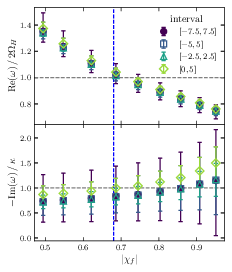
Figure 1: The direct wave frequency (normalized to 2ΩH) and damping (normalized to κ) versus remnant spin χf for several SXS simulations. Accidental frequency matching occurs only near GW250114’s χf.
This result fundamentally restricts the regime where horizon-based models of the direct wave are valid, undermining previous claims of universal association.
Temporal Evolution and Modeling of the Direct Wave
Detailed waveform analysis was performed through rational filters applied to the (2,2) component of NR GW strain data. Both constant frequency and time-dependent, horizon-motivated models were fit to the filtered signal. Two cases are highlighted: SXS:BBH:0305 (GW150914-like, χf=0.69) and SXS:BBH:0178 (extremal, χf≈0.95).
In moderately spinning remnant cases, the recovered direct wave frequency incidentally matches κ0 in short fitting windows, and evolving frequency models track well over short intervals.
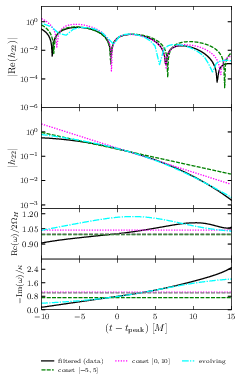
Figure 2: Model fits for the filtered direct wave component in SXS:BBH:0305, highlighting accidental agreement with horizon-based predictions for moderate spin.
Conversely, in high-spin systems, significant and systematic deviation is observed: the direct wave frequency is substantially lower than κ1, and damping rates evolve rapidly on timescales too brief to represent any horizon-defined process.
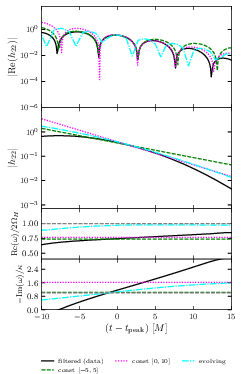
Figure 3: Direct wave in SXS:BBH:0178 (κ2) showing clear departure from horizon-based modeling; constant and evolving models fail over physically meaningful intervals.
The analysis confirms that neither constant nor horizon-following evolving frequency models adequately describe the direct wave in generic comparable-mass mergers, particularly at high spin.
Consequences for Horizon Area Law Testing
A major theoretical and observational consequence is addressed: if the direct wave is incorrectly assumed to yield horizon properties, area law tests (which rely on inferred κ3 and κ4) may spuriously indicate violations or confirmations of Hawking’s area theorem, depending on coincidental parameter overlap.
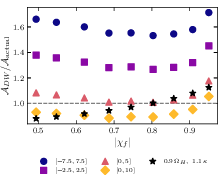
Figure 4: Ratio of direct wave-inferred horizon area to the true area, across systems and fit intervals; spurious (nonphysical) violations occur outside narrow κ5 windows.
The allowed region for proper inference is tightly limited in parameter space, undermining the utility of the direct wave as a general diagnostic of black hole area change from GW data. The finding highlights the critical need for physically consistent modeling frameworks, especially for high-precision GW tests of strong gravity.
Systematic Effects and Numerical Consistency
Extensive cross-validation over NR simulation resolution and QNM filter mode content demonstrates robustness of the reported results. Comparisons among high-spin SXS:BBH:0178 waveforms under varied filter settings show negligible differences, confirming that neither numerical noise nor filter inadequacy drives the observed deviations.
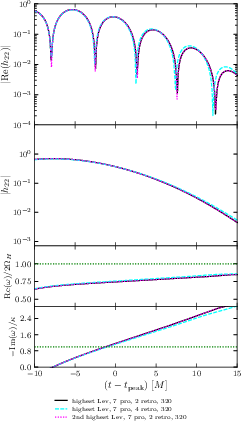
Figure 5: Resolution and filter variation analysis for SXS:BBH:0178, confirming reliability of waveform decomposition and frequency extraction.
Implications and Future Developments
Practically, these results mandate caution in interpreting direct wave properties as horizon data in comparable-mass binary black holes. Theoretically, the study implies that the excitation and evolution of the direct wave component are governed by post-merger dynamics not captured by simple matching to surface gravity or horizon frequency, and the physical mechanism of direct wave generation requires further investigation.
However, the authors note that their critique is focused on comparable-mass mergers; it remains possible that the direct wave–horizon association may persist in the extreme mass-ratio limit, as some theoretical arguments and EMRI calculations suggest. Further work is needed to probe this regime.
Future modeling of the merger-ringdown transition will likely require comprehensive frameworks that incorporate direct wave features without assuming spurious links to Kerr horizon properties, refining QNM expansion validity and improving systematic error control in GW spectroscopy.
Conclusion
This work provides a thorough, data-driven refutation of the widespread identification of direct wave frequency and damping with black hole horizon properties in numerical relativity binary mergers. Robust analysis demonstrates that such identification is not physically justified for generic spins, and leads to systematic errors in the interpretation of both gravitational wave data and fundamental tests of general relativity such as the area theorem. Accurate physical insight thus demands refined waveform modeling and a deeper understanding of the post-merger dynamics driving the direct wave phenomenon.
References
Anuj Kankani and Sean T. McWilliams, "The Direct Wave is Not a Meaningful Test of Horizon Properties" (2607.02380).
N. Oshita et al., "Probing Direct Waves in Black Hole Ringdowns" (Oshita et al., 11 Sep 2025).
N. Lu et al., "GW250114 reveals black hole horizon signatures" (Lu et al., 1 Oct 2025).
A. K.-W. Chung et al., "Measuring a Black Hole's Area Immediately after Merger: A Direct-Wave Test of Hawking's Area Law" (Chung et al., 4 Jun 2026).
R. Dyer, A. K.-W. Chung, C. J. Moore, "Modeling Direct Waves in Binary Black Hole Ringdowns" (Dyer et al., 23 Jun 2026).
The figures referenced correspond to those provided in the study (2607.02380).