Measuring a Black Hole's Area Immediately after Merger: A Direct-Wave Test of Hawking's Area Law
Published 4 Jun 2026 in gr-qc and astro-ph.HE | (2606.06592v1)
Abstract: Black-hole area is the geometric variable behind horizon thermodynamics. We introduce a gravitational-wave method to infer a Kerr-equivalent horizon area from direct waves in the near-merger signal, before quasinormal ringing dominates at late times. Applied to GW250114, and interpreting the fitted direct-wave frequency and damping rate as horizon quantities, we find that analyses initiated $3$--$4.5M$ before the peak-amplitude time yield an area consistent with the Kerr remnant. This result gives a first area measurement using direct waves and a new near-merger test of Hawking's area law.
The paper introduces a novel direct-wave method to estimate a newly merged black hole's horizon area, providing a localized test of Hawking’s area law.
It employs gravitational-wave data from GW250114 to map damped time-domain signals to effective Kerr horizon parameters like angular velocity and surface gravity.
Results show consistency between direct-wave and QNM ringdown estimates, confirming no violation of Hawking's area law within validated time windows.
Direct-Wave Measurement of Black Hole Horizon Area and Hawking's Area Law Test
Introduction and Motivation
The horizon area of a black hole is a uniquely significant geometric and thermodynamic quantity. It is directly connected to the black hole's entropy, surface gravity, and angular velocity, and fundamentally underpins the formalism of black hole thermodynamics and radiation. While electromagnetic observations have targeted the horizon scale (e.g., Event Horizon Telescope [event2019first]), they are strongly limited by astrophysical and accretion modeling uncertainties.
Gravitational-wave (GW) observations of coalescing black-hole binaries, on the other hand, offer a cleaner avenue for extracting information about the horizon area, particularly because most observed mergers lack significant electromagnetic emission or accretion disk contamination. Classical GW analyses typically infer progenitor and remnant horizon areas via the inspiral regime (pre-merger) and the late ringdown regime (quasinormal modes, QNMs) [Isi:2020tac, LIGOScientific:2025rid]. These methods have enabled the first observational tests of Hawking's area law, which posits non-decreasing event horizon area in classical general relativity [Hawking:1971tu].
In "Measuring a Black Hole's Area Immediately after Merger: A Direct-Wave Test of Hawking's Area Law" (2606.06592), a novel approach is introduced to probe the black hole horizon area during the highly dynamical, non-stationary regime—specifically, in the near-merger interval immediately following the GW peak, before the onset of the QNM-dominated ringdown. By directly measuring the properties of so-called "direct waves" in this intermediate regime, the authors open a new method to infer the Kerr-equivalent horizon area and to perform a more localized and independent test of the area law.
Methodology: From Direct Waves to Horizon Area
The key innovation in this study is the identification and modeling of direct-wave components in the GW signal during the near-merger epoch. Unlike the late-time QNM ringdown, which reflects the remnant's approach to stationarity, direct waves are generated immediately after merger but before the linear ringdown phase dominates. The direct-wave signal is characterized phenomenologically by a damped complex exponential, with parameters (ωDW,γDW) encoding oscillation frequency and damping rate, respectively.
In the Kerr interpretation, these parameters can be mapped to effective horizon quantities: ωDW/m∼ΩH (horizon angular velocity) and γDW∼κ (surface gravity), with m the azimuthal mode number. Eliminating the black hole mass M and spin a using these relations provides a time-localized, Kerr-equivalent area estimator,
ADW=ΩH2+κ2(ΩH2+κ2+κ)2π
which is valid once the post-merger spacetime is sufficiently close to perturbative Kerr. In practice, the accuracy of this mapping is quantitatively assessed by varying the window start time t0 and checking consistency with the standard ringdown area measurement.
This framework is applied to the GW250114 event, utilizing both Hanford and Livingston detector data. The direct-wave analysis performs nested sampling over the waveform parameter space, simultaneously fitting both the direct-wave and QNM ringdown components for various t0 values surrounding the merger. The QNM regime is separately analyzed at late times via standard ringdown spectroscopy.
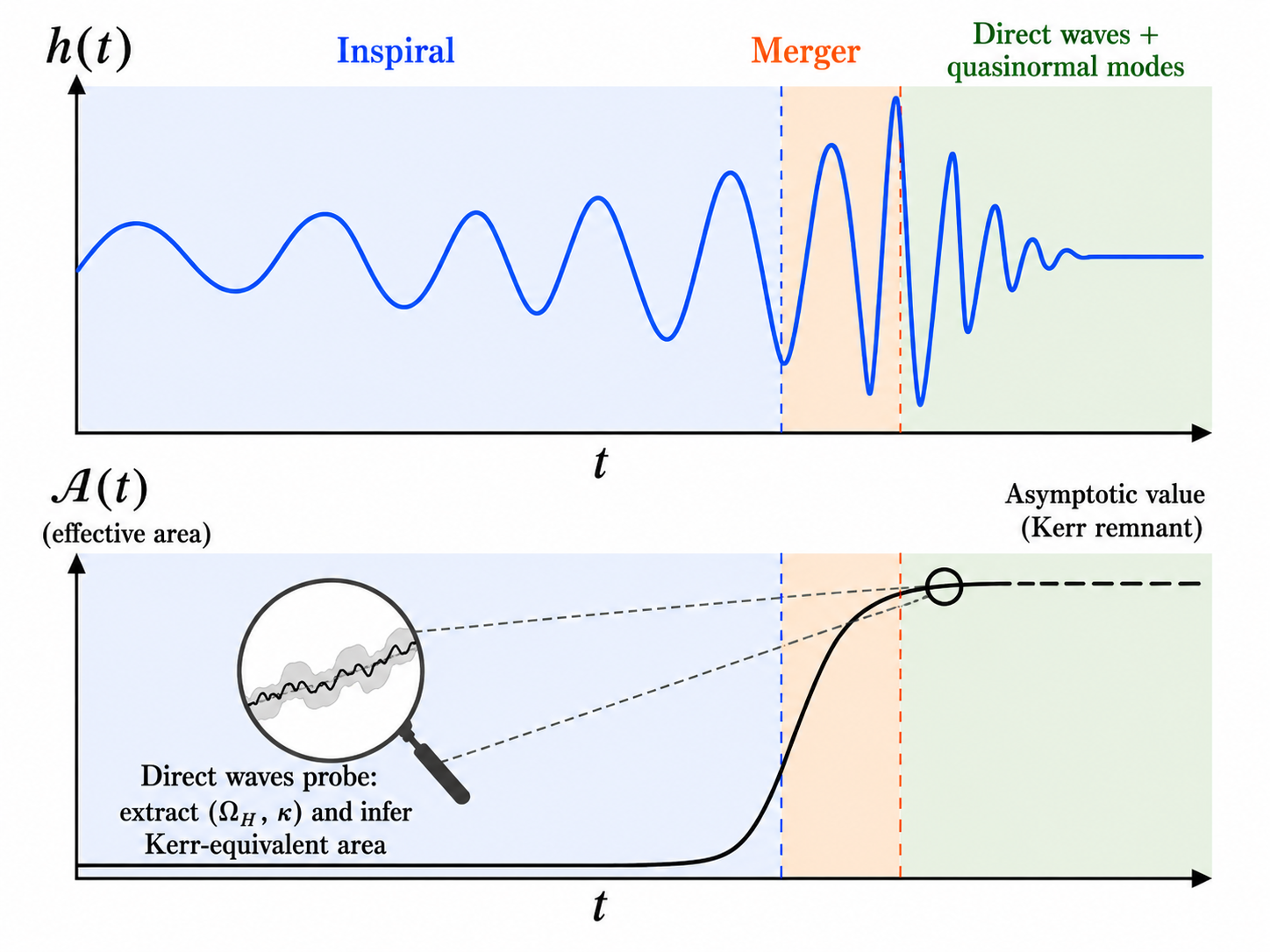
Figure 1: Schematic illustrating the direct-wave measurement protocol and the inferred Kerr-equivalent area A(t), emphasizing time localization relative to the inspiral, merger, and post-merger intervals.
Results: Horizon Area Estimation and Area Law Testing
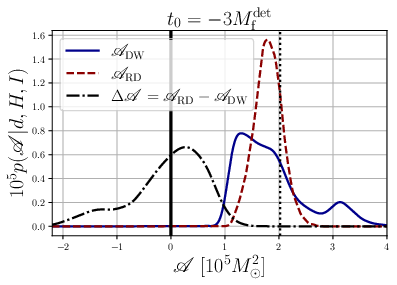
Posterior distributions for the horizon area estimated via the direct-wave regime (ωDW/m∼ΩH0), the QNM ringdown (ωDW/m∼ΩH1), and their difference ωDW/m∼ΩH2 were obtained for various choices of the analysis window.
Figure 2: Posterior PDFs for horizon area in the direct-wave (ωDW/m∼ΩH3, blue), ringdown (ωDW/m∼ΩH4, red), and area increment (ωDW/m∼ΩH5, black) at ωDW/m∼ΩH6.
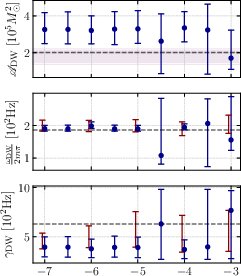
The analysis demonstrates that for window start times in the interval ωDW/m∼ΩH7, the marginalized posterior for ωDW/m∼ΩH8 encloses the predicted value inferred from remnant ωDW/m∼ΩH9, and significantly overlaps the γDW∼κ0 posterior. For earlier γDW∼κ1, the mapping between direct-wave parameters and Kerr horizon quantities breaks down, undermining the validity of γDW∼κ2 as an area estimator.
Figure 3: Medians and 90% credible intervals for γDW∼κ3 and direct-wave parameters as a function of γDW∼κ4.
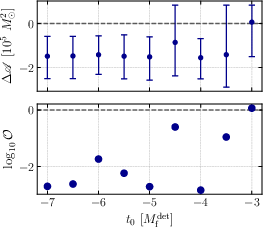
Testing Hawking's area law involves constructing the posterior for γDW∼κ5 and the odds ratio γDW∼κ6 for γDW∼κ7 vs. γDW∼κ8. For the regime where direct-wave and ringdown area estimates are mutually consistent, γDW∼κ9, signifying no evidence for violation of the area law. For earlier m0, m1 decreases, but this is attributed to the failure of the direct-wave/horizon identification rather than a physical violation.
Figure 4: Posterior median and credible interval for m2 (top), and m3 (bottom), versus direct-wave window start time m4.
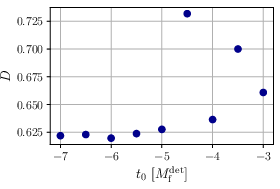
Robustness diagnostics confirm that the fractional deviation between fitted direct-wave parameters and Kerr-remnant predictions is moderate (typically 40-50%), with fluctuations localized near specific m5 choices, and not indicative of systematic bias.
Figure 5: Posterior-level fractional deviation diagnostic for direct-wave quantities with respect to Kerr-remnant predictions across start times m6.
Implications and Prospects
This direct-wave methodology enables the direct, time-localized inference of a black hole's horizon area immediately after merger, complementing existing techniques based solely on the inspiral or late ringdown regimes. The demonstration that m7 and m8 agree in the appropriate dynamical regime suggests that the direct-wave phase provides an independent probe of horizon-scale physics, with sensitivity to strong-gravity dynamics not encoded solely in QNM frequencies.
There are several immediate practical advantages:
Independent remnant spin constraints: Direct-wave analysis offers an additional constraint on remnant spin, potentially sharpening population inferences [LIGOScientific:2025pvj].
Complementary area law tests: Performing the area law test in the direct-wave regime provides a more localized check against energy or angular momentum loss obscured in longer-timescale analyses.
Robustness to modeling systematics: Agreement between methodologies with distinct signal models indicates that identification of direct waves is not strongly model-dependent, increasing confidence in future application to high-SNR events.
Theoretical ramifications include a more refined understanding of spacetime dynamics in the immediate aftermath of a merger, and possibly new avenues to probe deviations from classical general relativity, as higher-order effects or non-trivial area increments could become detectable in high-SNR GW events. Resolving the first-order correction in the area (m9) will require direct-wave SNRs of order M0, well beyond currently observed events but achievable with future ground- or space-based GW facilities.
Conclusion
The analysis in (2606.06592) introduces a direct-wave horizon area estimator enabling a time-localized, robust test of Hawking's area law in the post-merger regime. Within specific start-time intervals—where the effective Kerr correspondence is valid—the direct-wave and standard ringdown estimators both yield horizon areas consistent with Kerr predictions, and no evidence for a violation of the area law is found. The combined approach provides an invaluable new tool for precision black-hole physics using gravitational-wave observations, with anticipated utility in next-generation GW astronomy and theoretical investigations of strong-gravity regimes.