- The paper demonstrates that redshift/horizon modes vanish in Schwarzschild ringdown due to causality constraints on the source-convoluted Green function.
- It employs a detailed overtone summation and Laplace transform analysis to reveal the cancellation of non-physical mode contributions.
- The findings refine QNM regularization methods, reinforcing the no-hair properties and unique perturbative behavior of Schwarzschild black holes.
Vanishing of Redshift Modes in the Schwarzschild Black Hole Ringdown
Introduction
The ringdown phase of a black hole (BH) merger encodes critical information about strong-field gravity, with emitted gravitational waves (GWs) dominated by quasi-normal modes (QNMs). Recently, several studies identified additional waveform contributions in the form of exponentially decaying signals proportional to integer multiples of the black hole surface gravity, denoted as redshift modes, horizon modes, or direct waves. These are mathematically distinct from the familiar oscillatory QNMs and were conjectured to provide novel diagnostics of horizon-scale geometry. This paper (2606.07173) presents a rigorous and comprehensive analysis demonstrating that, for the Schwarzschild geometry, all such redshift-mode and horizon-mode contributions identically vanish in the observable gravitational waveform produced by a plunging point particle. The authors establish that this cancellation is enforced by causality at the level of the source-convoluted Green function, revealing key insight into the analytic structure of black hole perturbation theory.
Ringdown signals are derived by evolving linearized metric perturbations ψℓm(x,t) of the Schwarzschild spacetime (Regge-Wheeler-Zerilli framework), initialized by a point particle plunging into the black hole along a geodesic with energy E and angular momentum L. The waveform, as seen at a distant observer, is constructed by integrating the Green function G(x,xˉ,t−tˉ) against the source trajectory and field multipoles. The analytic structure of the retarded Green function, obtained via Laplace methods, possesses poles corresponding to QNMs and additional poles (Matsubara frequencies) or branch cuts, related to so-called redshift and horizon modes.
The time-domain response is partitioned into an "activation" term—integrating the source over its past history—and an "impulsive" term, tied to direct propagation on the light-cone. The structure of both components is such that, at the formal level, redshift modes arise from specific features of the source-Green function convolution evaluated close to the black hole horizon.
Analysis of Redshift and Horizon Modes
Numerical Demonstration
A salient feature shown by the authors is that the overtone decomposition of the ringdown initially yields nonvanishing redshift contributions for each individual mode. However, summing over all overtones (including high n) introduces intricate cancellations.
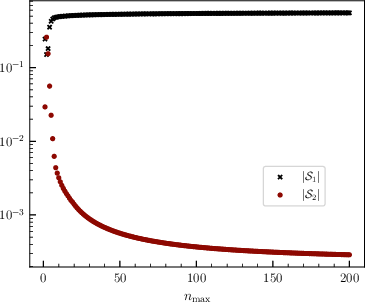
Figure 1: Approximated value of ∣S1∣ (uncanceled redshift mode amplitude) and ∣S2∣ (total summed amplitude) as a function of overtone truncation nmax; ∣S2∣→0 rapidly as nmax→∞.
This figure quantitatively demonstrates that the impulsive component, when summed over a finite number of overtones, appears nonzero, but the sum converges to zero for the full mode expansion. The same behavior is established analytically for the activation component, completing the demonstration that all redshift/horizon mode contributions vanish identically in the Schwarzschild waveform.
Proof via Causality and Analytic Structure
The key to this result is the strict imposition of causality on the source-convoluted Green function. The Laplace-transformed Green function, after convolution with the time-dependent source on a plunging trajectory, must vanish on the observer's light-cone due to the underlying hyperbolic character of the wave equation. Causal propagation enforces that the would-be redshift/horizon mode components derived by approximation or via stationary phase do not manifest in the full, physically consistent solution.
Careful technical analysis reveals that, although individual overtones and certain approximations (e.g., stationary phase or direct evaluation at Matsubara poles) yield nontrivial contributions, the full sum respects causality and cancels all such unphysical terms.
Relation to QNM Excitation Coefficient Regularization
The paper further provides a robust theoretical underpinning for the standard regularization schemes applied to divergent QNM excitation integrals in the literature (see, e.g., [Leaver 1986], [Zhang et al., Phys. Rev. D 88, 044018]). These prescriptions eliminate divergences in the excitation integrals arising from the near-horizon behavior of the source and homogeneous solutions; the authors establish that this regularization is physically equivalent to removing the spurious (and causally excluded) redshift-mode contributions in the complete Green function treatment. The demonstration links the mathematical procedure of regularization directly to the fundamental physics of causal propagation in Schwarzschild geometry.
Implications for Ringdown Modeling and Theoretical Physics
The vanishing of Schwarzschild redshift modes carries several important implications:
- No new observable signatures of redshift/horizon modes: This result indicates strong constraints on efforts to probe near-horizon geometry and horizon-scale modifications using non-oscillatory ringdown signals that decay at multiples of the surface gravity. For Schwarzschild spacetime, the only physically observable late-time content is the usual set of QNMs and the power-law tail.
- Consistency and calibration of ringdown models: The formalism introduced justifies and systematizes the subtraction of divergent components in QNM amplitude calculations, suggesting a regularized approach for smoothly interpolating between merger and ringdown, including the gradual dynamical excitation of QNMs.
- Disagreement with prior arguments for direct/horizon mode observability: The findings contradict previous results advocating nonzero horizon/direct modes in Schwarzschild ringdown waveforms based on simplified approximations ([Zimmerman & Chen 2011, Oshita et al. 2025]). The analysis here clarifies that those features are artifacts of incomplete treatments.
- Robustness and generalization: While the explicit proof is for Schwarzschild, the analysis indicates that the essential ingredient underpinning redshift mode cancellation is causality. The authors conjecture similar results are likely for the Kerr geometry, though nontrivial technical challenges remain for the rotating case.
- Connection to black hole "no hair" properties: The vanishing of all redshift and horizon modes parallels the vanishing of certain tidal response parameters (e.g., Love numbers), reinforcing the unique and rigid character of GR black holes in the perturbative regime.
Conclusion
This work provides an explicit and rigorous demonstration that redshift, horizon, and direct wave modes—the exponentially decaying, non-oscillatory components at integer multiples of the surface gravity—are absent from the physically observable ringdown waveform of Schwarzschild black holes. The absence is enforced by causality and manifests as a precise cancellation between impulsive and activation waveform components upon full overtone summation. The result enforces a robust constraint on ringdown modeling and the extraction of horizon physics from GW observations: all observable non-power-law, non-QNM content in Schwarzschild ringdown strictly vanishes. This both clarifies the theoretical landscape and guides future investigations into possible horizon diagnostics in more general backgrounds or beyond-GR scenarios.
(2606.07173)