- The paper demonstrates that a 5B-parameter video diffusion transformer can efficiently run on mobile NPUs by using recurrence distillation, learnable attention head pruning, and step distillation.
- It introduces a novel recurrent reformulation that converts transformer attention into an RNN-like process, reducing memory and compute complexity while preserving video quality and motion coherence.
- The optimized VAE decoder with an extended temporal receptive field ensures temporally consistent and visually stable video generation on resource-constrained devices.
MobileWan: Efficient Large-Scale Video Diffusion on Mobile Devices
Introduction
MobileWan addresses a central challenge in generative video modeling: bridging the persistent fidelity and coherence gap between server-scale, large-parameter video diffusion models and their resource-constrained, on-device counterparts. Historically, mobile video diffusion has been dominated by heavily reduced backbones (typically <2B parameters), which incurred substantial losses in video quality, motion coherence, and semantic preservation due to memory, compute, and latency limitations inherent to edge hardware. This paper contends that such drastic reductions in parameter count are not strictly necessary and demonstrates, for the first time, that a 5B-parameter video diffusion transformer can be deployed efficiently on commercial NPUs by means of principled recurrent reformulations, structured pruning, and system-level optimizations. The result is MobileWan, which delivers server-comparable quality and throughput under strict mobile constraints.

Figure 1: Qualcomm AI Research – organizational logo highlighting the core source of the research.
System Architecture and Decomposition
The transformation of the original Wan2.2 5B architecture into a deployable mobile model is achieved via a suite of complementary optimizations targeting both the diffusion transformer backbone and the decoder. The principal contributions are as follows:
- Recurrence Distillation: The transformer is recast into a chunk-wise autoregressive process, converting attention computation into an RNN-like execution. This formulation exploits causal linear attention to avoid quadratic memory growth with sequence length, crucial for long-video generation.
- Learnable Attention Head Pruning: Rather than resorting to coarse block pruning, MobileWan introduces a fine-grained, noise-biased, learnable per-head gating approach, enabling aggressive attention head pruning with minimal degradation in generative quality.
- Sampling-Step Distillation: Utilizing distribution matching and adversarial distillation techniques, the number of denoising steps required during sampling is reduced without introducing strong artifacts or perceptual quality loss.
- Decoder Optimization: An enhanced VAE decoder with an extended temporal receptive field mitigates temporal artifacts typical of efficient decoders, preserving consistency across frames while being adapted specifically to the constraints of mobile inference.
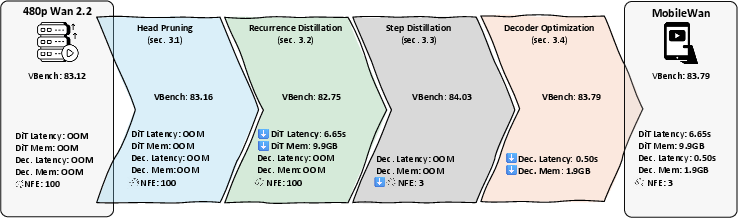
Figure 2: Pipeline of optimizations applied to the base Wan 2.2 5B model, culminating in native execution on Snapdragon 8 Gen 5 mobile NPUs.
Recurrence Distillation and Attention Head Pruning
Classic DiT (Diffusion Transformer) architectures incur memory and compute costs which grow quadratically with the video token count, rendering them impractical for edge deployment. In MobileWan, a recurrence distillation framework enables chunk-wise video generation, restricting full softmax attention to local tokens and leveraging causal linear attention for summarizing past context via lightweight running aggregates. This hybridization preserves the expressive power of transformer self-attention while allowing strictly linear scaling in both memory and compute during inference. In practice, all 30 transformer blocks are converted to this scheme, yielding a fully RNN-compatible model graph.
Learnable head pruning employs per-head binary gates, optimized under a sparsity regularizer and trained with a novel high-noise bias in the sampling distribution. The bias ensures the model prioritizes global spatiotemporal structure and motion retention during pruning. Empirically, learned pruning significantly outperforms heuristic alternatives, particularly at aggressive ratios.
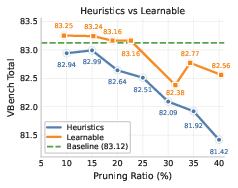
Figure 3: VBench scores comparing learned (noise-biased) and heuristic head pruning across pruning ratios. Learned pruning is consistently superior, especially under aggressive compression.
Step Distillation
To meet real-time and latency requirements, MobileWan adopts step distillation via distribution matching (DMD) and decoupled DMD (D-DMD), enabling the generator to operate with as few as 2–3 denoising steps per video. The DMD method uses classifier-free guidance augmented gradients and sample-wise weighting for stable distillation, while D-DMD further splits the supervision into DM and CA components with independently sampled noise levels. Adversarial losses (as in FastGen-inspired strategies) are also explored to improve motion dynamics. The distilled versions exhibit only modest drops in quantitative metrics but incur some saturation artifacts or reduced dynamism, which are mitigated by alternative step distillation configurations.
Decoder Optimization
Memory-efficient decoders are vital for on-device inference. MobileWan introduces an optimized VAE decoder building on LightX2V, extending its causal look-back window for each temporal prediction (conditioning on up to five prior frames). This modification reduces temporal artifacts and flicker under frame-to-frame compression, with training performed using a combination of L2 and perceptual losses over a mixed synthetic dataset.
The resultant decoder significantly outperforms previous efficient decoders across PSNR and VBench, yielding visually stable and temporally consistent reconstructions with acceptable resource demand.
End-to-End Integration and Deployment
The one-by-one integration of pruning, recurrence reformulation, distillation, and decoder optimization demonstrates negligible cumulative impacts on key generation metrics. Further, the system is quantized to 8-bit weights with mixed-precision activations; high-sensitivity operations are retained at higher precision via a two-stage, block-wise and end-to-end quantization-aware distillation pipeline. The resulting model supports the generation of 5-second, 480×832 videos at 16 FPS within a 20-second latency window on Snapdragon 8 Gen 5 NPU hardware, achieving a VBench score of 83.79—competitive with the full server-scale baseline.
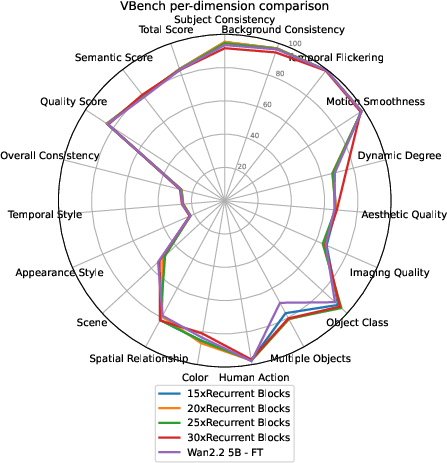
Figure 4: Radar plot shows MobileWan’s quality profile compared to the original Wan2.2 5B baseline on VBench dimensions (resolution: 480×832).
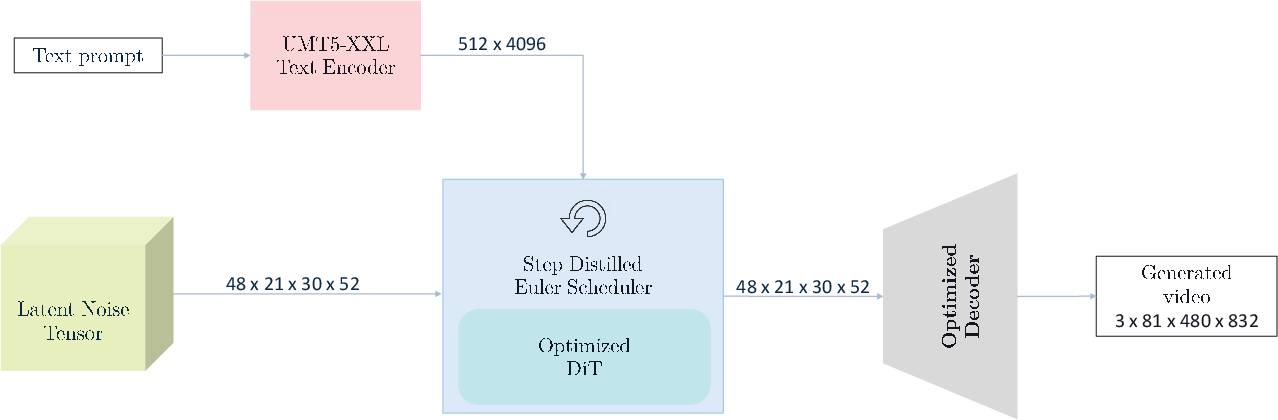
Figure 5: Final system overview—optimized transformer (RNN-reformulated, pruned, distilled) and decoder, replacing original server-heavy components in the video latent diffusion pipeline.
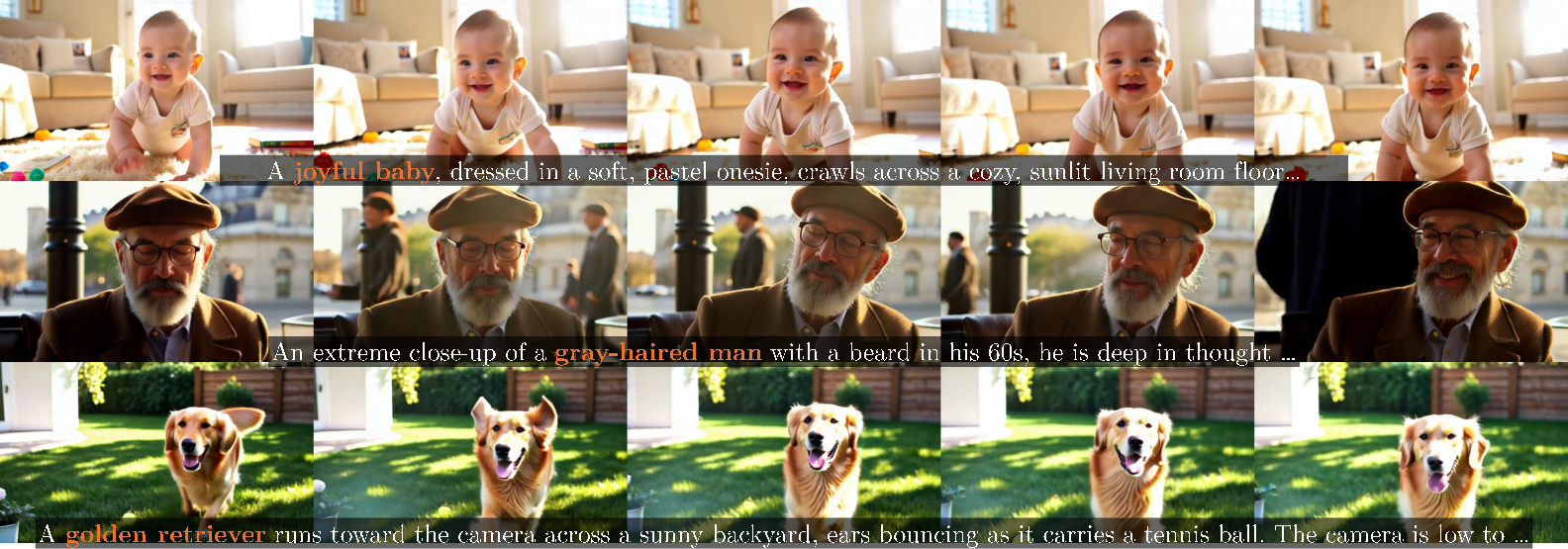
Figure 6: Qualitative evaluation—sample frames rendered at 81×480×832 from MobileWan, demonstrating coherence and visual detail on-device.
Empirical Evaluation
Quantitative experiments benchmark MobileWan against both generic and mobile-optimized video diffusion models. The model outperforms or matches state-of-the-art results on VBench for both quality and semantic metrics. Human visual preference studies are consistent with these findings, showing MobileWan is strongly preferred to previous on-device models and approaches parity with the server-scale baseline in approximately half of subjective comparisons.
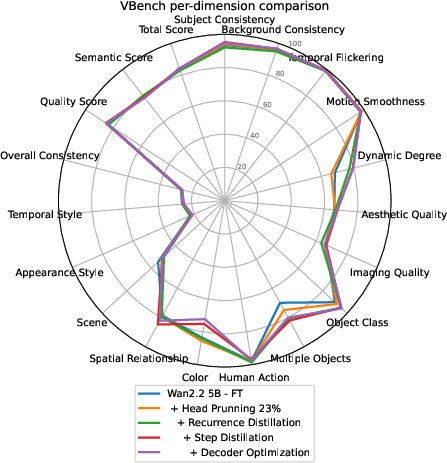
Figure 7: VBench breakdown across all dimensions for each successive optimization stage; step distillation mainly affects color metrics, highlighting trade-offs in perceptual parameters.
Implications and Future Directions
MobileWan demonstrates unequivocally that efficient, large-scale video diffusion on resource-limited devices is practical without resorting to drastic parameter reduction or specialized architectures. The use of recurrent hybrid attention, learnable pruning, and optimized decoders forms a robust template for future on-device generative modeling in the video domain. However, intrinsic limitations persist, including residual artifacts for challenging scene types, over-saturation or motion reduction contingent on distillation methods, and occasional temporal discontinuities introduced by chunked RNN reformulation.
Future directions include resolving these perceptual shortcomings, extending the backbone to higher spatiotemporal resolutions, refining step distillation to preserve dynamism, and further specializing VAE designs for edge deployments. Moreover, integrating robust digital watermarking and authentication may mitigate risks emerging from accessible, high-quality on-device video generation.
Conclusion
MobileWan closes the quality gap between mobile and server-scale video diffusion by leveraging a tightly integrated suite of optimizations: RNN-formulated attention, learnable pruning, advanced distillation, and tailored decoding. MobileWan's approach validates the deployment of 5B-scale video diffusion transformers on edge hardware, establishing a new quality standard and revealing practical pathways toward scalable, efficient generative models suitable for privacy-preserving, offline applications.
References
See (2607.06173) for complete references and further technical appendices.