- The paper introduces a unified on-device diffusion framework that combines structured depth pruning, adversarial step distillation, and hybrid quantization to significantly accelerate cinematic video generation.
- The methodology leverages PPCL for efficient pruning and employs a 4-step adversarial distillation, achieving a 40× runtime speedup and minimal quality degradation in cinematic effects.
- Experimental results demonstrate robust temporal continuity, identity preservation, and real-time performance on mobile devices, enabling practical AI-powered cinematic editing.
CineMobile: Efficient On-Device Image-to-Video Diffusion for Cinematic Camera Motion
Introduction and Motivation
CineMobile addresses a persistent bottleneck in deploying diffusion-based image-to-video (I2V) models on mobile platforms for cinematic camera motion generation. While state-of-the-art diffusion transformers (DiTs) deliver strong video generation, their computational and memory requirements are prohibitive for mobile devices. Prior work has mostly targeted U-Net-based accelerations, leaving DiT models underexplored, particularly for the structured and controllable camera effects such as bullet time, dolly zoom, and slow motion. CineMobile proposes a unified framework, built upon model pruning, step distillation, and quantization, to enable efficient, high-fidelity cinematic video synthesis on commodity smartphones.
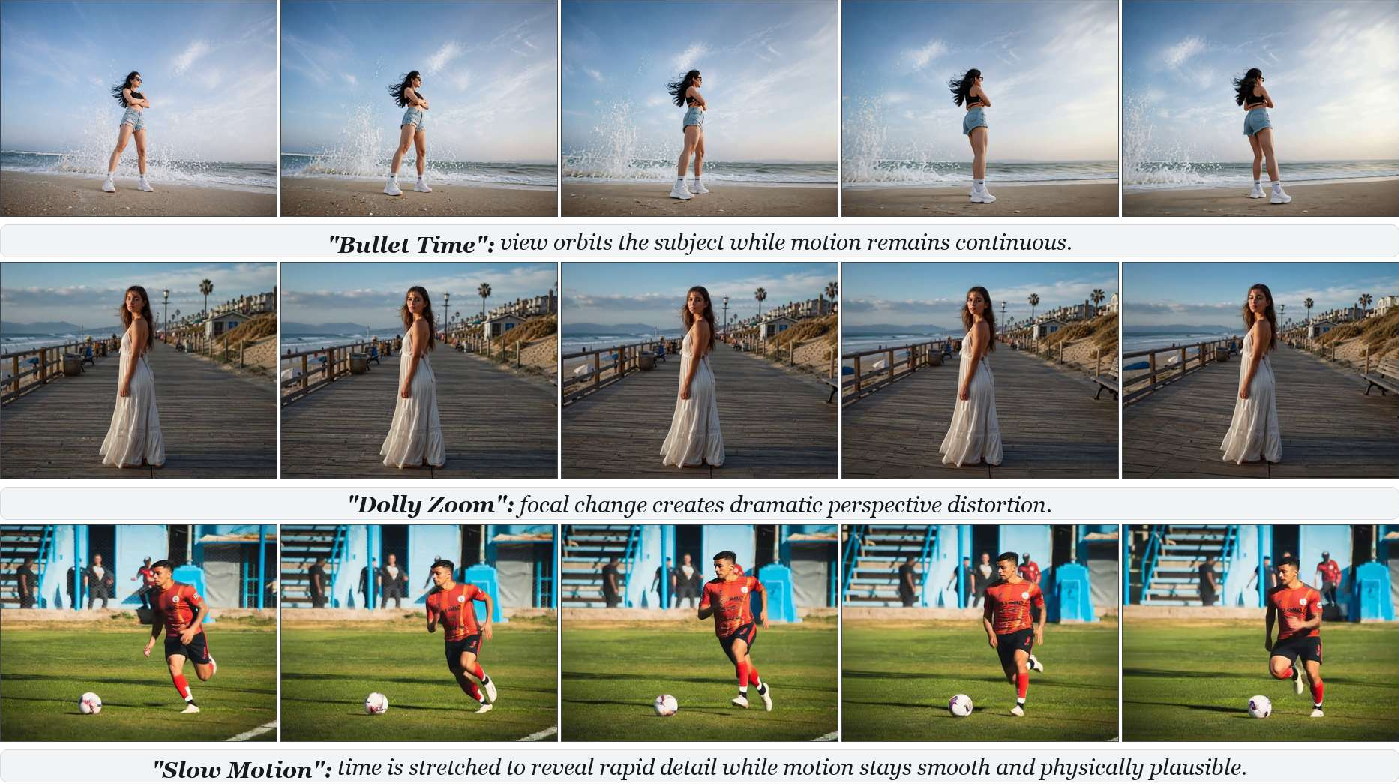
Figure 1: Bullet time, dolly zoom, and slow motion videos generated by CineMobile. CineMobile can produce continuous cinematic camera motion while preserving subject identity and scene consistency.
Methodology
Structured Depth Pruning via PPCL
CineMobile generalizes the Pluggable Pruning with Contiguous Layer Distillation (PPCL) paradigm—originally for text-to-image diffusion—to video DiTs. Unlike naive pruning, which often leads to significant temporal degradation and identity drift, CineMobile employs structured depth pruning while keeping hidden dimensions unchanged. Redundant intervals are automatically detected using residual linear probes and CKA-based similarity scoring over thousands of calibration video samples. Instead of width pruning (which the paper demonstrates results in severe identity shifts; see Figure 2), entire block spans are replaced by surrogate transformer blocks and distilled to align with the original backbone's feature space, preserving both temporal modeling and portrait fidelity.
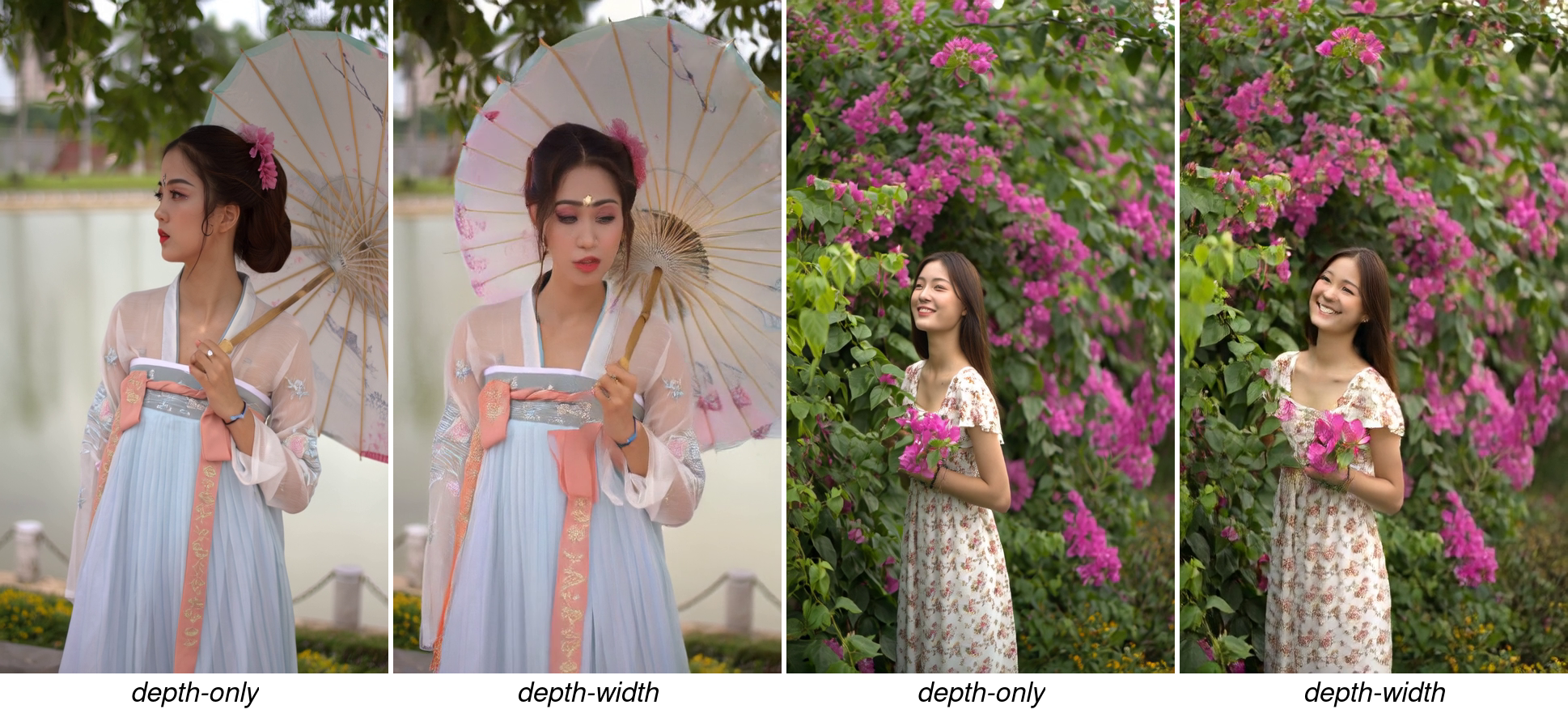
Figure 2: Width pruning may lead to identity shifts and deformation issues.
Step Distillation with Adversarial Reinforcement
To ensure few-step high-quality generation, CineMobile applies a two-stage step distillation. Firstly, a supervised fine-tuning (SFT) warm-up restores the student DiT's basic capability for the chosen cinematic trajectories. Then, CineMobile extends AdvDMD—an adversarial RL-driven distribution-matching distillation methodology—to video generation. The student model, after SFT, is further distilled to perform 4-step denoising via combined DMD-GAN-GRPO signals, incorporating both teacher and discriminator supervision. This adversarial fine-tuning closes the perceptual gap induced by aggressive acceleration and model compression.
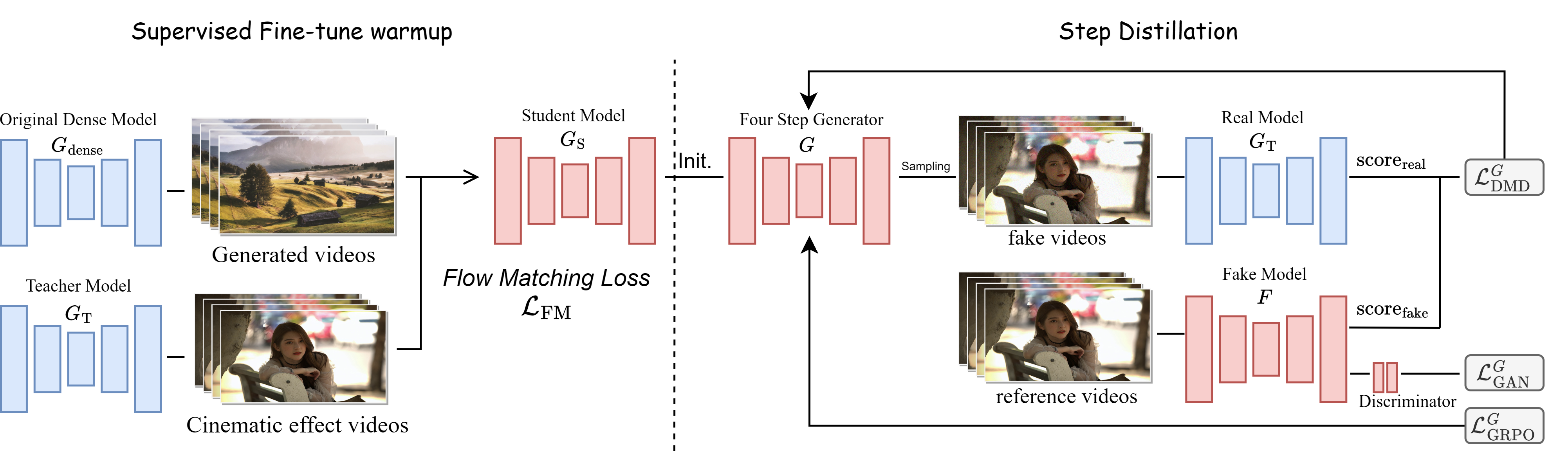
Figure 3: Overview of the step distillation pipeline: supervised fine-tuning warm-up on both teacher and student generations, followed by adversarial distillation with distribution-matching and GRPO rewards.
Hybrid Post-Training Quantization
To further minimize deployment overhead, CineMobile utilizes a hybrid quantization strategy: FFN weights are quantized to 4-bit, other linear weights to 8-bit, and activations are held at 16-bit precision, reducing model footprint below 1 GB while preserving numerical stability. The approach balances quantization-induced degradation and runtime efficiency, ensuring real-time on-device video generation with modest model size and low latency.
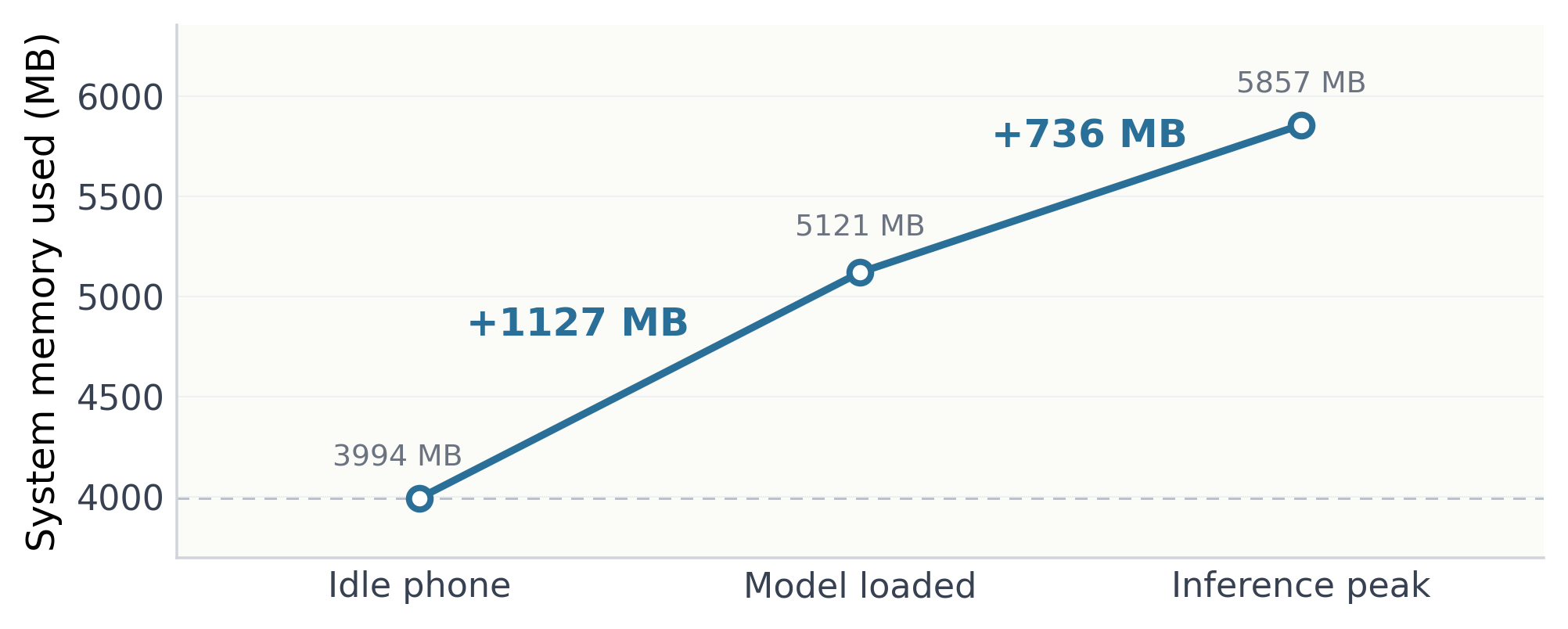
Figure 4: Memory footprint analysis on Infinix NOTE 60 Ultra demonstrates CineMobile's modest additional memory requirements during 480p video inference, supporting efficient mobile deployment.
Experimental Results
CineMobile achieves a 40× speedup in denoising time and a 71.89× reduction in DiT-FLOPs compared to the Wan2.1-14B teacher model, with only marginal loss in video quality metrics. On a MediaTek Dimensity 8400 Ultimate 5G, CineMobile generates 49-frame, 480p videos with 20s total latency and a peak memory usage of 1.8 GB. VBench evaluation reveals negligible quality drop versus large-scale baselines: the total score gap is 0.92 (bullet time), 0.66 (dolly zoom), and 0.46 (slow motion) against the teacher.
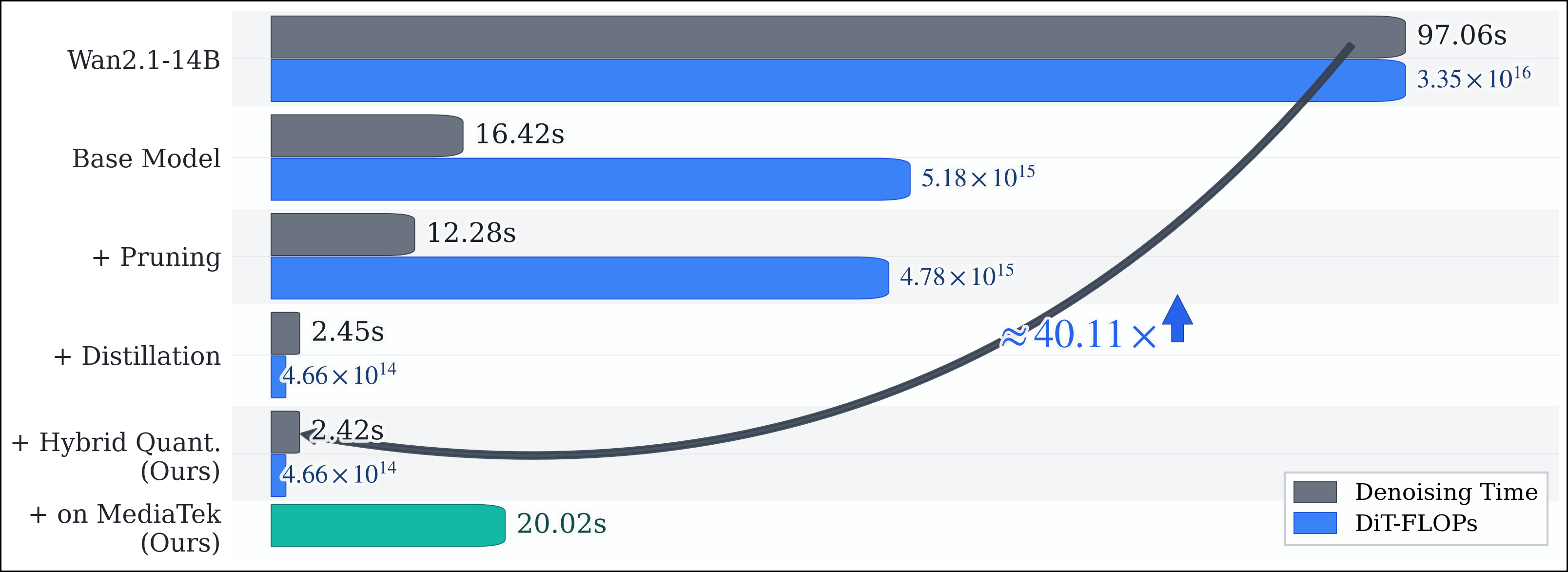
Figure 5: Denoising time and DiT-FLOPs comparison for CineMobile across pruning, distillation, and quantization stages.
Qualitative Assessment
CineMobile delivers robust temporal dynamics and subject-background consistency for all evaluated cinematic effects. Notably, compared to commercial alternatives (e.g., Kling, Hailuo, Vidu), CineMobile achieves superior camera trajectory control and more uniform subject anchoring as validated in human evaluations.
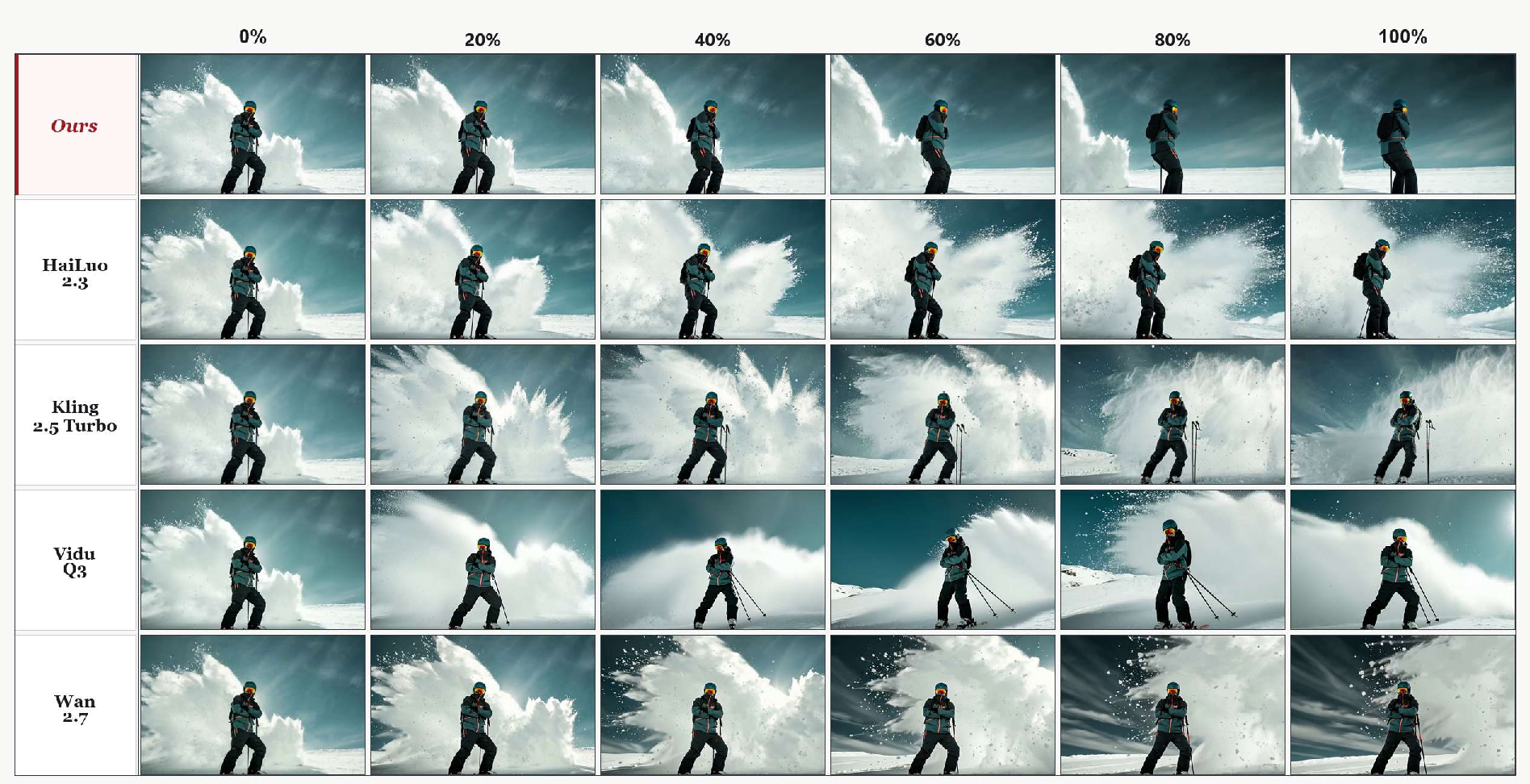
Figure 6: Qualitative comparison with commercial video generation models demonstrates CineMobile's more stable camera progression and stronger subject-background fidelity.
Further, on slow motion synthesis with extreme frame interpolation (20×), CineMobile produces substantially higher PSNR and SSIM than FILM, indicating superior reconstruction across large temporal gaps.
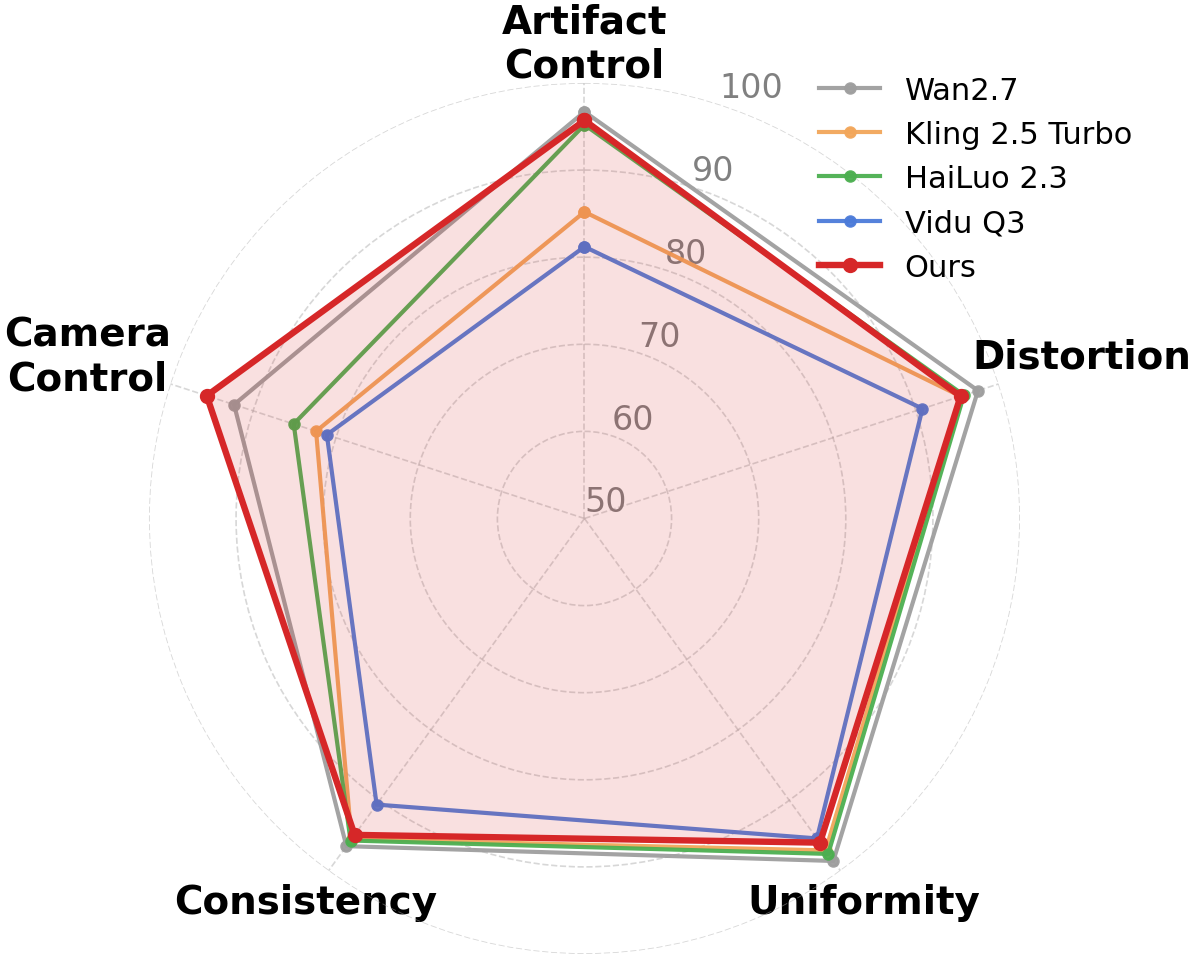
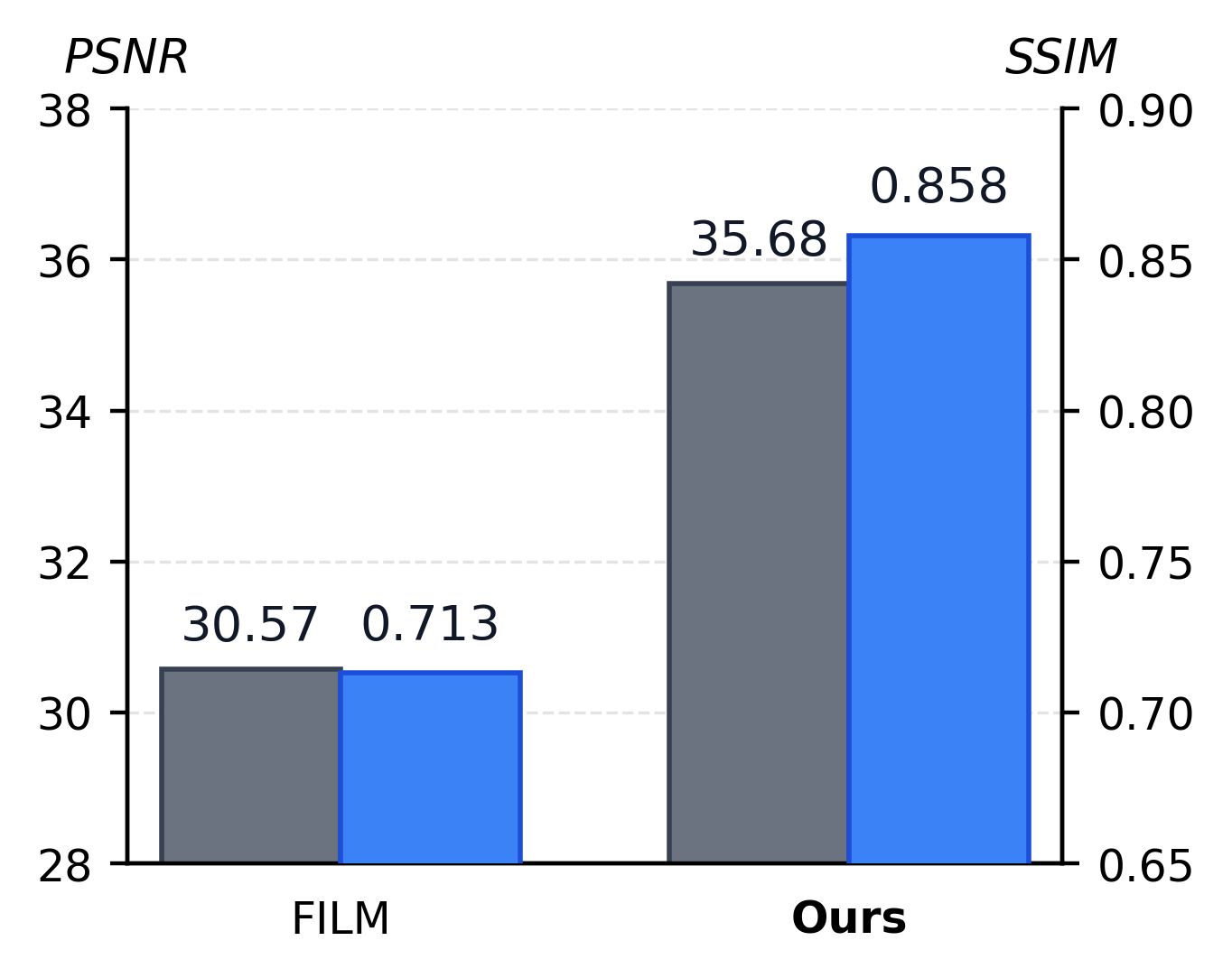
Figure 7: Left—radar plot of human evaluation shows CineMobile's advantage in camera motion control; Right—comparison on 20× slow motion synthesis, where CineMobile outperforms FILM in temporal consistency and perceptual scores.
Ablations and Deployment
GRPO refinement yields perceptual gains (notably in aesthetics and imaging), while hybrid quantization preserves quality with negligible artifact introduction. Memory and runtime analyses establish that CineMobile can be loaded and run efficiently, even in constrained mobile environments.
Discussion and Implications
CineMobile's unified acceleration-design pipeline highlights the limits of naive width pruning for DiTs (see Figure 2) and advocates for effect-aware structured pruning. Its adaptation of AdvDMD to video generation, with adversarial RL rewards, demonstrates a scalable path toward few-step high-fidelity synthesis under stringent compute budgets. The real-time on-device deployment opens opportunities for practical AI-generated video editing and content creation that avoid cloud dependency.
By decoupling core cinematic motions from full prompt semantics, CineMobile circumvents the fidelity-collapsing effect observed in more aggressive compression or distillation protocols. Future directions include generalization to open-ended motion generation, integration with dynamic prompt interpretations, and adaptation to emerging video backbone architectures. The approach can also inform edge AI deployments for other structured, controllable video manipulation or creative tasks.
Conclusion
CineMobile exemplifies how structured pruning, adversarial few-step distillation, and hybrid quantization can bring large DiT-based video generation models into the constraints of mobile hardware without meaningful perceptual compromise. The framework establishes a blueprint for high-quality, effect-controlled, and efficient I2V diffusion on edge devices, with clear implications for personalized cinematic content creation, mobile multimedia applications, and the broader adoption of generative AI video technologies.