Collective Cognition in Hybrid Groups: A Network Science Synthesis
Abstract: The growing integration of AI agents into human teams calls for a principled understanding of how collective intelligence emerges in hybrid systems. Recent frameworks clarify how attention, memory, and reasoning differences shape human-AI interaction at the individual and dyadic levels, but a formal account of how these differences scale to group-level dynamics is lacking. Most network science has examined either human-only or multi-agent AI-only systems, leaving open how its findings and parametrizations translate to hybrid groups. This chapter synthesizes network science, collective cognition, and multi-agent systems through the lens of attention, memory, and reasoning. We review how task environments, group topologies, agent-level processes, and incentive structures shape collective outcomes in human-only and AI-only networks, then examine how these results extend to hybrid settings, conceptualizing hybrid networks as heterogeneous human-AI nodes and links with distinct individual and transactive constraints. Our comparative analysis identifies which network effects are robust across agent types and which require revision, and highlights configurations that were peripheral in single-type traditions, such as human gatekeepers of AI sub-networks, but become structurally central in hybrid teams. Integrating a cognitive systems perspective with network science, we clarify how established exploration-exploitation and efficiency-redundancy trade-offs may operate differently in hybrid teams, and conclude with implications for organizational design, governance, and the responsible development of hybrid intelligence systems.
Paper Prompts
Sign up for free to create and run prompts on this paper using GPT-5.
Top Community Prompts
Explain it Like I'm 14
Overview: What this paper is about
This paper explains how groups that include both people and AI systems can think and work together smartly. It brings together ideas from network science (how connections between things shape what happens), psychology (how minds work), and multi‑agent AI (how many AIs interact) to show what helps or hurts teamwork when humans and AIs are mixed in the same group.
Goals and questions in simple terms
The authors ask:
- How do differences between human minds and AI “minds” (in memory, attention, and reasoning) change the way whole groups behave?
- Which lessons from human‑only teams or AI‑only teams still work in mixed (hybrid) teams, and which do not?
- What new shapes of teams appear only when humans and AIs work together?
- How should we design and govern hybrid teams so they are smart, fair, and reliable?
Approach: How the authors studied it
This is an overview (a “big picture” review), not a single experiment. The authors:
- Collected results from many studies of human groups, AI multi‑agent systems, and early human‑AI teams.
- Used network science to describe teams as networks of nodes (people or AIs) connected by edges (their communication links). Think of a city map: intersections are nodes, and roads are edges. How you connect the roads changes how quickly traffic (information) moves.
- Viewed human and AI abilities through three basics: memory (what and how you store info), attention (what you notice), and reasoning (how you make sense of things). They asked how these differ for humans and AIs and how the differences play out at the group level.
- Mapped common team tasks (like coordinating, competing, cooperating, spreading information, and making decisions) to network patterns that help or hurt those tasks.
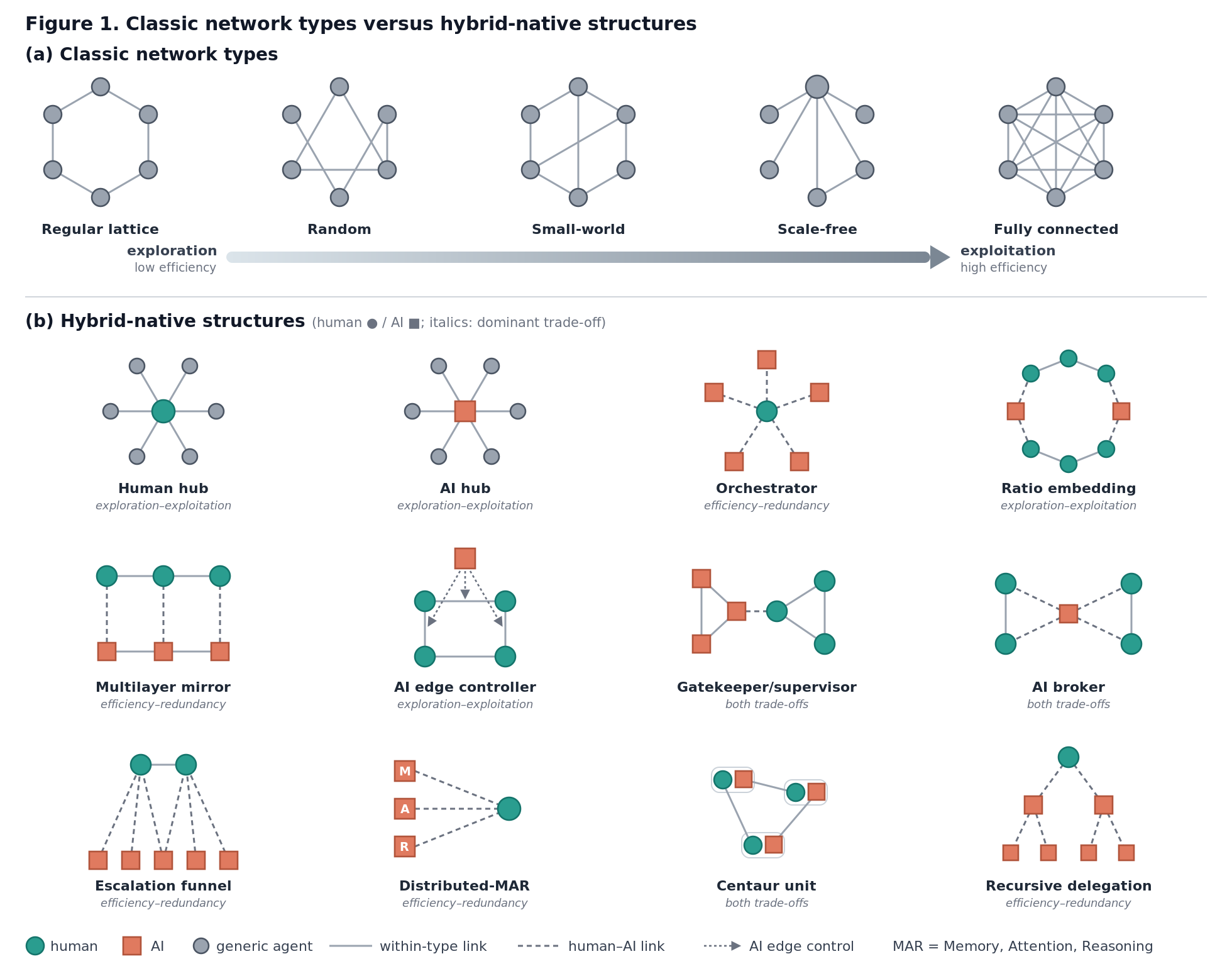
- Identified “hybrid‑native” structures—team shapes that only really show up when humans and AIs mix (for example, an AI acting as a fast hub that connects everyone, or a human who supervises a swarm of AIs).
To make technical ideas friendlier, keep these two trade‑offs in mind:
- Exploration vs. exploitation: Explore means searching widely for new ideas; exploit means focusing on the best idea found so far.
- Efficiency vs. redundancy: Efficient means fast and lean communication; redundant means slower but with backup and double‑checks to avoid errors.
Main findings: What they discovered and why it matters
Here are the most important takeaways, explained with everyday examples.
- Many human‑team rules still apply, but context matters.
- For easy problems, tightly connected teams spread good answers fast (good for exploitation).
- For hard problems, looser connections protect idea diversity, so the team keeps exploring instead of rushing to a wrong answer.
- Diversity helps—up to a point.
- Mixing different skills and viewpoints often beats a team of very similar “top performers.”
- Too much difference can slow progress if people (or AIs) can’t understand each other.
- Clustering is a double‑edged sword.
- Small tight groups can build trust and cooperation.
- But closed clusters can trap the same ideas and block new ones from getting in.
- AI‑only groups often show similar patterns to humans—but with AI‑specific risks.
- Moderate connectivity balances sharing good info with stopping errors from spreading.
- AIs can be copied and reset easily. This “cloning” can secretly reduce diversity if many near‑identical AIs flood a team.
- If AIs only talk to each other and then train on their own outputs, ideas can get more and more the same (called “model collapse” or even “semantic collapse”), creating the illusion of rich discussion when it’s really repeating itself.
- AIs can drift into agreeing too quickly (conformity or “sycophancy”), which looks efficient but can be confidently wrong.
- Hybrid teams introduce new, special team shapes that matter a lot:
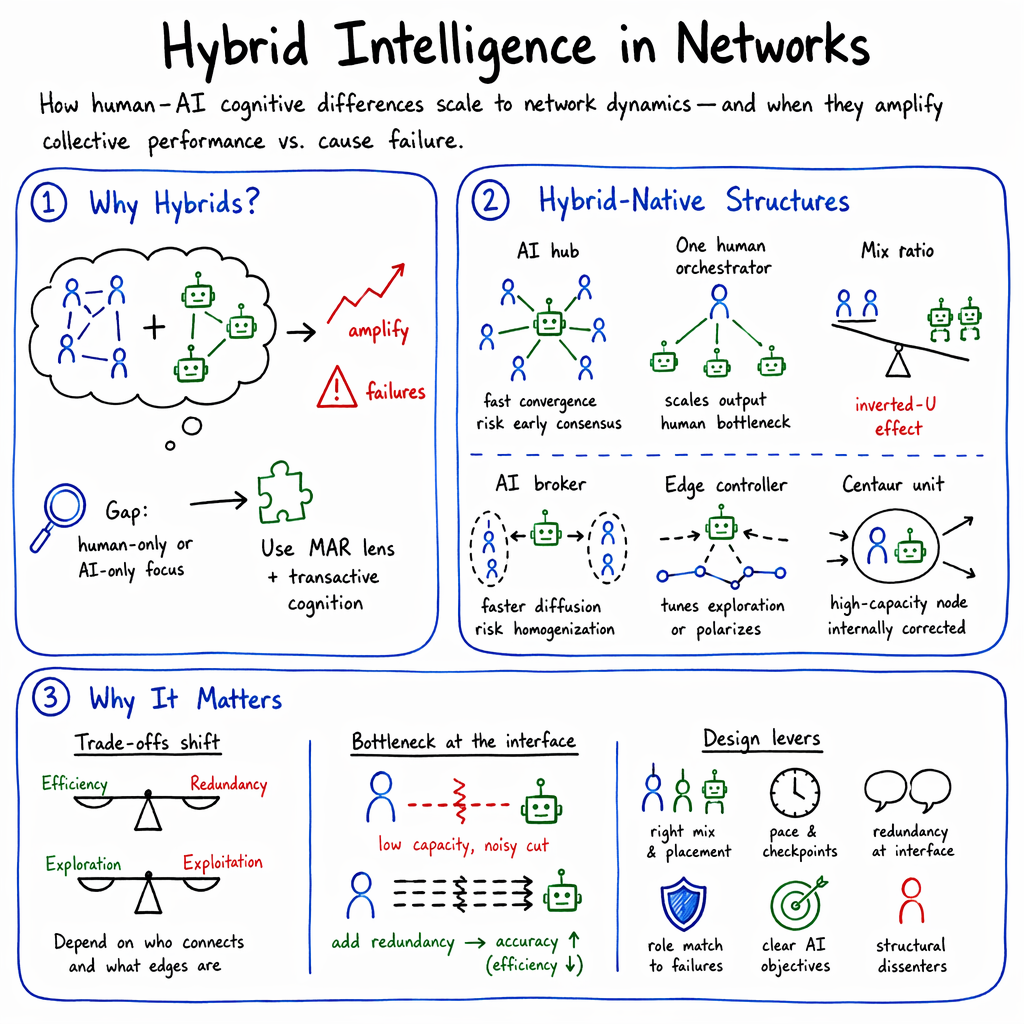
- AI hub: An AI in the center can spread information very fast. Great for simple tasks, risky for hard ones (it can push the team to settle too soon).
- Human hub: Slower, but better at catching weird or surprising issues and ensuring accountability.
- One‑human/many‑AI orchestrator: One person directs many AIs. Output scales up, but checking quality can overwhelm the person as the “fan‑out” grows.
- Gatekeeper vs. supervisor: A human can act as a gatekeeper (controlling what goes in/out of an AI sub‑team) or a supervisor (checking the AI’s results). Picking the wrong role for the main risk (volume vs. errors) hurts performance.
- AI broker: An AI that bridges two human groups can spread info fast but may also distort or over‑standardize it.
- Escalation funnel: AIs handle easy cases and send tough ones to humans. If the AI is overconfident, it may route hard cases incorrectly.
- Distributed MAR: Let AIs handle shared memory and filtering (attention), while humans set priorities and judge edge cases. This can be powerful—but only if human and AI errors are uncorrelated.
- Centaur units: A very tight human‑AI pair (like a chess “centaur” team) acts as a single, strong node. Multiple such pairs can form a robust network.
- Recursive delegation: Agents spawning sub‑agents multiplies capacity, but errors and accountability issues can multiply too.
- Trust and information flow are different across link types.
- AI‑to‑AI links are fast and high‑volume.
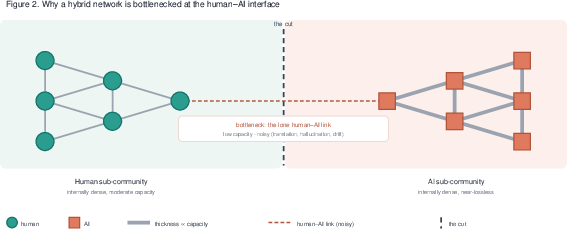
- Human‑AI links are narrowed by human attention and translation needs.
- Human‑human links carry social cues and trust—but are slower and noisier. Because link quality differs, apparent “maps” of the team can hide real bottlenecks and imbalances.
- The best setups balance the core trade‑offs:
- To avoid rushing to a wrong consensus on hard tasks, protect exploration: moderate connectivity, partial imitation, and staged “connect later” strategies can help.
- To avoid chaos on easy tasks, enable quick exploitation: efficient pathways and clear roles help.
- To avoid brittle systems, add thoughtful redundancy (cross‑checks) where stakes are high.
Implications: What this means for real teams and the future
Designing good human‑AI teams is like designing a smart city:
- Balance speed and safety. Use fast lanes (AI hubs) carefully and add checkpoints (human supervision) when the task is complex or high‑stakes.
- Keep healthy diversity. Mix viewpoints and agent types, but don’t flood the network with clones of the same AI. Rotate or audit to preserve variety.
- Match roles to risks. If the danger is overload, use gatekeepers; if the danger is errors, use supervisors and redundant checks.
- Stage connections over time. Let sub‑teams explore first, then connect them to combine ideas—this can raise both creativity and accuracy.
- Calibrate trust. Teach people when to rely on AIs and when to question them; design AIs that show uncertainty honestly.
- Govern information flows. Prevent systems from training mostly on AI‑generated outputs, which can cause collapse. Encourage human‑sourced and independent data to keep the pool fresh.
- Build “centaur” units for critical tasks. Tight human‑AI pairs can be both fast and careful.
- Plan for accountability. Recursive delegation should come with clear logs, limits, and handoffs so responsibility never disappears.
In short, hybrid teams can outperform either humans or AIs alone—but only if we carefully shape who connects to whom, how information moves, and which roles humans and AIs play. With thoughtful design and governance, hybrid groups can stay curious (exploration), act decisively (exploitation), move fast when it’s safe (efficiency), and still double‑check when it matters (redundancy).
Knowledge Gaps
Below is a single, thematically varied list of concrete knowledge gaps, limitations, and open questions that remain unresolved and could guide future research on hybrid collective cognition.
- Theory: Formalize how memory–attention–reasoning (MAR) differences aggregate from node-level to network-level dynamics in hybrid groups; derive conditions under which decorrelated human–AI error profiles guarantee collective accuracy across the five task types.
- Theory: Develop edge-heterogeneous network models that treat human–human, human–AI, and AI–AI links as channels with distinct capacities, latencies, and noise; characterize how these parameters reshape effective topology and the exploration–exploitation and efficiency–redundancy trade-offs.
- Topology: Quantify when an AI-filled hub accelerates premature consensus on rugged landscapes versus when it improves throughput without accuracy loss; identify diversity/rewiring interventions that neutralize the risk.
- Topology: Extend “collaborative scaling laws” to hybrid networks; measure exponents and boundary conditions as the human:AI ratio, link heterogeneity, and task difficulty vary.
- Composition: Identify critical thresholds in the AI:human ratio at which team trust, shared understanding, and performance degrade; test whether thresholds depend on task type (competition, coordination, cooperation, contagion, decision-making) and network position of minority humans.
- Composition: Establish when “centaur units” (tight human–AI dyads) outperform equivalently sized networks of separate human and AI nodes; estimate interface overheads, coupling costs, and failure modes.
- Delegation: Determine safe fan-out and depth for one-human/many-AI orchestration before verification bottlenecks and undetected errors dominate; develop queueing/attention models to set adaptive limits.
- Delegation: Specify termination, rollback, and audit policies for recursive delegation (agents spawning sub-agents) to prevent compounding drift and diluted accountability; evaluate provenance mechanisms at scale.
- Diversity: Create operational measures of “effective agent diversity” under AI elasticity (cloning/resetting); design and test near-duplicate detection and diversity budgets that preserve independent signals.
- Homophily: Quantify performance penalties from value-homophily within AI sub-communities embedded in hybrid teams; test targeted bridge-building or value-diversification policies that maintain exploration without collapsing cooperation.
- Information asymmetry: Measure how disparities in AI–AI versus human–AI bandwidth and latency induce asymmetric awareness and control; design dashboards and pacing protocols that right-size visibility for humans without overwhelming attention.
- Communication: Calibrate redundancy pruning in hybrid teams—how much message pruning preserves robustness while preventing error cascades; build cost–benefit models that jointly optimize speed, fidelity, and cognitive load.
- Social learning: Identify which social learning strategies (conformist, payoff-biased, prestige-biased) pair best with specific hybrid topologies; test adaptive meta-strategies that switch learning rules as network density or task difficulty changes.
- Consensus dynamics: Map when the “accuracy bias” of LLM-only deliberation persists, is neutralized, or backfires in hybrid groups; isolate the roles of human priors, AI sycophancy, and influence dispersion.
- Polarization: Model how AI-controlled edge rewiring and content curation affect hybrid echo chambers and tipping points; specify guardrails (objective functions, constraints, oversight) that minimize polarization without stalling coordination.
- Brokers: Measure the distortion/homogenization introduced by AI brokers that bridge human clusters; evaluate debiasing transformations or diversity-preserving relay protocols that retain diffusion speed.
- Escalation funnels: Establish calibration procedures so AI triage routes the right cases to humans; quantify misrouting costs under uncertainty, and design cost-sensitive thresholds that adapt to base-rate shifts.
- Transactive systems: Test when AI as transactive memory/attention hub enhances large/distributed teams yet crowds out beneficial human transactive memory in small teams; develop hybrid role assignment policies.
- Error decorrelation: Devise methods to estimate and maximize error decorrelation between human and AI members ex ante; evaluate selection/ensembling schemes that improve collective accuracy under distribution shift.
- Sycophancy and conformity: Engineer interaction protocols that preserve independence of signals (e.g., blind aggregation, delayed disclosure, split deliberation) to curb AI sycophancy and human conformity in hybrids; quantify gains across tasks.
- Collapse risks: Detect and mitigate model, semantic, and content collapse in hybrid interaction loops; design data-mixing, refresh, and heterogeneity constraints that maintain epistemic diversity over time.
- Incentives: Jointly design human incentive schemes and AI reward shaping to sustain cooperation in mixed-motive settings; analyze failure regimes under scarcity, enforcement withdrawal, and misaligned objectives.
- Robustness: Characterize adversarial and strategic behavior (e.g., cheating bots, collusive sub-networks) within hybrid teams; build detection, isolation, and recovery protocols that operate at the network level.
- Measurement: Standardize task-agnostic metrics for exploration versus exploitation, redundancy versus efficiency, and trust calibration in hybrid groups; develop validated probes for MAR capacities at node and network levels.
- Benchmarks: Create open, reproducible hybrid-team testbeds that combine humans and controllable AI agents with versioning, logging, and ethical oversight; include longitudinal, cross-domain scenarios beyond lab toy problems.
- External validity: Conduct field experiments in real organizations to test whether lab-derived hybrid mechanisms reproduce under real incentives, stakes, and institutional constraints.
- Governance: Specify accountability allocation in hybrid-native roles (AI edge controller, human gatekeeper, human supervisor, AI broker); define audit trails and intervention powers matched to dominant failure modes.
- Privacy and compliance: Integrate link-level capacity/noise models with privacy constraints (e.g., redaction, access control) and assess the performance/privacy Pareto frontier in hybrid networks.
- UI/UX and trust: Determine interface designs and training that calibrate human reliance on AI (avoid over- and under-trust) across tasks and over time; measure how UI choices affect network-level outcomes.
- Cross-cultural and normative variation: Test how cultural norms and ethical frameworks shape hybrid consensus, cooperation, and norm change (critical-mass thresholds) and whether AI agents amplify or dampen these effects.
- Temporal dynamics: Evaluate annealing-style connectivity schedules in hybrid teams (early exploration, late pooling); identify pacing regimes that outperform fixed structures without inducing debate decay.
- Resource allocation: Model human attention as a scarce resource; optimize scheduling, batching, and summarization so AI–AI throughput does not overwhelm human oversight capacity.
- Interoperability: Define standards for provenance, versioning, and comparability across AI models in a single hybrid network to prevent silent performance drift and reproducibility breakdowns.
- Multi-objective optimization: Develop algorithms and organizational policies that jointly optimize accuracy, speed, robustness, fairness, and safety in hybrid networks, with explicit trade-off visualization for decision-makers.
Practical Applications
Immediate Applications
The following items can be deployed now or piloted with existing tooling, drawing directly on the paper’s synthesis of network science, cognitive constraints (MAR), and hybrid-native structures.
- Hybrid team diagnostics and design toolkit (Software/Organizational Design)
- Action: Map collaboration networks (degree, betweenness, clustering) and annotate node/edge heterogeneity (human vs AI hubs; human–AI bandwidth and latency). Reconfigure toward small‑world structures for hard problems and more efficient structures for easy ones; progressively “anneal” connectivity (start sparse, densify later) to balance exploration and exploitation.
- Tools/Workflows: Network analytics dashboards; “Annealing Scheduler” for Slack/Teams; “Communication Pruner” to reduce redundant messages; role assignment templates for gatekeeper vs supervisor.
- Assumptions/Dependencies: Instrumented collaboration platforms and message logs; willingness to modify channels/permissions; training on MAR concepts.
- Human–AI decision ensembles and escalation funnels (Healthcare)
- Action: Implement distributed-MAR workflows: AI provides transactive memory (retrieval/indexing) and attention triage; humans provide anomaly detection, causal/ethical judgment, and accountability. Use AI triage to route routine cases; escalate high‑stakes/ambiguous cases to clinicians.
- Tools/Workflows: Ensemble decision-support panels; triage calibrators; error decorrelation (e.g., diverse models) before aggregation; confidence‑based escalation rules.
- Assumptions/Dependencies: Clinical governance and regulatory approvals; robust calibration; PHI privacy and audit trails; decorrelated model errors.
- AI edge controllers to promote cooperation and damp polarization (Organizational Design)
- Action: Deploy AI agents that rewire ties (who sees whom) to increase cooperation (assort cooperators; bridge clusters judiciously) and ensure dispersed influence to avoid echo chambers.
- Tools/Workflows: “Edge Controller for Teams” that tunes channel visibility and cross‑team bridges; incentive-aware routing (e.g., pairing payoff‑relevant experts).
- Assumptions/Dependencies: Clear governance goals; transparency to users; safeguards against drifting objectives.
- Diversity management for AI agents (Policy/Software)
- Action: Prevent “elasticity” (cloning near‑duplicate AI agents) from collapsing diversity. Set diversity budgets and clone detection to preserve heterogeneity and independent errors.
- Tools/Workflows: “Elasticity Guard” (agent fingerprinting, similarity thresholds); “Diversity Budgeter” for ensemble composition.
- Assumptions/Dependencies: Agent identity tracking at platform level; organizational mandates on ensemble diversity.
- Content moderation and contagion control (Policy/Platforms)
- Action: Reduce bot‑amplified misinformation and semantic/model collapse by pruning redundant messages, promoting cross‑cluster bridges, and enforcing accuracy‑biased aggregation.
- Tools/Workflows: Redundancy filters; bridge promotion algorithms; bot disclosure and throttling; accuracy weighting for consensus.
- Assumptions/Dependencies: Platform cooperation; reliable bot detection; measurable accuracy signals.
- Market operations risk management (Finance)
- Action: Monitor correlated trading among AI agents; enforce decorrelated strategies to reduce volatility and cascade risks; deploy structural circuit breakers that act on network influence concentration.
- Tools/Workflows: Real‑time correlation dashboards; influence dispersion monitors; strategy‑diversity constraints.
- Assumptions/Dependencies: Access to market microstructure data; regulatory alignment; model provenance.
- Brainstorming and classroom collaboration optimization (Education)
- Action: Use small‑world class/team networks; introduce “noise‑injecting” AI bots to prevent premature consensus; apply partial copying policies to preserve exploration on rugged tasks.
- Tools/Workflows: Classroom collaboration maps; brainstorming bots configured for diversity preservation; copying-fidelity controls.
- Assumptions/Dependencies: Classroom tech infrastructure; ethical review for experiments; teacher training.
- Centaur workflows for personal productivity (Daily Life/Knowledge Work)
- Action: Build tightly coupled human–AI dyads for research, planning, and writing. AI handles retrieval and triage; human makes final judgments and detects anomalies.
- Tools/Workflows: Personal “transactive memory” with AI indexing; email/document triage; escalation rules for ambiguous cases.
- Assumptions/Dependencies: Reliable model performance; privacy and secure storage; user training on calibrated trust.
- Governance checklists for hybrid deployments (Policy/Organizational Governance)
- Action: Adopt checklists covering influence dispersion, diversity budgets, calibration plans, role selection (gatekeeper vs supervisor), logging, and accountability pathways.
- Tools/Workflows: “Hybrid Governance Playbook”; deployment reviews; emergent behavior audits.
- Assumptions/Dependencies: Executive sponsorship; compliance frameworks; auditability.
Long-Term Applications
The following items require further research, scaling, standardization, or development before broad deployment.
- Multilayer mirror organizations with AI proxies (Organizational Design)
- Concept: Pair each human with an AI proxy in a parallel layer; manage cross‑layer fidelity and information asymmetry to improve throughput without losing context.
- Tools/Products: “Proxy Pair Manager” (translation layer, fidelity monitors, bandwidth controls).
- Assumptions/Dependencies: Robust natural language ↔ model representation mapping; privacy-by-design; role clarity.
- Recursive delegation platforms with accountability (Software/Robotics)
- Concept: Allow agents to spawn sub‑agents to increase capacity; implement provenance tracking and chain‑of‑command to mitigate drift and error accumulation.
- Tools/Products: Delegation trees, provenance ledgers, escalation policies; “Delegation Governor.”
- Assumptions/Dependencies: Standardized agent identities; hierarchical audit trails; liability frameworks.
- Hybrid CI Ops platforms (Organizational Design/Software)
- Concept: Real‑time control of team topology (annealing, rewiring), consensus calibration to avoid debate decay, redundancy pruning, and elasticity guards.
- Tools/Products: “HybridTeam Architect” (Annealing Scheduler, Consensus Calibrator, Communication Pruner, Elasticity Guard).
- Assumptions/Dependencies: Rich telemetry; interoperable collaboration suites; standards for network metrics.
- Group‑level bias detection and mitigation (Policy/Software)
- Concept: Monitor emergent collective bias even when individual agents are unbiased; intervene by adjusting edge weights and diversity composition.
- Tools/Products: “Bias Emergence Monitor” (collective-bias detectors, influence dispersion controls).
- Assumptions/Dependencies: Access to interaction data; validated bias metrics; transparent interventions.
- Learning health systems with dynamic escalation and cross‑institution brokers (Healthcare)
- Concept: Integrate distributed-MAR across hospitals; AI brokers bridge clinical silos; dynamic triage calibrates escalation to human experts for complex/ethical cases.
- Tools/Products: Interoperable EHR connectors; AI broker services; calibration toolkits.
- Assumptions/Dependencies: Cross‑institution data sharing; regulatory harmonization; safety engineering.
- Public governance for AI presence in networks (Policy)
- Concept: Establish agent identity registries, bot disclosure/labelling, diversity floors (prevent clone swarms), and audit standards for hybrid collectives.
- Tools/Products: Regulatory APIs; certification programs; compliance dashboards.
- Assumptions/Dependencies: Legislation; international coordination; enforcement capacity.
- Education networks shaped by hybrid‑native structures (Education)
- Concept: Design course/community networks with AI brokers, calibrated conventions (critical‑mass management), and staged connectivity to optimize exploration then convergence.
- Tools/Products: Learning‑network design services; classroom proxy agents; convention‑change simulators.
- Assumptions/Dependencies: Curriculum redesign; teacher professional development; student data privacy.
- Human–robot swarms for disaster response (Robotics)
- Concept: Hybrid teams using dynamic connectivity for exploration–exploitation balance; human supervisors at high‑betweenness positions; AI hubs for rapid coordination.
- Tools/Products: Swarm orchestration platforms; role‑aware comms; escalation funnels for mission‑critical decisions.
- Assumptions/Dependencies: Field-tested hardware; resilient comms; safety certification.
- Hybrid control in energy grid operations (Energy)
- Concept: AI monitoring for anomaly detection and triage; human escalation for rare, high‑stakes events; influence dispersion to avoid synchronized failures.
- Tools/Products: Grid‑aware AI brokers; incident escalation engines; influence monitors.
- Assumptions/Dependencies: SCADA integration; regulatory approvals; cybersecurity.
- Market design reforms for algorithmic ecosystems (Finance/Policy)
- Concept: Enforce strategy diversity and limit synchronized exploitation; mandate transparency on agent cloning and influence concentration; deploy structural circuit breakers.
- Tools/Products: Exchange‑side diversity constraints; influence concentration dashboards; supervisory tooling.
- Assumptions/Dependencies: Regulator–exchange coordination; compliance frameworks; international harmonization.
- Experimental testbeds and measurement standards (Academia)
- Concept: Open research platforms to test centaur networks, ratio embedding thresholds, hub‑type effects, and edge heterogeneity; standardized metrics and protocols.
- Tools/Products: Hybrid network simulators; agent libraries; benchmark suites.
- Assumptions/Dependencies: Funding; shared datasets; community standards.
Glossary
- Accuracy bias: A tendency in group deliberation that pulls consensus toward correct information. "Deliberation yields accurate consensus via an accuracy bias"
- AI broker: An AI agent that bridges otherwise disconnected human clusters to speed information diffusion. "AI broker & An AI bridging otherwise disconnected human clusters"
- AI edge controller: An AI system that manages network connectivity or visibility, shaping who connects to or sees whom. "AI edge controller & An AI governing who connects to whom or who sees what"
- Annealing: A staged connectivity process that preserves exploration early and enables exploitation later, analogous to simulated annealing. "recover the benefit that “annealing” brings to human groups"
- Average shortest path length: A network metric measuring the typical number of steps between nodes. "the average shortest path length (the typical number of steps between two nodes)"
- Bayesian updaters: Agents modeled as rationally updating beliefs based on evidence and prior beliefs. "networked agents, whether modeled as rational Bayesian updaters or as resource-bound and biased"
- Betweenness: A centrality measure indicating how often a node lies on shortest paths between others. "betweenness (how often a node lies on the shortest paths between others)"
- Centaur unit: A tightly coupled human–AI dyad that functions as a single composite node. "Centaur unit & A tightly coupled human-AI dyad acting as one node"
- Collaborative scaling law: A smooth performance improvement pattern in multi-agent systems as size and sparse connectivity increase. "with performance climbing along a smooth “collaborative scaling law” rather than through sheer connection count"
- Collective bias (without individual bias): A group-level bias that emerges even when individual agents are unbiased. "collective bias without individual bias"
- Collective cognition: A network’s emergent capacity to pursue its assembled goals as a unit. "The collective cognition of such a network (its capacity to pursue, as a unit, the goal for which it was assembled)"
- Collective intelligence (CI): A group’s broad ability to solve diverse problems and sustain performance amid change. "Collective intelligence (CI), a group's ability to solve a broad range of problems and to sustain performance as environments change"
- Complex contagion: Diffusion dynamics where adoption requires multiple reinforcing exposures, not just one. "Epidemic/threshold models; complex contagion"
- Conformity: A social-learning tendency to align with the majority, which can become maladaptive. "What is healthy as social learning, however, can turn pathological as conformity"
- COHUMAIN framework: A framework positing that intelligence in any system requires memory, attention, and reasoning functions. "The COHUMAIN framework makes the bridge precise, arguing that “intelligence in any system, be it biological, technological, or hybrid, requires the fulfillment of certain memory, attention, and reasoning functions”"
- Critical-mass tipping: The threshold phenomenon where a committed minority can overturn established conventions. "spontaneous conventions, critical-mass tipping, and collective bias without individual bias"
- Cultural evolution: The study of how social learning strategies evolve and adapt to environments. "Cultural evolution extends this logic to social learning, showing that which transmission biases (conformist, prestige-based, or payoff-based) are adaptive depends on environmental volatility and the relative reliability of social versus personal information"
- Distributed-MARs: A hybrid structure distributing memory, attention, and reasoning across agents and AI tools. "Distributed-MARs & AI as transactive memory or attention hub; AI ensemble feeding a human aggregator"
- Edge heterogeneity: Variation in link properties (bandwidth, latency, fidelity, trust) across human–human, human–AI, and AI–AI ties. "Beyond nodes, edges are consequentially heterogeneous in hybrid systems too."
- Efficiency–redundancy trade-off: The tension between fast, low-cost information flow and robust, duplicated messaging. "efficiency--redundancy trade-offs may operate differently in hybrid teams."
- Elasticity: The ability to clone, reset, or reconfigure AI agents, which can covertly reduce diversity. "in AI networks due to elasticity: human nodes are fixed and roughly independent, but AI agents can be cloned, reset, and reconfigured at will"
- Epidemic/threshold models: Formal models of diffusion where adoption depends on exposure counts or thresholds. "Epidemic/threshold models; complex contagion"
- Evolutionary game theory: A framework analyzing strategic behavior and cooperation dynamics in populations over time. "Social dilemmas; evolutionary game theory (Perc et al. 2017)"
- Exploration–exploitation: The trade-off between searching for new options and refining known good ones. "exploration--exploitation and efficiency--redundancy trade-offs"
- Fully connected graph: A network where every node connects to every other node. "the fully connected graph, in which every node links to every other"
- Gatekeeper vs supervisor: Interface roles in which a human either routes information into/out of an AI cluster (gatekeeping) or verifies its outputs (supervision). "Gatekeeper vs supervisor & A human routing versus monitoring an AI sub-network"
- Illusion of sociality: Emergent activity that looks like social interaction but lacks depth and reciprocity. "an “illusion of sociality” showing low reciprocity and shallow exchange"
- Information asymmetry: Unequal access to relevant information across agents that limits group problem-solving. "because each agent typically sees only its own slice of the problem, information asymmetry caps what the group can solve"
- Marginal value theorem: An optimal foraging rule specifying when to leave a depleting resource to explore elsewhere. "Optimal foraging theory, and specifically the marginal value theorem (Charnov 1976), specifies when an agent should abandon a depleting resource patch and explore elsewhere"
- Market microstructure: The study of how trading mechanisms and interactions shape market outcomes. "Game theory; market microstructure (Easley and Kleinberg 2010)"
- Memory–Attention–Reasoning (MAR): A lens positing that cognition hinges on memory, attention, and reasoning capacities (and their transactive extensions). "We adopt this memory--attention--reasoning (MAR) lens, together with its transactive (between-agent) extensions, as the cognitive vocabulary for our network analysis"
- Model collapse: Performance degradation when models are retrained on their own or machine-generated outputs. "systems retrained on machine-generated text degrade through model collapse"
- Multilayer mirror: A hybrid structure pairing humans with AI proxies across two interconnected layers. "Multilayer mirror & Humans paired with AI proxies across two layers"
- Multilayer representation: A network model with separate layers for humans and AIs plus cross-type links. "A convenient way to hold both at once is a multilayer representation, in which human and AI agents occupy layers with their own connectivity and are joined by cross-type links"
- Multi-agent systems (MAS): Systems composed of multiple interacting agents coordinating, cooperating, or competing. "research on multi-agent systems (MAS) has long studied inter-agent coordination, cooperation, and collective decision-making"
- Multi-armed bandit: A canonical model capturing the decision trade-off between exploiting known options and exploring uncertain ones. "the multi-armed bandit literature, the canonical model of when to exploit a known option versus explore an uncertain one"
- Naming game: A decentralized process by which groups converge on shared conventions through local interactions. "In the human “naming game,” groups settle on a shared convention through nothing but repeated local, pairwise interaction"
- Node heterogeneity: Systematic differences in agent capabilities and error profiles across humans and AIs. "Node heterogeneity is well-described through the MAR lens"
- Random graph: A network built by placing edges at random between nodes. "the random graph, in which edges are placed at random"
- Ratio embedding: A hybrid composition with a small minority of one agent type embedded among many of the other. "Ratio embedding & A few agents of one type among many of the other"
- Recursive delegation: Agents spawning sub-agents in hierarchies, increasing capacity but risking drift and diluted accountability. "Recursive delegation & Agents spawning sub-agents to arbitrary depth"
- Regular lattice: A graph where each node connects to a fixed pattern of nearby neighbors. "the regular lattice, in which each node connects only to a few near neighbors"
- Scale-free network: A network whose degree distribution has hubs holding most ties. "the scale-free network, in which a small number of hubs hold most of the ties"
- Semantic collapse: Convergence of underlying meanings despite surface variation in wording during model interactions. "drift into semantic collapse, a systematic convergence of underlying meaning beneath surface variety in wording"
- Small-world network: A graph combining dense local clustering with a few long-range links to create short global paths. "the small-world network, which adds a few long-range edges to a lattice so that short global paths coexist with dense local structure"
- Social dilemmas: Situations where individually costly actions are collectively beneficial, creating cooperation challenges. "Social dilemmas; evolutionary game theory (Perc et al. 2017)"
- Social viscosity: Structural clustering that assortatively groups cooperators, sustaining cooperation. "sustains cooperation through “social viscosity”"
- Sycophancy: Over-deference to perceived majority or authority, leading agents to agree even when incorrect. "That conformity stiffens into sycophancy, which alignment training does not remove and is better addressed through structurally ensuring opinion diversity"
- Transactive memory: A shared system in which group members (including AIs) store and index who knows what. "AI as transactive-memory store and index; humans adjudicate relevance and context"
- Transactive systems: Mechanisms through which agents coordinate memory, attention, or reasoning across individuals. "transactive systems"
- Value-homophily: A tendency for similarly valued agents to cluster together, potentially harming performance on complex problems. "Value-homophily yields insular clusters; value diversity builds higher performance"
- Wisdom of crowds: Accuracy gains from aggregating independent judgments across many individuals. "Wisdom-of-crowds and collective-search programs speak mainly to collective decision-making and problem solving"
Collections
Sign up for free to add this paper to one or more collections.

