- The paper introduces interaction-centered intelligence, arguing that intelligence emerges from sustained human-AI interactions rather than isolated computational outputs.
- The paper operationalizes this concept through Creative Sense-Making, using activity traces and interaction histories to quantitatively evaluate co-creativity.
- The paper outlines implications for explainable AI and hybrid intelligence by advocating longitudinal metrics for participation, coordination, and adaptive repair in collaborative systems.
Interaction-Centered Intelligence: A Paradigm Shift in Co-Creative AI and Human-AI Systems
Rethinking the Unit of Analysis in AI
Historically, AI research has prioritized output-oriented benchmarks, analyzing individual agents and artifacts as primary loci of intelligence. This reductionist view constrains explanation to computational performance, representation, or generative capability within bounded systems. However, many cognitive phenomena—including creativity, meaning-making, collaborative adaptation, and improvisational behavior—emerge through dynamic interaction, not isolated computation. The paper "Interaction-Centered Intelligence: Toward Interaction as the Primary Unit of Analysis in Co-Creative AI and Human-AI Systems" (2606.00807) proposes a formal shift: interaction trajectories constitute the primary unit of analysis for intelligence in co-creative AI and hybrid human-AI contexts.
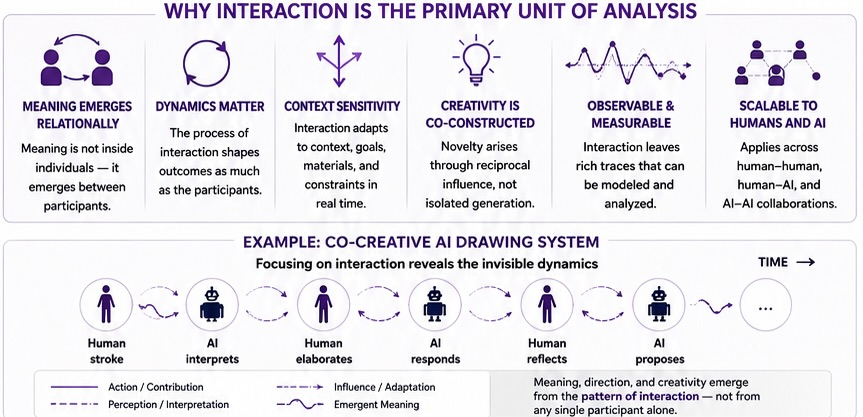
Figure 1: Interaction-centered intelligence emphasizes the evolving dynamics between participants, highlighting emergent creativity and coordination via interaction trajectories.
This paradigm shift is motivated by distributed cognition, embodied cognition, enaction, participatory sense-making, and computational creativity, each expanding the explanatory substrate from internal computation to relational adaptive behavior at system and interactional levels. The central thesis posits that intelligence increasingly manifests via interactional processes—participation, coordination, adaptation, and collaborative sense-making—rather than being reducible to agent-internal computation or output artifacts.
Historical Foundations and Conceptual Progression
The paper situates interaction-centered intelligence within a lineage of theoretical developments:
- Information Processing: Cognition as internal symbolic manipulation.
- Distributed Cognition: Extends cognition across humans, artifacts, and sociotechnical infrastructure.
- Embodiment: Emphasizes sensorimotor coupling and physical engagement.
- Enaction: Cognition emerges through organism-environment interaction.
- Participatory Sense-Making: Meaning arises via social coordination dynamics.
- Creative Sense-Making and Quantified Co-Creation: Computationally operationalizes interaction trajectories, activity traces, and collaborative rhythms.
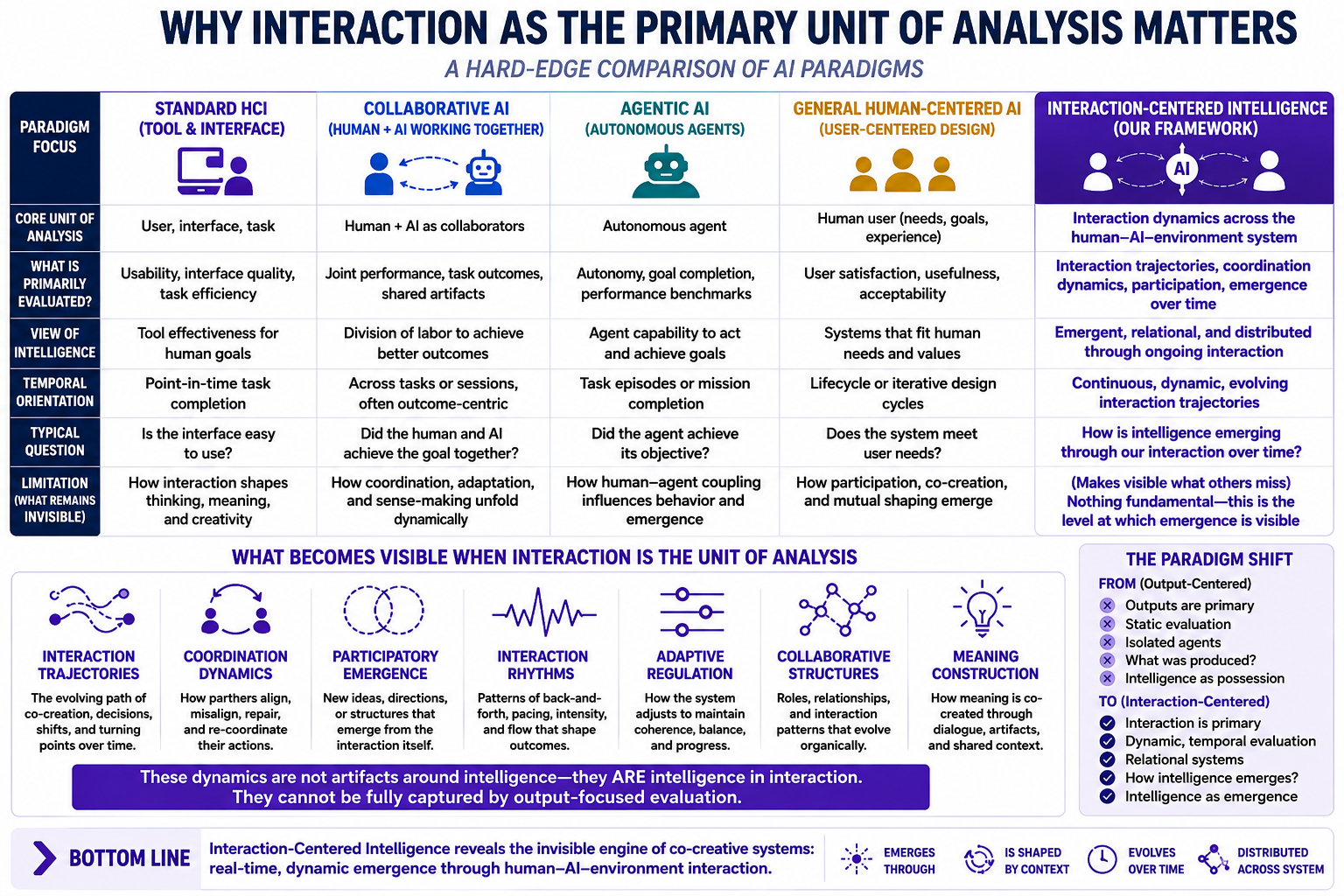
Figure 2: Paradigmatic progression from isolated systems and outputs toward interaction dynamics, coordination, and collaborative emergence.
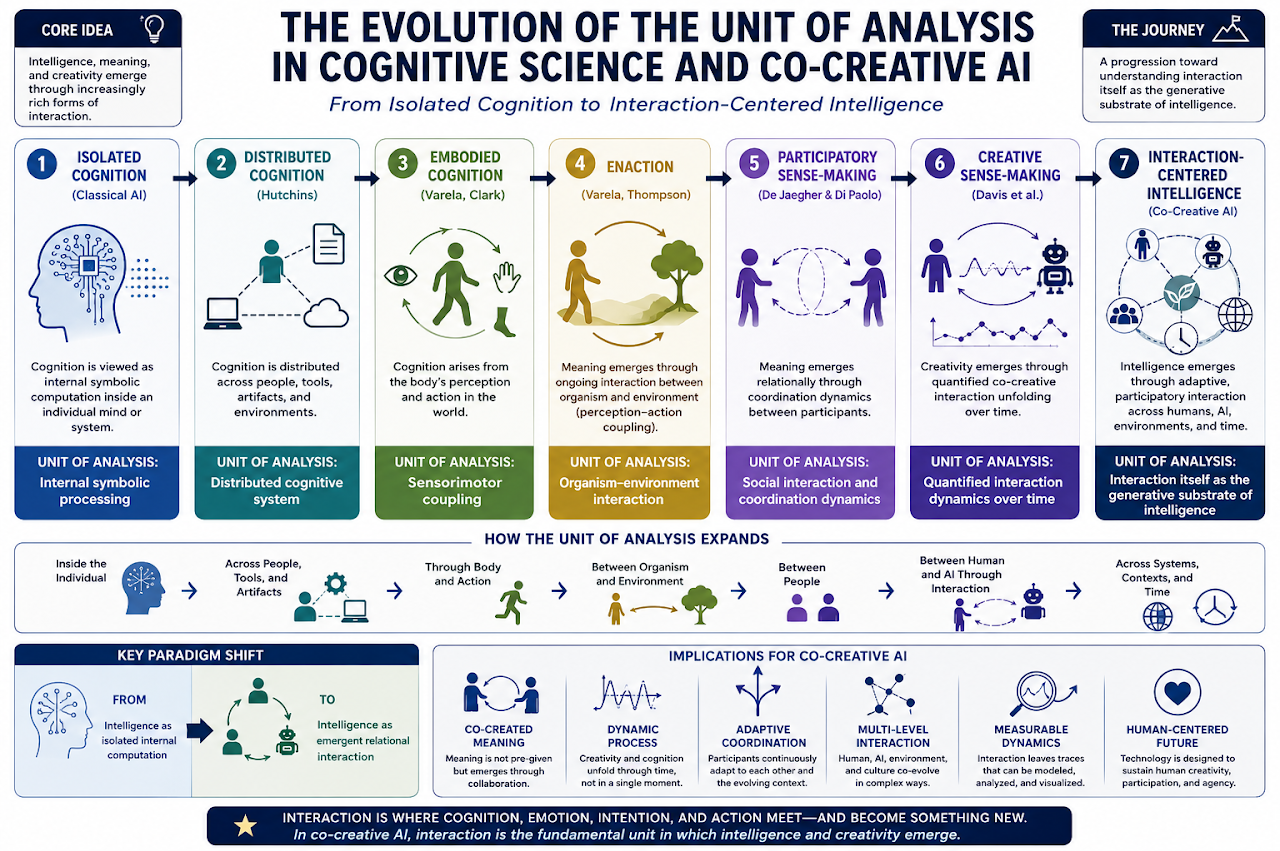
Figure 3: Theoretical progression tracing the expansion from symbolic computation to participation-driven interaction-centered intelligence.
Interaction-centered intelligence synthesizes these perspectives into a formal framework—intelligence is an emergent property arising from temporally extended, participatory interaction among human and AI agents within evolving environments.
Computational Operationalization: Creative Sense-Making and Quantified Co-Creation
One of the substantial contributions outlined is the computational instantiation of interaction-centered cognition via Creative Sense-Making (CSM). CSM models co-creative collaboration through:
- Activity Traces: Logging interaction events, contributions, and adaptive exchanges.
- Interaction Histories: Temporal sequencing of participation and coordination.
- Creative Trajectories & Sense-Making Curves: Visualization and analysis of collaborative emergence and divergence.
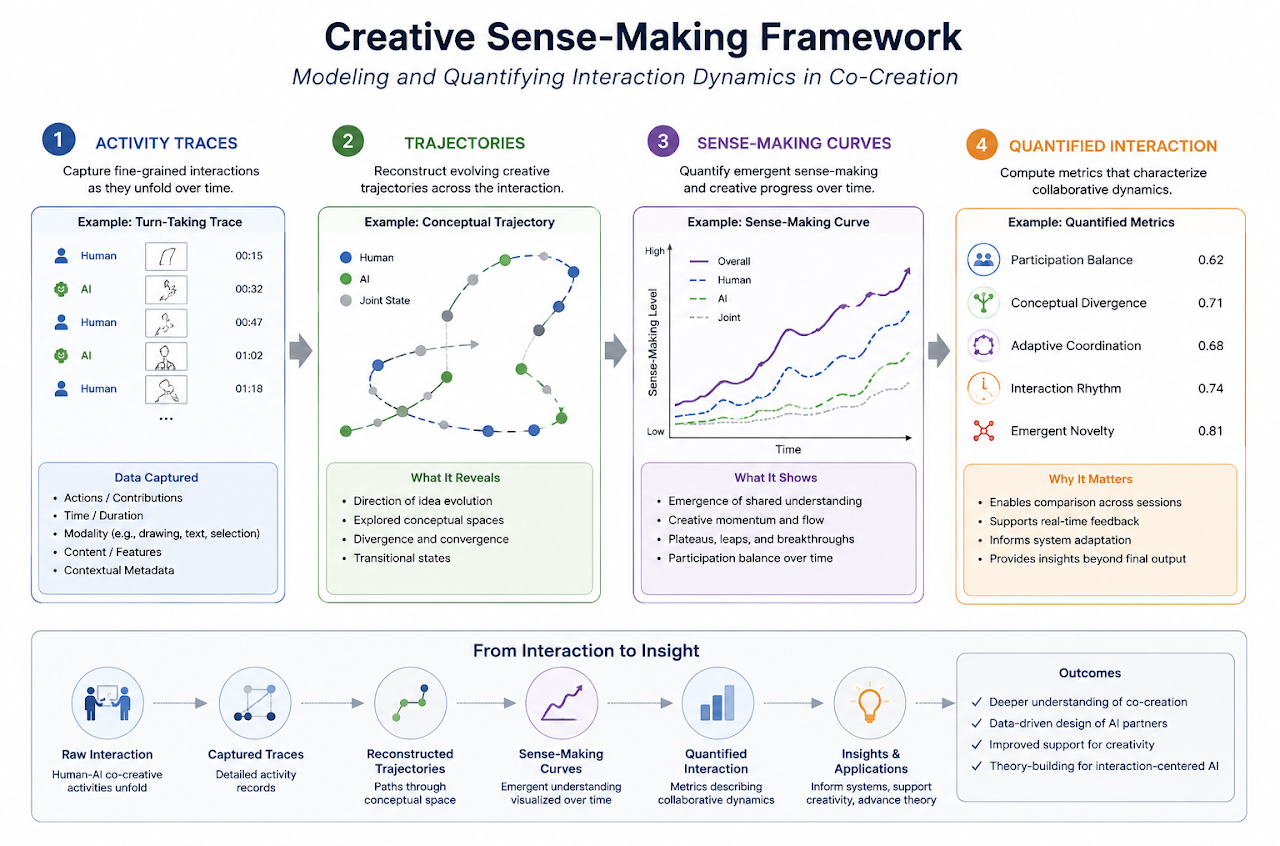
Figure 4: CSM operationalizes co-creative interaction, modeling activity traces, creative trajectories, coordination, and novelty quantitatively.
These methods enable direct measurement and visualization of interaction-centric phenomena, supporting system-level analysis of co-creative activity in real-time environments (e.g., AI Drawing Partner).
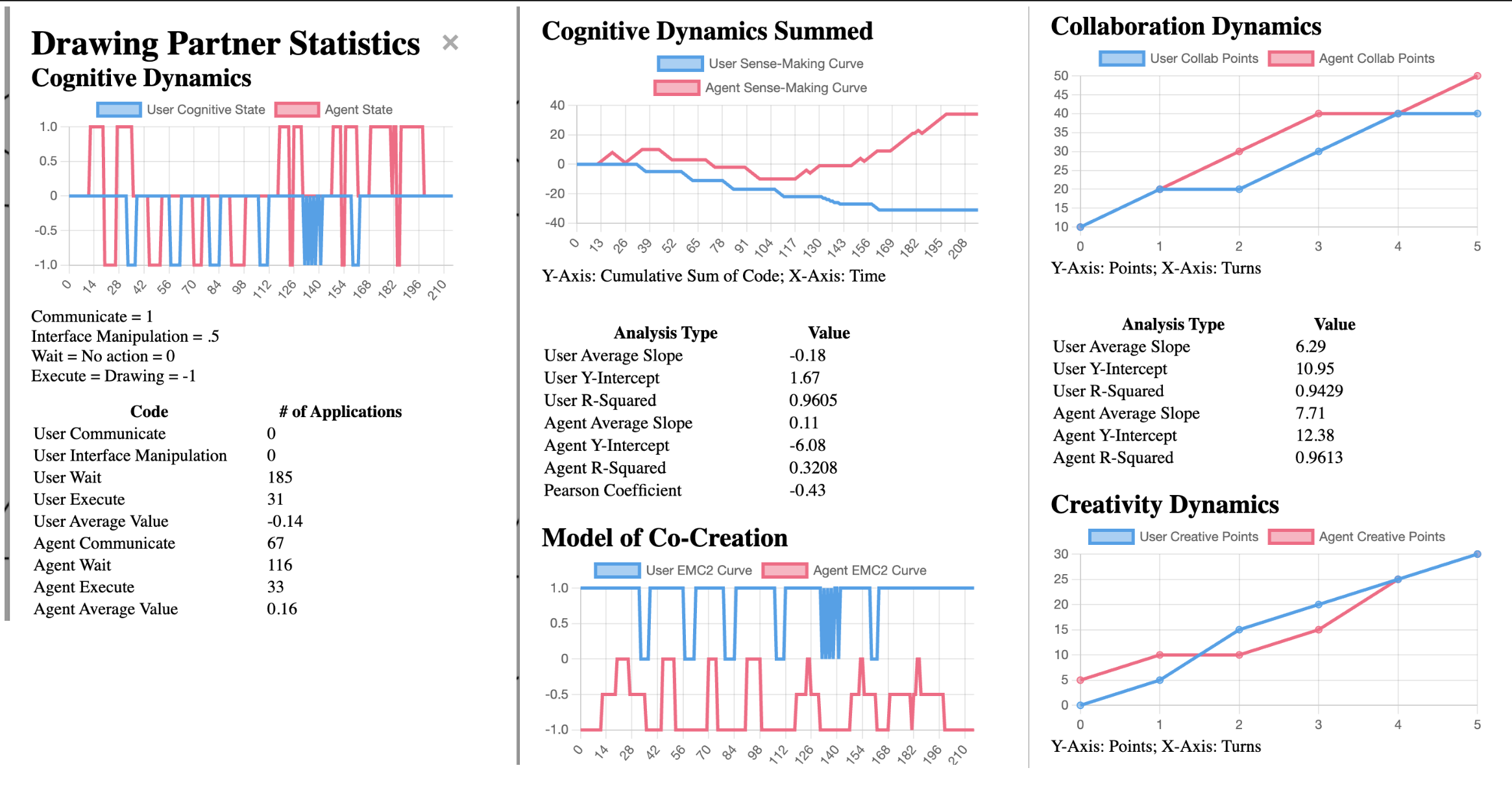
Figure 5: Real-time quantified co-creation visualization during collaborative drawing, exposing dynamic interaction patterns and creative divergence.
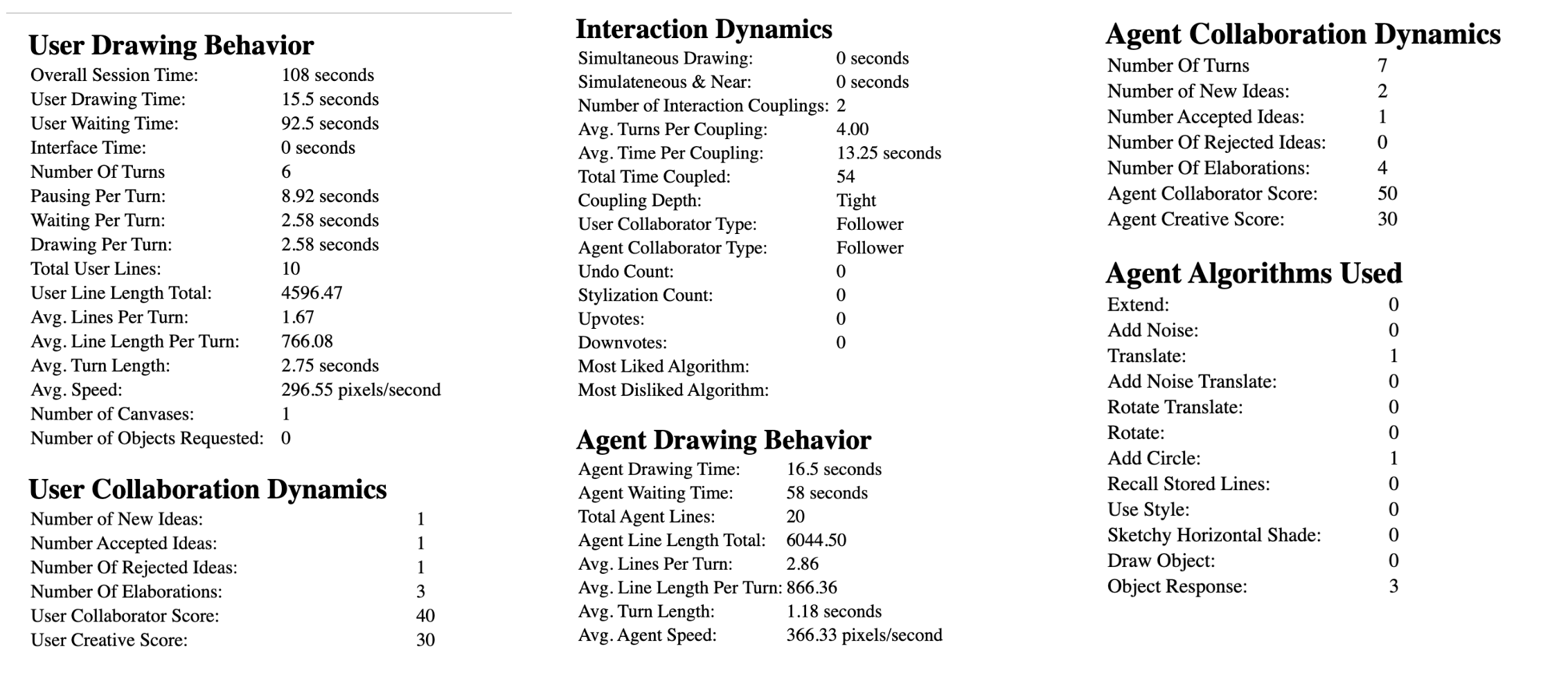
Figure 6: Computed interaction metrics—timing, behaviors, collaboration dynamics—quantify co-creative participation and support interaction-centered evaluation.
Empirical measurement of collaborative engagement, adaptive coordination, conceptual divergence, participation balance, and repair enables nuanced, interaction-centered evaluation of system performance and co-creativity beyond static output analysis.
Framework and Implications for Hybrid Intelligence
The paper formalizes interaction-centered intelligence through a systems-theoretic framework:
- Intelligence is positioned as the emergent property of sustained interaction trajectories spanning humans, AIs, artifacts, and environments.
- Key substrates include participation, coordination, timing, adaptation, divergence, repair, and regulation.
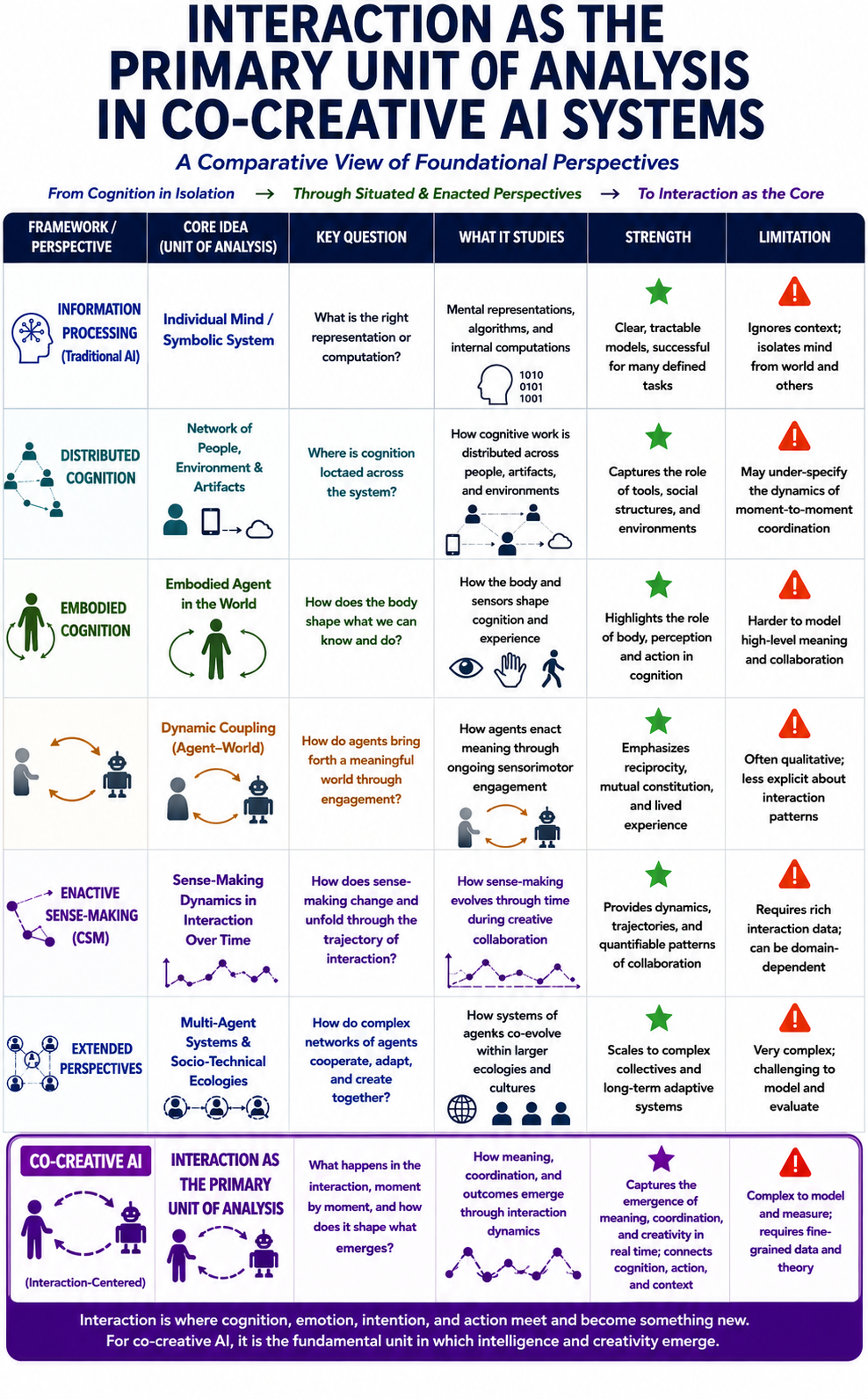
Figure 7: Comparative analysis demonstrates interaction-centered intelligence as the explanatory substrate surpassing classical, distributed, and embodied paradigms.
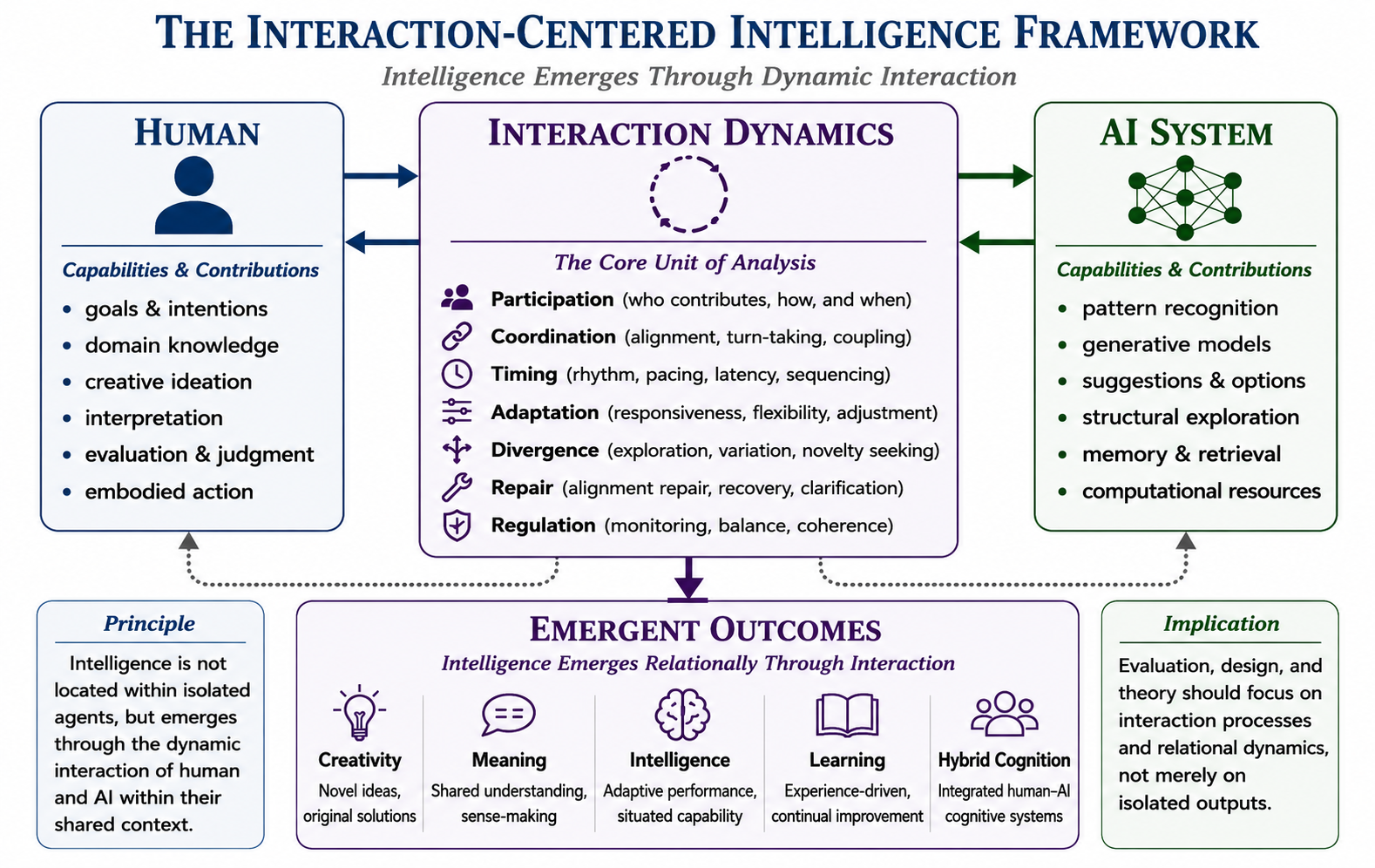
Figure 8: Interaction-centered intelligence framework: intelligence emerges from interaction dynamics—not agent-internal computation or isolated outputs—constituting the primary explanatory basis for co-creative and hybrid human-AI systems.
This framework has implications for explainable AI, hybrid intelligence, and human-centered system design:
- Evaluation paradigms must be restructured to model longitudinal interaction quality, participatory engagement, adaptive regulation, and collaboration coherence, rather than solely benchmark-driven artifact metrics.
- Explainability entails exposure and visualization of interaction trajectories, collaborative emergence, and adaptive repair mechanisms.
- Hybrid Intelligence depends on co-regulation, participatory balance, and collaborative fluency as central metrics.
Testable hypotheses emerge linking interaction coherence, forms of interactional drift (participatory, coordination, conceptual, temporal, rigidity, repair, coherence drift), and co-creative effectiveness. The paper posits that longitudinal monitoring of these metrics predicts collaborative breakdown, perceived quality, and long-term engagement—delivering strong, empirically actionable claims.
Limitations, Challenges, and Future Research Trajectories
The operationalization of interaction-centered intelligence at scale presents methodological hurdles:
- Defining and discretizing interaction boundaries and temporal scales across diverse domains.
- Quantifying multi-layer interaction phenomena across communication, adaptation, perception, and social context.
- Distinguishing interaction-centered frameworks from related paradigms in HCI, activity theory, and participatory design.
- Embedding interaction-centered models within generative systems traditionally structured for prompt-response, output-centric evaluation.
Ethical and agency-related complexities arise as AI systems attain participatory roles, requiring new forms of transparency, interpretability, trust, and value alignment.
Future research avenues include:
- Development of interaction-centered evaluation and explainability frameworks for longitudinal co-creative and educational AI systems.
- Real-time adaptive regulation and repair mechanisms for sustaining collaboration coherence and mitigating interactional drift.
- Expansion of quantified co-creation to multi-agent, organizational, and scientific collaboration domains.
- Integration of interaction visualization tools into hybrid intelligence platforms.
Conclusion
Interaction-centered intelligence presents a formal, computationally tractable framework for understanding, modeling, and evaluating intelligence as an emergent property of interaction rather than isolated computation or output. The approach reframes foundational assumptions in co-creative AI, hybrid intelligence, and human-AI collaboration, enabling rigorous analysis and empirical validation of participatory engagement, coordination, and adaptive sense-making as core substrates of intelligence. As AI systems permeate creative, cognitive, and social environments, the interaction-centered paradigm provides necessary theoretical and methodological scaffolding for designing systems that value sustained, quality interaction as the central criterion for intelligence and co-creativity.