- The paper demonstrates that specialist and generalist networks excel at different tasks, with network properties enhancing performance by up to 1.84 standard deviations.
- It employs computational optimization and systematic variation of 18 network topologies and 30 task types to analyze multi-agent system performance under varying bounded rationality.
- The findings suggest that aligning MAS network design with specific task demands can drastically reduce computational costs and improve convergence speed.
Specialist-Generalist Tradeoffs in Artificial Collectives
Conceptual Foundations: Interpretive Networks and Agent Spectra
The paper "Artificial collectives of specialists and generalists excel at different tasks" (2606.20877) introduces a rigorous investigation into the interplay between agent interpretive abilities, network topology, bounded rationality, and task qualities in multi-agent systems (MAS). Agents are characterized along a specialist-generalist continuum, with interpretive abilities determining an agent’s capacity to encode, decode, and leverage information from others. This spectrum, operationalized as network ties, reflects fundamental differences in collective architectures: sparse, centralized structures (specialists) versus dense, decentralized structures (generalists).
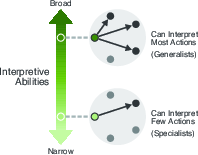
Figure 1: Interpretive abilities map to network connectivity; specialist agents feature few ties, generalists exhibit many ties.
Leveraging insights from both human and artificial collective intelligence literature, the paper models MAS agents as optimizers—abstracting away implementation details—to focus on how networked information access governs emergent collective performance. This design avoids assumptions of particular AI instantiations and instead uses computational analogs (e.g., Nelder-Mead, L-BFGS-B, simulated annealing) to ensure the generality and robustness of the analysis. The methodology systematically varies teams by group size, interpretive network architecture (18 topologies), agent rationality bounds, and a spectrum of 30 tasks spanning generate, choose, coordinate, and negotiate difficulties.
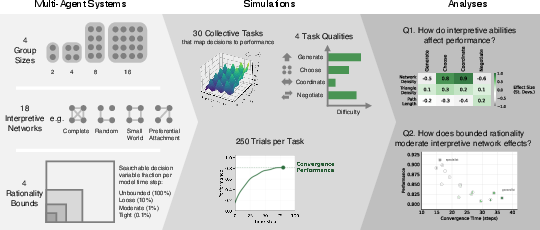
Figure 2: Experimental schema illustrates parameterization of MAS group sizes, network topologies, rationality bounds, and task battery.
Task Dependence of Network Property Effects
A primary finding is the non-uniformity of network property effects across task types. While network density, decentralization, and path length yield small main effects (mean 0.07 standard deviations), conditional effects—relative to task quality—are robust: 4.5x larger on average (0.33 sd), with maximal effects approaching 1.84 sd for particular tasks. Generate, choose, and coordinate tasks are maximally aided by decentralized, dense networks featuring short paths; conditional effects reach +1.60 to +1.84 sd for coordinate tasks. Conversely, negotiate tasks benefit from centralized, sparse structures with negative density effects (-0.55 sd) and positive effects for longer path lengths; this configuration restricts premature convergence and preserves solution diversity necessary for successful negotiation.
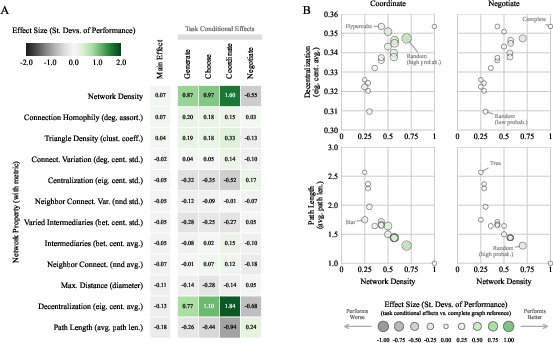
Figure 3: Heatmap and topology performance plot show conditional network effects for task types; dense, decentralized structures excel at coordinate tasks, while sparse-centralized networks are optimal for negotiate tasks.
These results underscore the need to match MAS topologies not just to application domain but to precise task structure and demands. The central theoretical claim is thus: interpreter network properties are only weakly predictive in aggregate but strongly determinative when modulated by task quality.
Network-Rationality Interactions: Regime Shifts and Tradeoffs
Bounded rationality, formalized as agent search limits within variable domains, further mediates optimal design. At loose bounds (±10%), specialist-driven topologies outperform generalist configurations both in performance (+6.7%) and convergence speed (+23%), exploiting lower dimensional sampling. At tight bounds (±0.1%), generalist-dominated networks surpass specialist collectives (+7.3%), achieving fastest convergence. Moderate bounds (±1%) elicit a discontinuous Pareto frontier: specialist networks are slower but deliver higher performance, while generalists are faster yet suboptimal.
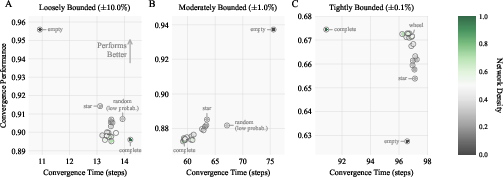
Figure 4: Convergence-performance graphs illustrate network and rationality regime shifts: specialists dominate with loose bounds; generalists with tight bounds; moderate bounds yield speed-quality tradeoff.
This dynamical inversion is attributed to: at tight search constraints, broad interpretive networks improve local gradient estimates and accelerate optimization; at loose bounds, increased dimensionality from dense interpretive ties undermines effective exploration due to exponentially growing search spaces. For strategic optimizers, these effects are pronounced and validated across multiple algorithms; for random-walk agents, effects are absent or reversed, indicating the centrality of goal-directed search in realizing the documented tradeoffs.
Implications for MAS Design, Efficiency, and Human-AI Collaboration
The empirical findings, backed by robust, systematic experimentation, lead to several strong prescriptive recommendations: MAS efficiency and performance demands careful matching of interpretive network design to task structure and agent computational limits, contrary to prevailing universal approaches. For creative, generative, and coordinated tasks—a broad set in science, engineering, and social domains—generalist architectures (decentralized, dense networks) are superior. For negotiation-intensive tasks where diversity and conflict persistence are beneficial, specialist-heavy centralized networks with generalist mediators are optimal.
Practical implications include the potential for significant reduction in computational and energy costs of MAS deployments—by aligning network topologies with both task and resource constraints, up to 2 sd improvements in performance are achievable, and convergence time can be sharply optimized. This is critical given the escalating energy and carbon costs of multi-agent and datacenter workloads [Aczel2026Environmental]. Further, the results bridge theoretical gaps between human and artificial collective intelligence and, by extension, offer design principles for hybrid human-AI collectives, suggesting interpretive topology as a common language for same-task alignment.
The work advances descriptive science in MAS, highlighting underexplored dimensions (interpretive abilities, bounded rationality) and advocating for domain-specific, resource-aware engineering. Limitations include the use of static topologies, homogeneity in agent optimization, and abstraction away from AI implementation detail; future work should address adaptive networks, heterogeneous collectives, and domain-specific validation.
Conclusion
This paper delivers an authoritative mapping between agent interpretive ability spectra, network properties, bounded rationality, and collective task quality in artificial multi-agent systems. Network topologies cannot be universally prescribed: their impact is task-conditional and mediated by agent computational bounds. Specialist-centric networks excel in loosely constrained exploration, generalist-centric networks are crucial for tightly bounded optimization and coordination, while negotiate tasks require hybrid, centralized structures. These findings offer rigorous theoretical and practical guidance for multi-agent system design, scaling, and efficiency, and suggest new research avenues in dynamic topology adaptation and mixed human-AI teams.

