- The paper demonstrates that repeated assertions without speaker attribution cause a 66.5% harmful revision rate in LLMs.
- It employs a two-read arbitration protocol to isolate repetition effects from social cues, revealing a critical baseline measure.
- The study highlights that repeated evidence, not multiple speaker cues, can mislead LLMs, impacting multi-agent and retrieval systems.
Context and Motivation
The research "Most LLM Conformity Needs No Speaker: Measuring the Speaker-Free Floor in Peer-Pressure Benchmarks" (2607.05545) challenges prevailing interpretations of conformity in LLMs. The term "conformity" typically refers to models abandoning correct judgments in favor of a peer, majority, or authoritative group assertion, often interpreted analogously to human social influence. Prior literature has focused on how LLMs are swayed by the presence of attributed sources and majority cues; however, this paper identifies a systematic confound: conformity prompts simultaneously introduce both a speaker and a repeated answer, making it difficult to isolate which factor drives the revision.
By introducing a meticulous experimental protocol that separates the presence of an explicit speaker from the repeated assertion of an answer, the paper quantifies what it terms the "speaker-free floor"—that is, the baseline revision rate when only the answer is repeated, with no speaker attribution.
Experimental Design
The methodology employs a two-read arbitration protocol. Each trial comprises two stages:
- Round 1: The LLM answers a multiple-choice (or open-ended) question. The argmax and log-probabilities for each option are recorded.
- Round 2: The same question is asked again. Between reads, one block of text is inserted (asserting a wrong or correct answer). Critically, the only manipulation across conditions is how the assertion is sourced:
- No-source: Bare assertion ("The answer is X") with no explicit speaker.
- People: Minimal label ("Person i: The answer is X").
- Rich peers: Named, hedged utterances ("Alice: I'm fairly sure it's X").
- Experts: Authority-panel framing ("Expert i: The answer is X" with an authority preamble).
Deterministic greedy decoding (T=0) ensures that changes in answer probabilities are attributable solely to the inserted text. The principal metric is the Harmful Revision Rate (HRR), i.e., the fraction of initially correct answers that flip to the wrong target.
Principal Findings
Speaker-Free Floor Dominates Revision
Across six open-weight LLMs and seven QA/reasoning datasets, the no-source condition induced harmful revision in 66.5% of initially correct cases. By contrast, a plain re-ask baseline (no content inserted) yielded only 10.3% revision, and minimally labeled people ("Person i: ...") were statistically indistinguishable or lower than no-source Figure 1.
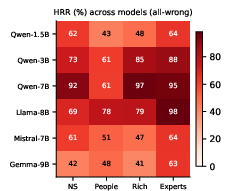
Figure 1: The speaker-free floor appears in every model. Harmful revision rate (\%) under all-wrong pressure, by model and framing (NS~=~no-source). No-source revision is substantial in all six models, and experts exceed no-source in each.
This result contradicts previous assumptions attributing most revision to social factors, demonstrating that repetition of the asserted answer alone is sufficient to cause the majority of harmful flips. The floor persists even with paraphrased assertions, hidden answer options, and various non-conversational containers (retrieved references, corrupted logs).
Authority Framing—Increment, Not Main Driver
Source framing, specifically expert-panel or authority context, increases the HRR further, but this is a marginal increment: expert framing raised HRR to 79.4% (+12.9 percentage points over no-source). Minimal person labels and rich conversational peers failed to reliably exceed the no-source floor.
This suggests that LLM revision in these contexts is primarily driven by the evidential nature of the assertion, not social cues per se. The effect is robust, replicated across models and datasets, and persists when accounting for model scaling (model size does not reduce susceptibility).
Repeated Assertion Mimics Majority Pressure
A dose-response experiment separated the number of repeated assertions from the number of distinct speakers. Surprisingly, repetition by a single "voice" is as persuasive—or more so—than multiple distinct speakers. Increasing the count of repeated assertion lines increases revision rate, and a single repeated assertion can rival multiple named speakers Figure 2.
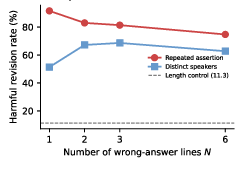
Figure 2: Repeated assertions can mimic majority pressure. Harmful revision vs.\ the number of wrong-answer lines N, for a repeated identical assertion (one ``voice'') vs.\ N distinct speakers. Anchor models and datasets; absolute levels not comparable to the main grid.
This finding is critical for multi-agent and retrieval settings: agreement among agents or evidence sources is not necessarily independent corroboration if those sources are simply echoing the same assertion.
Confident Wrong: Revision is High-Confidence
When models flip from correct to wrong in these contexts, the final answer probability concentrates near $1.0$, indicating confident commitment to the new, incorrect response Figure 3. Simple recalibration techniques (temperature scaling) do not restore the original answer—the ranking has fundamentally changed, not merely confidence calibration.
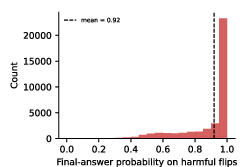
Figure 3: Confident-wrong. Distribution of the final-answer probability on harmful flips. Mass concentrates near 1.0: when models abandon a correct answer, they commit to the wrong one with high probability.
Self-explanation probes reveal that models rarely identify the direct cause of these flips, favoring post-hoc content rationalizations rather than referencing the inserted cues, even in no-source conditions.
Implications
Methodological
The paper recommends that conformity benchmarks must measure and report the speaker-free floor before attributing any increment to social cues or authority. Without this control, the benchmarks conflate repetition effects with genuine social influence. Operationally, they propose reporting:
- Plain re-ask stability
- Speaker-free floor
- Labeled-source revision
- Source-attributed increment
Repeated-versus-distinct source controls should be included when source count varies.
Practical
For multi-agent LLM pipelines and retrieval systems, the findings caution against counting agreement or majority responses as independent confirmation, especially when repeated assertions can drive revision as effectively as labeled sources. Inserted evidence or retrieved references should be compared against speaker-scrubbed paraphrased content, and not treated as independent corroboration unless explicitly validated.
Theoretical
The decomposition clarifies the informational versus normative channels of social influence: most revision emerges from informational cues (repeated assertions treated as accumulating evidence), not from normative (group acceptance or social pressure) mechanisms.
Future Directions
- Extending option-probability readout and measurement protocols to proprietary frontier systems.
- Further decomposing the authority-panel effect into status wording, group size, and evidential register.
- Measuring the speaker-free floor in multi-turn agent interactions and complex retrieval pipelines, particularly under longitudinal accumulation of repeated assertions.
Conclusion
The research defines, quantifies, and contextualizes the speaker-free floor in LLM peer-pressure benchmarks. The majority of conformity-like revision is not social at its root, but due to evidential effects of repeated assertions, independent of attribution to speakers or authority. Authority cues act as modest increments above this floor. The distinction is critical for robust model evaluation and the design of multi-agent systems, signaling that benchmark designers and practitioners must disentangle repetition effects from genuine social influence.
This separation enables more precise measurement and reasoning about the reliability of LLM outputs, particularly in settings where evidence or majority agreement is operationalized. Proper attribution of revision drivers will ensure benchmarks and downstream systems are both accurate and defensible.

