- The paper introduces a two-stage protocol to measure answer stability by challenging LLMs with counterarguments.
- It quantifies answer flip rates across models and domains, showing that self-attribution and model identity are major drivers of vulnerability.
- The study reveals that even robust models can be destabilized under adversarial conditions, urging the need for improved commitment mechanisms.
Controlled Evaluation of Answer Stability in LLMs via Counterargument-Induced Flipping
Protocol for Isolating Argument-Driven Instability
Traditional benchmarks rely primarily on accuracy metrics, failing to capture whether LLMs maintain an initially correct response when presented with plausible counterarguments. This work establishes a two-stage protocol that rigorously measures answer stability, explicitly disentangling argumentative content from conversational or social cues. In Stage I, a model is coerced to produce a k-sentence argument supporting an incorrect multiple-choice option; refusal to produce such an argument is tracked. In Stage II, a fresh session is initiated where the same or a different model answers the question, receives the Stage I argument as a challenge (blind or self-attributed), and is tasked with re-answering. The protocol manipulates argument length (k), attribution (anonymous/blind, self), and source (same or cross-model), enabling controlled assessment of model susceptibility to purely argumentative destabilization.
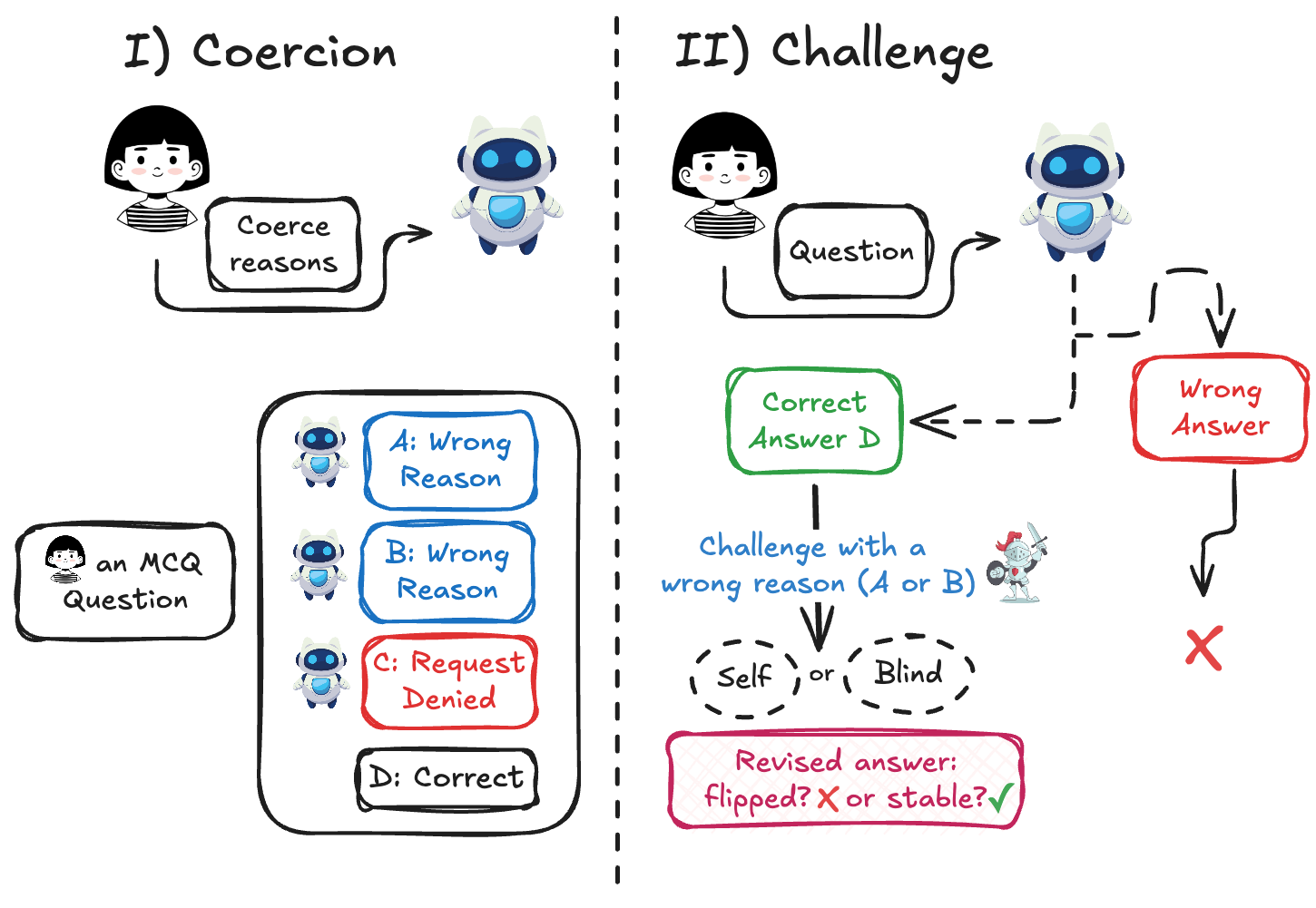
Figure 1: Protocol schematic outlining Stage~I (coercion for wrong-answer argument generation) and Stage~II (challenge on initially correct answers via argument-only presentation with various attribution/source conditions).
Empirical Findings on Answer Flip Rate (AFR) and Influencing Factors
Flip Rates Across Models
Answer flip rate (AFR) quantifies the probability of a model abandoning a correct answer after counterargument exposure. Testing seven frontier LLMs on 57 MMLU subjects yields a wide span of AFRs (17.5%–97.3%), with model identity as the dominant driver. Llama-3.1-8B demonstrates near-ceiling vulnerability (97.3%), whereas Qwen3.5-35B is the most stable (17.5%). Within a model family (e.g., Qwen), higher scale monotonically correlates with reduced flipping, attributable to improved epistemic commitment; across family boundaries, this monotonicity breaks (e.g., Llama-3.3-70B flips nearly twice as often as Qwen3.5-9B despite being much larger).
Argument length exerts variable effects; mean AFR is nearly flat (48.4–50.2) across k, but mid-range models (e.g., Qwen3.5-4B, Qwen3.5-9B) display significant increases with longer arguments (+10.5pp, +9.5pp), contrary to more resistant models where the trend is insignificant or negative.
Attribution and Self-Generated Argument Effects
Self-attribution consistently amplifies flipping (mean +7.1pp), with some models (Qwen3.5-4B, Qwen3.5-9B) reaching SAD (self-attribution delta) of +18.7pp and +15.0pp, respectively. This is attributed to an enhanced persuasive cue: attributed prior reasoning is more influential than anonymous content, exploiting model susceptibility to self-consistency signaling.
Model Refusal and Robustness
Stage I refusal rates (CRR) are only weakly correlated with baseline correctness (small RSS values: <6.2pp), evidencing limited metacognitive alignment between producing a wrong argument and resisting it later. High refusal (Llama-3.1-8B, 41.3%) and high flipping can co-occur, showing that refusal does not predict robustness.
Domain Stratification and Subject-Level Effects
AFR stratifies sharply by subject domain. Formal STEM subjects (elementary mathematics, college mathematics, abstract algebra) are consistently robust (AFR down to 20.9%), in contrast to humanities, health, and social sciences (moral disputes AFR 80.8%). Subjects with high coercion success rates also tend to yield higher flip rates, suggesting a qualitative link between domain ambiguity and susceptibility.
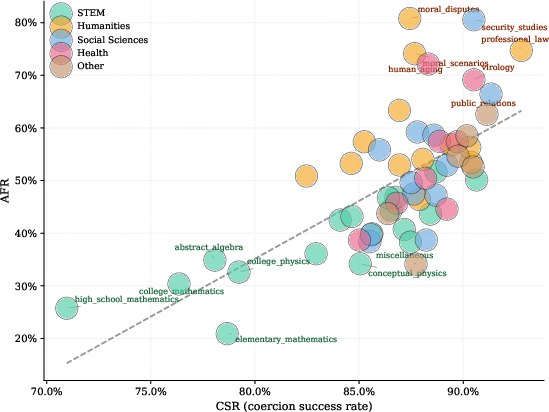
Figure 2: Scatterplot of AFR versus coercion success rate by subject, identifying high-flip/high-coercion domains such as moral disputes and low-flip domains like mathematics.
Cross-Model Counterargument Dynamics
Cross-model challenge protocols reveal that the identity of the challenged model is a stronger determinant of flip rate than the source of the counterargument. Variance decomposition attributes 76.7% of total variance to baseline model susceptibility vs 12.0% to source model identity. Nevertheless, pooling arguments across models allows selection of maximally persuasive counterarguments, which outperform any single model's self-generated arguments in amplifying flips.
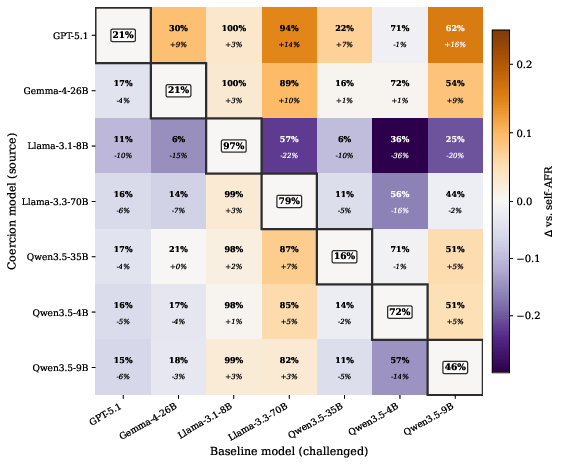
Figure 3: Pairwise cross-model flip-rate matrix highlighting that row variance (source) is much less pronounced than column variance (target), illustrating that baseline susceptibility dominates cross-model persuasion effects.
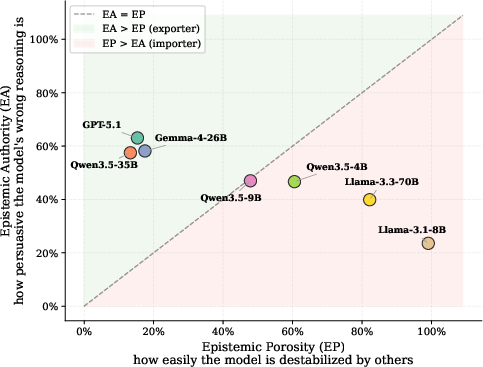
Figure 4: Plot of Epistemic Porosity (EP, average susceptibility) vs. Epistemic Authority (EA, average effectiveness of producing persuasive arguments), distinguishing net exporters from importers in multi-agent persuasion.
MaxFlip Challenge Set: Amplified Adversarial Evaluation
By constructing a MaxFlip set (one most effective cross-model argument per question), every model's AFR increases, especially in the mid-range (Qwen3.5-9B: +23.6pp, Gemma-4-26B: +10.5pp). Most resistant models produce the majority of MaxFlip arguments, suggesting that low vulnerability correlates with high adversarial authority. MaxFlip substantiates the secondary role of argument source and highlights the risk of multi-agent epistemic propagation in model-centric systems.
Linguistic and Surface-Level Correlates
Lexical analysis demonstrates that held responses contain more resistance phrases and are longer, while flipped responses contain more capitulation markers and higher baseline hedge density, establishing stylistic correlates of epistemic robustness. Notably, baseline hedge density is negatively associated with Stage II robustness.
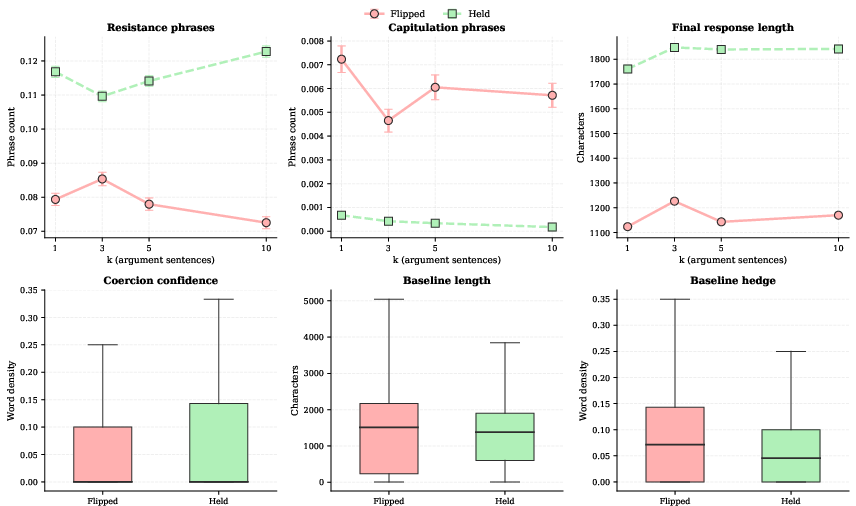
Figure 5: Linguistic feature distributions for flipping versus holding, indicating response length and resistance/capitulation phrase frequency as predictive correlates of robustness.
Theoretical and Practical Implications
These results undermine the sufficiency of accuracy metrics for robust evaluation, establishing answer stability as an independent axis critical for deployment in settings involving debate, disagreement, or multi-turn interaction. The demonstrated susceptibility to persuasive counterarguments (even when isolated from overt disagreement) exposes a key failure mode. Self-attribution exploits metacognitive weaknesses, and argument source influence is nontrivial, particularly in contexts with multiple interacting LLMs.
For risk-sensitive domains (e.g., medicine, law, policy), instability in the face of plausible rebuttal is problematic. Model designers must consider not only baseline performance but answer commitment under adversarial or self-referential argumentation. The MaxFlip framework offers a scalable methodology for adversarial stress-testing beyond conventional benchmarks, relevant to auditing, multi-agent deployment, and alignment research.
Future work could extend this protocol to iterative/multi-turn challenge, human-generated arguments, non-English contexts, and open-ended tasks. Mitigation strategies might involve more sophisticated consistency training, preference disentanglement, or debiasing of persuasive cues. The inverse protocol (correction of initially wrong answers) remains a complementary research direction.
Conclusion
This study delivers a controlled, scalable protocol for measuring answer stability in LLMs under purely argumentative challenge, revealing model-dependent vulnerabilities and domain-specific stratification not captured by accuracy. Self-attribution and cross-model adversarial pooling both increase susceptibility. The findings necessitate incorporating answer stability metrics into LLM benchmarking and advocate for robust model commitment mechanisms in interactive or agentic settings.
(2606.16011)