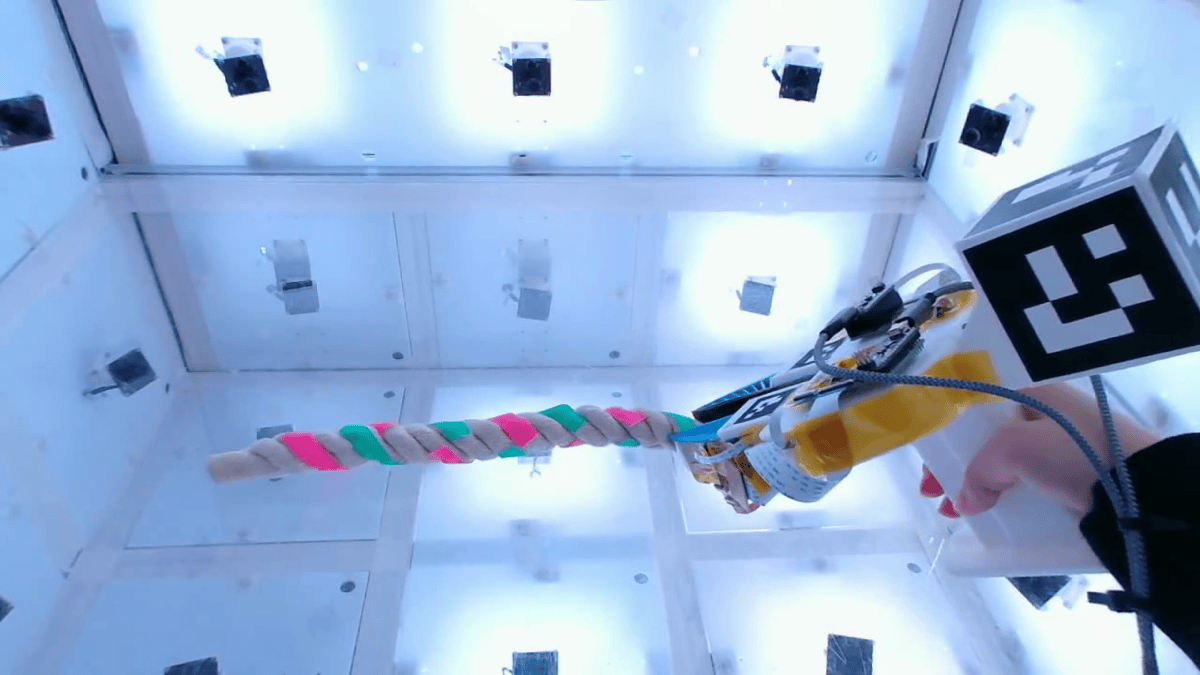
- The paper presents Deform360, a large-scale dataset capturing 41-camera views and tactile signals across 198 deformable objects over 215 hours of interaction.
- The study introduces a markerless tracking pipeline that integrates 3D Gaussian Splatting, 2D feature tracking, and multi-view alignment to ensure precise deformation tracking even under occlusions.
- The paper benchmarks 2D versus 3D world models, revealing trade-offs between geometric supervision and large-scale visual pretraining, with practical implications for real-world robot planning.
Motivation and Dataset Overview
Robotic manipulation of deformable objects poses significant challenges due to high-dimensional state spaces, non-linear material properties, and frequent occlusions during interaction. The "Deform360" dataset (2607.05390) directly addresses these issues by providing a large-scale, multi-modal dataset featuring synchronized multi-view (41 cameras) and tactile recordings from 198 diverse real-world deformable objects across 1,980 interaction sequences and over 215 hours of data. Deform360 captures both global object motion and contact-induced local deformations, supporting research on both 2D and 3D object-centric world models, contact detection, and real-world robot manipulation tasks.
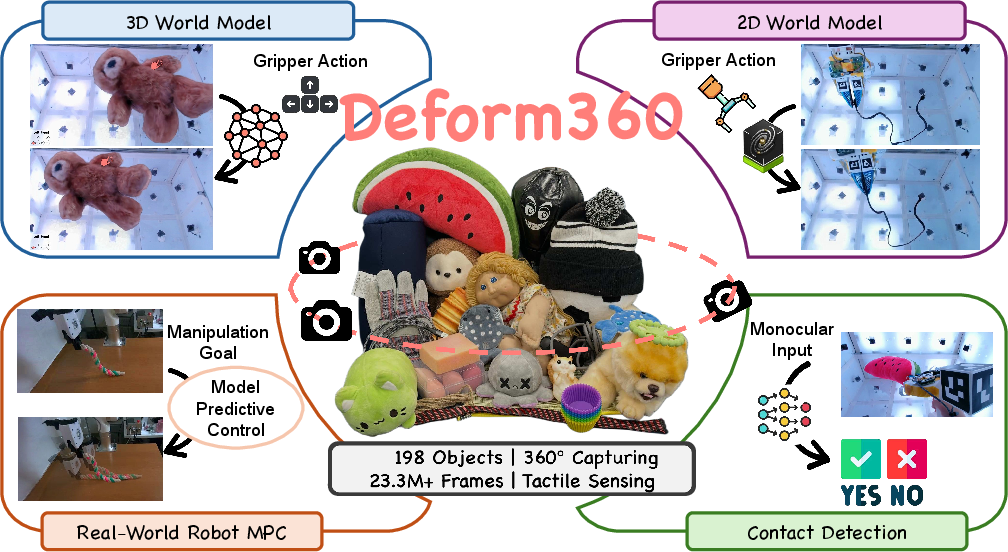
Figure 1: Deform360 dataset overview, demonstrating the scale and diversity of objects and the multi-view visuotactile capture setup.
Acquisition System and Object Taxonomy
The Deform360 capture system deploys 41 spatially calibrated RGB cameras for dense, surround-view observation at 720p and 30 FPS, paired with bimanual UMI grippers instrumented with tactile sensors. The protocol encompasses a spectrum of unimanual and bimanual tasks—poking, squeezing, stretching, folding, twisting—designed to exercise both global motion and fine-grained local deformations. Object diversity is a central strength, spanning:
- 1D deformables: ropes, cables, threads
- 2D deformables: cloths, garments, bags, papers
- 3D volumetric deformables: plush toys, foam, squeezable objects
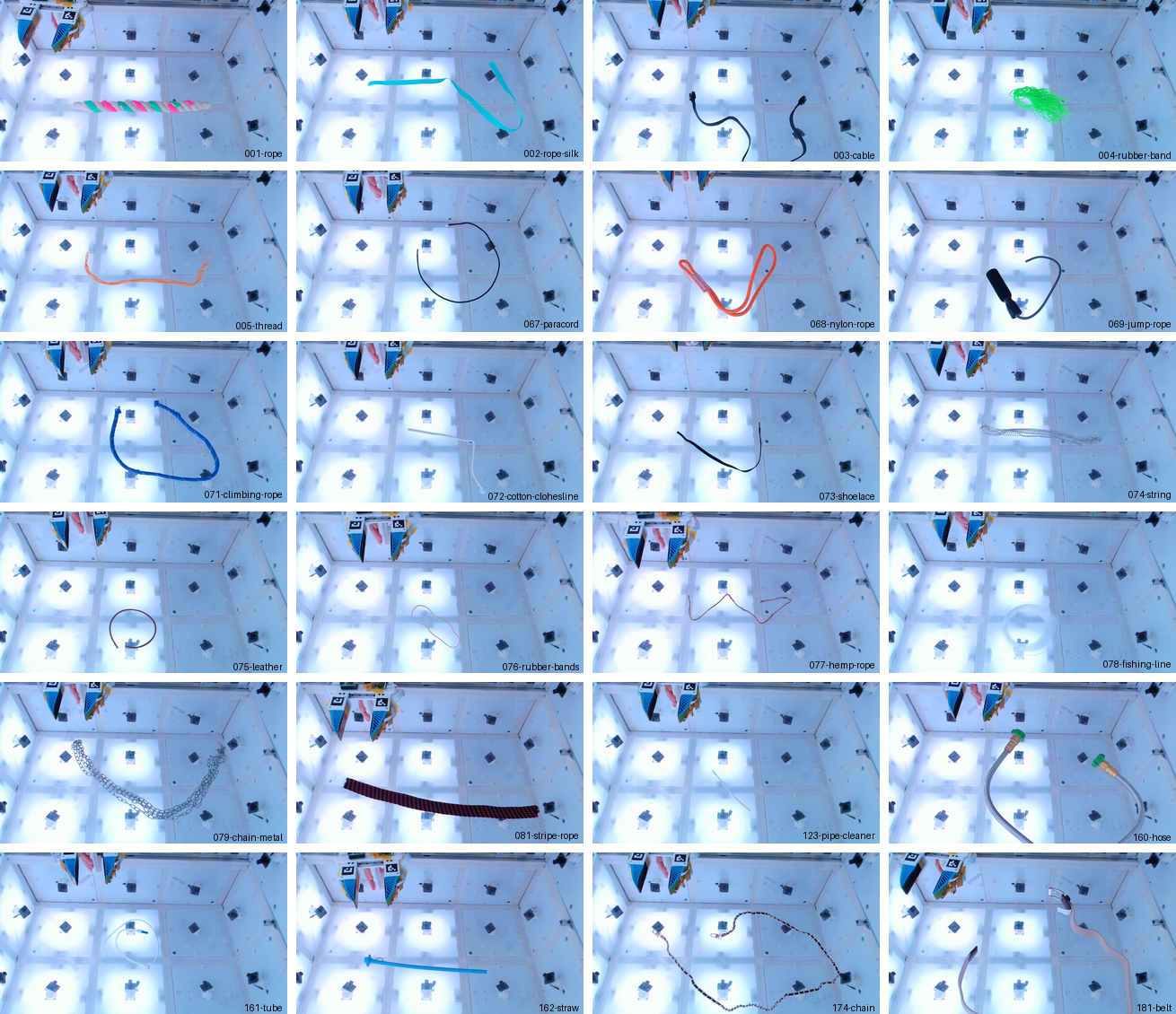
Figure 2: Visualization of 1D deformables such as various ropes, cables, and wire-like objects.
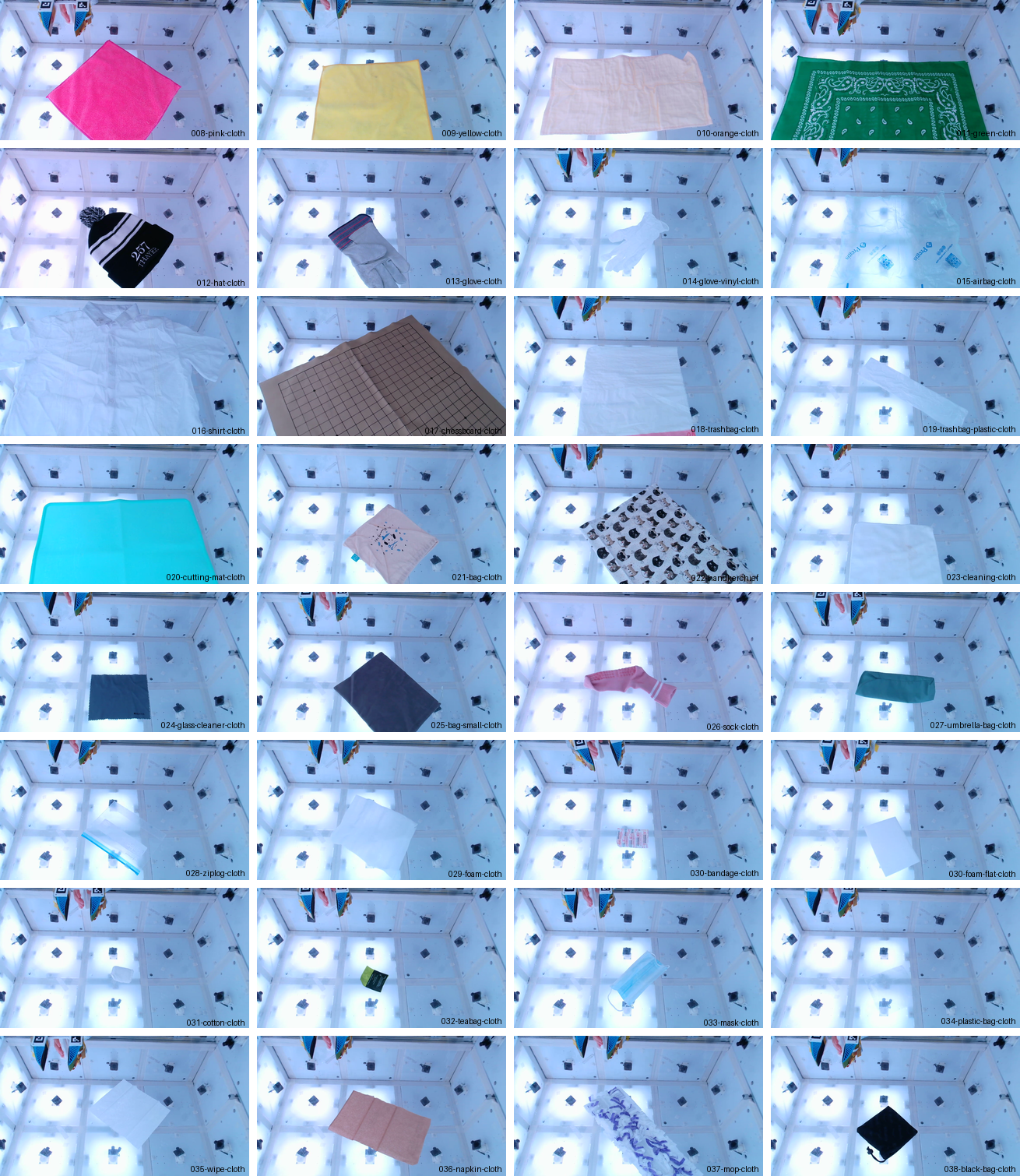
Figure 3: Representative 2D deformables including fabrics, bags, and paper-like thin shells.
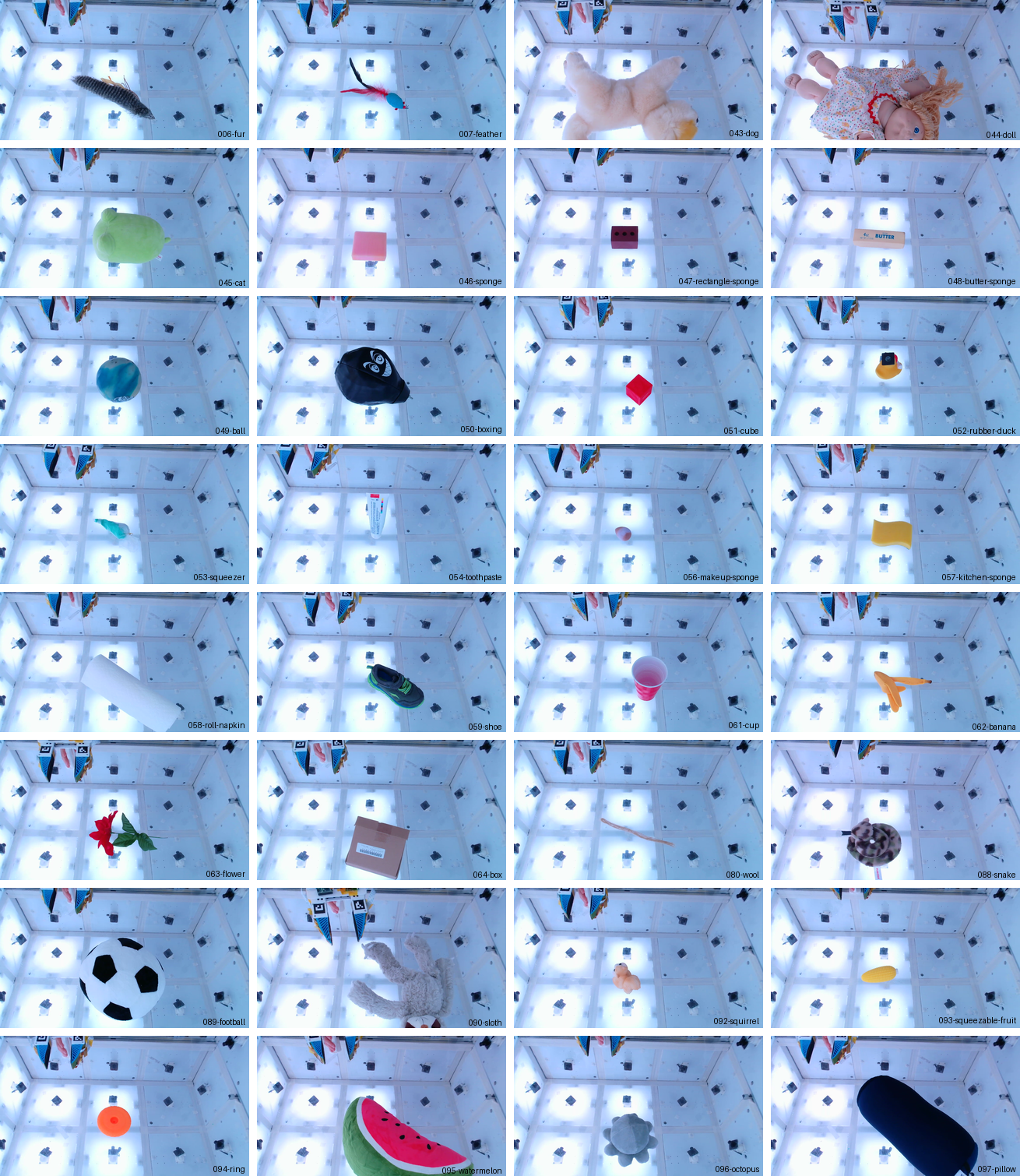
Figure 4: Selected 3D volumetric deformables encompassing plush toys, foams, and squeezables.
This taxonomy facilitates research in both intra- and cross-class dynamic modeling, and the dataset’s scale surpasses prior real-world benchmarks in both sensory richness and annotated interactions.
Markerless Visuotactile Tracking Pipeline
To generate ground-truth dense geometry and motion annotations in the presence of heavy occlusions, the authors introduce a markerless tracking pipeline combining per-frame 3D Gaussian Splatting (GS), robust 2D feature tracking, and multi-view geometry alignment.
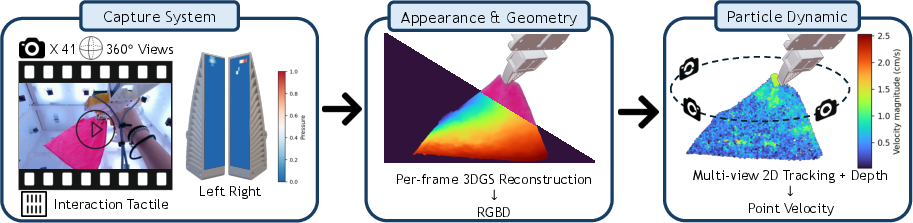
Figure 5: Annotation pipeline — per-frame 3D Gaussian Splatting, markerless 2D tracking, 2D-to-3D lifting, and cross-view/tactile consistency optimization.
This sequence decouples high-fidelity rendering from physical tracking, enabling the enforcement of:
- Temporal consistency and local rigidity (ARAP constraints)
- Spatial smoothness and tactile plausibility (via physically-informed losses)
- Geometric accuracy (bidirectional Chamfer losses against reconstructed surfaces)
Critically, tactile signals are leveraged as a supervisory signal to regularize particle trajectories during occluded contact events, resulting in persistent object-centric particle identities even under severe deformations.


Figure 6: Qualitative visualization of the particle tracking system across object categories, showing robust tracking under interaction.
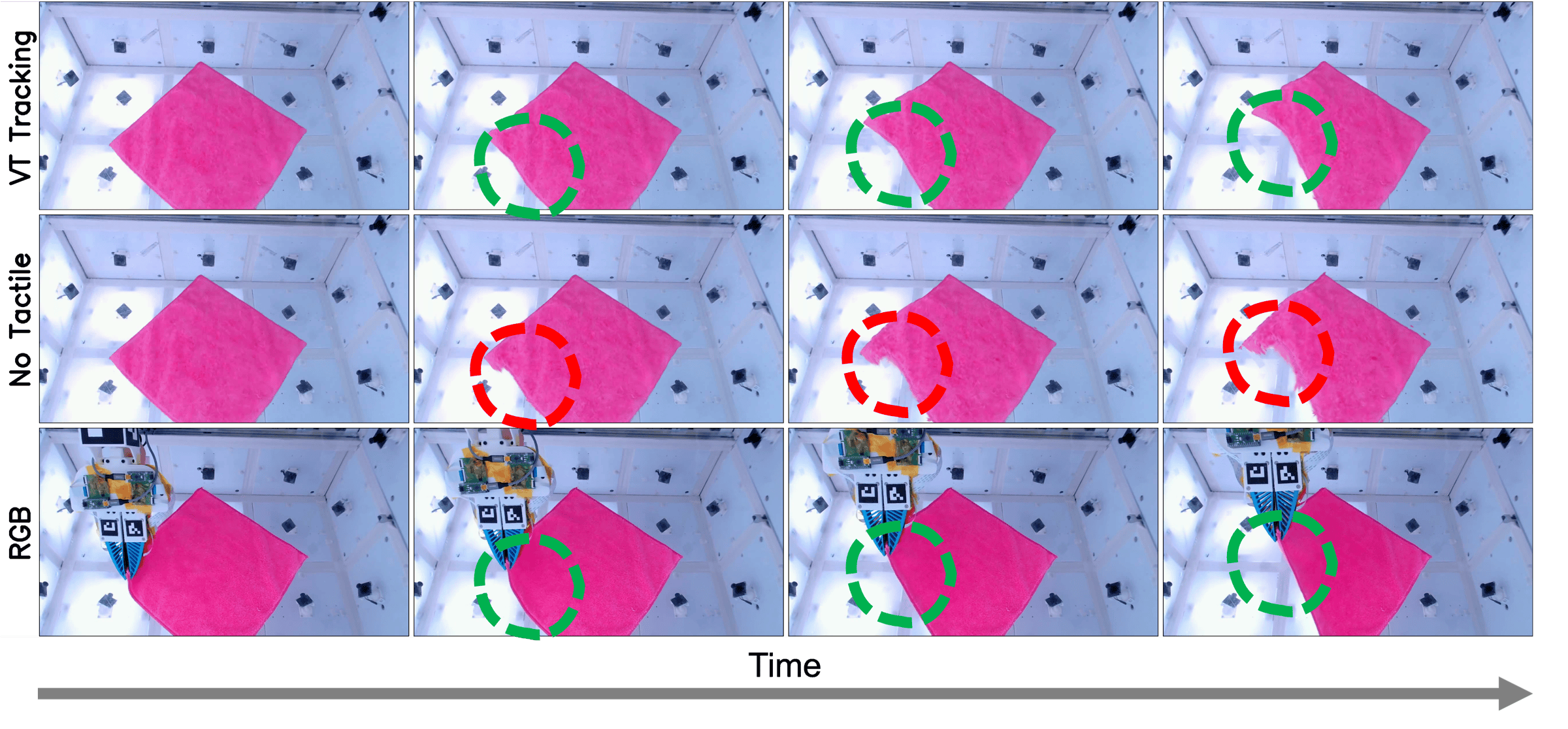
Figure 7: Benefit of visuotactile integration—tracking with tactile input yields lower error and preserves fidelity under severe occlusion compared to vision-only baselines.
Empirically, visuotactile fusion reduces point cloud Chamfer error by 5× under occlusions, validating the importance of synchronized force sensing.
Benchmarking World Models: 2D vs. 3D
To systematically probe modeling capabilities, the authors formulate three core tasks: contact prediction, multi-modal world model benchmarking, and real robot planning. Two major paradigms are compared:
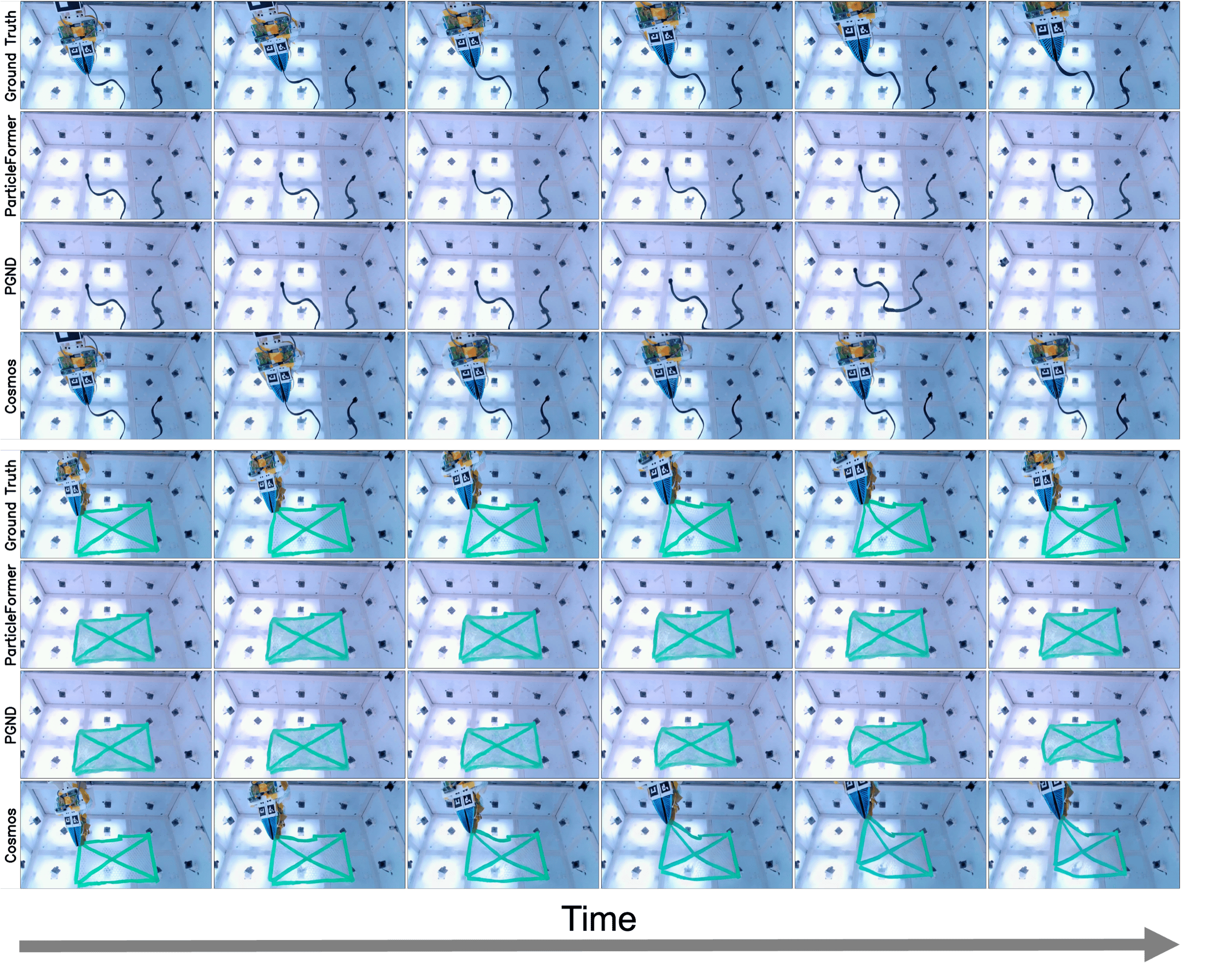
- 2D action-conditioned video models (e.g., Cosmos-Predict 2.5B): Direct latent-space video prediction, leveraging large-scale internet pre-training for generalization.
- 3D particle-based models (e.g., PhysTwin, PGND, ParticleFormer): Explicit geometry prediction via learning (GNNs, Transformers) or differentiable physical simulation.
Evaluation is staged under three generalization settings:
- Per-episode (frame): Intra-sequence forecasting.
- Multi-episode: Cross-sequence, same-object generalization.
- Multi-object: Zero-shot to novel objects.
Key results and numerical claims:
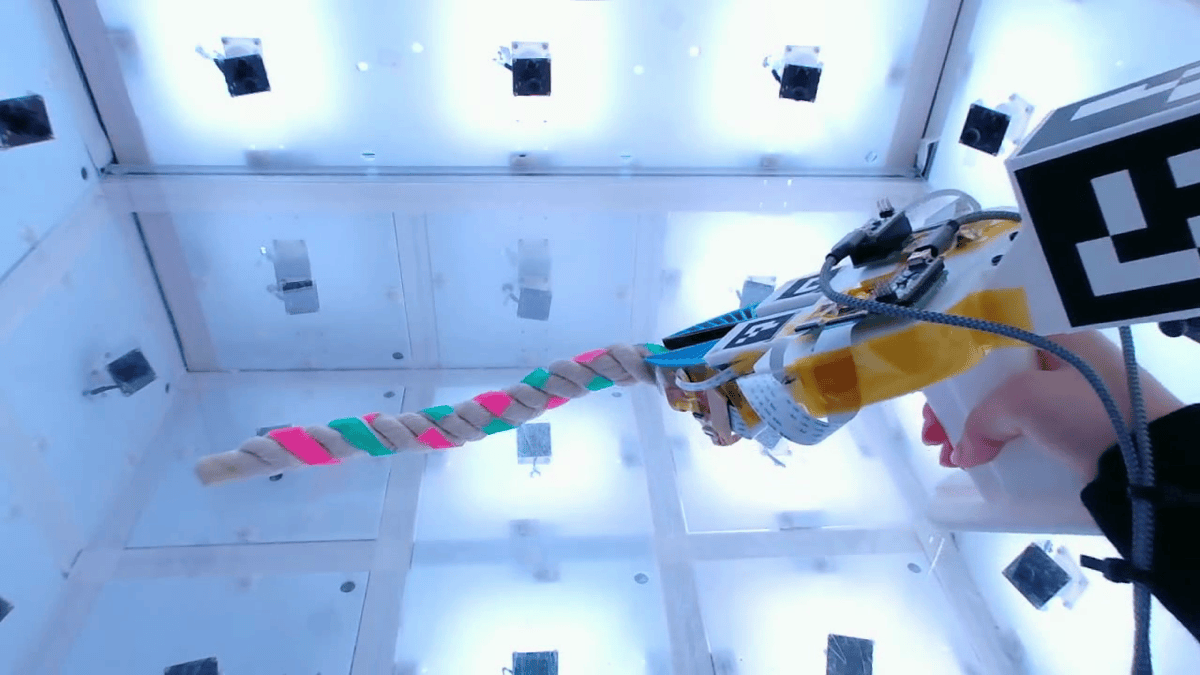
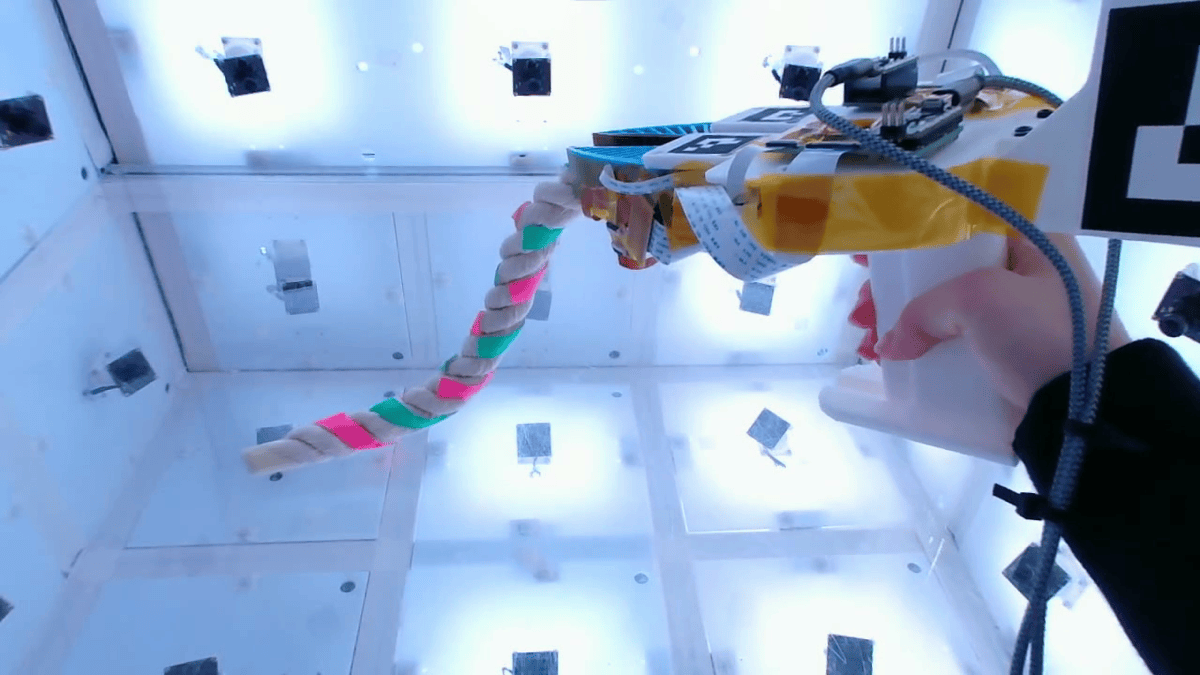
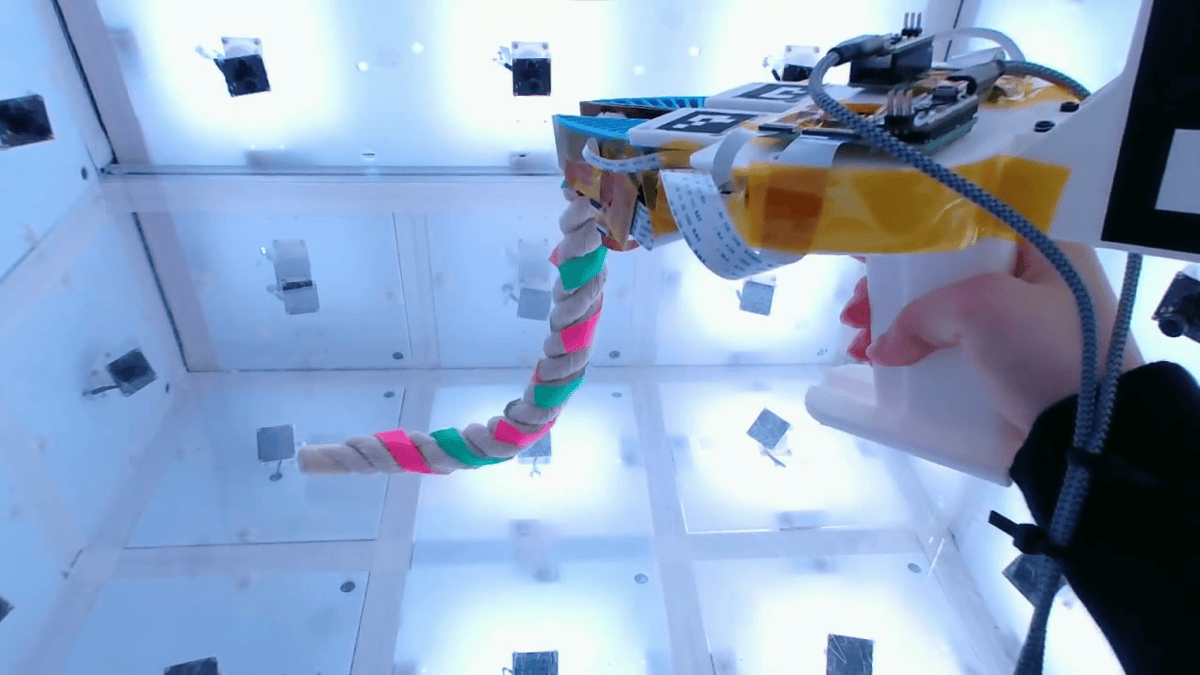
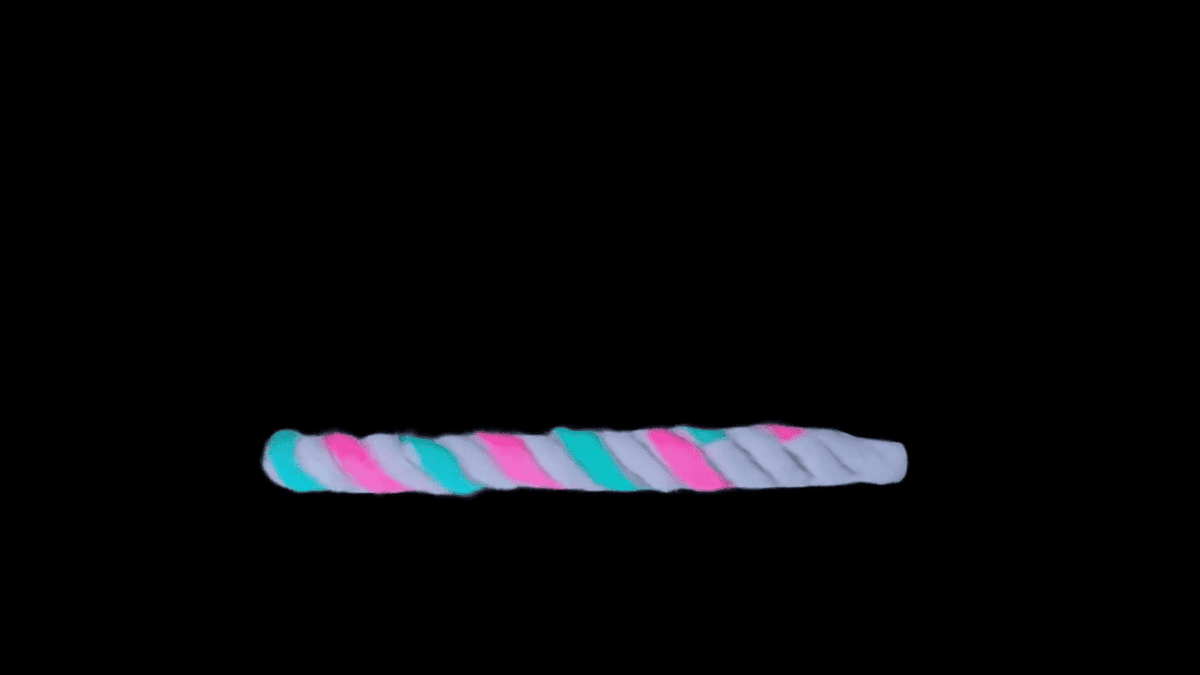
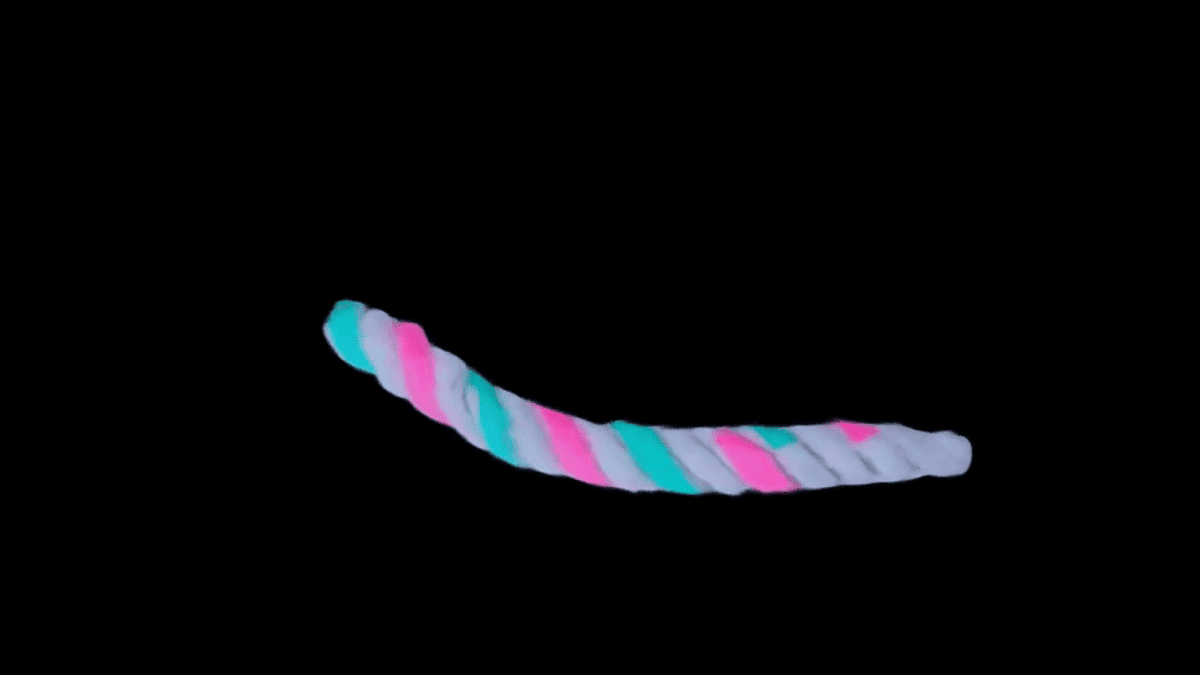


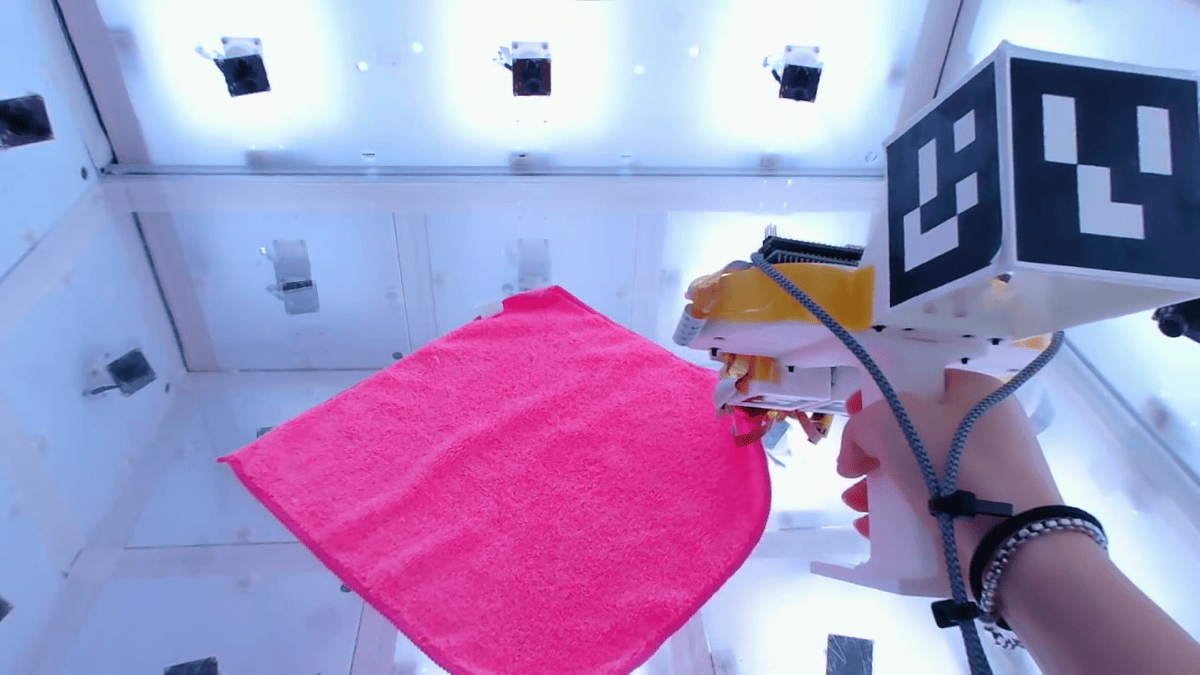
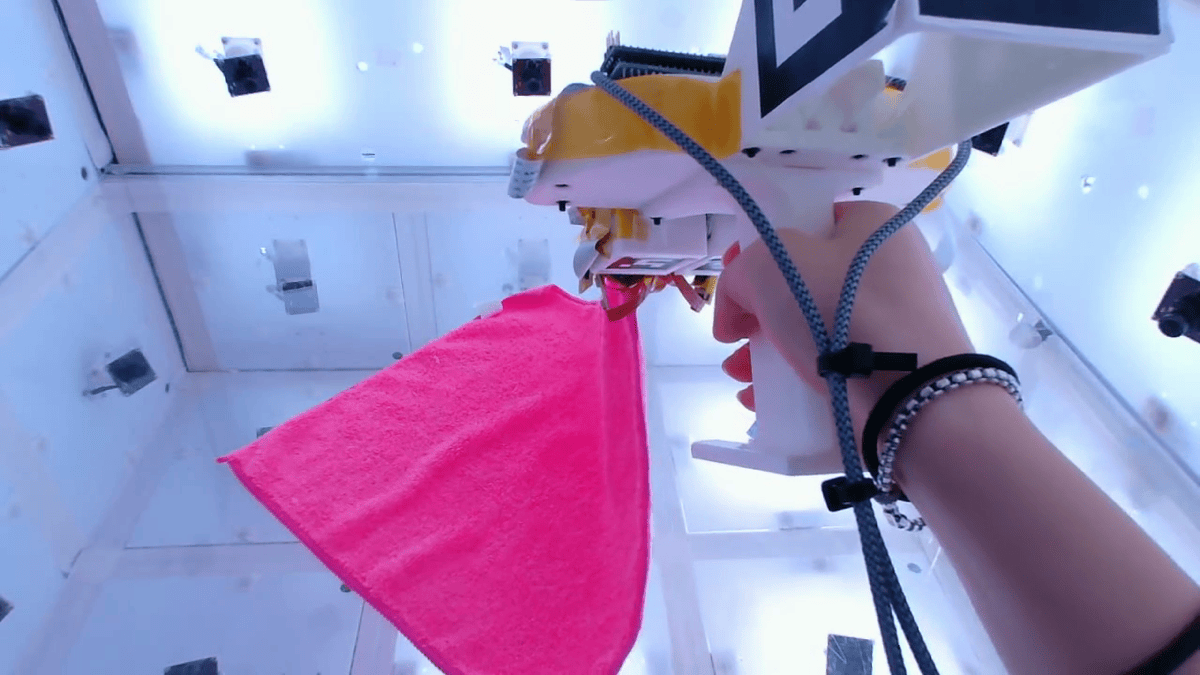
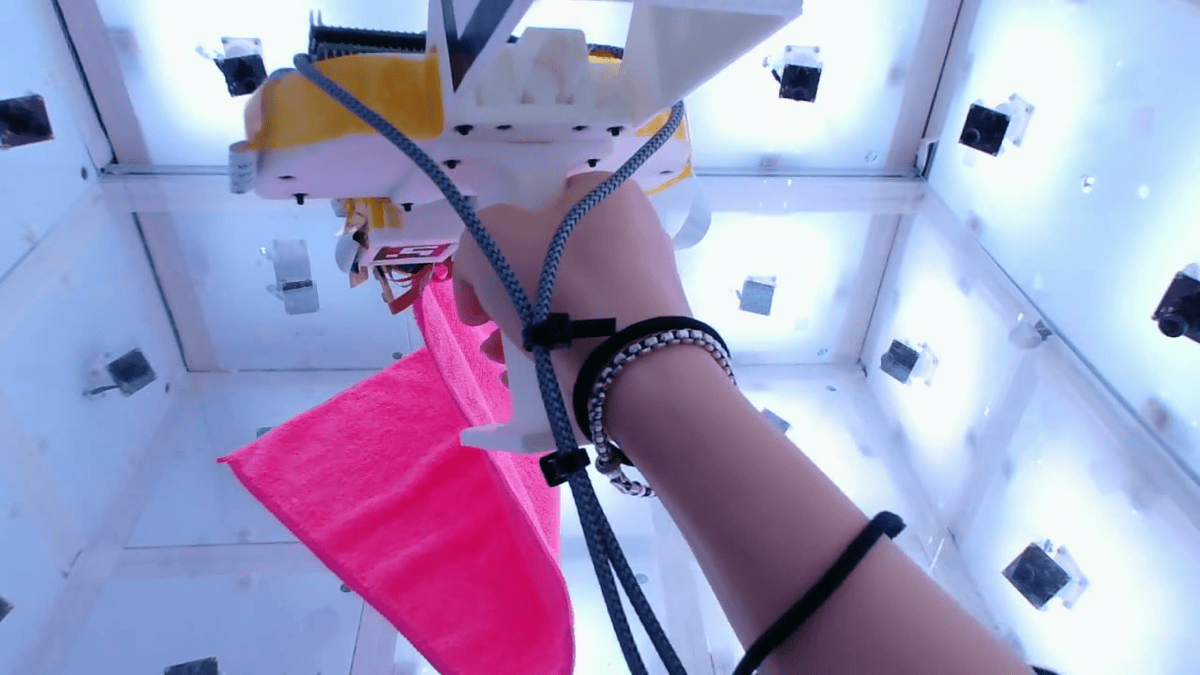
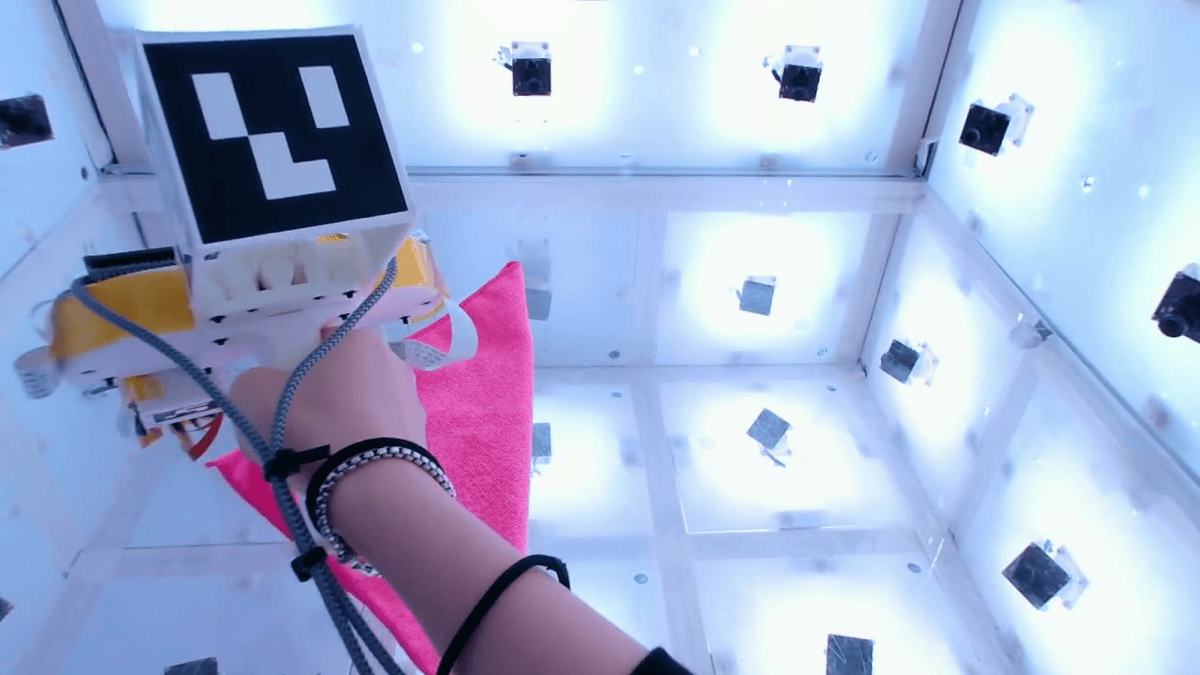
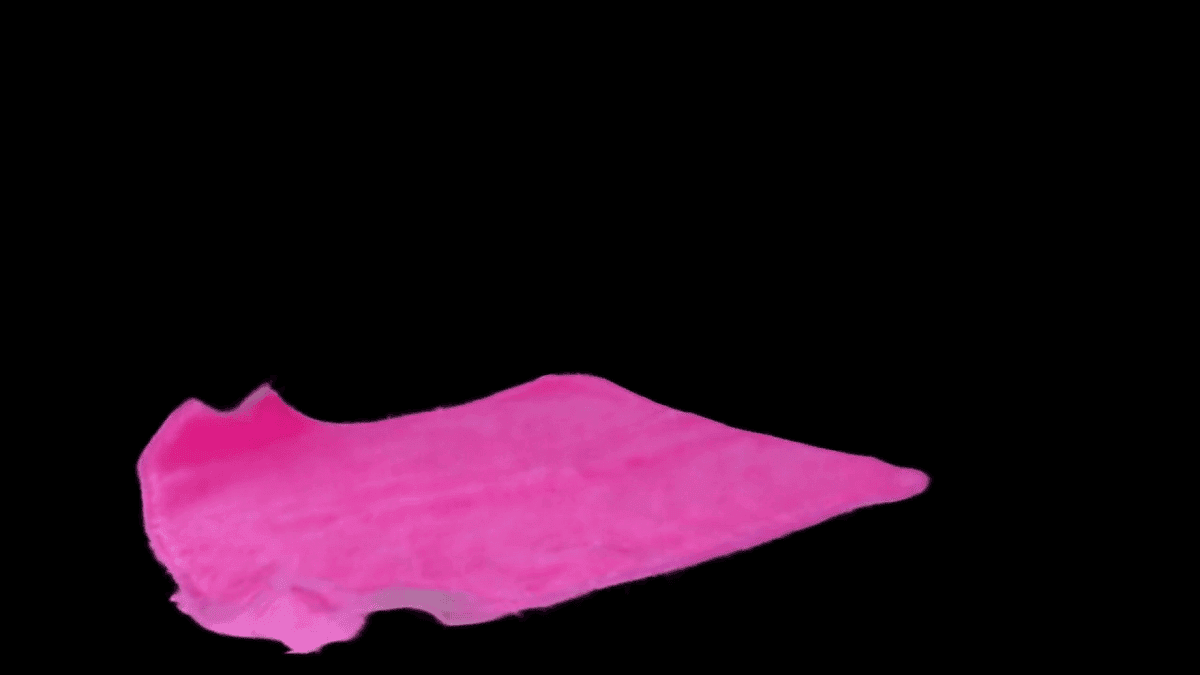
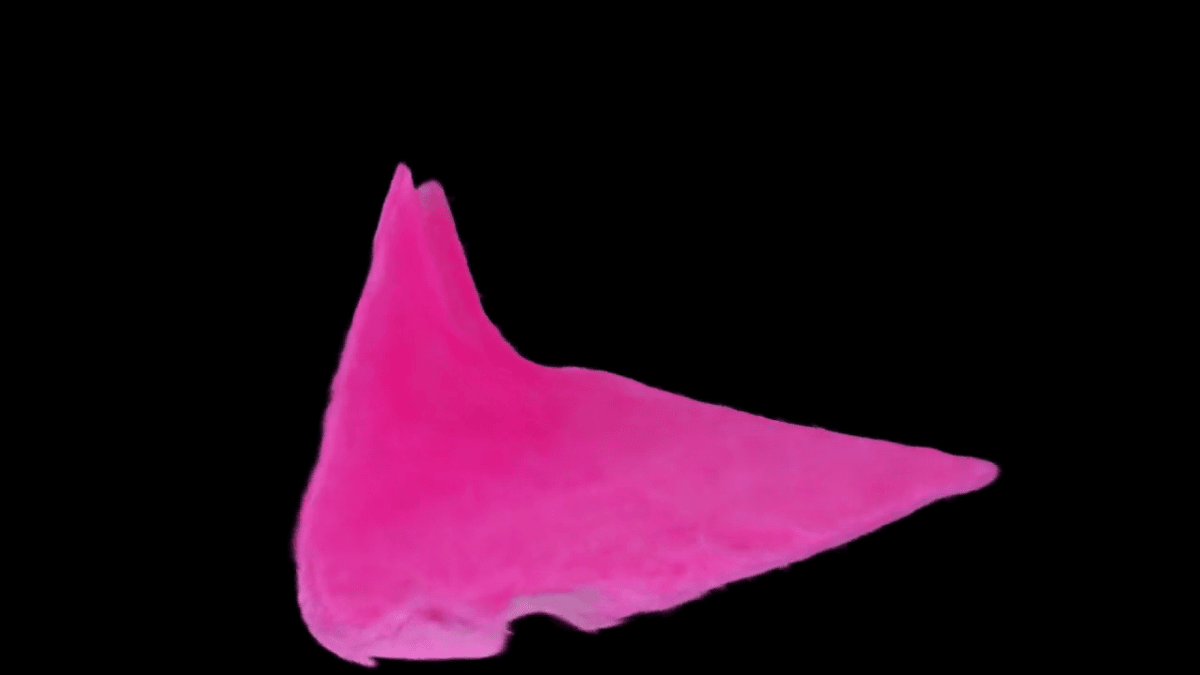


Figure 9: Dynamic reconstruction examples—novel view synthesis at different time steps for rope and cloth sequences.
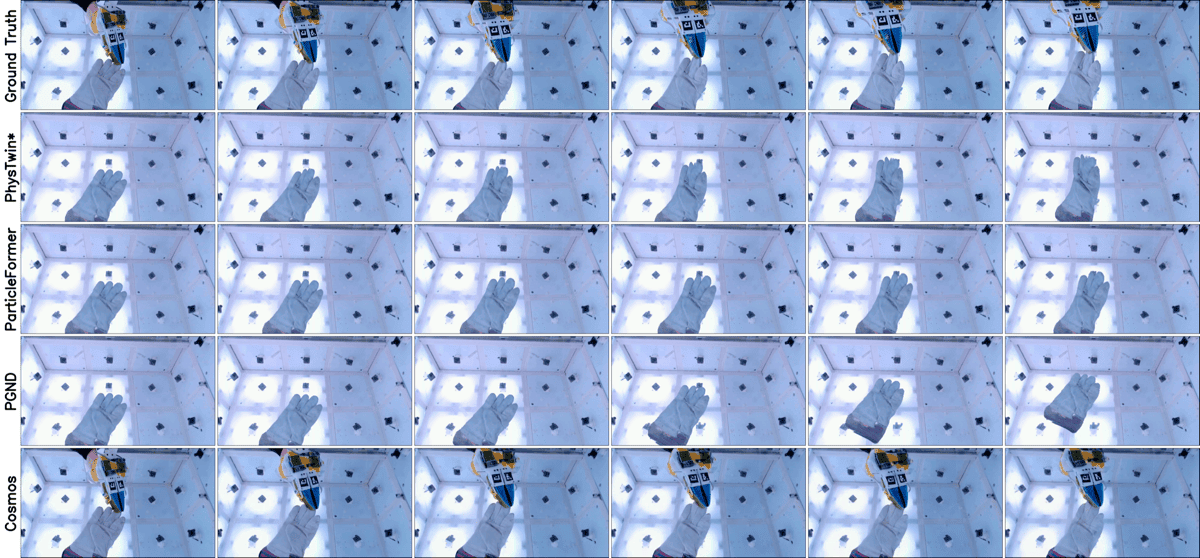
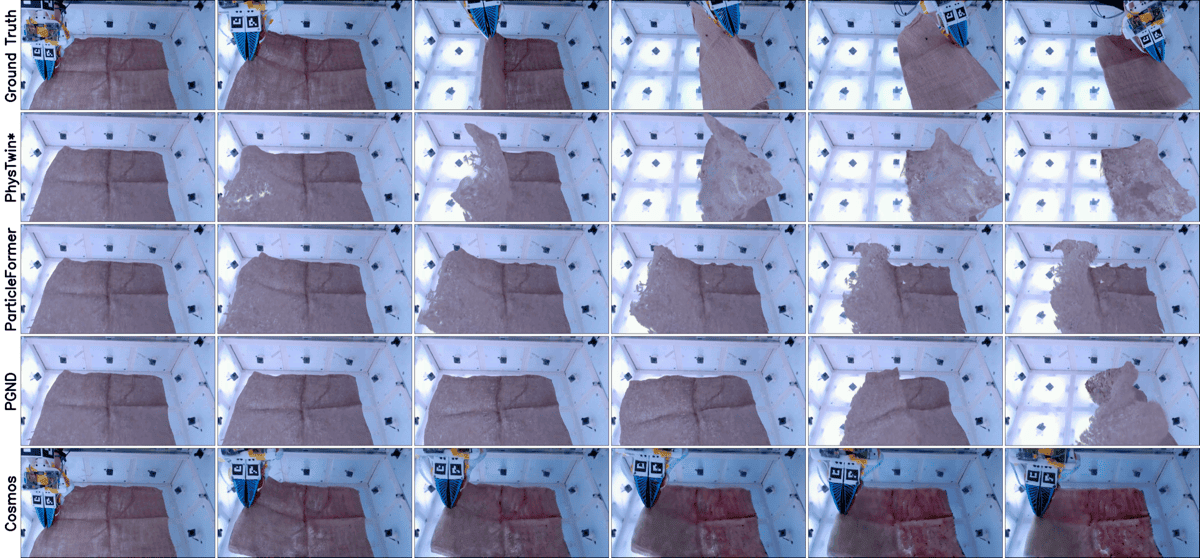
Figure 10: Multi-episode generalization on glove-cloth and sack-cloth, illustrating cross-episode predictive robustness.
These benchmarks reveal a fundamental trade-off between inductive structure and scaling: 3D models provide strong priors and exploit geometric supervision in low-data settings, while 2D models exploit large-scale visual pretraining to generalize better on novel categories but have limited controllability and policy integration in open-loop settings.
Beyond world model evaluation, Deform360 enables downstream robotic planning. Models trained on Deform360 (notably PhysTwin) were deployed in a zero-shot manner on a different robot platform for model-predictive control (MPC) of real deformables, demonstrating the data’s cross-robot transfer potential.
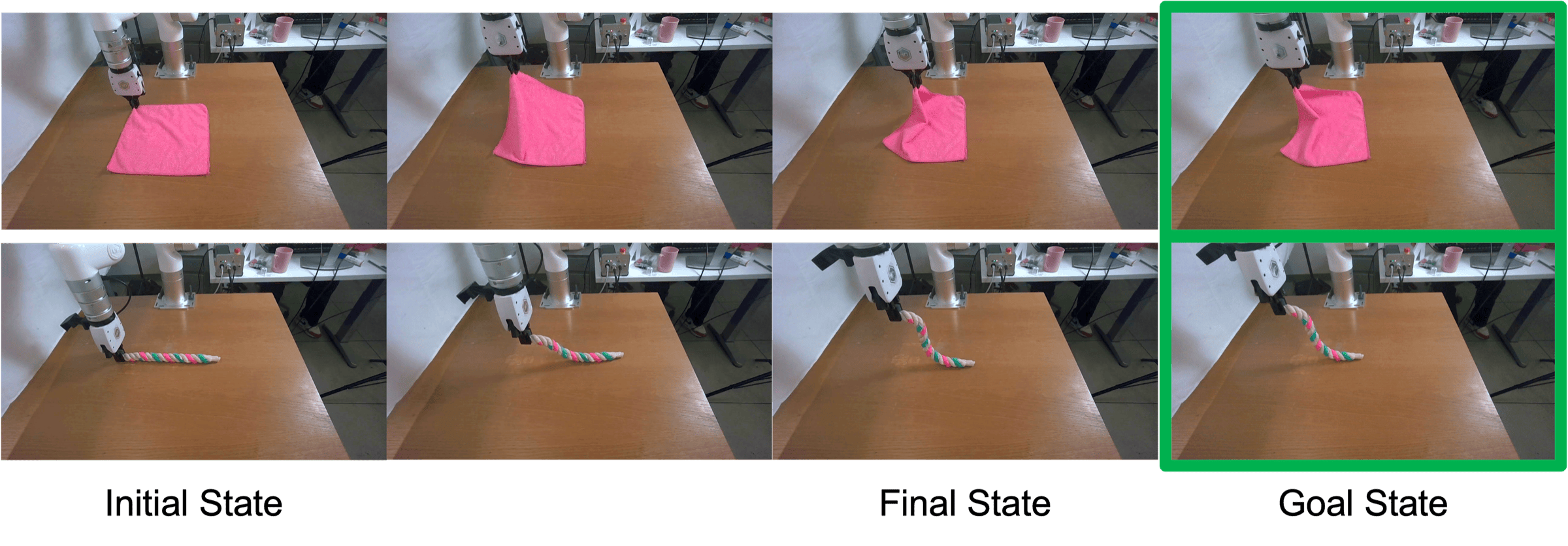
Figure 11: Real robot planning via MPC — learned 3D world models guide deformable object manipulation in physical setups different from dataset capture.
Additionally, the dataset’s synchronized visuotactile streams permit high-accuracy contact prediction (88.67% mean accuracy, $0.8909$ F1), quantifying the learnability of tactile events from exteroceptive streams and confirming the tight visual-physical coupling in the dataset.
Limitations and Future Research Directions
Despite its scope, Deform360 faces inherent challenges:
- Severe self-occlusion and large plastic deformations remain difficult for vision-based tracking.
- Tactile sensors only capture normal-axis pressure, limiting slip detection and rich surface force recovery.
- Current large-scale video models exhibit action-command drift in long rollouts, likely due to action encoding deficiencies and lack of sufficiently action-conditioned pretraining.
Implications: The dataset sets the stage for several future avenues:
- Design of foundation 3D world models leveraging large-scale pretraining and hybrid physics learning
- Scaling multi-modal policy learning across robot platforms and interaction types
- Advanced tactile/force sensing enabling richer contact inference and model fidelity
Conclusion
Deform360 sets a new standard for deformable object world modeling by coupling large-scale, high-resolution multi-view video with dense, markerless 3D tracking and tactile data across an unprecedentedly diverse set of daily-life objects. Through systematic benchmarking, it reveals the scalability-structure trade-off in current world models, highlights the necessity of tactile supervision, and enables deployment of learned models in real-world robotic planning tasks. Its design and empirical insights provide a robust foundation for next-generation research aiming at physically grounded, generalizable, and robot-ready world models in deformable manipulation (2607.05390).