- The paper rigorously establishes the monotonicity and convergence of cross-click operators, eliminating the need for high-dimensional numerical methods.
- It derives closed-form spectral bounds and explicit photon-number weight estimates that underpin secure QKD protocols with passive detection.
- The analysis introduces efficient dimension reduction and exact bipartite factorization, simplifying security proofs even in mismatched detector scenarios.
Analytic Properties of Cross-Click Operators in Passive Multi-Basis Photodetection: Rigorous Spectral Theory and Implications for Quantum Key Distribution
Overview and Motivation
The paper "Analytic properties of cross-click operators in passive multi-basis photodetection: monotonicity, exact convergence rates, and dimension reduction for quantum key distribution" (2607.04186) provides the first comprehensive analytic treatment of the spectral properties of cross-click POVM elements, central to security analysis methodologies for QKD with realistic detectors. The lack of analytic guarantees for the monotonic growth and convergence of the minimum eigenvalue f(n) of cross-click operators in the literature has previously necessitated expensive high-dimensional numerics and left key steps in QKD proofs conditional on finite-dimensional calculations. This work rigorously closes that analytic gap for a general class of passive receiver architectures with arbitrary efficiency mismatch and loss, and derives closed-form photon-number weight bounds that remove the need for large-scale Fock-space numerics.
Structure Theorem and Spectral Reduction
The core result establishes that for any passive linear-optical analyzer, each "silence" operator (no click in a specified set of detectors S) is the second quantization Γ(AS) of an explicit contraction AS acting on the single-photon subspace; thus, its restriction to the n-photon sector is AS⊗n projected onto the symmetric subspace. This reduces the spectral analysis of n-photon cross-click operators to questions about symmetric tensor powers of M×M matrices, where M is typically small (e.g., $2$ for polarization qubits).
Monotonicity and Convergence
Monotonicity: The paper gives a direct operator inequality proof that the minimum eigenvalue S0 is monotonically increasing with photon number S1, i.e., S2 for all S3. This justifies the dimension-truncation arguments in QKD security analyses over all photon-number sectors, replacing conjectural or numerically-supported monotonicity with a rigorous statement.
Exponential Bounds and Rates: A two-sided exponential bound pins S4 between S5 and S6, where S7 are explicit passive transformation-induced contractions associated with each measurement basis. The exact asymptotic rate of convergence is identified as S8 under mild coverage conditions.
Closed-Form Values: For ideal detectors, analytic expressions for S9 are determined, e.g., Γ(AS)0 for an Γ(AS)1-basis, balanced analyzer, with Γ(AS)2. For the balanced six-state analyzer, Γ(AS)3, providing a direct characterization of cross-click operator spectra.
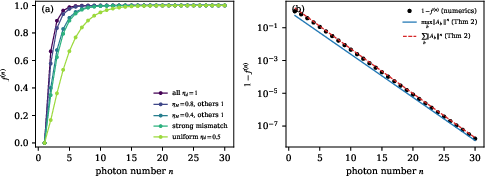
Figure 1: Minimum eigenvalue Γ(AS)4 for the balanced six-state analyzer with different detector efficiencies, calculated via the analytic symmetric-power approach. The monotonicity and rapid exponential convergence are evident.
Bipartite Factorization
For joint cross-click operators relevant to entanglement-based QKD and entanglement verification, the authors prove that Γ(AS)5 factorizes exactly: Γ(AS)6. This demonstrates that analyzing the bipartite operator reduces to single-party spectra, substantially simplifying the computation and interpretation of bounds on multi-photon contributions in QKD protocols.
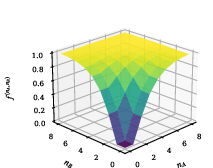
Figure 2: Joint minimum eigenvalue Γ(AS)7 for two distinct six-state analyzers, computed from the analytic factorization; joint monotonicity and sector degeneracies are clearly visible.
The analytic results permit the derivation of explicit, rigorous upper bounds on the probability weight of photon-number sectors above a chosen truncation, conditioned on the observed cross-click probability. Specifically, for a measured cross-click probability Γ(AS)8, the bound
Γ(AS)9
can be applied in arbitrary multi-basis, multi-mode passive detection protocols with mismatched and lossy detectors. All spectral quantities in this bound are given in analytic or efficiently computable closed form, eliminating the need for ad hoc numerics even with efficiency mismatch or high mode count.
This advancement strengthens the logical foundation of recent numerical security analysis frameworks and makes entire classes of experimental QKD setups with passive detection amenable to dimension-reduced, fully rigorous security proofs, even in the presence of strong detector mismatch.
Numerical Illustrations and Algorithmic Aspects
The paper presents efficient, polynomial-time algorithms for evaluating sector spectra (eigenvalues of symmetric tensor powers of contractions), validated independently against brute-force Fock-space calculations. Numerical results match the analytic predictions and confirm the tightness of bounds, rapid monotonic convergence, and exact factorization even in highly mismatched scenarios.
Theoretical and Practical Implications
The analytic characterization of cross-click operators brings several consequences:
- Security Rigorousness: Complete removal of heuristic or finite-sectors-extrapolation steps from photon-number weight certification, crucial for the composable security of finite-key QKD analyses.
- Scalability: Closed-form spectral bounds scale to arbitrary photon number, input mode count, and detector heterogeneity, supporting high-dimensional time-bin and spatial-mode encodings.
- Numerical Efficiency: Certified sector-by-sector quantities are efficiently computable, greatly reducing the computational cost associated with Fock-space manipulations in convex-optimization-based QKD analysis.
- Dimension Reduction: The results provide the analytic backbone for the dimension reduction methods needed for unstructured protocols, enabling tighter key rate estimates with less conservative loss-of-weight penalties.
The factorization of bipartite spectra suggests that the analysis could generalize to multipartite and network QKD scenarios, provided passive detection architectures and threshold detection models remain valid. The structural approach via second quantization of contractions could inspire new analytic treatments for squashing models, double-click operators, or phase-error estimators in advanced protocols.
Prospective Directions
Future developments might address robustness to correlated noise (afterpulsing, memory effects), analytic characterization of double-click or basis-dependent events, or extension to measurement-device-independent and side-channel-robust protocols. The explicit rates derived for convergence could inform detector engineering and calibration standards by connecting efficiency mismatch directly to cross-click-based certification power in security proofs.
Conclusion
This paper (2607.04186) delivers the first fully analytic spectral characterization of cross-click operators in passive multi-basis photodetection, rigorously underpinning their use in QKD security proofs. The results, including monotonicity, tight exponential bounds, closed-form sector values, and bipartite factorization, remove key practical and theoretical bottlenecks in QKD dimension reduction and error certification, and provide concrete analytic tools for the implementation and analysis of secure quantum communication with realistically imperfect detectors.