- The paper presents a reflection-based remote state preparation protocol that enables simultaneous high-fidelity initialization of n-qubit product states.
- It leverages a single photon in a superposition of 2^n temporal modes with controlled qubit-photon interactions to overcome sequential decoherence limitations.
- The method is experimentally feasible with current high-cooperativity cavity QED systems, offering scalability for blind quantum computation and quantum networks.
Remotely Preparing Many Qubits with a Single Photon
Introduction and Theoretical Motivation
This work presents a formal framework and concrete protocol for remote state preparation (RSP) of many qubits using a single photon coherently distributed over a superposition of temporal modes. The authors introduce a reflection-based RSP (R-RSP) protocol that leverages the natural qudit encoding of a photon in d=2n temporal modes, enabling deterministic and high-fidelity remote preparation of n-qubit product states, crucial for applications such as verifiable blind quantum computation (BQC), quantum networks, and distributed benchmarking.
The major constraint in scaling BQC and multi-qubit quantum networks is the overhead and decoherence suffered when preparing qubits sequentially. Existing single-photon single-qubit RSP protocols are bottlenecked by phase stabilization demands, sequential attempts, and inefficiency under photon loss. R-RSP offers a quantum speed-up, permitting simultaneous preparation of multiple qubits heralded by a single photonic detection event, mitigating decoherence and substantially enhancing success rates and fidelities, especially relevant for noisy intermediate-scale quantum (NISQ) devices.
Description of the R-RSP Protocol
The R-RSP protocol's main resource is a photonic state in a superposition over 2n time bins, each coupling to an n-qubit quantum register on the server. Through a controlled qubit-photon interaction engineered via conditional phase flips—realized with efficient cavity QED systems (e.g., trapped ions, quantum dots, silicon-vacancy color centers)—the photon mediates multi-qubit entanglement.
Detection of the photon post–time-bin erasure heralds successful state transfer, up to single-qubit Pauli corrections dependent on detection outcome and the specific random phases the client imprinted in each time-bin. The client remains private with respect to these phases, providing cryptographic utility in BQC.
The implementation comprises three steps:
- Photon Preparation in Superposition: The client prepares a photon state ψ=∑xcxa^x† coherently delocalized over 2n temporal modes, each mode mapped to an n-bit string.
- Controlled Register Interaction: The photon's mode x controls conditional phase flips on register qubits at positions determined by ones in x.
- Time-bin Information Erasure and Detection: Coherent erasure of which-time-bin information is realized by a quantum Fourier transform (QFT) or time-lens, after which a single-photon detection heralds the simultaneous preparation of the entire n-qubit register.
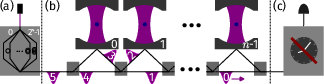
Figure 1: Schematic of the R-RSP protocol: (a) single photon superposition creation, (b) engineered qubit-photon interaction, and (c) which-time-bin information erasure and detection.
Notably, the protocol is not restricted to emission-based designs; absorption-based and measurement-based variants (leveraging a communication and a heralding qubit) are also tractable.
Rate-Fidelity Trade-Off: Single Qubit and Many Qubit Regimes
The detection probability to prepare all n0 qubits with heralding on a single photon is
n1
where:
- n2 is end-to-end photon transmission efficiency (mainly limited by fiber loss),
- n3 denote the photon routing/interaction/detection efficiencies,
- n4 is the time-bin erasure and detection efficiency.
The exponential scaling in temporal modes allows compensation for losses while maintaining high fidelity; only the single photon and associated attempts must be transmitted and detected, not n5 photons in n6 events.
Single-Qubit Regime (n7):
Compared against leading alternatives (Single-Click (SC) and Double-Click (DC) RSP schemes), R-RSP achieves comparable or superior rate-fidelity trade-offs, especially in regimes where phase stabilization is impractical or matter–photon coupling is a bottleneck.
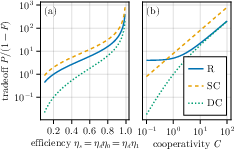
Figure 2: Fidelity-versus-success-probability trade-off for different RSP protocols in realistic regimes (e.g., photon routing– and detection-limited; matter–photon interface limited).
SC-RSP offers optimal rates but requires stringent phase stabilization over the entire optical path—often infeasible for network-wide or long-distance applications. DC-RSP, while phase-insensitive, is strictly less efficient and not scalable to n8 qubits. R-RSP, by contrast, matches or exceeds performance with substantially relaxed experimental requirements.
Many-Qubit Regime:
When the preparation must succeed within a decoherence-limited time window, R-RSP achieves a beyond-classical, exponential multiplexing advantage. Simultaneous preparation with a single photon enables quantum multiplexing—a coherent quantum effect inaccessible to straightforward repetition or classical parallelization.
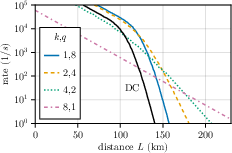
Figure 3: Numerical rates for simultaneous n9 qubit R-RSP versus batch sizes and window durations as a function of optical path length and loss.
As 2n0 increases, the performance gain consolidates: The protocol rapidly outperforms sequential approaches constrained by decoherence or finite windowing, and outstrips classical coding techniques, as shown by the scaling transition visible in simulation.
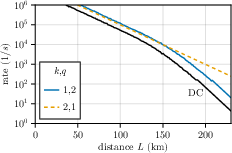
Figure 4: Two-qubit R-RSP performance as a function of window size and fiber length; demonstrates earlier crossover as 2n1 increases.
Error Model, Imperfections, and Practicality
The protocol rigorously models imperfections due to:
- photon loss and detection efficiency,
- imperfect photon mode-matching (2n2),
- multi-photon errors when using weak coherent pulses (WCPs).
The fidelity lower bound,
2n3
shows the net impact is mild in realistic loss regimes for high-cooperativity cavity QED. Critically, the exponential cost is paid in temporal (not spatial or qubit) resources; explicit proof is given that 2n4 temporal modes are necessary and sufficient for deterministic and faithful 2n5-qubit preparation with a single photonic qudit.
Comparative Protocols and Fundamental Overhead
Alternative approaches (e.g., multi-qubit RSP via generalized DC/double-single-click or fixed Hamming weight encoding) introduce exponential memory or operational gate count overhead, or fail to encode the requisite 2n6-independent phases needed for applications like BQC. The presented R-RSP protocol, by leveraging engineered light-matter interactions rather than single-qubit emission, realizes an exponential improvement in resource efficiency.
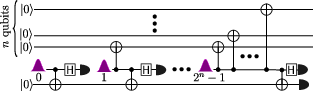
Figure 5: Alternative implementation schematic with single communication and heralding qubits in an absorption-based variant; further reduces decoherence burden via centralization of quantum control.
Experimental Feasibility
The required controlled CPhase interaction (multi-qubit multi-mode control conditional upon time-bin index) is realizable using current high-cooperativity quantum emitter–cavity systems, as illustrated in:
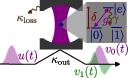
Figure 6: Input-output model of qubit–photon reflection-based gate for a trapped-ion quantum memory coupled to a photonic cavity.
Time-bin erasure and detection, a critical step in heralding the target register state, can be implemented optically via QFT circuits and time-lenses in the photonic domain.
Security and Applications in Quantum Networks
The R-RSP protocol, by decoupling phase-stability requirements and supporting weak coherent pulses, is naturally compatible with security proofs developed for phase-insensitive DC-RSP and the abstract cryptography framework. It supports distributed, multi-user applications and opens new directions for scalable, device-independent quantum network protocols, including multi-client BQC, quantum secret sharing, and quantum position verification.
Fundamental Limits and Open Problems
A rigorous proof is included establishing the optimality of the exponential temporal mode requirement, rooted in Hilbert space dimensionality and the necessity for deterministic, one-to-one encoding of 2n7-qubit equatorial product states.
While the exponential scaling is unavoidable, the protocol achieves optimal trade-offs in rate, fidelity, hardware practicality, and quantum resource contention, especially for NISQ-era and long-distance quantum networking scenarios.
Conclusion
This work develops and rigorously analyzes a protocol for simultaneous remote preparation of arbitrary 2n8-qubit states using a single photonic qudit. The R-RSP protocol achieves high-fidelity, high-rate remote multi-qubit initialization with a resource-efficient implementation compatible with current quantum hardware. It establishes the irreducible exponential temporal mode resource cost while sidestepping the exponential scaling in qubit memory and gate complexity found in alternatives. These features position R-RSP as a foundational primitive for large-scale, scalable, and secure quantum network protocols.
The immediate direction for future research involves extending security proofs for multi-qubit and qudit RSP regimes, optimizing batch sizes under realistic temporal and decoherence constraints, and further engineering practical high-cooperativity matter–photon interfaces for scalable deployment.