- The paper presents a novel protocol that certifies non-Gaussian CV entanglement using single-copy homodyne detection with randomized phases.
- It constructs unbiased U-statistics estimators for second and third partial transpose moments, enabling robust linear and quadratic entanglement witnesses.
- The method achieves practical sample complexity and provides a closed-form, dimension-independent negativity bound for rigorous entanglement certification.
Detecting Non-Gaussian Continuous-Variable Entanglement from Single-Copy Homodyne Data
Introduction and Motivation
Certification of entanglement in continuous-variable (CV) quantum systems underpins progress in quantum information processing, quantum communication, and fault-tolerant CV quantum computation. While Gaussian states admit a complete entanglement theory via second moments—exploited by the Duan, Simon, and PPT criteria—non-Gaussian states present substantial obstacles. Non-Gaussian resources are essential for universal CV quantum computation, error correction, and quantum advantage contexts, but entanglement certification for these states eludes conventional methods, as many non-Gaussian entangled states evade any second-moment or covariance-based witness (e.g., photon-subtracted, NOON, and cat states). The Shchukin–Vogel (SV) moment hierarchy and approaches based on full state tomography are intractable due to cost scaling with Fock-space dimension.
Recent advances have generalized entanglement witnesses based on moments of the partially transposed density matrix—specifically, the p3-PPT criterion—to CV contexts, using multi-copy interferometry and photon-number-resolving (PNR) detection [deside2025detectinggenuinenongaussianentanglement]. Yet, multi-copy generation and PNR detection are experimentally prohibitive in most optical laboratories. This work introduces a protocol capable of certifying non-Gaussian CV entanglement using only single-copy homodyne detection and randomized measurement phases, requiring neither PNR detection nor multi-copy access, thus drastically improving the practical accessibility of non-Gaussian entanglement detection.
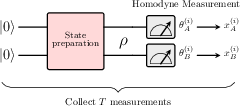
Figure 1: Schematic of the measurement protocol: single-copy, randomized-phase homodyne detection on each mode enables unbiased estimation of PT moments via classical post-processing.
Theoretical Framework and Protocol Design
The proposed protocol leverages the informational completeness of homodyne pattern functions in a truncated Fock space and constructs unbiased estimators—the U-statistics—for the second and third moments (p2, p3) of the partial transpose of the quantum state. The approach applies randomized homodyne measurements with local oscillator phases θA,θB drawn uniformly. The output statistics, via pattern functions Fn,m(x,θ), admit efficient and completely unbiased reconstruction of density matrix elements up to a chosen Fock cutoff N.
Rather than reconstructing the full partial transpose (as would be required for the direct Peres–Horodecki PPT criterion [peresSeparabilityCriterionDensity1996, simonPeresHorodeckiSeparabilityCriterion2000]), the method evaluates scalar witnesses based on PT moments:
Wlin=p3−23p2−1
Wquad=p3−p22
Negativity of either witnesses certifies entanglement; the quadratic witness further directly lower-bounds the state's entanglement negativity via closed-form expressions derived from these moments.
Crucially, the U-statistic estimators are computed through efficient accumulation over measurement tuples and can be evaluated with O(TN4) computational complexity, where T is the number of homodyne samples, sidestepping intractable combinatorial enumeration of moment matrices.
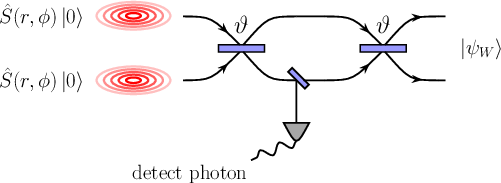
Figure 2: State preparation protocol for the Walschaers photon-subtracted state, a non-Gaussian benchmark used to demonstrate the failure of Gaussian criteria and the power of the p20-PPT family.
Entanglement certification is executed by evaluating whether the one-sided confidence interval of p21 lies below zero, controlling the false-positive rate and enabling rigorous detection with finite samples. Distribution-free concentration bounds provide explicit (though conservative) sample complexity scaling of p22 for additive accuracy p23, with more favorable scaling for states with geometric Fock-space decay.
Key Guarantees and Robustness
The protocol exhibits four essential features:
- Genuine entanglement witnessing under Fock truncation: Violation of the witness at any cutoff p24 implies genuine entanglement in the full, infinite-dimensional state. No false positives arise from truncation artifacts.
- No loss in detection validity due to local losses: As local loss channels are LOCC, any witness value p25 for a lossy state implies source entanglement, obviating the need for detector-efficiency calibration.
- Dimension-free negativity lower bound: The same estimators yield a closed-form, dimension-independent lower bound for the negativity, allowing direct entanglement quantification.
- Practical sample complexity: For typical states with p26 per mode, empirical one-sided detection probabilities of p27 are achieved with only p28–p29 homodyne shots.
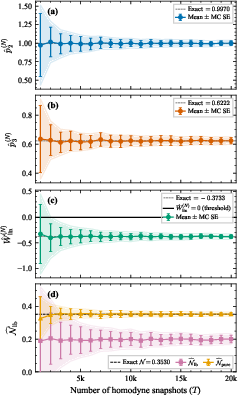
Figure 3: Convergence of moment and witness estimators with increasing homodyne sample size for the photon-subtracted state; truncation bias is negligible in the operational regime.
Empirical Benchmarking
The protocol's performance is demonstrated on a suite of Gaussian and non-Gaussian bipartite states, including:
The photon-subtracted Walschaers state at moderate squeezing (p32, p33) requires p34 samples for reliable detection. States with more concentrated Fock support (e.g., NOON states, cat states) allow certification with as few as p35 samples. The negativity bound recovered from p36 and p37 is tight for states with a single dominant negative PT eigenvalue (NOON and cat), but is looser for TMSV and its variants (18–50% of the exact value), consistent with wide spectral negativity distribution.
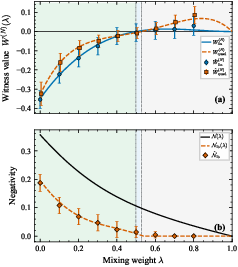
Figure 5: Witness values and negativity bounds for the mixed Walschaers state as a function of noise admixture. The protocol robustly detects entanglement with substantial vacuum noise.
Robustness tests to loss and phase noise show that local detector inefficiency predominantly degrades witness values, leading to higher sample complexity, while phase jitter has minimal influence within experimentally relevant ranges.
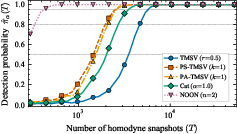
Figure 6: Empirical detection probabilities for six state families, showing practical detection budgets for all considered non-Gaussian states.
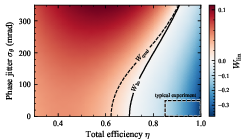
Figure 7: Witness value heatmap for the photon-subtracted Walschaers state under detector inefficiency and local phase jitter, highlighting loss-limited detection thresholds.
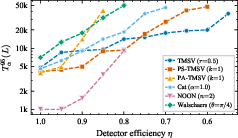
Figure 8: Required sample size for high-confidence detection versus detector efficiency across families, demonstrating practical feasibility for p38.
The protocol, by leveraging partial-transpose moment witnesses with efficient estimation, offers the following strong numerical and formal claims:
- Universal, truncation-independent detection: For any bipartite state, at any Fock cutoff, p39 implies genuine entanglement of the infinite-dimensional physical state.
- Closed-form, dimension-free negativity bounds: For any θA,θB0 with θA,θB1, negativity is bounded below by the root of a cubic polynomial, with an analytic rational bound as well.
- Robustness to local operations: Local optical loss, imperfect phase control, and phase discretization cannot produce false positives, simplifying experimental demands versus traditional approaches.
- Sample complexity scaling: Empirically, θA,θB2–θA,θB3 samples suffice in realistic regimes; worst-case state-independent complexity scales as θA,θB4, with more favorable scaling for rapidly decaying Fock states.
Implications and Prospects
Experimentally, this protocol places non-Gaussian entanglement certification—previously limited by the need for PNR or multi-copy detection—well within the reach of standard homodyne detection platforms. It can be applied immediately to existing datasets using only offline post-processing.
Theoretically, it demonstrates that non-Gaussian measurements are not required to detect non-Gaussian entanglement; instead, the non-Gaussianity is encoded in measurement statistics and efficiently extractable by appropriate functionals and classical processing. The protocol is agnostic to the state's detailed structure and efficiently tests all bipartitions, thus extensible to multipartite or high-mode CV systems.
Given the ubiquity of homodyne setups, this approach opens new avenues for entanglement certification in quantum optics, quantum networks, and future practical CV quantum processors, providing a scalable foundation for benchmarking and certifying experimentally relevant non-Gaussian resources.
Further extensions could incorporate more powerful PT-moment criteria (θA,θB5-OPPT [yuOptimalEntanglementCertification2021]), joint analysis across multiple bipartitions, improved sample-optimal strategies via quantum learning theory for CV states [Wu2024, Mele2025, mele2026advancesquantumlearningtheory], and leveraging efficiency-dependent pattern functions to reconstruct source-entanglement under calibrated loss.
Conclusion
The work establishes single-copy randomized-phase homodyne detection as a universal and experimentally accessible tool for non-Gaussian entanglement certification in continuous-variable quantum systems. By efficiently estimating partial-transpose moments and constructing robust statistical entanglement witnesses, the protocol overcomes the principal bottlenecks of previous approaches, enabling practical and rigorous certification for a broad class of entangled CV states. Practical sample budgets, universal guarantees, and insensitivity to standard experimental imperfections make this method a new standard for entanglement detection and quantification in quantum optics and CV quantum information science.
Figure 1: Schematic of the measurement protocol—single-copy, randomized-phase homodyne detection enabling unbiased PT-moment estimation.
Figure 2: State preparation sequence for the Walschaers non-Gaussian benchmark state.
Figure 3: Convergence and standard error of PT-moment and witness estimators for the photon-subtracted state as a function of sample size.
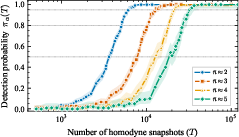
Figure 4: Detection probability as a function of shot number for several squeezing parameters, illustrating increasing sample complexity with growing mean excitation.
Figure 5: Witness and negativity estimates for the mixed Walschaers state, robust entanglement detection persists for significant vacuum contamination.
Figure 6: Comparison of detection probabilities across six state families for representative parameters.
Figure 7: Witness value heatmap under varying detector efficiency and phase noise, with contours of entanglement detectability.
Figure 8: Sample complexity versus detector efficiency for representative state families, confirming practical feasibility for minor losses.

