Basis- and Channel-Selective Quantum Photodetection
Published 16 May 2026 in quant-ph | (2605.16886v1)
Abstract: Photodetection converts optical quantum states into measurement events, but the usual electric-field response model becomes restrictive when the detector response is shaped by cavity, superconducting, or metamaterial engineering. We develop a generalized quantum photodetection framework in which electric and magnetic field amplitudes contribute coherently to the detection operator, and analyze it in a far-field two-source geometry, a two-mode single-photon setting, and a lossy resonant detector model. The far-field reference case exhibits complete detector-amplitude cancellation, absent in the electric-only Glauber response, while the single-photon model shows that the detector continuously rotates the effective measurement basis and controls the first-order visibility via an exact closed-form law. In the resonant realization, a monitored radiative output channel can be dark while the detector remains internally excited and absorptive, with unit absorption of the matched input mode at critical coupling. These results identify basis-selective readout and channel-selective absorption as experimentally relevant signatures of engineered electric-magnetic photodetection.
The paper introduces a generalized quantum detection operator that integrates coherent responses to both electric and magnetic fields, enabling new measurement modalities.
It demonstrates that tuning the detector parameter ζ permits basis rotation and interferometric control, illustrated by complete amplitude cancellation at ζ = -1.
The framework establishes design principles for channel-selective absorption, achieving unit resonant absorption with dark radiative output in engineered photonic platforms.
Generalized Quantum Photodetection: Basis- and Channel-Selective Readout
Introduction and Motivation
The paper "Basis- and Channel-Selective Quantum Photodetection" (2605.16886) presents a formal quantum photodetection framework extending the conventional electric-field-only model to incorporate a coherent response to both electric and magnetic field amplitudes. This extension is motivated by the emergence of engineered photodetectors in superconducting, cavity-assisted, and metamaterial platforms where the detector's response is controlled at a microscopic level and cannot be reduced to pure electric sensitivity. The approach captures detector-induced coherent superpositions and mode selectivity, enabling measurement-basis rotation and channel-selective absorption operationally relevant in quantum sensing, communication, and control.
Generalized Detector Formalism
The generalized detection operator is constructed as
O(r,t)=ue∗⋅E(+)(r,t)+ζum∗⋅F(+)(r,t)
where ζ∈C quantifies the magnetic-to-electric amplitude ratio, and F(+) is the rescaled magnetic field in electric units. The resulting detection probability includes interference terms between electric and magnetic sectors, permitting amplitude cancellation or enhancement—features inaccessible to the electric-only model.
Far-Field Cancellation Mechanism
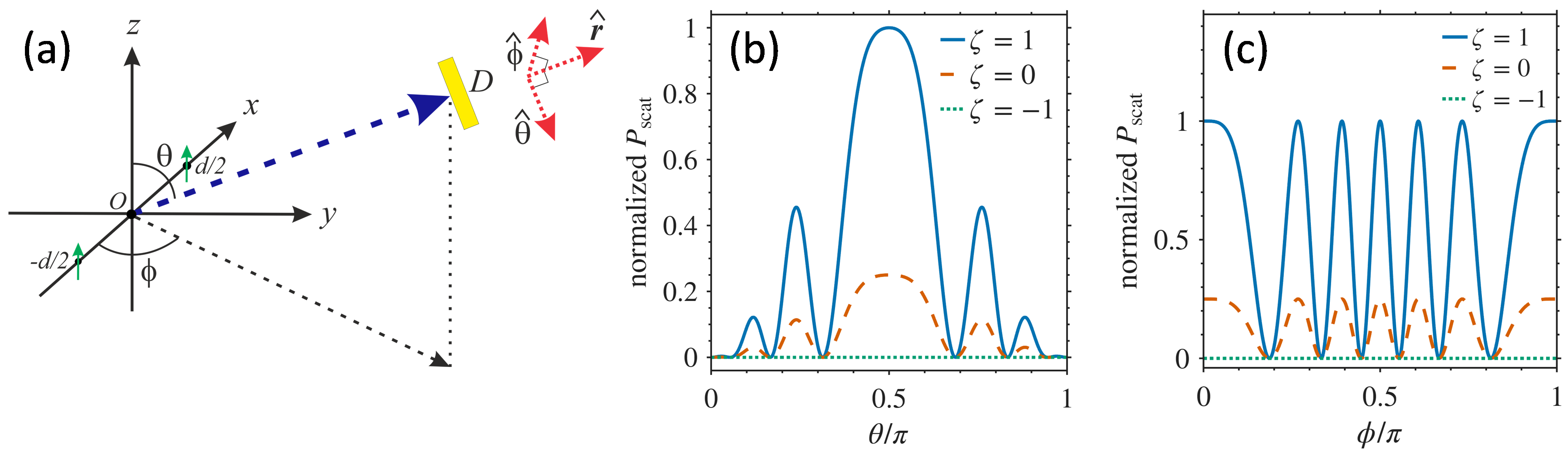
The first application is a two-dipole far-field geometry with proportional electric and magnetic projected amplitudes. The generalized detector modifies the detection weight but preserves spatial fringe structure. Critically, it exhibits complete amplitude cancellation at ζ=−1—a feature absent in pure electric detection, as the detection amplitude sums coherently with opposite sign magnetic response.
Figure 1: Two-dipole far-field reference geometry demonstrates complete radiative amplitude cancellation at ζ=−1 due to coherent electric-magnetic detector response.
This result establishes amplitude control as a design principle, but to achieve measurement-basis selectivity, the electric and magnetic responses must address distinct optical mode superpositions.
Single-Photon Mode Basis Rotation and Visibility Control
In a two-mode single-photon (right/left propagating) geometry, the detector's parameter ζ acts as a measurement-basis rotation in Hilbert space. The generalized operator selects
Oζ(x)∝(1+ζ)a^Reikx+(1−ζ)a^Le−ikx
The detector-defined visibility law is
Vζ=1+∣ζ∣2∣1−ζ2∣
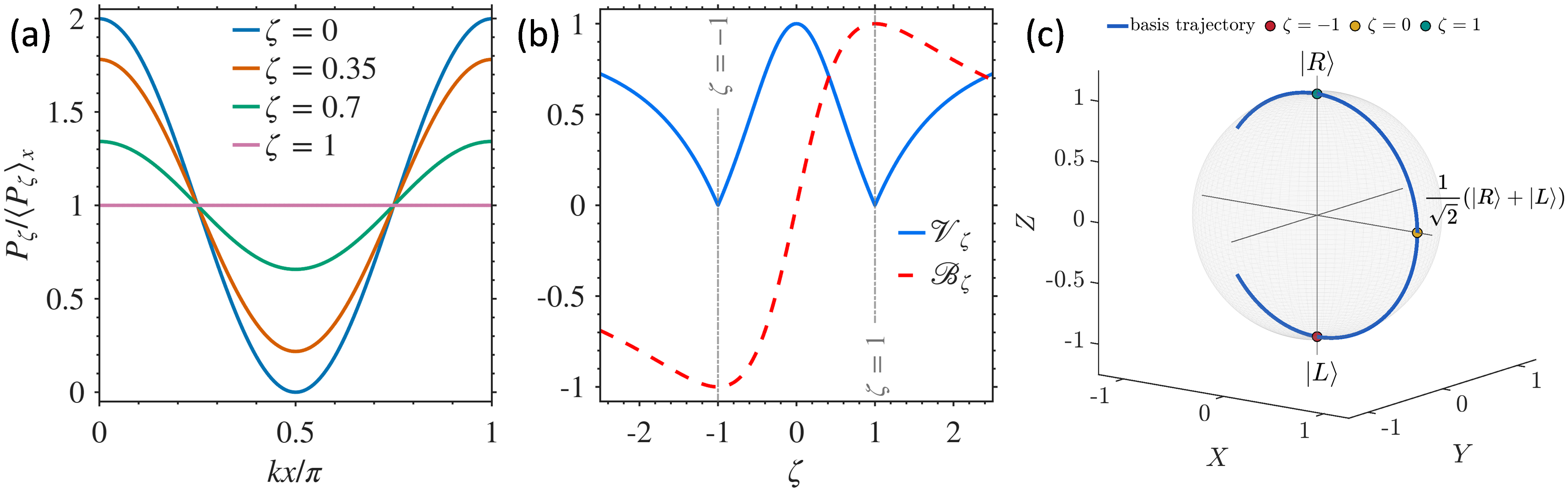
For ζ=0, conventional full-standing-wave visibility is recovered; for ζ=±1, the detector projects onto a single propagation direction, suppressing visibility while retaining quantum coherence. The detector thus interpolates between interference-sensitive (superposition) and path-sensitive (propagation mode) measurements.
Figure 2: Suppression of fringe visibility with real ζ∈C0 due to continuous detector-induced measurement-basis rotation; for ζ∈C1, visibility vanishes and the detector is path-selective.
The complementarity relation
ζ∈C2
links visibility to detector-induced path bias, confirming the operation is not decoherence but measurement-basis change.
Channel-Selective Radiative Output and Internal Absorption
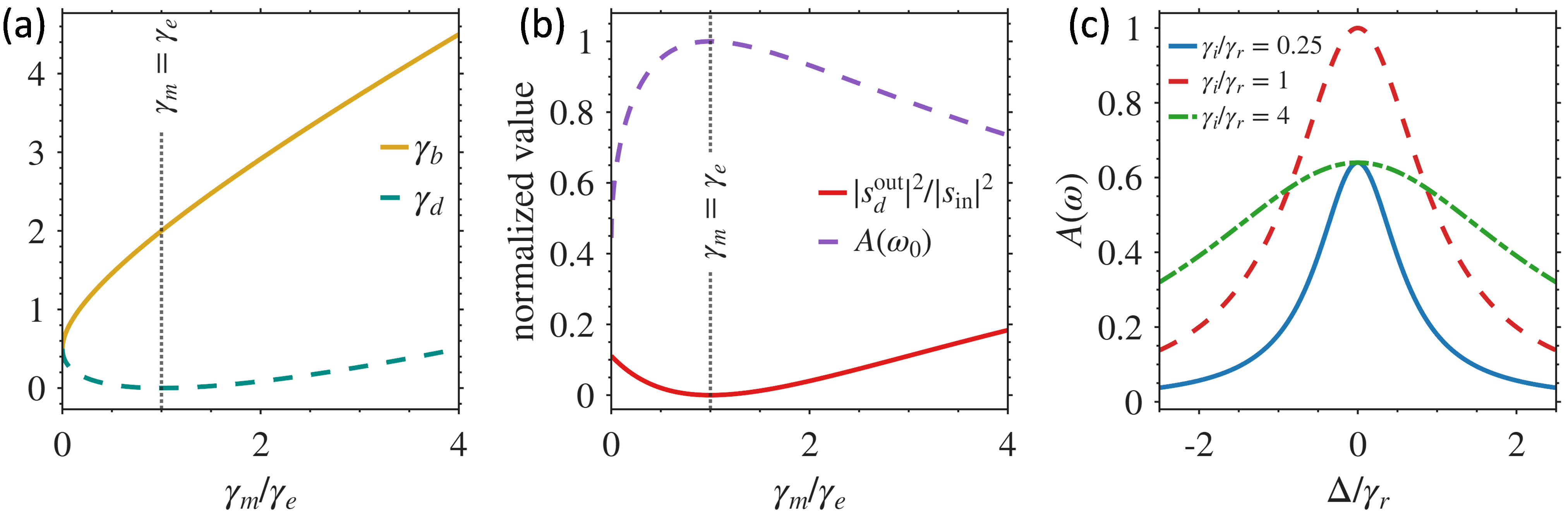
The final setting analyzes a lossy resonant detector with radiative electric and magnetic channels and internal dissipation. Bright and dark output channels are defined via constructive/destructive superpositions. At ζ∈C3, the dark output vanishes through electric-magnetic interference, while the detector remains internally excited and absorptive. The absorbed power at resonance and critical coupling (ζ∈C4) reaches unity, with no elastic radiative output in either channel.
Figure 3: At balanced ζ∈C5, monitored dark output is suppressed, but resonant absorption remains finite; at critical coupling, absorption is maximized and output is totally suppressed.
This establishes operational separation between radiative output darkness and internal absorption: suppression of monitored scattering channels does not imply vanishing interaction. The framework enables targeted control over accessible radiative channels and internal dissipation, highly relevant to engineered detectors in quantum photonic and microwave regimes.
Practical and Theoretical Implications
The paper's formalism provides explicit operational targets for engineered quantum photodetection:
Basis-selective readout: Detector parameter ζ∈C6 controls measurement-basis rotation in single-photon Hilbert space, directly affecting visibility and path bias.
Channel-selective absorption: Balanced electric-magnetic coupling allows suppression of selected radiative outputs with persistent internal absorption, enabled by geometric or impedance engineering.
Critical coupling absorption: The theory predicts conditions for unit absorption and elastic output suppression, foundational for device optimization.
These principles are applicable to superconducting nanowire detectors, nanophotonic and metamaterial devices, and microwave platforms, where magnetic and electric couplings can be balanced or designed. Extracting ζ∈C7, ζ∈C8, ζ∈C9, and F(+)0 experimentally enables platform-specific optimization for quantum information, sensing, and control.
Speculation on Future Developments
Future research directions include multimode extensions, device-resolved microscopic models, and platform-specific extraction of generalized detector parameters. The formalism invites approaches to active detector control, programmable measurement-basis selection, and robust channel engineering. Practical developments may leverage balanced electric-magnetic couplings for custom output suppression and absorption profiles in quantum networks, integrated detectors, and photonic circuits.
Conclusion
The generalized quantum photodetection framework developed in the paper establishes coherent electric-magnetic response as a design principle for engineered quantum detectors. Detector-controlled amplitude, measurement-basis rotation, and channel-selective absorption are formalized, with implications for single-photon visibility laws and operational separation between radiative and absorptive channels. The results provide rigorous targets for basis- and channel-selective quantum measurement in advanced photonic platforms.