- The paper introduces Enactive Drift Regulation (EDR) as a method that treats environmental drift as an organizational signal requiring structural reorganization.
- It details the Emergence Machine architecture, which uses multiscale attractors and regime memory to sustain adaptive coherence.
- The study compares EDR with traditional continual learning and online models, emphasizing regulation of systemic coherence over mere error correction.
Enactive Drift Regulation and the Emergence Machine: A Framework for Coherent Adaptation
Introduction and Motivating Problem
Adaptive artificial systems frequently encounter environments characterized by persistent non-stationarity, where statistical assumptions such as ergodicity and stationarity fail. Existing online learning and continual learning paradigms address degradation in predictive performance under drift by treating drift as noise, error, or distribution shift to be minimized via retraining, parameter adjustment, or filtering. However, these approaches often overlook the more fundamental phenomenon of the progressive breakdown of organizational coherence between the adaptive system and the changing environment.
This paper introduces Enactive Drift Regulation (EDR) as an alternative principle. EDR posits drift as an organizational signal, indicating systemic misalignment and requiring explicit regulation of structural coherence rather than mere error correction. Adaptation, under EDR, is reframed as a regulatory process governing the maintenance, reorganization, and selection of internal organizational regimes—a departure from the dominant view that emphasizes continual optimization and parameter fitting.
Conceptual Foundation: Drift as Loss of Organizational Coherence
The paper rigorously delineates distinct interpretations of drift—contrasting it with noise, transient error, and classical concept drift treatments. While noise is a stochastic perturbation, and error is an outcome-based performance measure, EDR defines drift as persistent, multiscale breakdown in system–environment coherence. This misalignment can manifest via unstable attractors, increased internal entropy, regime fragmentation, or cross-scale inconsistency, phenomena not diagnosable by classical error metrics alone.
Crucially, EDR interprets drift not as an anomaly but as the normative state in real-world conditions. In continuous, interactive settings—physiological monitoring, human-robot interaction, financial systems—regimes are not static; they reorganize, recur, and fragment. EDR foregrounds the need for mechanisms that proactively monitor and regulate coherence, ultimately requiring adaptation at the level of organization and not just model content.
EDR is formally defined as the process by which adaptive systems preserve organizational coherence by interpreting drift as a regulatory signal. EDR operates across three commitments:
- Regulation is primary: System-level regulation—deciding when and how to reorganize attractors, regimes, or scale dominance—supersedes parameter-level learning.
- Drift as endogenous signal: Drift is not treated as performance defect but as an organizing signal for adaptive regulation.
- Coherence as the central adaptive measure: Rather than optimizing an objective function, EDR seeks to maintain viable, stable, and recoverable couplings between organization and environment.
EDR explicitly distinguishes learning (parameter/content modifications within a regime) from regulation (structural reorganization, memory management across regimes, balance of plasticity and stability).
Emergence Machine: Architectural Instantiation
The Emergence Machine is presented as a system built around EDR. Its architecture captures the flow from streaming input, through hierarchical attractor formation (local, regional, global), to regime organization, coherence evaluation, skill and stress regulation, reorganization dynamics, and regime memory retention.
Core Components:
- Regimes: Distinct, temporally extended organizational modes stabilizing system behavior and enabling operation under variable environmental structure.
- Attractors: Multiscale, stable dynamic patterns encapsulated within regimes; they capture recurring structures at different timescales.
- Coherence Measures: Multivariate relational metrics—not limited to error—including attractor persistence, cross-scale agreement, internal entropy, and regime stability.
- Reorganization Dynamics: Mechanisms for selective, graded reconfiguration—dissolution or formation of attractors, regime transitions, cross-scale rebalancing—triggered by quantitative coherence degradation.
- Regime Memory: Structural memory spanning multiple regimes, supporting the reactivation of previously successful organizational forms upon recurrence of compatible environmental structure.
The architecture is designed as a closed regulatory cycle, where learning and prediction are nested within ongoing coherence-based meta-regulation.
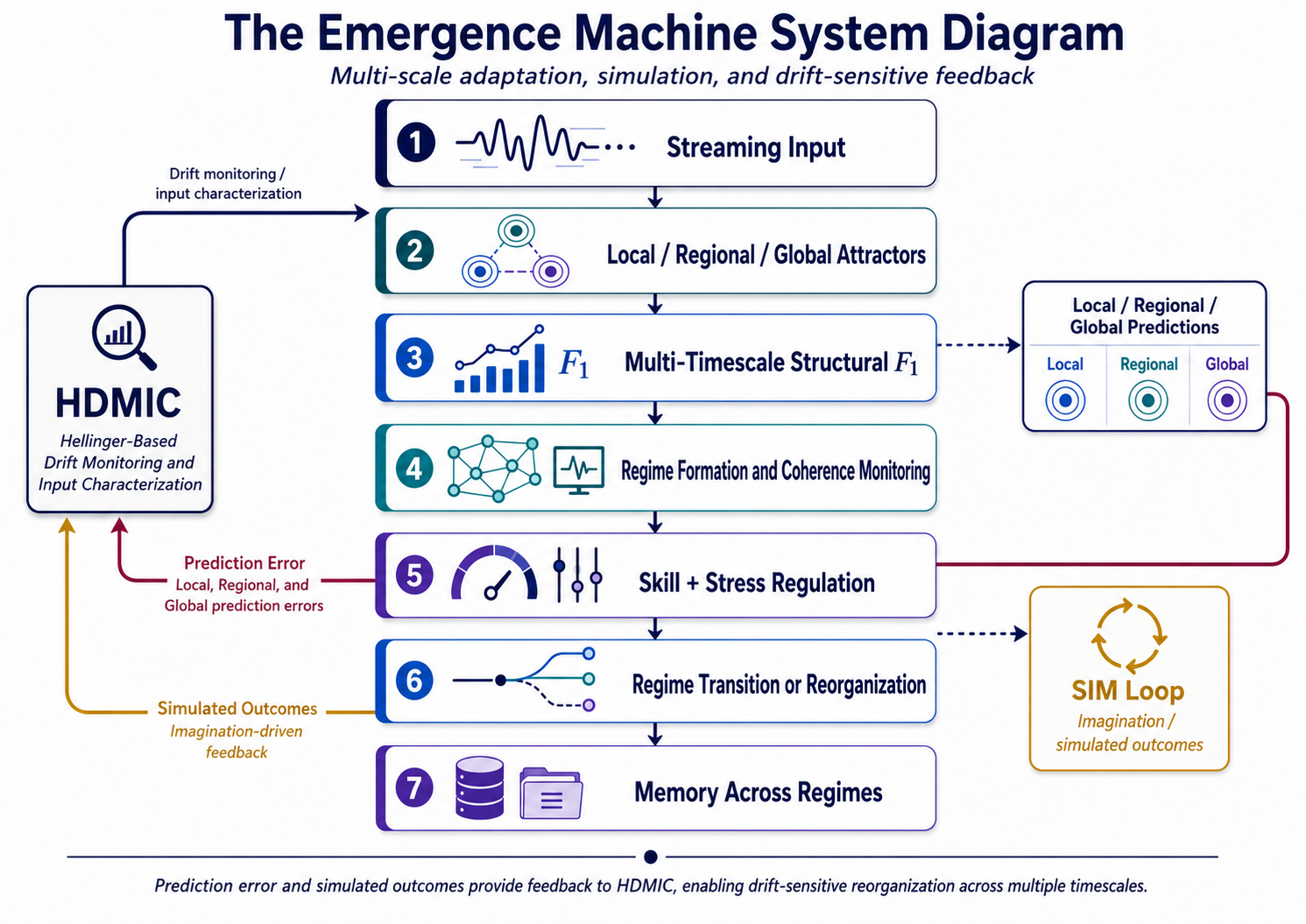
Figure 1: The Emergence Machine architecture emphasizes streaming, multiscale attractor formation, skill and stress regulation, and memory across regimes as part of its recurrent adaptation cycle.
The Tiny Emergence Machine provides a public, browser-based demonstration, implementing fully online, one-step-ahead forecasting and real-time visualization of regime assignments, prediction error, and drift pressure, all running locally for maximum inspectability.
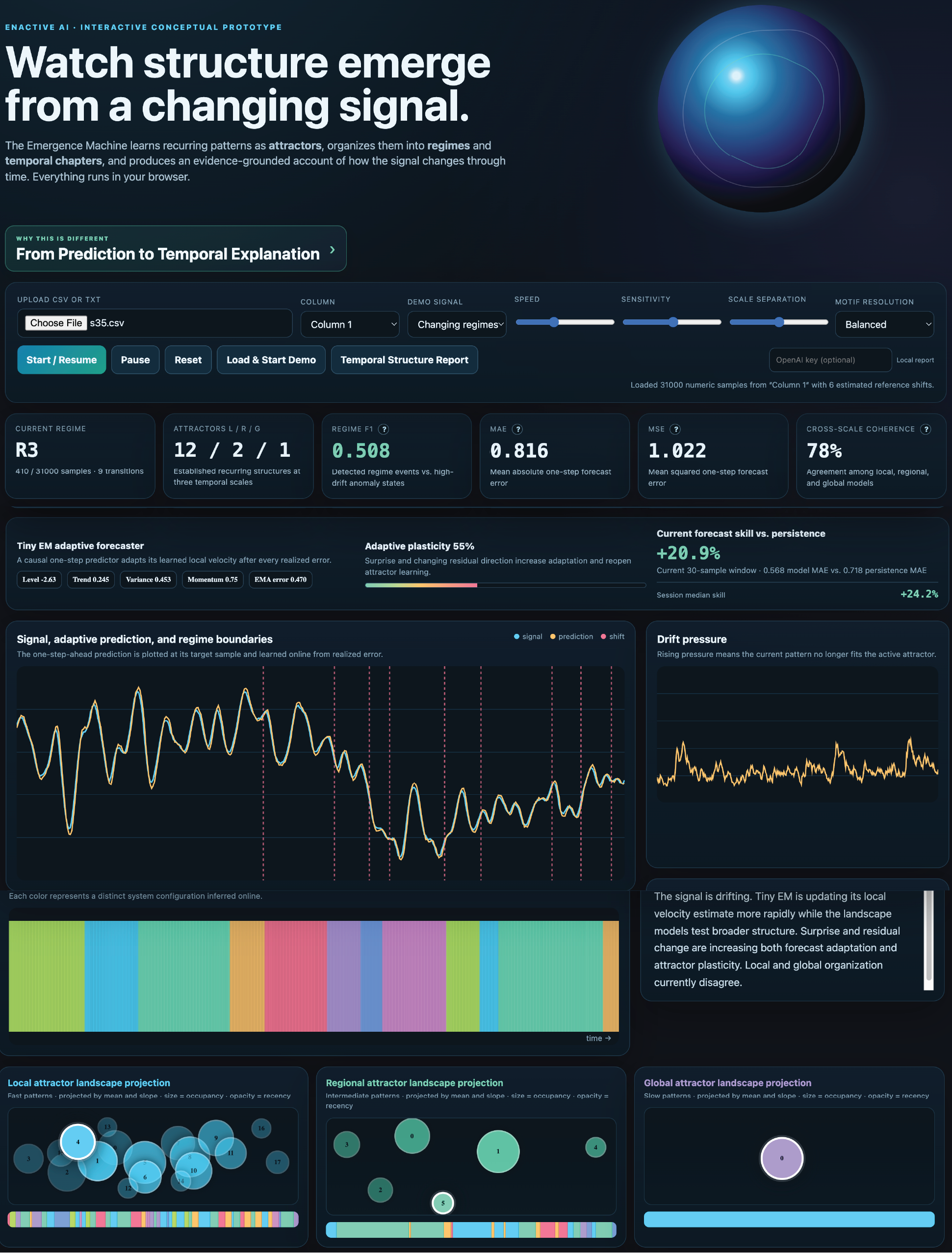
Figure 2: The Tiny Emergence Machine exposes real-time organizational processes, forecasting dynamics, and regulatory signals in a lightweight webpage implementation.
Comparison to Existing Adaptive Paradigms
The paper systematically positions EDR against continual learning, adaptive filtering, online learning, and predictive processing:
- Continual Learning: Focused on task-sequential knowledge retention and avoidance of catastrophic forgetting, typically operating under explicit or implicit task boundaries. EDR generalizes to non-task-delimited, continuous reorganization settings and maintains organizational coherence rather than task-specific performance.
- Adaptive Filtering: Assumes validity of model form, adapts parameters for smooth drift but fails to accommodate structural or regime-level changes.
- Online Learning: Employs incremental optimization, discounting, or windowing but fundamentally assumes single-objective, fixed-organization contexts. EDR decouples adaptation from continual optimization.
- Predictive Processing: Minimizes prediction error/free energy but often lacks explicit organizational meta-regulation. EDR directly targets regime coherence and proactive meta-adaptation rather than only error correction.
EDR contradicts the conventional objective of maximizing or preserving performance under change; instead, it asserts that sustaining coherence amid regime reorganization is paramount—even if this temporarily degrades classical accuracy metrics.
Implications and Future Directions
Practical Implications: EDR yields architectures that are robust to prolonged regime shifts, capable of continuous adaptation without catastrophic forgetting, reactive to organizational degradation before performance collapse, and intrinsically interpretable via regime states and transitions. This profile is beneficial for health monitoring, industrial control, adaptive robotics, and any domain where environmental regularities are subject to ongoing, multiscale reconfiguration.
Organizational Interpretability: By making regime assignments, attractor landscapes, skill/stress levels, and coherence metrics explicit and inspectable (as per the Tiny Emergence Machine), explainability arises naturally at the architectural level—addressing persistent challenges in interpretability for adaptive ML systems.
Theoretical Implications: EDR operationalizes an enactive conception of cognition, importing principles from organizational cybernetics and theorizing adaptation as ongoing maintenance of viable organization rather than performance on fixed tasks. This perspective offers a principled basis for the design of open-ended, long-duration adaptive agents.
Future Work: The paper outlines avenues for development of formal coherence metrics, empirical comparisons to mainstream continual and online adaptive methods, and practical deployment in domains requiring online, non-stationary adaptive intelligence. Benchmarking the Emergence Machine and similar architectures against long-duration streaming datasets is highlighted as critical for empirical grounding.
Conclusion
By reframing drift as an organizational signal and distinguishing between learning and regulation, the paper establishes a novel computational foundation for adaptive systems under non-stationarity. The Emergence Machine serves as an architectural exemplar, demonstrating continuous, drift-sensitive regulation via multiscale attractors, regime organization, structural coherence monitoring, and selective reorganization. This approach is well-positioned to reshape the design and understanding of adaptive intelligence in non-stationary environments, emphasizing coherence and organizational viability as central objectives rather than classical performance minimization (2607.03834).