- The paper introduces a modified Bardeen black hole metric incorporating perfect fluid dark matter effects, revealing altered singular behavior and horizon structures.
- It conducts a detailed thermodynamic analysis using the first law and heat capacity to identify phase transitions and stability regimes.
- The study generalizes to rotating solutions via the Newman-Janis algorithm, uncovering modified ergospheres and implications for energy extraction.
Bardeen Black Hole Surrounded by Perfect Fluid Dark Matter
The paper provides a comprehensive study on the Bardeen black hole immersed in perfect fluid dark matter (PFDM) and explores its thermodynamic properties, rotating generalizations, and energy conditions. This study extends known regular black holes' physics by incorporating PFDM, theoretically essential due to the cosmological prevalence of dark matter.
Spherically Symmetric Bardeen Black Hole in PFDM
The Bardeen black hole without singularities is realized in a nonlinear electrodynamics framework, where a magnetic charge is key. In the presence of PFDM, the gravitational field modifies due to an additional energy-momentum tensor representing the dark matter. The metric function of the black hole, modified to include dark matter effects, reveals singular behavior at the origin, unlike the regular Bardeen black hole, indicating a challenge posed by PFDM's influence.
The paper derives the metric:
f(r)=1−(r2+g2)3/22Mr2−rαln∣α∣r
where %%%%1%%%% is the magnetic charge and M is the mass. The thermodynamic analysis considers g and α as variables, leading to a discussion on thermodynamic stability marked by critical radii and phase transitions visible in the heat capacity analysis.
Thermodynamic Properties
The thermodynamics of the Bardeen black hole in PFDM is explored using the first law and Smarr formula. The entropy is computed based on the horizon area, and critical phenomena are highlighted through heat capacity analysis, revealing stable/unstable regimes influenced by the magnetic charge and dark matter parameter.
The temperature and thermodynamic potentials are derived and shown to follow standard thermodynamic relations, with critical behaviors indicating phase transitions.
Rotating Bardeen Black Hole via Newman-Janis Algorithm
Using the Newman-Janis algorithm, the paper generalizes the spherically symmetric solution to a rotating one, with the metric described in Boyer-Lindquist coordinates. This transformation reveals the black hole's rotating characteristics, such as horizons and ergospheres.
The presence of PFDM further modifies the typical Kerr black hole traits, influencing horizon structures, ergosphere sizes, and potentially energy extraction processes.
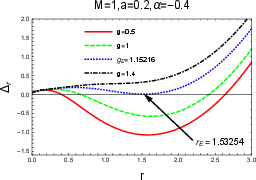
Figure 1: Plot showing epsilon and ϵ+pθ illustrating energy conditions near the black hole.
Weak Energy Condition and Horizons
The weak energy condition is evaluated, showing that PFDM violates this condition near the regular black hole's center. Such violations are common in rotating regular black holes and suggest quantum gravity effects may be at play.
The critical parameters (a,g,α) determine the horizon structures—indicating extremal configurations—and highlight the interplay between rotation and charge in forming horizons and ergospheres.
Penrose Process and Energy Extraction
The paper outlines the Penrose process for energy extraction from rotating Bardeen black holes in PFDM. The presence of the ergosphere allows negative energy orbits, facilitating energy extraction from the black hole's rotational energy.
Efficiency calculations suggest the maximal efficiency increases with rotation and magnetic charge, with complex dependencies on the dark matter parameter.
Conclusion
The paper extends the understanding of regular black holes surrounded by dark matter. It highlights how PFDM influences the classical properties and thermodynamic behaviors of such solutions, with implications for future studies in gravitational physics, particularly concerning dark matter's effects on cosmic and astrophysical phenomena.