Gemma 4 Technical Report
Abstract: We introduce Gemma 4, a new generation of open-weight, natively multimodal LLMs in the Gemma model family. Designed to advance compute efficiency and reasoning, the Gemma 4 model suite features dense and Mixture-of-Experts architectures, ranging from 2.3B to 31B parameters. Alongside improved vision and audio encoders for all model sizes, we propose a unified, encoder-free architecture for our 12B model, which ingests raw audio and image patches. Furthermore, we integrate a thinking mode, enabling Gemma models to generate reasoning traces prior to responding. We improve inference speed, memory, and compute efficiency, as well as long-context abilities through critical design choices. Gemma 4 establishes a leap in performance across STEM, multimodal, and long-context benchmarks, and rivals larger, frontier open models in human-rated tasks.
Paper Prompts
Sign up for free to create and run prompts on this paper using GPT-5.
Top Community Prompts
Explain it Like I'm 14
Gemma 4 Technical Report — Explained Simply
1) What is this paper about?
This paper introduces Gemma 4, a new family of AI LLMs from Google DeepMind. These models can understand and work with text, images, and audio (like speech). They are designed to be:
- better at reasoning (figuring things out step by step),
- faster and more memory‑efficient (so they can run on cheaper computers or even phones),
- and strong at handling very long documents.
Gemma 4 comes in different sizes, from small (2.3 billion parameters) to large (31 billion). There’s also a special “team of specialists” version called an MoE (Mixture‑of‑Experts).
2) What were the main goals?
In simple terms, the researchers wanted to:
- Make an AI that thinks more carefully before answering (a “thinking mode”).
- Handle longer inputs (like big PDFs or books) without running out of memory.
- Run faster and use less memory, so it works well on many devices.
- Be great at multimodal tasks: reading, seeing (images), and listening (audio).
- Stay open and usable by the community (they release the model weights under an Apache 2.0 license).
3) How did they build it? (Methods in everyday language)
Think of Gemma 4 like a very smart, flexible reader that can read text, look at pictures, and listen to short audio clips. Here are the key ideas, explained with analogies:
- Model sizes and types:
- Dense models: like one big brain that does everything.
- MoE (Mixture‑of‑Experts): like a team of specialists; only a few specialists are called in for each question, which saves time and energy.
- Multimodal understanding (text + images + audio):
- Older models often used separate “front ends” (encoders) for pictures and audio before passing info to the main brain.
- Gemma 4 improves these encoders and, for one model (the 12B version), removes them entirely. Instead, it feeds small image patches and 40‑millisecond audio pieces directly into the main brain using lightweight “projection” layers. Imagine taking small tiles of an image and short slices of sound and slotting them directly into the AI’s language space—simpler and more memory‑friendly.
- Thinking mode (reasoning traces):
- The model writes rough notes to itself before giving the final answer—like showing its work in math class. This helps it solve tougher problems in math and coding.
- Handling long documents (long‑context efficiency):
- The model needs “short‑term memory” to keep track of what it has seen. This memory can get huge for long inputs.
- The team uses two tricks:
- 1) Local vs global attention: Most of the time, the model pays close attention nearby (local), and only sometimes looks far away (global). It’s like skimming a book but carefully reading key parts.
- 2) Smarter memory storage: They reuse certain memory pieces and pick more compact “positional notes” (p‑RoPE), which reduces the memory footprint by up to about 37.5% in some parts.
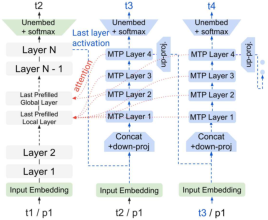
- Speed‑ups with speculative decoding (MTP drafter):
- Imagine a helper that quickly drafts several next words, and the main model checks and accepts many of them. This “drafter head” speeds up writing without losing accuracy.
- Using less memory with quantization:
- Quantization is like compressing images from very high quality to smartly smaller sizes you can’t easily tell apart. The model’s numbers are stored with fewer bits, reducing memory and making it run faster, including on mobile devices, while keeping quality high.
- Training and evaluation:
- They trained on a large, filtered dataset that includes text, code, images, and audio (cutoff January 2025).
- They tested the models on many benchmarks: school subjects (MMLU Pro), math competitions (AIME), coding tests, long‑document tasks, vision tests, audio transcription/translation, and human ratings. Safety and responsibility checks were also part of the process.
4) What did they find, and why does it matter?
- Stronger reasoning and coding:
- With thinking mode, Gemma 4 scores much higher on math and coding benchmarks than earlier Gemma versions.
- Better multimodal performance:
- It reads images and understands diagrams more accurately.
- It transcribes and translates speech better—even while using smaller or simpler audio components.
- The 12B model that skips separate encoders still performs competitively, which is impressive and simplifies deployment.
- Faster and more efficient:
- The MTP drafter speeds up text generation.
- Quantized versions greatly reduce memory use, helping the models run on devices with less hardware power.
- Long‑context tricks let the model read very long inputs with far less memory.
- Competitive with larger models:
- On human‑rated leaderboards, the largest Gemma 4 model (31B) performs on par with much bigger open models, and it leads among “dense” open models in that comparison.
Why it matters: These improvements mean you can get high‑quality reasoning and multimodal understanding without always needing massive, expensive servers. It’s a step toward making powerful AI more accessible, faster, and easier to use in real apps.
5) What could this change in the real world?
- More capable on‑device AI:
- Phones, laptops, and small servers can run strong models for chat, study help, coding, and media understanding (images/audio), even offline or with weak internet.
- Better tools for learning and work:
- Stronger reasoning helps with math explanation, step‑by‑step solutions, coding help, and document analysis.
- Improved multimodal skills help read charts, homework photos, or technical PDFs with diagrams.
- Open ecosystem and research:
- Open weights under Apache 2.0 let developers and researchers build, customize, and improve on top of Gemma 4.
- Safer and more responsible AI:
- The team filtered training data, followed safety policies, and tested models to reduce harmful outputs, while still keeping the models useful.
In short, Gemma 4 shows that careful design—thinking mode, efficient memory tricks, speed‑up helpers, and simpler multimodal inputs—can deliver a smarter, faster, and more accessible AI that works well across text, images, and audio.
Knowledge Gaps
Knowledge gaps, limitations, and open questions
Below is a focused list of what remains missing, uncertain, or unexplored in the Gemma 4 technical report, structured to guide follow‑up research.
Architecture and modeling
- Lack of ablation studies quantifying the impact of each architectural choice (local/global attention ratio, p‑RoPE settings, KV cache sharing, “keys=values” in global attention, QKNorm, per-layer embeddings in E2B/E4B) on quality, stability, and memory.
- No theoretical or empirical justification for reusing keys as values in global layers (except E2B/E4B): what are the attention expressivity trade‑offs and failure modes across tasks and lengths?
- Unclear how p‑RoPE with p=0.25 was selected and how it interacts with 1M/10k RoPE frequency split; missing sensitivity analysis across context lengths and tasks.
- Missing details on tokenizer design trade‑offs (262k vocab) across languages and code, and how vocabulary size affects memory, latency, and downstream accuracy.
- No discussion of catastrophic forgetting or instabilities (e.g., attention collapse) at extreme context lengths with the proposed attention patterns and position encodings.
MoE (26B‑A4B) specifics
- Absent description of MoE routing (number of experts, gating function, capacity factor, load balancing loss, token‑to‑expert assignment statistics) and its training/inference stability.
- No measurements of MoE inference latency vs dense models under identical hardware, batch sizes, and context lengths.
- Unclear how long‑context optimizations (KV sharing, keys=values) interact with expert routing and cache footprints.
Thinking mode (reasoning traces)
- No training details for thinking mode (data sources, supervision signals, formatting strategies, and whether traces are hidden by default at inference).
- Missing analysis of compute/latency overhead, token length control, and when thinking improves or harms performance across domains.
- Absent safety evaluation of reasoning traces (e.g., leakage of sensitive reasoning, jailbreak susceptibility, bias propagation) and mitigation strategies.
Multi‑Token Prediction (MTP) drafter and speculative decoding
- No quantitative acceptance rates, end‑to‑end speedups, or quality deltas across temperatures, draft lengths, tasks, and context sizes; lacks hardware‑specific benchmarks (TPU/GPU/CPU/mobile).
- Insufficient detail on the token‑cluster top‑k projection (how clusters are formed/updated, domain/language sensitivity, accuracy trade‑offs).
- Unclear memory overheads of the drafter (extra KV/state) under long contexts and its interaction with KV sharing/int8 caching.
- No guidance on when to enable/disable MTP, how to adapt draft length dynamically, or fallback behavior under low acceptance rates.
Quantization and memory efficiency
- Absent accuracy deltas for quantized vs bf16 models across text, vision, audio, and long‑context benchmarks; no per‑task/per‑size degradation report.
- Missing quantization details (zero‑points, rounding, per‑channel vs per‑tensor per layer, outlier handling, layerwise bitwidth assignments beyond high‑level labels).
- No robustness analysis of quantized models under OOD inputs, adversarial prompts, or extreme context lengths.
- Unclear stability of fp16 inference with introduced per‑block scales across sizes/hardware; no reproducibility guidance for kernel selection and graph fusions.
Vision modality
- No ablations isolating the effect of 2D‑RoPE plus absolute positional embeddings and non‑causal attention on downstream tasks.
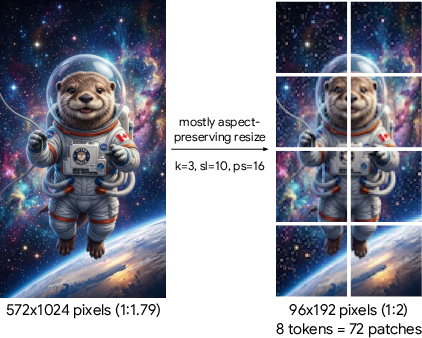
- Missing trade‑off study for the variable aspect ratio resizing/pooling pipeline (effect on OCR, dense reasoning, fine‑grained spatial tasks); how N_max choices affect accuracy and latency.
- Absent comparisons between 150M and 550M vision encoders on identical evals at matched resolution and compute budgets.
Audio modality
- The 12B encoder‑free audio path claims no additional positional encoding; unclear how temporal position is represented, especially for long utterances and cross‑utterance coherence.
- Limited robustness analysis under noise, accents, overlapping speech, far‑field, and streaming constraints; no latency and streaming benchmarks.
- No comparison between frozen USM‑based encoders and the encoder‑free approach on identical data and compute budgets.
Encoder‑free 12B (unified multimodal input)
- No ablation vs a 12B model with frozen encoders to quantify gains/losses in quality, latency, and memory fragmentation.
- Unclear scaling of 48×48×3 vision patches and single‑matmul projection to higher resolutions or dense reasoning tasks (e.g., docs, charts); missing failure case analysis.
- No description of training curricula or data balancing required for stable learning without encoders in multimodal settings.
- Absent robustness evaluation (e.g., image distribution shifts, audio noise) and sample‑efficiency comparison with encoder‑based setups.
Long‑context capabilities
- No training distribution details for context lengths, curriculum, or positional extrapolation techniques; unclear how much pretraining occurs at 32k/128k.
- Missing memory/latency curves across lengths and batch sizes, and guidance for practitioners on throughput trade‑offs.
- Absent evaluation beyond 128k tokens and on real‑world RAG pipelines (document retrieval, chunking, tool use) to assess practical utility.
- No analysis of degradation modes (e.g., pointer following, off‑by‑one addressing, multi‑needle MRCR tasks) under different attention ratios or p‑RoPE settings.
Training data and procedure
- No breakdown of pretraining data composition (domains, languages, code ratios, image/audio volumes), deduplication details, or mixing weights.
- Missing token counts, number of steps, LR schedules, optimizers, weight decay, gradient clipping, warmup, dropout, and regularization—hindering reproducibility.
- Limited transparency on decontamination methodology (rules, hash approaches, near‑duplicate thresholds) and residual contamination risk analyses.
Evaluation methodology
- Benchmarks often reported “with thinking,” but setup details (shots, prompts, temperatures, decoding params, trace length limits) are absent, making reproduction hard.
- Limited human evaluations outside text (e.g., no systematic multimodal human raters, inter‑rater reliability, and annotation protocols).
- No calibration and variance estimates across multiple seeds/runs on static benchmarks; few confidence intervals beyond Arena.
- Sparse analysis of task‑specific failure cases (hallucination patterns, tool‑use errors, format violations).
Function calling and tools
- Minimal detail on training for tool use, schema generalization, and function call reliability under adversarial inputs or schema drift.
- No end‑to‑end evaluation of tool‑use success rates (precision/recall) and security posture (prompt injection, data exfiltration via tools).
Safety, ethics, and security
- High‑level safety claims without concrete red‑teaming protocols or results for dual‑use risk areas (bio/chem/cyber, persuasion/deception, jailbreaks, multimodal harms).
- No measurements of memorization/regurgitation beyond generic filtering (e.g., verbatim recall rates, privacy audits).
- Absent discussion of watermarking, provenance, or weight signing to mitigate supply‑chain attacks and downstream tampering.
- No detailed mitigation strategies for potential harms from exposing reasoning traces (e.g., revealing exploit chains or sensitive step‑by‑step content).
Deployment and on‑device performance
- Claims of reduced memory and latency lack device‑level benchmarks (smartphones, edge GPUs/NPUs) across real workloads; no power consumption/thermal data.
- No guidance on model selection under different hardware constraints (e.g., when 12B encoder‑free beats 550M encoder variants in practice).
Licensing, release, and documentation
- Apache 2.0 licensing is stated, but data licensing/provenance for training content is unspecified; risks of training on non‑permissive data remain unclear.
- Missing comprehensive model cards with known limitations, bias audits, and usage constraints; limited ecosystem integration guidance for the custom IT/thinking tokens.
Reproducibility and environmental impact
- Absent compute budget reporting (TPU hours, FLOPs, energy, carbon footprint) and training efficiency metrics per quality point.
- No seeds, checkpoints, or scripts for exact reproduction of reported scores (beyond model weights), and no controlled ablations to isolate contributions.
These gaps, if addressed, would significantly improve scientific transparency, practical deployment guidance, and safety assurance for the Gemma 4 model family.
Practical Applications
Immediate Applications
Below are concrete, deployable uses that leverage Gemma 4’s open weights, multimodal inputs (text, images, audio), “thinking mode,” long-context capabilities, and efficiency improvements (quantization, KV sharing, MTP speculative decoding).
- On‑device multimodal assistants
- Sectors: consumer, accessibility, education
- Use cases: offline speech transcription and multilingual translation; image captioning and document Q&A on phones/tablets; assistive reading for low-vision users
- Tools/workflows: E2B/E4B quantized checkpoints (mobile/llama.cpp-style runtimes), 40ms audio chunking, variable‑aspect ViT encoders, <|think|> toggle disabled for end-user UX
- Assumptions/dependencies: device NPU/GPU with int8/Q4_0 support; acceptable latency budgets; supported language coverage (see FLEURS/CoVoST results); local safety guardrails
- Enterprise document copilots with long‑context
- Sectors: finance, legal, healthcare administration, government
- Use cases: chat over large contracts/policies (up to ~128k); summarize/compare versions; extract entities and obligations; analyze scanned PDFs and infographics
- Tools/workflows: long‑context RAG (RULER/LOFT‑informed chunking), OmniDoc/InfographicVQA‑style pipelines, variable‑resolution image ingestion (up to 1120 tokens), function calling for structured outputs
- Assumptions/dependencies: memory per request even with KV sharing; privacy/compliance (PII redaction); OCR integration where needed; quality monitoring for hallucinations
- Customer support and sales agents
- Sectors: telecom, retail, airlines (Tau2 tasks)
- Use cases: triage and resolution assistants; policy lookup; workflow orchestration (tool calling) with transparent intermediate reasoning for supervisors
- Tools/workflows: instruction‑tuned models with function calling (<|tool>), integration with CRM/ticketing, retrieval over knowledge bases, optional “thinking mode” for agent assist dashboards
- Assumptions/dependencies: robust grounding via RAG; agentic execution guards (RBAC, allow-lists); safety policy enforcement; call QA/auditing
- Coding assistants and code review
- Sectors: software, DevOps, embedded systems
- Use cases: in‑IDE autocomplete/explanations; test generation; refactoring; competitive programming; terminal task automation (TerminalBench)
- Tools/workflows: IDE plugins; sandboxed execution; tool calling for tests/builds; thinking mode for stepwise reasoning; long‑context for large repos
- Assumptions/dependencies: license scanning; secure code execution; organization‑specific fine‑tuning; evals for regressions
- Cost‑efficient model serving for LLM providers
- Sectors: cloud/edge inference, MLOps
- Use cases: higher throughput and lower latency serving using MTP drafters and KV cache sharing; mixed MoE/dense serving portfolios
- Tools/workflows: integrate MTP cross‑attention heads; enable shared KV caches; QAT/Q4_0 deployment paths; fp16 activation scaling
- Assumptions/dependencies: inference stacks supporting speculative decoding; acceptance rate tuning; monitoring of quality‑latency trade‑offs; engine support for cache sharing
- Business intelligence and analytics understanding
- Sectors: BI, consulting, research
- Use cases: interpret dashboards/infographics; automatically generate slide notes; extract insights from complex visuals
- Tools/workflows: image‑to‑text pipelines using ViT encoders or 12B encoder‑free projections; structured extraction via tool calls
- Assumptions/dependencies: consistent chart types; image token limits (e.g., 1120); visual prompt design
- Education and assessment support
- Sectors: K‑12, higher ed, test prep
- Use cases: step‑by‑step explanations for STEM; multimodal math (MATH‑Vision); rubric‑aligned feedback
- Tools/workflows: teacher vs student modes (thinking traces hidden for students); item‑bank alignment; offline classroom devices using quantized E2B/E4B
- Assumptions/dependencies: institutional policies on chain‑of‑thought; content safeguards; localization
- Accessibility and translation in the field
- Sectors: public safety, NGOs, media
- Use cases: offline meeting captioning; live translation for community services; reading assistance for printed forms
- Tools/workflows: streaming ASR + translation (E2B/E4B), language‑specific profiles; on‑device deployment for low‑connectivity contexts
- Assumptions/dependencies: language/domain adaptation; mic quality; latency targets
- Research and reproducibility
- Sectors: academia, open‑source
- Use cases: studies on long‑context retrieval, multimodal fusion without encoders (12B), effects of thinking traces; teaching courses on efficient inference
- Tools/workflows: Apache‑2.0 open weights; JAX/TPU training configs as references; quantization recipes; explicit conversation/formatting tokens
- Assumptions/dependencies: compute availability; dataset licensing; careful prompt templates for PT vs IT formatting
- Privacy‑preserving local deployments
- Sectors: SMEs, legal practices, clinics (non‑diagnostic admin)
- Use cases: on‑prem summarization/transcription of confidential materials; intake form processing
- Tools/workflows: quantized E2B/E4B local servers; Doc‑Q&A with OCR; redaction tools; audit logs with optional thinking traces for internal review
- Assumptions/dependencies: domain fine‑tuning; security hardening; regulatory compliance (e.g., HIPAA, GDPR)
Long‑Term Applications
These concepts are feasible but depend on additional research, engineering, domain data, or regulatory approvals.
- Persistent multimodal AR copilots
- Sectors: consumer wearables, enterprise field service
- Use cases: continuous audio‑visual guidance on glasses; context‑aware prompts over manuals, labels, schematics in real time
- Tools/workflows: encoder‑free vision/audio pipeline matured for low power; streaming long‑context; on‑device MTP and KV sharing
- Assumptions/dependencies: dedicated NPUs; heat/power constraints; continual learning without privacy leakage; robust tracking
- Clinical decision support (diagnostic)
- Sectors: healthcare
- Use cases: multimodal triage aides; summarization + structured extraction from EHRs and medical imagery; medical Q&A with verified reasoning traces
- Tools/workflows: domain‑specific fine‑tuning; retrieval from vetted guidelines; chain‑of‑thought for clinician audit (not shown to patients)
- Assumptions/dependencies: clinical validation; regulatory approvals (FDA/CE); strong safety and bias audits; protected data access
- Advanced agentic systems for IT/ops
- Sectors: cloud, cybersecurity, fintech
- Use cases: autonomous runbook execution across terminals/CLIs; long‑horizon remediation with auditable thought traces
- Tools/workflows: tool calling with strict policies; policy‑as‑code guardrails; secure shells; rollback and human‑in‑the‑loop approvals
- Assumptions/dependencies: high‑assurance verification; robust hallucination containment; fine‑grained access controls
- Cross‑lingual speech‑to‑speech assistants (fully offline)
- Sectors: public safety, travel, defense, humanitarian response
- Use cases: on‑device S2S translation without network; emergency communications in low‑resource settings
- Tools/workflows: extend ASR→NMT→TTS chain around Gemma‑based ASR/NMT; streaming latency optimizations
- Assumptions/dependencies: high‑quality TTS on device; expanded language/domain coverage; compression for small devices
- Legal/finance high‑stakes analytics with auditable reasoning
- Sectors: legal services, audit, banking
- Use cases: reasoned analyses of regulations and filings; risk scoring; structured extraction from annual reports with traceable rationales
- Tools/workflows: thinking mode logging; provenance tracking; long‑context RAG over internal corpora; red‑team review workflows
- Assumptions/dependencies: acceptance of machine‑generated rationales; robust grounding; liability frameworks
- Energy and industrial maintenance copilots
- Sectors: energy, manufacturing, utilities
- Use cases: interpret multimodal maintenance logs, schematics, and sensor imagery; long‑context incident analysis
- Tools/workflows: encoder‑free vision paired with domain ontologies; retrieval over maintenance KBs; field‑device deployment
- Assumptions/dependencies: domain datasets; ruggedized hardware; safety certification for advisory tools
- Education at scale with mastery learning
- Sectors: EdTech, public education
- Use cases: personalized, multimodal tutors that adapt to student mastery; teacher dashboards with chain‑of‑thought audits
- Tools/workflows: curriculum‑aligned reasoning traces; analytics on learning gains; on‑device for privacy
- Assumptions/dependencies: pedagogy research; policy decisions on CoT exposure; equity and bias monitoring
- Standardized efficient‑inference stacks
- Sectors: semiconductor, cloud platforms
- Use cases: hardware/software co‑design for MTP drafters, KV sharing, and quantized activations; inference standards for long‑context
- Tools/workflows: NPU kernels for speculative decoding; cache‑sharing APIs; compiler passes for activation scaling
- Assumptions/dependencies: ecosystem alignment (frameworks, vendors); benchmarking consensus; investment in kernel engineering
- Scientific literature and code copilots
- Sectors: academia, pharma, materials, climate
- Use cases: navigate long papers, lab notebooks, and multimodal figures; propose reproducible analyses; assist with code + data pipelines
- Tools/workflows: long‑context multimodal retrieval; lab‑tool function calls; reasoning traces for peer review
- Assumptions/dependencies: curated corpora with licenses; rigorous evaluation of factuality; integration with notebooks/ELNs
- Public‑sector policy analysis at scale
- Sectors: government, NGOs
- Use cases: process large, multimodal public comments; summarize impacts; produce traceable briefing materials
- Tools/workflows: thinking‑mode audit trails; open‑weight deployments for transparency; redaction and privacy tooling
- Assumptions/dependencies: governance around AI‑assisted policy; fair representation across communities; bias audits
Notes on Feasibility and Dependencies (Cross‑cutting)
- Model choice: E2B/E4B for on‑device and cost‑sensitive scenarios; 12B/31B for higher accuracy; MoE 26B‑A4B for cost/quality balance in server settings.
- Safety and alignment: apply domain‑specific guardrails, refusals, and monitoring; limit exposure of raw reasoning traces to end users where appropriate.
- Data constraints: knowledge cutoff Jan 2025; use retrieval for freshness; perform domain fine‑tuning for specialized tasks (medical, legal, industrial).
- Context and memory: long‑context still incurs memory/latency; plan hardware accordingly even with KV cache sharing and local/global attention ratios.
- Multimodal limits: image token caps (e.g., 1120 tokens) and variable aspect handling; audio pipeline assumes 16kHz/40ms chunks; encoder‑free 12B may require more tuning for specialized domains.
- Licensing and integration: Apache‑2.0 open weights enable commercial use; ensure third‑party data/tool licenses; adopt the provided formatting tokens (<|think|>, tool declaration/calls) for reliable tool use.
Glossary
- 2D absolute positional embeddings: Fixed position encodings in two spatial dimensions for images. "incorporate both axial 2D-RoPE~\citep{heo2024rotary} with non-causal attention and 2D absolute positional embeddings."
- 2D coordinate-based positional embeddings: Positional signals built from explicit x–y coordinates added to patch representations. "adding 2D coordinate-based positional embeddings directly to the patch representations before a final LayerNorm layer"
- Axial 2D-RoPE: A two-dimensional, axis-wise extension of Rotary Positional Embeddings for vision tokens. "incorporate both axial 2D-RoPE~\citep{heo2024rotary}"
- bfloat16 (bf16): A 16‑bit floating-point format with a larger exponent range than fp16, used for efficiency. "Model & bf16 & Quantized & KV Cache"
- Blockwise quantization (Q4_0): Quantizing weights in fixed-size blocks to 4 bits (Q4_0 variant). "Q4_0 quantization: blockwise quantization, often referred to as Q4_0."
- Conformer: A speech model architecture combining convolution and Transformer layers. "two downsampling convolution layers followed by twelve Conformer layers~\citep{gulati2020conformer}."
- Cross-attention: Attention mechanism where one sequence attends to another’s keys/values. "a 4-layer Transformer block that cross-attends to the KVs of the main model"
- Drafter (MTP drafter head): A small auxiliary model that drafts multiple future tokens for speculative decoding. "We train a small autoregressive MTP drafter head with our models, used for speculative decoding."
- Einsums: Count of compute-intensive tensor contractions (Einstein summations) in the model. "Einsums"
- Encoder-free architecture: A design that ingests raw modalities via projections without separate encoders. "we propose a unified, encoder-free architecture for our 12B model, which ingests raw audio and image patches."
- Global self-attention: Attention over the entire sequence, contrasted with local attention windows. "a 5:1 ratio of local sliding window to global self-attention"
- GSPMD partitioner: A system for general and scalable parallelization/partitioning of models across devices. "along with the GSPMD partitioner~\citep{gspmd}"
- int8 KV caching: Storing attention key/value tensors in 8‑bit integers to reduce memory. "int8 KV caching (+KV)"
- JAX: A high-performance numerical computing and ML system for Python with XLA compilation. "We use the single controller programming paradigm of JAX~\citep{bradburyJAX}"
- Keys-as-values reuse: Memory optimization reusing attention keys as values in global layers. "We improve memory efficiency by re-using keys as values in the global attention layers"
- KV cache: Cached attention key/value tensors used to speed up autoregressive decoding. "Extended contexts lead to a memory explosion in the KV cache."
- KV cache sharing: Sharing key/value caches across heads/layers to reduce memory. "Combined with KV cache sharing~\citep{mqa}"
- LayerNorm: A normalization technique applied across features within a layer. "before a final LayerNorm layer~\citep{ba2016layer}."
- Local sliding window attention: Attention restricted to a fixed neighborhood around each token. "a 5:1 ratio of local sliding window to global self-attention"
- MegaScale XLA compiler: A large-scale variant of the XLA compiler used for efficient ML computation. "and the MegaScale XLA compiler~\citep{xla}."
- Mel filterbank: Spectral features computed using mel-scaled filterbanks for audio input. "processes audio in 40ms chunks with Mel filterbank inputs."
- Mixture-of-Experts (MoE): An architecture where input tokens are routed to specialized expert subnetworks. "a Mixture-of-Experts~\citep[MoE]{jacobs1991adaptive} variant with 3.8B activated and 26B total parameters."
- Multi-Token Prediction (MTP): Predicting multiple future tokens per step to accelerate decoding. "We release an autoregressive multi-token prediction (MTP) drafter head~\citep{li2024eagle} designed for speculative decoding"
- Multi-pod training: Training across multiple hardware pods with data reduction over data center networks. "For multi-pod training, we perform a data replica reduction over the data center network"
- Non-causal attention: Attention that is not restricted by temporal order (can see future tokens). "with non-causal attention"
- Pathways: Google’s distributed system for large-scale ML training and execution. "using the Pathways approach of \citet{barham2022pathways}."
- Per-layer embeddings: Additional embeddings applied at each layer to enhance model capacity. "E2B and E4B use per-layer embeddings as in Gemma 3n"
- p-RoPE: A modified Rotary Positional Embedding with parameter p to alter frequency scaling. "use -RoPE~\citep{barbero2025round} as positional encoding."
- Pre-norm / Post-norm: Applying normalization before/after the main sublayers within each Transformer block. "Our models have pre-norm and post-norm with~RMSNorm~\citep{rmsnorm}, and~QKNorm~\citep{henry2020query}."
- Prefill (MTP prefill): The initial computation of context activations before iterative decoding; avoided by their MTP. "thus eliminating the need for MTP prefill"
- Quantization-aware training (QAT): Training models while simulating quantization to preserve accuracy post‑quantization. "quantization-aware training~\citep[QAT]{jacob2018quantization}"
- QKNorm: Normalization technique applied to query and key vectors in attention. "and~QKNorm~\citep{henry2020query}."
- RMSNorm: Root Mean Square Layer Normalization, a variant of LayerNorm without mean subtraction. "with~RMSNorm~\citep{rmsnorm}"
- RoPE (Rotary Positional Embeddings): A positional encoding method rotating queries/keys by position-dependent angles. "with RoPE on local attention layers"
- SentencePiece tokenizer: A subword tokenizer that learns a vocabulary of pieces, including byte-level encodings. "a SentencePiece tokenizer~\citep{kudo-richardson-2018-sentencepiece} with split digits, preserved whitespace, and byte-level encodings."
- Slice-Granularity Elasticity: Mechanism to continue training with fewer hardware slices when failures occur. "we leverage Slice-Granularity Elasticity~\citep{comanici2025gemini}, which allows continuous training with fewer “slices” of TPU chips"
- Speculative decoding: A faster decoding strategy that drafts tokens with a smaller model and verifies them with the main model. "designed for speculative decoding~\citep{10.5555/3618408.3619203}"
- Thinking mode: A generation mode where the model first produces reasoning traces before final answers. "we introduce a thinking mode~\citep{jaech2024openai} to Gemma 4 models."
- TPUv5p and TPUv6e: Google’s Tensor Processing Unit hardware versions used for training. "We train our models with TPUv5p and TPUv6e as outlined in Table~\ref{tab:training_infra_sharding}."
- Universal Speech Model (USM): A large-scale multilingual speech model architecture used as an audio encoder backbone. "The encoder architecture is based on the Universal Speech Model~\citep[USM]{zhang2023google}"
- Vision Transformer (ViT): Transformer architecture applied to image patches for vision tasks. "Both are Vision Transformers~\citep[ViT]{dosovitskiy2020image} with a patch size of 16"
- W8A8: Quantization format with weights and activations at 8‑bit precision. "quantizing activations and weights to 8-bit precision~(W8A8) yields a 2 reduction"
- ZeRO-3: A memory-optimization strategy that shards optimizer states, gradients, and parameters across devices. "The optimizer state is sharded using an implementation of ZeRO-3~\citep{ren2021zero}."
Collections
Sign up for free to add this paper to one or more collections.

