- The paper demonstrates that temporal nonlocality in qudit systems is exclusively determined by the mixedness of the input state across standard noise channels.
- It establishes a robustness hierarchy among temporal entanglement, steering, and nonlocality, with NSIT violation serving as a device-independent witness for temporal correlations.
- The research sets a fundamental fidelity bound for device-independent temporal teleportation, highlighting over-certification issues and operational limits in high-dimensional quantum systems.
Temporal Nonlocality in Qudit Systems: State-Bound Resource Characterization and Its Operational Implications
Overview and Motivation
The paper "Temporal nonlocality of a qudit resides in the input state, not the channel, and certifies temporal teleportation up to a fundamental limit" (2607.02331) rigorously addresses the nature of temporal quantum correlations in finite-dimensional systems, focusing especially on the operational meaning of temporal nonlocality in qudit systems subject to noise. The work provides a systematic hierarchy of robustness-based nonclassical correlations (entanglement, steering, nonlocality) in time, reveals an asymmetric dependence of temporal Bell-type resources on the initial state rather than the quantum channel, and establishes sharp bounds—both theoretical and practical—on the certified fidelity achievable by temporal teleportation protocols.
The Temporal Scenario and the State-Bound Resource
In the temporal scenario under study, a single qudit is initialized in a state ρA, measured at time tA (basis x), sent through a noisy channel E, and remeasured at tB (basis y). The central object of analysis is the joint probability P(a,b∣x,y) of measurement outcomes (Figure 1).
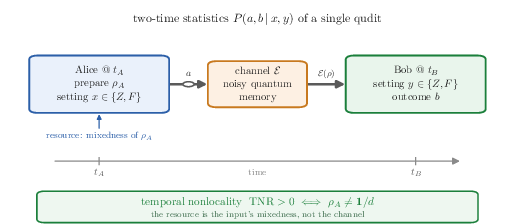
Figure 1: A schematic of the two-time scenario where a qudit is prepared in ρA, measured at tA (setting x), passed through tA0, and measured again at tA1 (setting tA2); all nonclassicality of tA3 arises from non-maximal mixedness of tA4 rather than channel coherence.
The primary, and somewhat surprising, result is that for all standard noise channels (including amplitude damping, phase damping, and depolarizing), the nonclassicality of two-time correlations—as quantified by the temporal nonlocality robustness (TNR)—is entirely determined by the mixedness of the input state tA5. Explicitly, TNR vanishes if and only if tA6 is maximally mixed (tA7) under a canonical two-MUB measurement scheme. The channel's action is generically irrelevant; only the initial state's nonuniformity supplies the necessary resource for observable temporal nonlocality.
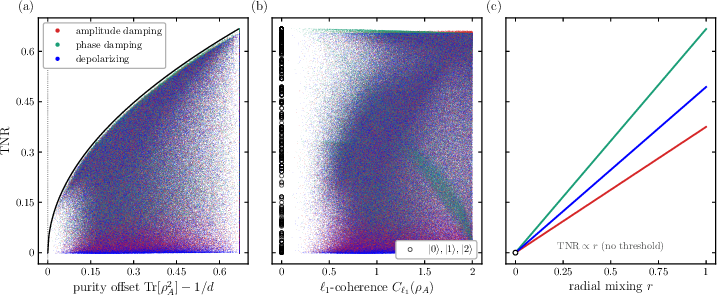
Figure 2: Monte Carlo sampling for qutrits (tA8) shows TNR correlates strictly with input state purity offset, saturating an analytic curve; coherence plays no direct role, with zero-coherence pure states attaining maximal TNR.
Hierarchy of Temporal Correlations and NSIT Equivalence
Temporal quantum correlations are organized analogously to their spatial counterparts: entanglement robustness (TER), steering robustness (TSR), and nonlocality robustness (TNR) satisfy a strict hierarchy,
tA9
for the maximally mixed input. The bounds are tight for canonical channels, with analytic and numerical validation across x0 to x1.
An important operational equivalence is established: the violation of the no-signaling-in-time (NSIT) condition is both necessary and sufficient for nonzero TNR. This renders NSIT not merely a consistency check but a genuine device-independent witness of temporal nonlocality; it can be monitored by Bob's marginal statistics alone without requiring full joint measurements.
Temporal Teleportation: Power and Fundamental Limits
The resource theory developed is applied to device-independent temporal teleportation (DI-TIT), where certification of quantum memory or communication is performed by a prepare-and-measure protocol using fixed test states and measurements (Figure 3).
The certified operational fidelity for temporal teleportation is analytically characterized. For any Heisenberg–Weyl-twirl covariant channel, the device-independent fidelity bound is
x2
with x3 the certified nonlocality robustness. The maximal honest certified fidelity is x4 for qutrits (x5), reached at x6.
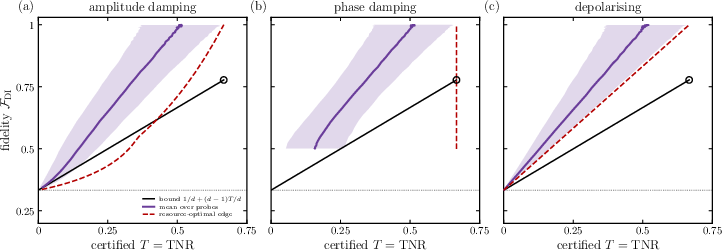
Figure 3: The fidelity x7 as a function of certified TNR for various random input probe states and standard channels at x8; fidelity is set by channel, but TNR may over-certify for fixed points of the channel.
Over-Certification and Its Resolution
A subtlety emerges: the device-independent certificate (e.g., TNR) can overestimate the actual channel's capability. This occurs when the probe state is invariant under the channel action (e.g., phase-damping preserves energy eigenstates), resulting in a maximal TNR value while the teleportation fidelity x9 falls below the honest classical threshold E0. The authors provide a complete classification: over-certification is excluded for the depolarizing channel, and universally for probes sufficiently mixed away from any channel-protected direction. There is a sharp, achievable fidelity ceiling at E1 (e.g., E2 for E3).
Numerical Results and Multi-Dimensional Generality
Extensive Monte Carlo sampling confirms the theoretical predictions up to E4. The TNR vanishes exclusively at the maximally mixed point, regardless of channel. The robustness hierarchy and NSIT bounds are saturated with high precision, and the symmetry between entanglement, steering, and nonlocality tiers persists in all accessible dimensions.
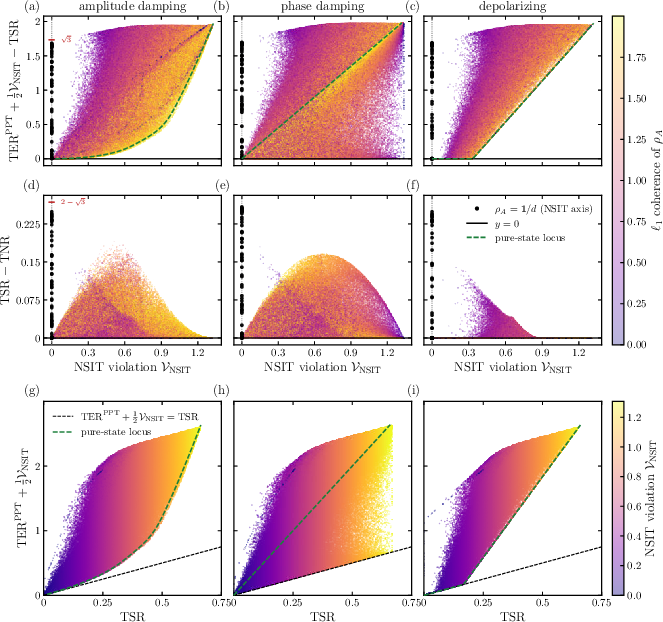
Figure 4: Numerical sweep illustrating the tightness of the universal NSIT-corrected upper bound and lower hierarchy, with the analytic pure-state locus agreeing with the extreme points.
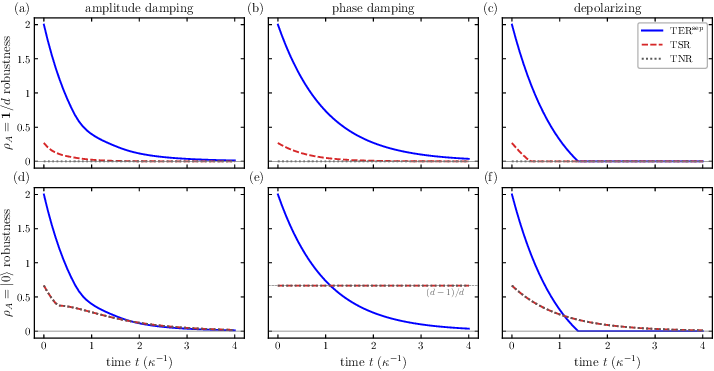
Figure 5: Detailed tier dynamics as a function of dephasing time, showing robustness plateau and explicit break of the upper hierarchy for pure, NSIT-violating inputs.
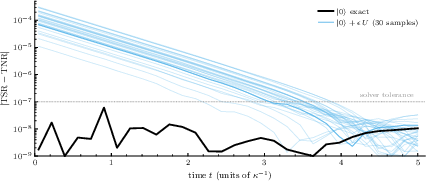
Figure 6: High-precision verification that E5 for the E6 phase-damping configuration, a unique submanifold saturating both robustnesses.
Implications, Limitations, and Prospects
Theoretically, the work reveals a fundamental asymmetry in temporal resource theories compared to spatial quantum protocols: device-independent temporal resources are controlled by input state properties, not by nontrivial quantum channel structure. Quantum back-action (measurement disturbance) is shown to be a sufficient and necessary driver of temporal Bell-type correlations.
Practically, this sharply constrains trustless certification of quantum communication and quantum memories based on temporal Bell-inequality violations. The possibility of over-certification necessitates mixed-state probes and careful protocol design to avoid certifying unphysical or unachievable fidelities. The result has immediate implications for the benchmarking of time-bin channels, solid-state and photonic memories, and secure time-distributed cryptographic protocols.
Speculatively, the identification of state-bound temporal resources opens questions on continuous-variable generalizations, optimal certification strategies for adversarial channels, and connections to quantum contextuality and two-state vector formalism. The scaling of the temporal robustness hierarchy and device-independent teleportation with system dimension suggests intriguing prospects for high-dimensional quantum information processing and memory architectures.
Conclusion
The paper delivers a definitive analysis of temporal nonlocality for single qudits, establishing that—contrary to naive expectation—the resource for device-independent temporal nonclassicality is entirely a property of the input state. This insight underpins a rigorous certification framework for temporal teleportation and quantum memory protocols, sharply characterizing both the achievable power and inevitable limits of device-independent approaches in noisy, high-dimensional quantum systems.
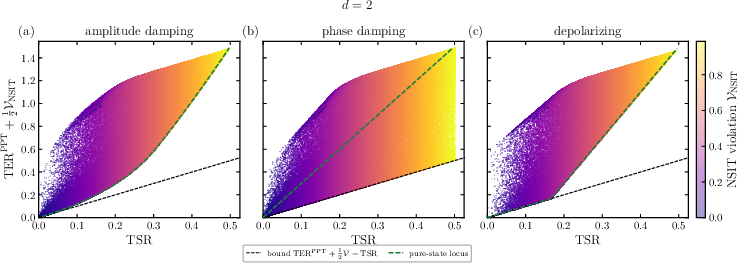
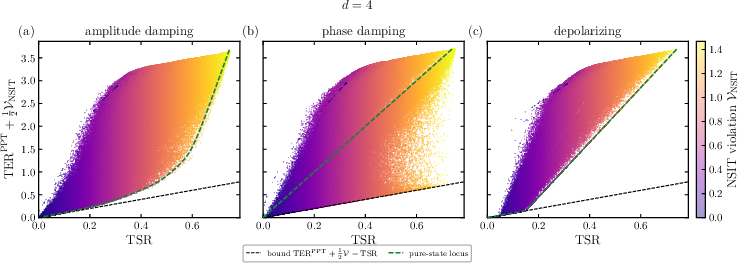
Figure 7: The universal bound E7 versus E8 across a full configuration ensemble, demonstrating tight hierarchy relations and complete coverage of the operational regime.