- The paper establishes strong converse bounds that precisely capture the decay of classical identification capacity as noise increases.
- It employs a geometric ellipsoid-covering approach and classical-quantum soft-covering lemmas to derive tight upper bounds under product measurements.
- The results align identification capacity with classical transmission capacity for simultaneous codes while highlighting limitations in noisy regimes.
Strong Converse Bounds on the Classical Identification Capacity of the Qubit Depolarizing Channel
Introduction and Background
This work rigorously addresses strong converse bounds for classical identification capacity in the context of the qubit depolarizing channel, one of the canonical quantum noise models. Classical identification capacity quantifies the doubly exponential scaling of the number of classical messages that can be reliably identified (rather than transmitted) through parallel uses of a quantum channel. In contrast to transmission capacity, identification accommodates codes where the receiver only answers whether the sent and tested message coincide, relaxing the operational requirement and entailing profoundly different capacity phenomena.
The authors' central technical contribution is deriving strong converse bounds—upper bounds that become tight in the strong converse sense, i.e., above which the identification error necessarily converges to unity as the blocklength increases. Prior advances, e.g., Atif, Pradhan, and Winter, provided universal strong converse bounds for fully quantum channels [atif2024quantum], but these suffer from nonvanishing positivity even on completely noisy (fully depolarized) channels, leading to incorrect asymptotic behavior. The present paper establishes bounds for the qubit depolarizing channel Np that inherently vanish as p→1, conclusively capturing the operational impossibility of identification in the fully noisy limit.
Identification Task and Channel Model
Classical identification codes over quantum channels are defined via families of encoding states and decoding measurements, where the identification test is binary—accepting or rejecting—rather than reconstructing the full message. Codes exist in unrestricted (potentially incompatible binary tests) and simultaneous (coexistent measurements from a refining POVM) forms. The identification capacity CID(N) specifies the maximal double-exponential rate (per channel use) at which messages can be identified with vanishing error probabilities.
The focus is the qubit depolarizing channel Np, defined for any input state ρ∈D(C2) as:
Np(ρ)=(1−p)ρ+p2I2,
with p∈[0,1] parameterizing the noise strength. As p approaches 1, the channel output approaches the fully mixed state, completely erasing input information.
Simultaneous Identification: Complete Product Measurements
The paper delivers a single-letter characterization of the simultaneous identification capacity under the physically motivated restriction of complete product measurements. Leveraging the structure of the depolarizing channel and product measurements, the problem is mapped onto identification over an n-fold binary symmetric channel (BSC) with crossover probability p/2.
(Figure 1)
Figure 1: The identification capacities and converse bounds for the qubit depolarizing channel as functions of p→10. (A): Unrestricted codes—quantum and geometric bounds. (B): Simultaneous codes with product measurements—tight achievability and converse results.
Measurement statistics after the product channel reduce to classical distributions, allowing the application of classical-quantum soft-covering lemmas to bound covering numbers for code-induced output distributions. The main result is that, for simultaneous codes with complete product measurements,
p→11
with p→12 the binary entropy. This equality is established in the strong converse sense: any rate exceeding this bound leads to asymptotically unit error. Notably, this matches the classical capacity, indicating that, in this setting, the identification and transmission tasks are equally constraining.
Unrestricted Identification: Geometric Ellipsoid Covering
For general (unrestricted) identification codes, the channel output set for p→13 uses is geometrically embedded as an ellipsoid in p→14, representing contractions of the generalized Bloch vector due to depolarizing noise. The core methodological innovation is to analyze the minimal covering with unit-radius Euclidean balls, circumventing prior dimension-based bounds.
By quantifying the number of Pauli directions with sufficiently large contraction factors, and applying tail bounds for the binomial distribution of the indices of nontrivial Pauli strings, the authors derive the following strong converse upper bound:
p→15
where p→16 and p→17 is the binary relative entropy.
The salient features of this result are twofold:
- The upper bound correctly vanishes in the completely noisy limit (p→18), as desired for a strong converse,
- The bound is strictly tighter (especially for high noise) than prior soft-covering-based dimension-dependent bounds.
Capacity Bounds for General Quantum Channels
A further generalization for arbitrary quantum channels p→19, without the constraint of simultaneity, refines the universal quantum soft-covering bounds by replacing the strong converse quantum capacity with the classical capacity, yielding:
CID(N)0
where CID(N)1 is the input dimension. This result follows by refining the rank constraints in soft-covering arguments and explicitly constructing low-rank approximations to input states whose channel outputs approximate any output with high probability. While this bound is not dimension-free, the replacement of quantum with classical capacity simplifies its evaluation for additive channels (such as depolarizing) and more accurately tracks the operational cut-off in the high-noise regime.
Numerical Illustration and Comparative Analysis
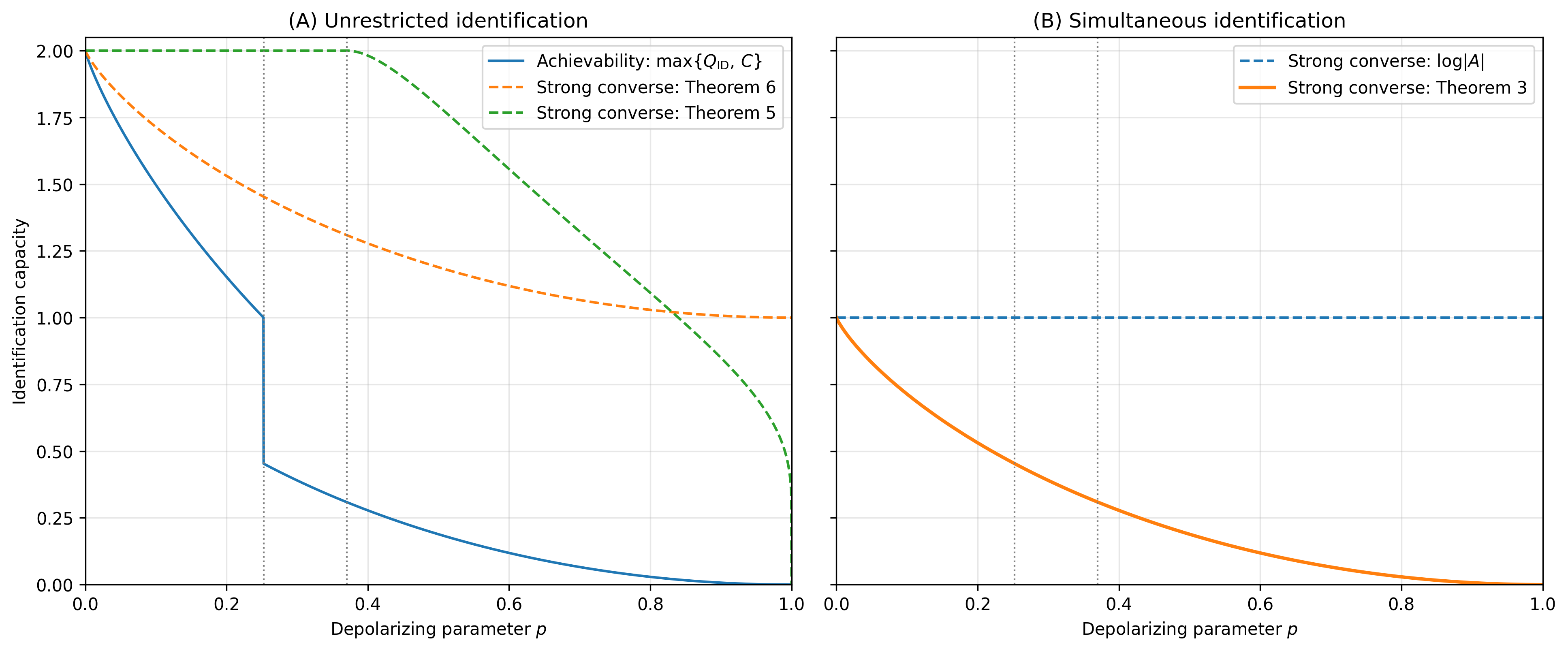
Figure 2: (A): Unrestricted identification capacities—comparison of the new geometric bound and classical capacitybased bounds for varying CID(N)2. The strict decay as CID(N)3 is highlighted. (B): Simultaneous codes with complete product measurements—strong converse matches achievability, compared to previous bounds exhibiting dimension-dependent saturation.
The figures demonstrate:
- For unrestricted identification, the geometric ellipsoid-covering bound (green curve) better captures the operational vanishing of capacity as the channel becomes noisy, outperforming the prior combined dimension-classical capacity bound for CID(N)4.
- For simultaneous identification with product measurements, the achievability and strong converse coincide (orange), while the older log-dimension bound (blue) overestimates the true capacity except for CID(N)5.
Implications and Avenues for Future Work
Practically, the identification capacity characterizes systems where only question-specific message verification (rather than full transmission) is needed, e.g., privacy-preserving authentication. The matching of simultaneous identification capacity and classical transmission capacity in the presence of product measurements delineates the frontier where quantum advantage is nullified by measurement locality.
Theoretically, this work provides the first instance of a dimension-free strong converse bound for full quantum channels exhibiting the physically correct vanishing in extreme noise. It also clarifies the role of the channel's output geometry in constraining identification rates, an aspect possibly extendable to other unitarily covariant or additive-noise channels.
Several directions remain open. Most notably:
- For the depolarizing channel without the restriction to product measurements, it is unknown whether simultaneous identification capacity always coincides with the classical capacity or if entangled measurements can enhance identification rates.
- Further generalizations could consider non-unital channels, higher-dimensional "qudit" depolarizing noise, or identification under adversarial noise models.
- Tight lower bounds and possible exact characterizations in the unrestricted, simultaneous, and entanglement-assisted identification regimes remain largely unexplored.
Conclusion
The paper establishes operationally meaningful, strong converse upper bounds for the classical identification capacity of the qubit depolarizing channel, sharply capturing the noise dependence that prior work failed to reflect. Under product measurement constraints, the identification and transmission capacities align, while for unrestricted codes, the innovative ellipsoid covering argument produces the correct asymptotic decay in highly noisy environments. The broader architecture of the techniques has implications for general quantum channel identification theory and invites significant further research, especially on the optimality of entangled measurements and the interplay between channel symmetries, noise, and quantum identification phenomena.