- The paper demonstrates that sequential protocols achieve higher fidelity than parallel ones at n=4, highlighting a non-asymptotic advantage in noisy channel purification.
- It introduces an explicit U(2)-covariant entanglement-assisted QECC that meets the first-order scaling lower bound for purification error in the low-noise regime.
- Combining numerical SDP analysis with metrological bounds, the study establishes a tight Theta(1/n) noise suppression law for qubit unitary channels.
Scaling-Optimal Purification of Noisy Qubit Unitary Channels
Problem Formulation and Context
The paper addresses the purification of noisy qubit unitary channels under depolarizing noise, i.e., given a channel NU,p=Dp∘U (where U is an unknown $2$-dimensional unitary and Dp is a qubit depolarizing channel with strength p), the goal is to construct a quantum superchannel Ξ that outputs a channel approximating U as closely as possible, provided n uses of NU,p. The performance is quantified via the Choi fidelity with respect to the identity channel for all U∈U(2).
Unlike quantum state purification, channel purification admits a richer set of protocols—sequential, parallel, and those implementing adaptive or indefinite causal order strategies. While state purification is constrained by the no-cloning and symmetric structure, channel purification benefits from the operational freedom to leverage channel composition, encoding, and error correction techniques, including quantum error-correcting codes (QECCs) and superchannels.
Sequential Versus Parallel Strategies: Finite-U0 Behavior
Through semidefinite programming (SDP) formulations exploiting unitary symmetry, the authors numerically analyze the optimal purification fidelity for small U1. They observe that for U2 uses, sequential and parallel protocols are equivalent in performance. In contrast, for U3, sequential strategies yield strictly higher fidelity than parallel strategies, with the largest observed improvements U4 in the U5 regime, thus establishing a clear separation between the two at finite U6. For U7, the two approaches converge to the same fidelity within numerical precision.
This establishes a strict but non-asymptotic advantage for sequential strategies at select low U8, suggesting that the set of optimal protocols depends on the parity and structure of U9, and, more fundamentally, on the available group-covariant code constructions.
Covariant Entanglement-Assisted Quantum Codes and Scaling Bounds
A central result is the construction of an explicit $2$0-covariant entanglement-assisted QECC tailored to the purification task. The construction employs the quantum Schur transform and exploits the representation-theoretic decomposition of $2$1-fold qubit tensor products. This code saturates the first-order scaling lower bound for purification error in the low-noise ($2$2) regime. Concretely, for odd $2$3:
$2$4
where $2$5 is the optimal (sequential) average channel fidelity. The optimal decoding map is enabled via ancillary entanglement, so the protocol is entanglement-assisted.

Figure 1: An entanglement-assisted $2$6-covariant quantum error-correcting code that purifies $2$7 noisy channels, attaining optimal first-order noise suppression.
Asymptotic Optimality and Quantum Metrological Upper Bound
The scaling-optimality of the scheme is established by matching the code's lower bound to a quantum metrological upper bound. The latter leverages the regularized symmetric logarithmic derivative (SLD) quantum Fisher information (QFI) and shows that under any sequential (or parallel) strategy, the leading scaling of infidelity must satisfy
$2$8
The $2$9 scaling is thus tight, and the gap between prefactors in the lower and upper bounds is subleading. This demonstrates that, asymptotically in Dp0 and for Dp1, parallel (QECC-based) strategies are as effective as adaptive sequential strategies.
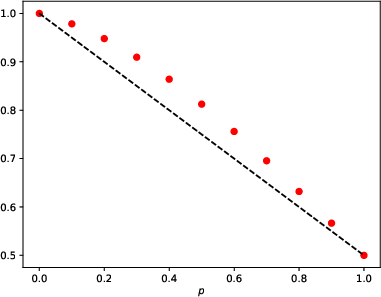
Figure 2: Channel fidelity as a function of depolarizing strength Dp2 for the optimal protocol, demonstrating Dp3 first-order noise scaling.
Comparison to Prior Art and Code Properties
The constructed code outperforms previously proposed covariant QECCs for the depolarizing channel, such as generalized W-state encodings, which only achieve Dp4 suppression. Alternative protocols that concatenate minimal schemes (e.g., the 3-slot protocol) achieve strictly suboptimal scaling. Notably, topological/thermodynamic codes attaining Dp5 scaling lack full universality (i.e., Dp6 covariance) and thus do not generally solve the unitary purification problem for unknown target unitaries. The parity effect in Dp7 is rooted in the structure of irreducible representations supporting the covariant code.
Implications and Future Directions
The results provide a precise operational distinction between state and channel purification, showing strict sequential advantages for finite Dp8 and full asymptotic equivalence for large Dp9. The asymptotic scaling result p0 for the depolarizing model is likely to be a benchmark for future protocol designs in fault-tolerant quantum computation and noise-resilient quantum information processing.
Open questions include:
- Characterization of the exact leading-order coefficient for all p1 and the existence of even/odd separations.
- Extension to non-unital noise models (e.g., amplitude damping).
- Generalization to dimension-independent (arbitrary p2) purification with p3 covariance and minimal resource overhead.
- Analytical tightness of the lower bound for all noise regimes and p4.
Conclusion
This work establishes the optimal noise suppression law for purification of qubit unitaries under depolarizing noise, unifies the roles of sequential and parallel strategies across finite and large p5, and provides both a practical (explicit QECC construction) and theoretical (metrological resource bound) foundation for channel purification. The insights into group-covariant code design and quantitative benchmarking are relevant for future advances in quantum error correction, distributed unitary synthesis, and quantum channel simulation.