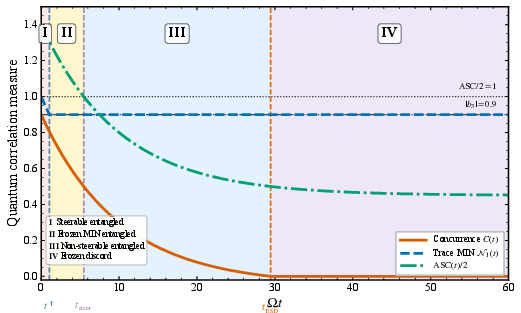
- The paper establishes a precise temporal hierarchy among quantum correlations (concurrence ≤ Trace MIN ≤ ASC) in a dephased hydrogen hyperfine system.
- It derives exact analytical expressions for concurrence, trace-norm measurement-induced nonlocality, and average steering coherence using a two-qubit X-state model under Markovian dephasing.
- The study demonstrates that quantum teleportation fidelity exceeds classical limits if and only if entanglement persists, highlighting the operational significance of quantum correlations.
Quantum Correlation Hierarchy and Teleportation in Dephased Hydrogen Hyperfine Systems
Overview
The study addresses the dynamical structure and operational implications of quantum correlations within the hydrogen hyperfine spin system, treated as an open two-qubit model subject to Markovian dephasing. By deriving exact analytical results for concurrence, trace-norm measurement-induced nonlocality (Trace MIN), and average steering coherence (ASC) for the full two-qubit X-state family, the work rigorously establishes a robust hierarchy among distinct quantum correlations under decoherence. The interplay between these measures is further linked to the performance of quantum teleportation through a noisy (thermal and dephased) hydrogen hyperfine channel, illuminating precise operational boundaries imposed by decoherence.
Physical Model and Analytical Framework
The hydrogen atom, in its $1s$ ground state, provides a uniquely controlled realization of a bipartite spin-1/2 system, with an isotropic hyperfine interaction coupling electron and proton spins:
H=α(σx⊗σx+σy⊗σy+σz⊗σz)
where α is the hyperfine coupling constant. Environmental phase noise is implemented via a Lindblad-form dephasing channel, leading the system’s time evolution to preserve the X-state structure of the density matrix, with populations frozen and coherences decaying exponentially at a collective dephasing rate κ.
The considered family of initial states encompasses thermal states, Werner mixtures, and one-way steerable states, all characterized by maximally mixed local marginals—a property that simplifies the structure of quantum correlations and their subsequent evolution.
Hierarchical Structure of Quantum Correlations
Three distinct quantum correlation measures are analyzed:
- Concurrence (C): Standard entanglement measure, vanishing upon entanglement sudden death (ESD).
- Trace MIN (N1): A geometric discord-type quantifier, capturing measurement-induced nonlocality with a propensity for decoherence-immune "freezing" when the σz⊗σz population imbalance is nonzero.
- Average Steering Coherence (ASC): An operational witness of EPR steering, shown here (unlike discord or entanglement) to be the most robust, always satisfying ASC(t)≥N1(t)≥C(t).
A key analytical result is the strict temporal ordering:
C(t)≤N1(t)≤ASC(t)∀t≥0
valid for all members of the considered X-state family.
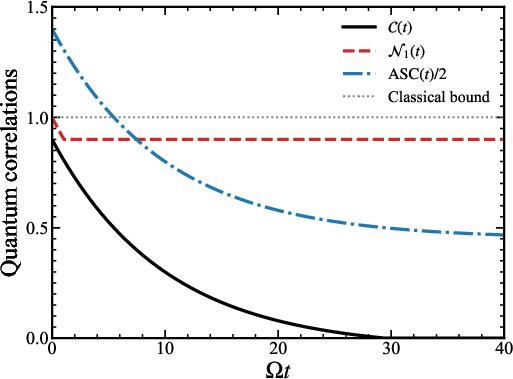
Figure 1: Time evolution of concurrence C, Trace MIN H=α(σx⊗σx+σy⊗σy+σz⊗σz)0, and ASC for a representative X-state, demonstrating the established hierarchy and correlation loss under dephasing.
The robustness of these correlations is governed predominantly by the dephasing-invariant parameter H=α(σx⊗σx+σy⊗σy+σz⊗σz)1, yielding long-time freezing plateaus for Trace MIN and ASC even after entanglement vanishes.
Dynamical Regimes and Robustness
The dynamical interplay of these measures under dephasing universally reveals four discrete regimes:
This hierarchy reflects the increased fragility of entanglement and steering over discord under decoherence, directly traceable to the dissipative suppression of off-diagonal coherences.
Quantum Teleportation: Operational Boundaries
The thermalized and dephased hyperfine state is analyzed as a noisy resource for quantum teleportation, with the operational figure of merit being the Horodecki teleportation fidelity H=α(σx⊗σx+σy⊗σy+σz⊗σz)4. The study establishes, with closed-form expressions, that the temporal region of quantum advantage for teleportation,
H=α(σx⊗σx+σy⊗σy+σz⊗σz)5
is strictly coincident with the survival of entanglement, i.e.,
H=α(σx⊗σx+σy⊗σy+σz⊗σz)6
for all time-evolved X states with maximally mixed marginals. Thus, residual discord- or steering-type correlations alone are \textbf{insufficient} to provide an advantage in this standard protocol once ESD occurs.
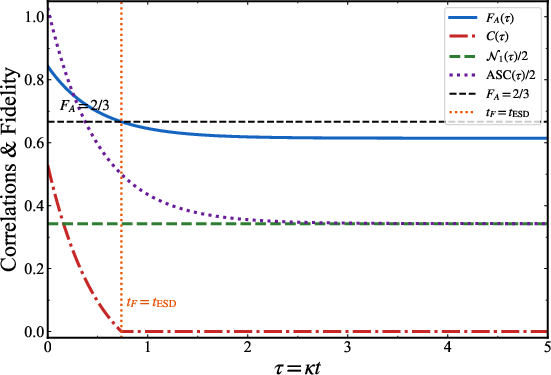
Figure 3: Temporal decay of teleportation fidelity compared to the quantum correlation measures. The quantum advantage in teleportation ceases exactly at the ESD time.
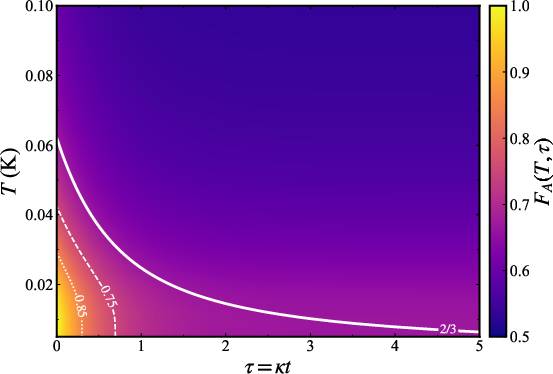
Figure 4: Heatmap of average teleportation fidelity as a function of temperature and dephasing time. The boundary for quantum-enhanced teleportation is aligned with the ESD curve.
Consequently, while Trace MIN and ASC may freeze and persist under strong decoherence, these do not translate into operational utility for canonical quantum teleportation.
Experimental Reconstruction of the Correlation Hierarchy
The work proposes a Pauli-tomographic protocol, requiring only the measurement of three joint spin correlators (H=α(σx⊗σx+σy⊗σy+σz⊗σz)7, H=α(σx⊗σx+σy⊗σy+σz⊗σz)8, H=α(σx⊗σx+σy⊗σy+σz⊗σz)9) to fully determine concurrence, Trace MIN, and ASC, circumventing the need for full state tomography. This protocol is experimentally feasible with existing hydrogen spin-manipulation and readout techniques, especially within solid Hα0 films at millikelvin temperatures.
Implications and Future Directions
The results elucidate both the limitations and potential of noise-resilient quantum correlations in realistic open-system architectures. The nuanced structure of correlation freezing, hierarchy, and their respective operational fate under dephasing is mapped with full analytic clarity. The tight correspondence between entanglement and teleportation advantage underscores the irreducibility of quantum nonseparability as a resource for certain protocols, even within broader frameworks of quantum resource theories.
Looking forward, the analytic frameworks and experimental protocols here provide the groundwork for investigating:
- Alternative noise models (non-Markovianity, amplitude damping, correlated decoherence).
- Operational tasks sensitive to quantum discord and steering in ways not related to standard protocol thresholds.
- Extensions to higher-spin or multi-qubit (multipartite) hyperfine networks.
Conclusion
By obtaining exact, practical, and experimentally accessible descriptions of the quantum correlation hierarchy and its operational role in the hydrogen hyperfine system, this work clarifies both the persistence and limitations of different quantum resources under decoherence. The findings support new avenues for experimental exploration of quantum correlations and operational quantum information science within fundamental atomic systems.