- The paper introduces a compact predictive world-prior mechanism that anticipates action-induced scene changes for improved robotic manipulation.
- It employs a decoupled teacher-student strategy to distill multi-modal priors—future tokens, change maps, and motion-flow maps—for enhanced policy robustness.
- Experimental results demonstrate significant improvements in success rates on benchmarks like VLABench, LIBERO-Plus, and real-robot tests under challenging conditions.
Predictive World Priors for Robust Vision-Language-Action in Robotic Manipulation
Introduction
"Bridge-WA: Predicting Where and How the World Changes for Robotic Action" (2607.02195) puts forth an action-focused world-model policy architecture for robotic manipulation termed Bridge-WA. The central thesis is that direct vision-language-action (VLA) policies are limited by their lack of explicit representation for the causal structure of world change, making them brittle under nuisance appearance variations and insufficiently generalizable to out-of-distribution (OOD) visual conditions. Bridge-WA addresses this by introducing a compact, multi-modal predictive prior over "what," "where," and "how" scene changes induced by actions are expected to manifest, and conditioning the policy on these compact world-change summaries rather than photorealistic future image rollouts.
Framework and Methodology
Bridge-WA organizes training into two decoupled phases. First, a dedicated manipulation-focused future-prediction teacher (Wan2.2-TI2V-5B) is trained to anticipate action-induced scene evolution given multi-view RGB, proprioception, and natural language instructions. From this frozen teacher, three distinct priors are distilled:
- Future tokens: entangled latent embeddings summarizing intended outcome over a horizon.
- Change maps: spatial masks localizing intervention-relevant scene regions expected to differ post-action.
- Motion-flow maps: dense low-resolution optical flow fields indicating local direction and magnitude of anticipated change.
A lightweight predictor network then maps current observations to estimates of these priors (Figure 1).
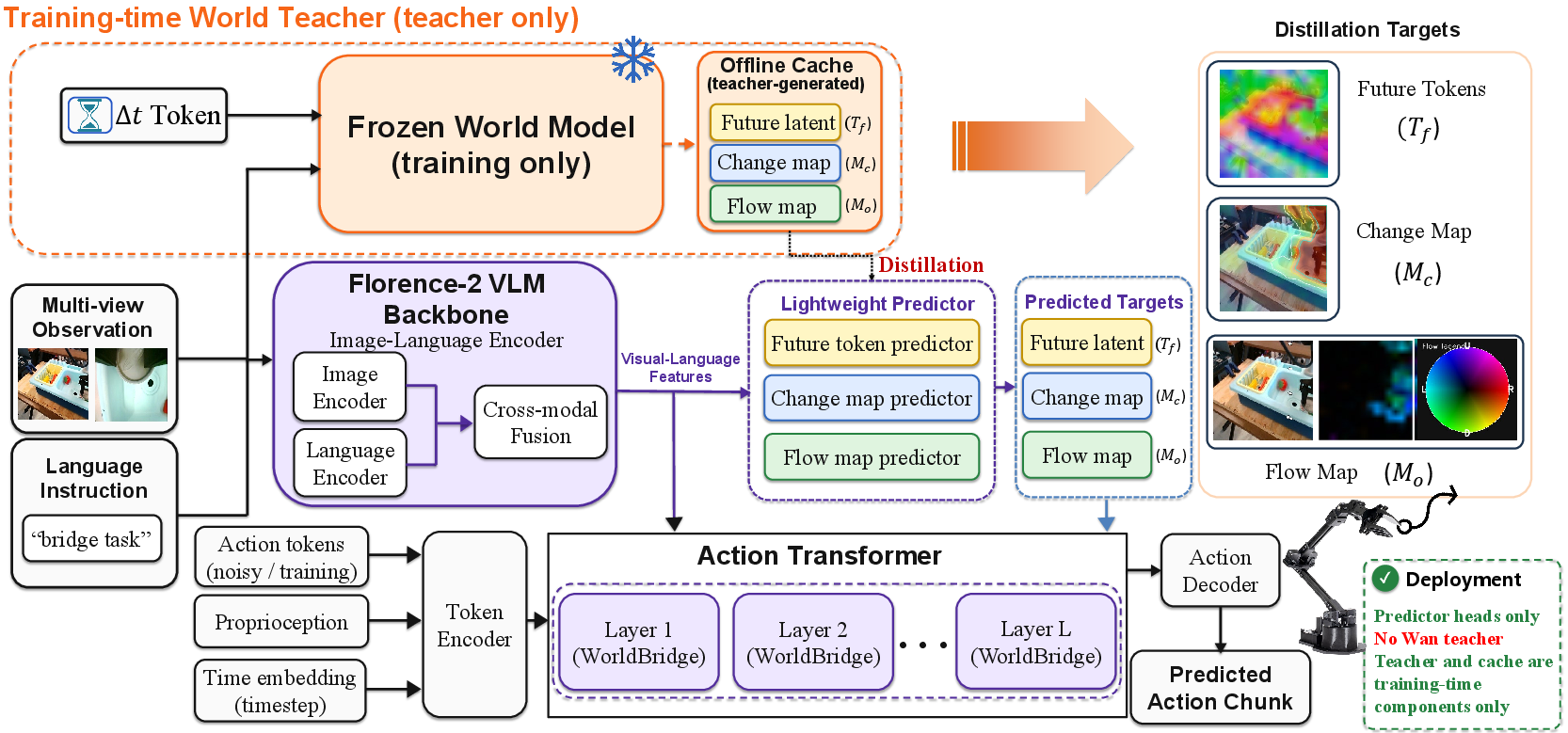
Figure 1: Schematic of Bridge-WA, showing the estimation of compact, action-critical world priors and their effect on action transformer conditioning.
During policy learning, these predicted priors are introduced into the action-transformer by Bridge-WA blocks (\wbblock), which inject the prior information as both additional attention memory tokens and as spatial-temporal biases at different abstraction depths (Figure 2).
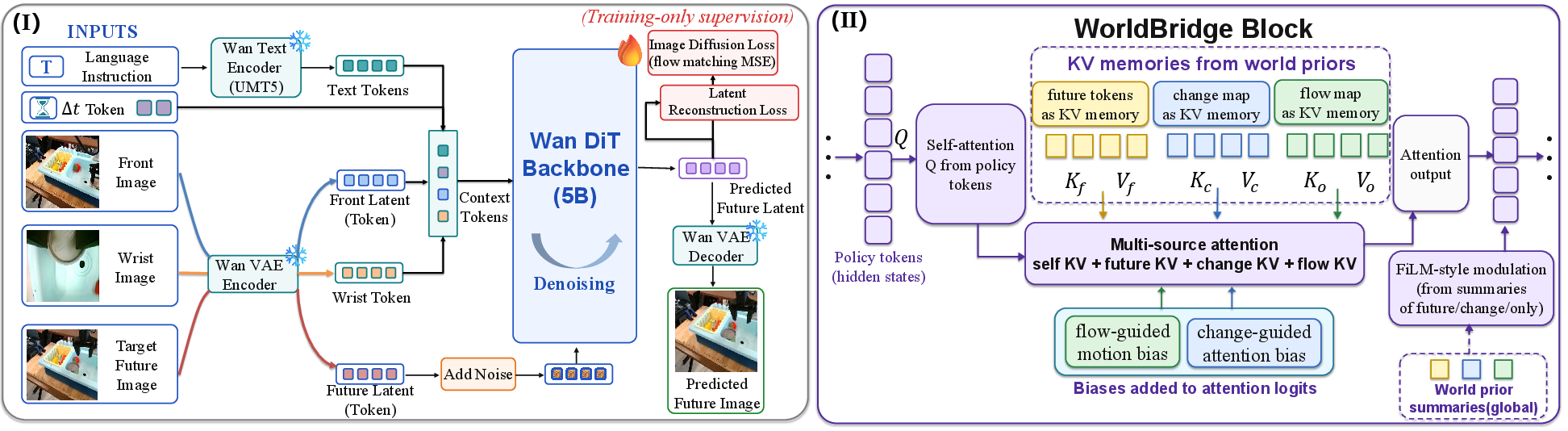
Figure 2: Schematic for world-prior teacher and the Bridge-WA conditioning block, detailing teacher pretraining and multi-layer prior routing.
Key technical innovations include a layered conditioning schedule: global outcome priors (future tokens) are introduced early in the transformer stack; change maps at intermediate abstraction; and fine-grained motion flow closest to final action prediction. This coarse-to-fine abstraction aligns the spatial-temporal semantics of world-change priors with the evolving internal representation hierarchy of the policy model.
Experimental Results
Bridge-WA is evaluated on multiple challenging embodied robotic manipulation benchmarks:
- VLABench: A long-horizon, language-conditioned manipulation suite for multi-view, multi-object tasks with explicit OOD splits.
- RoboTwin 2.0: A bimanual manipulation domain with strong domain randomization across object pose, appearance, and scene factors.
- LIBERO-Plus: A zero-shot robustness suite evaluating generalization to novel camera viewpoints, robot states, language, lighting, background, noise, and object layouts.
- Dobot/Franka Real World: Physical robot experiments under controlled visual perturbations—distractors, texture, and lighting.
Strong, quantitative improvements are demonstrated across these settings. Notably, on VLABench, Bridge-WA outperforms the strongest baseline in average success rate (SR) by 9.7 points, with an average SR of 52.8% (Table \ref{tab:vlabench_sr}). On LIBERO-Plus, Bridge-WA delivers a 72.1% average zero-shot success rate, with particularly strong improvements under OOD robot state (92.8%), background (94.3%), and lighting (96.7%) perturbations. On RoboTwin 2.0, the method boosts Easy/Hard average success (52.3% → 58.7% over X-VLA). Real-robot results on Dobot confirm the robustness of world-prior conditioning, especially on hard tracks involving appearance perturbations (Table \ref{tab:dobot_real}).
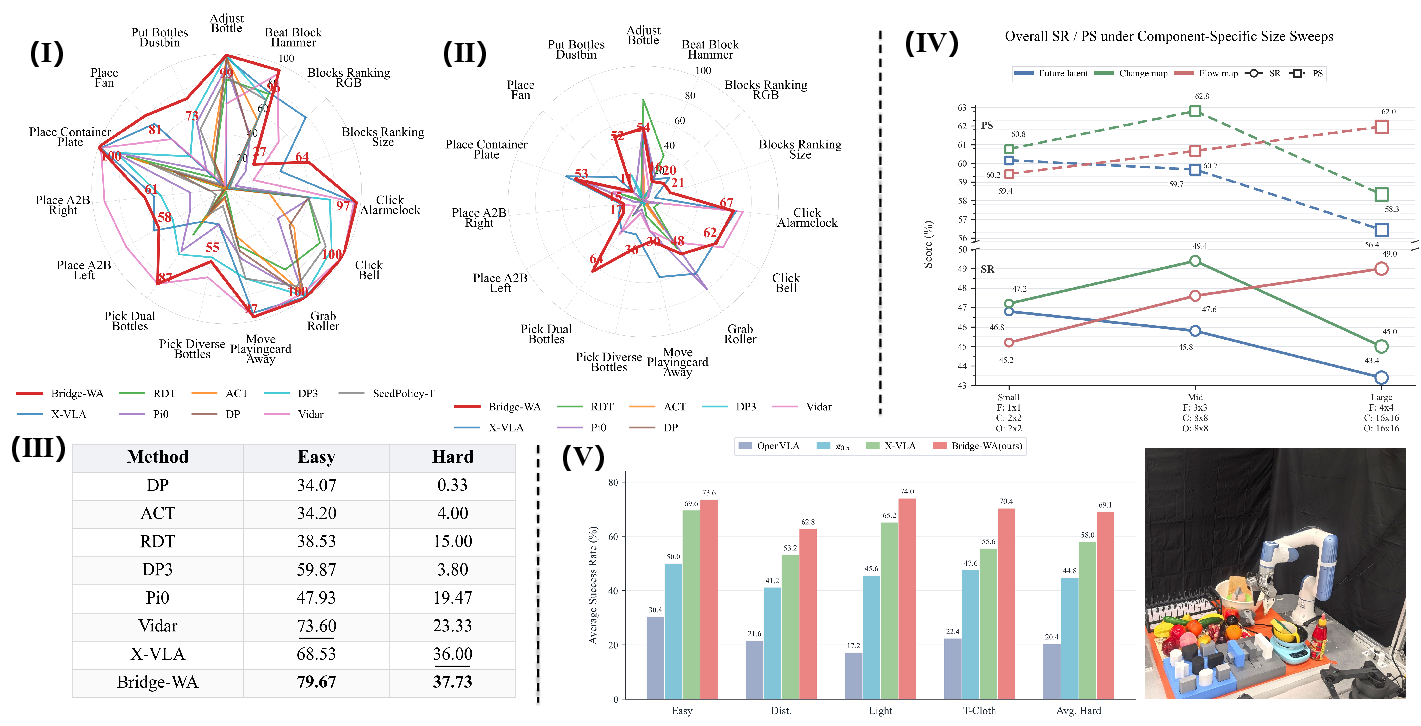
Figure 3: Aggregated experimental results, including per-task success under OOD shifts, world-prior ablations, and real-robot generalization.
Ablation studies on the world-prior interface reveal that all three priors contribute complementary information; further, the conditioning schedule (layered routing) is critical—naive attention-only or undifferentiated prior injection reduces performance. Resolution sweeps confirm that outcome priors benefit from compactness, while flow priors require higher spatial detail. These findings support the hypothesis that disentangling task-causal, spatial, and dynamic scene predictions from visual nuisance is crucial for robust robotic control.
Qualitative visualization (Figure 4) shows that Bridge-WA’s change maps and flow correlate tightly with task-decisive regions and action-relevant local motion, even as scene distractors, backgrounds, and non-affordant objects vary.
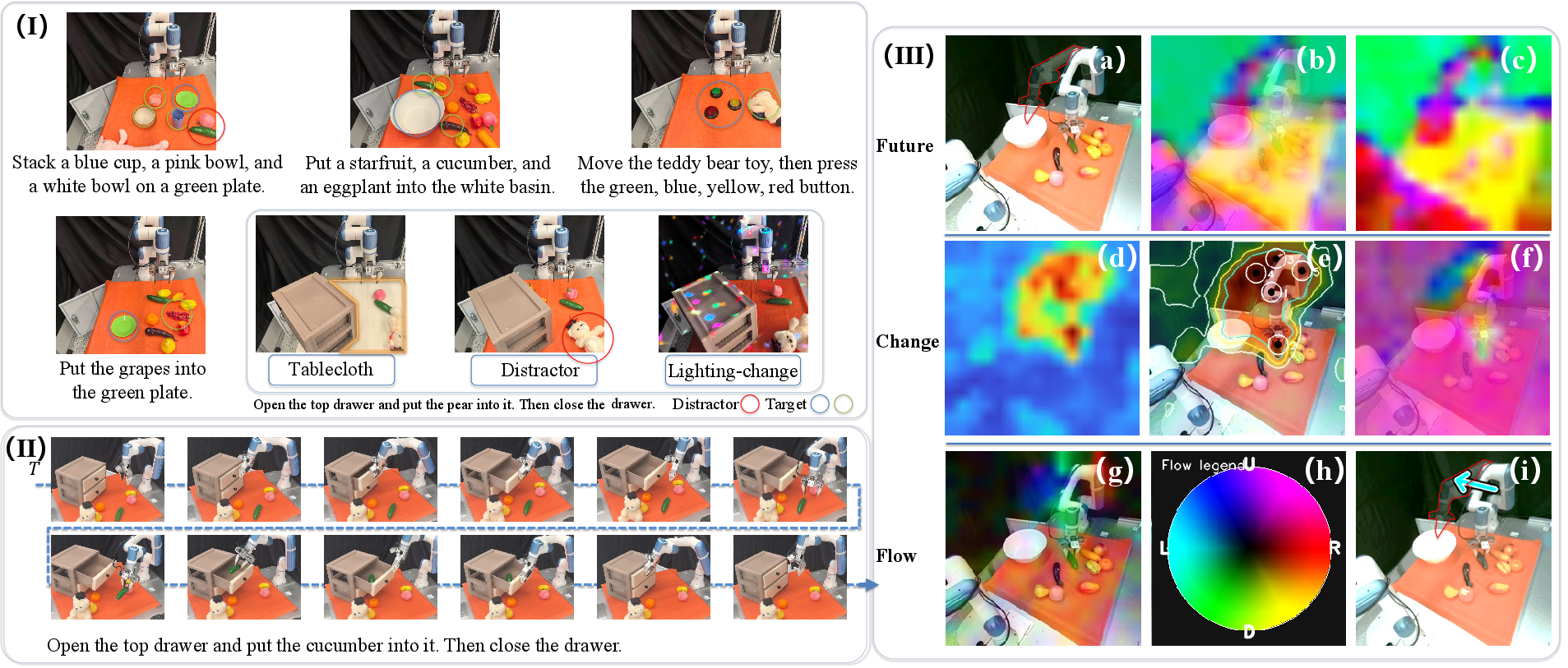
Figure 4: Visualization of ground-truth and predicted priors—target regions, change-maps, and flow fields—demonstrating precise spatial-temporal grounding.
Theoretical and Practical Implications
Bridge-WA’s compact world-prediction interface situates the method in a regime that balances reactive VLA policies and full generative world models. Its key insight—that manipulation policies benefit more from succinct, intervention-centric world priors than from pixel-level scene rollouts—addresses a critical efficiency and generalization tradeoff. The approach suppresses shortcut exploitation of nuisance cues, which is a recurrent limitation of direct reactive policies, as established by several prior works in embodied robustness and visual representation learning.
Importantly, by entirely removing the expensive future generator teacher at inference, Bridge-WA achieves near-baseline computational cost with much-improved generalization, making the approach highly suitable for real-world deployment scenarios.
Limitations and Future Directions
While results are robust, limitations exist:
- Performance remains constrained by the representational and coverage limitations of the frozen world-model teacher.
- Priors remain short-horizon and pixel-space driven; geometric, 3D, or temporal abstraction is not directly encoded.
- The cache construction and offline teacher deployment impose additional training-time memory and storage requirements.
- Cross-viewpoint robustness, while improved, is not fully closed; stronger geometric invariants and multi-view aggregation may be required.
Future work should explore integrating geometric or explicit object-centric priors, extending to longer-range world-prediction horizons, and unifying across more diverse embodiments and sensory modalities.
Conclusion
Bridge-WA offers a rigorous, practically efficient method for distilling and integrating compact, action-relevant predictive world priors into standard vision-language-action policies. It delivers consistently higher robustness and success across long-horizon, OOD, and real-world robotic manipulation by explicitly modeling "where" and "how" the world should change, without incurring the test-time cost of generative video models. This work represents a significant advance in the structured, causal grounding of robotic manipulation policies, with broad implications for future architectures in embodied AI.