- The paper introduces operator kirigami, a novel method to enforce both Abelian and non-Abelian symmetry in Trotterized quantum simulations.
- It demonstrates that employing Hermitian excitation operator bases preserves electron number and spin symmetry under Trotterization while quantifying energy error trade-offs.
- Numerical tests on molecules like H₂, LiH, and H₂O validate the approach, offering practical insights for scalable quantum chemistry simulation.
Symmetry Conservation in Trotterization and Quantum Phase Estimation
Introduction
The simulation of quantum many-body fermionic systems, crucial for quantum chemistry and materials science, faces exponential Hilbert space scaling with system size. Quantum algorithms, particularly those utilizing Trotterization and Quantum Phase Estimation (QPE), address this challenge by mapping the fermionic Hamiltonian to qubit operator sums, e.g., products of Pauli strings, whose exponentials are efficiently encodable on quantum hardware. However, the non-commutativity intrinsic to most Hamiltonian fragmentations induces Trotter errors, which can result in symmetry violations (e.g., electron number, spin). The presented work rigorously analyzes symmetry conservation within Trotterized quantum algorithms and introduces a novel operator manipulation technique—termed “operator kirigami”—to systematically enforce symmetry, with explicit analysis across Abelian and non-Abelian cases.
Hamiltonian Fragmentation and Symmetry Challenges
Hamiltonian fragmentation schemes serve as the foundation for quantum simulation approaches. Commonly, the electronic structure Hamiltonian is mapped (e.g., via Jordan-Wigner, Bravyi-Kitaev) into sums of Pauli strings. While this provides a tractable route to gate decompositions, a generic random ordering of these non-commuting operators breaks important physical symmetries such as particle number and spin, since Trotterization only approximates time evolution by consecutive applications of non-symmetry-conserving fragments.
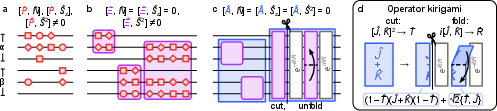
Figure 1: Schematic of Hamiltonian decompositions and their symmetry conservation properties with Trotterization. a: Pauli string sum; b: Hermitian excitation operator grouping; c-d: Operator kirigami for non-Abelian symmetry.
To address this, the authors show that by expressing the Hamiltonian in Hermitian excitation operator bases (which correspond to real-valued, commuting Pauli string sums across all common encodings), symmetries corresponding to Abelian groups (e.g., electron number, Sz) can be strictly preserved under Trotterization. For non-Abelian cases (notably, total spin S2), simple fragmentation does not suffice; specialized techniques are required.
Operator Kirigami: Systematic Non-Abelian Symmetry Conservation
The core contribution is the introduction of “operator kirigami”—a two-step process:
- Cutting: Projections isolate commuting and non-commuting operator components.
- Folding: Non-commuting fragments are consolidated via unitary rotations into a form permitting exact exponential implementation (i.e., no Trotter error, symmetry preserved).
Mathematically, this leverages the tripotency of Hermitian excitation operators and manipulates their BCH commutator structures. In the framework, all terms are recursively expressed in combinations whose exponentiation, along with unitary rotations defined by commutators, precisely preserves the target symmetry sector, as formalized for composite fragments like C^qpr and B^qp.
This procedure is applicable to all fermion-to-qubit encodings supporting one Pauli string/Majorana operator correspondence (includes all standard encodings in quantum chemistry).
Numerical Analysis: Symmetry Error and Energy Behavior
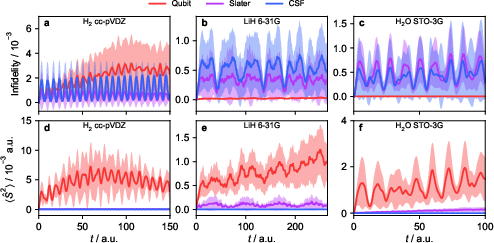
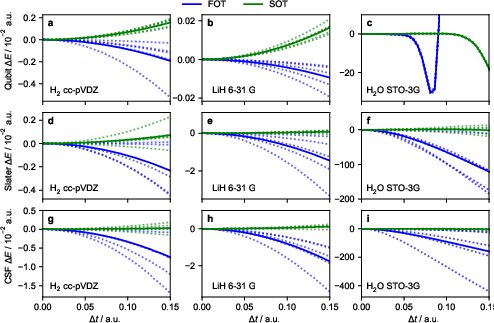
To validate the theoretical claims, the performance of various fragmentation and ordering schemes was benchmarked on quantum simulations (classically emulated) for small molecules (H2, LiH, H2O) across several basis sets. Operator pools compared:
Empirical results revealed that:
Notably, with first-order Trotterization, symmetry-conserving pools exhibit energy errors up to an order of magnitude larger than the unstructured Qubit pool for intermediate system sizes, attributed to increased fragment commutator complexity. However, second-order Trotterization (SOT) substantially suppresses these errors, rendering the energy discrepancies comparable across all pools, while retaining enforced symmetry.
Algorithmic and Practical Implications
Theoretically, this work establishes that non-Abelian symmetry conservation in Trotterized quantum algorithms is feasible and systematic for arbitrary fermion-to-qubit encodings using operator kirigami. Practically:
- Quantum resource requirements: Symmetry-conserving pools drastically reduce Hilbert space dimension and operator count for classical simulation, permitting larger-scale pre-quantum validation.
- Quantum hardware translation: On quantum devices, operator kirigami prescribes gate compilation steps to exactly preserve physically-relevant symmetries, eliminating symmetry-induced errors and symmetry-breaking leakage.
- Error analysis: The formalism clarifies that Trotter error suppression is nontrivial for symmetry-adapted bases, guiding operator ordering, Trotter step sizing, and symmetry sector targeting in real devices.
These findings are directly useful for quantum simulation algorithm developers seeking scalable and symmetry-respecting implementations for quantum chemistry and materials science.
Perspectives and Future Developments
While the kirigami method is algorithmically complete for Abelian and spin symmetry in electronic structure Hamiltonians, the approach is extensible to broader symmetry groups (e.g., spatial symmetry, combined electronic and nuclear spins) and is compatible with advanced Hamiltonian simulation or error mitigation techniques. Its explicit mapping between classical electronic structure methods and quantum simulation enables near-term benchmarking and algorithmic innovation. Future work could target
- Automated detection and enforcement of higher symmetries using kirigami-style projections and folds,
- Integration into hybrid quantum-classical and variational simulation frameworks,
- Application on fault-tolerant devices for large-scale chemical simulation with provable error bounds.
Conclusion
This work rigorously addresses symmetry conservation in Trotterized quantum simulation of fermionic systems, introducing operator kirigami as a systematic technique for enforcing Abelian and non-Abelian symmetries. The method achieves exact symmetry conservation or controlled Trotter error, is demonstrated numerically for challenging cases, and provides a foundation for symmetry-preserving, scalable quantum simulation algorithms. The results clarify the trade-offs between symmetry conservation and Trotter error scaling and empower practical quantum algorithm design for chemical applications.